
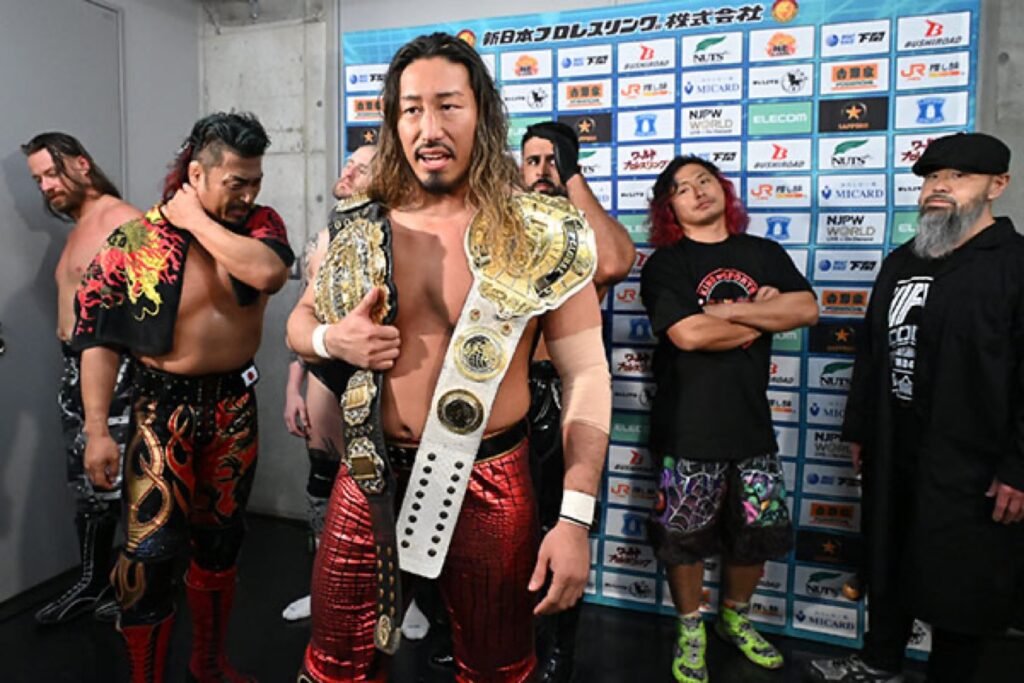
For nearly thirteen years, Bullet Club was more than a faction — it was an institution. Its influence permeated NJPW’s creative decisions, global exposure, and even wrestling culture itself, transforming the way heel stables were built, marketed, and interpreted worldwide. From its audacious beginnings under Prince Devitt to its global dominance under Kenny Omega and The Elite, Bullet Club became the defining standard for faction-based storytelling in modern wrestling. Its presence was omnipresent, omnipotent, and, by its final years, almost unassailable.
Yet, as NJPW entered 2026, it quietly ended the faction. There was no over-the-top sendoff, no lingering nostalgia angle — just a clean, strategic transition. At New Year Dash!!, the final iteration of Bullet Club, the War Dogs, was absorbed into a new power structure: Unbound Co., a faction designed not just to fill a void but to reshape NJPW’s factional hierarchy and creative direction for the next era.
This was not a collapse. It was a calculated conclusion to a 13-year run that had long outlived its narrative utility.
Bullet Club: A 13-Year Stranglehold on NJPW Storytelling
To understand why Bullet Club ended, it is essential to examine its historical evolution and creative impact. Founded in May 2013, Prince Devitt’s original vision was audacious: a gaijin-led heel faction designed to disrupt NJPW’s established hierarchy. Devitt, later known internationally as Finn Bálor, leveraged charisma and rebellious energy to challenge the traditional faction model in Japan. The early Bullet Club thrived on disruption, introducing a foreign heel ethos into a system that had historically emphasized dojo loyalty and hierarchical respect.
- AJ Styles Era: When Devitt departed and AJ Styles assumed leadership, Bullet Club shifted from a disruptive entity to a championship-driven powerhouse. Styles elevated the faction to main event prominence, demonstrating its ability to anchor NJPW’s narrative while remaining a dominant heel faction.
- Kenny Omega / The Elite Era: Omega and The Elite transformed Bullet Club into a global brand, transcending NJPW entirely. Merchandise sales, international attention, and crossover appearances in ROH and later AEW amplified Bullet Club’s influence beyond Japanese borders. During this era, the faction’s identity became intertwined with its members’ star power, creating both a cultural phenomenon and a storytelling shortcut for NJPW.
- Jay White Era: Returning the faction to NJPW-centric dominance, Jay White emphasized strategic control over chaos, using Bullet Club as a tool for championship focus and long-term heel dominance. Narrative complexity increased, but global brand influence waned slightly as White’s leadership emphasized precision and authority over spectacle.
- David Finlay / War Dogs: The final iteration of Bullet Club, the War Dogs, stripped away excess. Without the glamour of Omega’s Elite or Styles’ charisma, the faction returned to raw aggression and tactical dominance. This final form highlighted both the faction’s enduring utility and its eventual limitations. By 2025, Bullet Club was no longer a creative engine — it was a factional crutch, a name carrying more weight than narrative innovation.
Keep reading with a free LNC Wrestling account
Every article is free. A free account keeps out spam and bots, and lets you join the forums and comment.


Comments
Sign in to join the conversation. Comments are for registered readers only. It keeps the spam out.
Sign in Create a free account