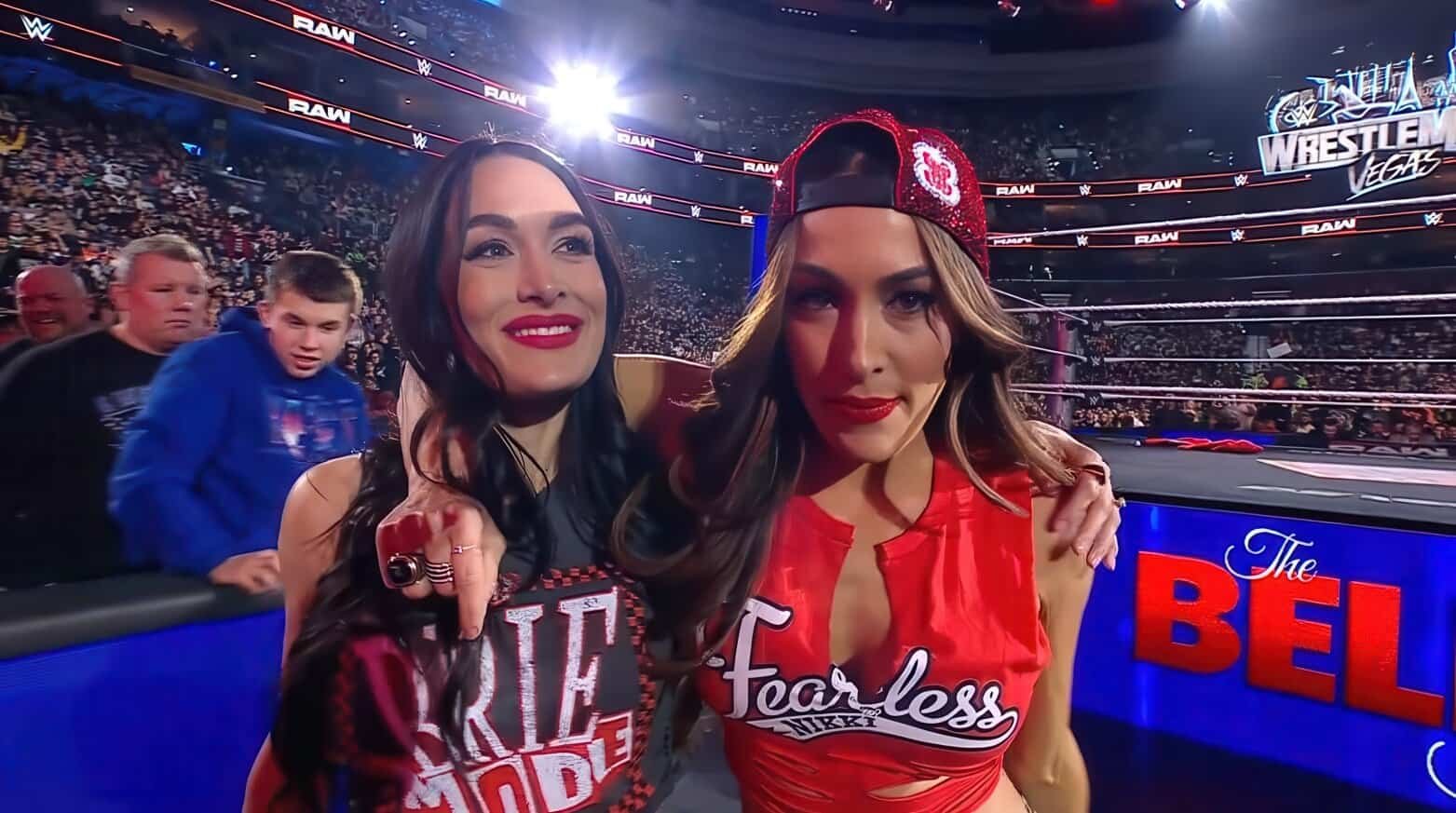
March is Women’s History Month, and The Bella Twins are one of those careers that forces an honest conversation. Not “were they the best workers of their era?” but what did they change? Because Nikki and Brie Bella changed the way women’s wrestling was packaged, consumed, marketed, and eventually mainstreamed. They weren’t just part of the Divas era — they became one of the most visible faces of it, then helped bridge the gap into the Women’s Evolution era where women’s wrestling stopped being treated like a side quest.
And whether people loved them, hated them, or argued about them every Monday, the truth is the same: you had to pay attention.
The start: how they got in, how they got over
Nikki and Brie signed with WWE in June 2007 and trained in FCW, where they started refining the identity that would make them instantly recognizable on TV: Twin Magic — the switch behind the ref’s back that turned every match into a little magic trick with heat attached.
Brie debuted on SmackDown (August 29, 2008). Nikki was revealed shortly after, and once the “there are two of them” angle hit, the act made sense immediately. Simple, clean, effective. That’s how WWE works when it’s at its best: you get the gimmick in two seconds.
The first WWE run: tag team brand, then separate lanes
Early on, the Bellas were less “two singles wrestlers” and more a packaged act. They had a look, a rhythm, a catchphrase cadence, and a built-in fan identity that eventually became the Bella Army. In an era where women were often presented as interchangeable, the Bellas weren’t. They had a hook and WWE leaned into it.
Then came the splits, reunions, heel turns, babyface turns — all the classic WWE soap opera DNA — and the Bellas stayed relevant because their pairing gave WWE a constant story lever: sisters, jealousy, loyalty, betrayal, reconciliation. Easy to book, easy to understand, easy to keep in the mix.
Nikki’s Divas Championship reign: the record that became a reference point
Here’s the fact that still defines the conversation: Nikki Bella’s second Divas Championship reign lasted 301 days — from November 23, 2014 to September 20, 2015 — the longest reign in the title’s history.
That reign became a lightning rod for an entire era. Some fans saw it as proof Nikki had grown into a reliable centerpiece. Others saw it as WWE clinging to Divas-era priorities while the audience was demanding something deeper. But either way, that reign became a timeline marker — the “right before the full shift” era stamped into the record books.
And the important part in a Women’s History Month piece isn’t whether you personally loved the reign. It’s that WWE treated Nikki like a top-of-division anchor long enough for the record to matter — and once that happened, it changed how people discussed women’s title reigns moving forward.
Brie’s value: the glue role that kept stories moving
Brie’s legacy is quieter in the title department — she’s a former Divas Champion — but her real value was always in being the connective tissue. She could be the sympathetic sister, the betrayed friend, the heel who finally snapped, the one used to give emotional weight to what WWE was doing with the division at the time.
Brie also became central to the “women as personalities” boom because she read as real. That mattered once reality TV became part of the pipeline.
Total Divas / Total Bellas: the crossover that changed the audience
This is where their impact goes beyond wrestling discourse.
Total Divas premiered in 2013 and it put women wrestlers into a mainstream lane WWE didn’t consistently create on its own. Then Total Bellas premiered in 2016 and doubled down on the “the women are the draw” idea by centering the twins’ lives directly.
Love reality TV or hate it, it did two things that mattered for women’s wrestling:
- It made women’s stories and personalities appointment viewing for non-wrestling audiences.
- It helped normalize women as the drivers of WWE content beyond matches.
A lot of current fans didn’t “discover” women’s wrestling through five-star classics. They discovered it through that reality-TV pipeline — then stayed when the in-ring product improved. That’s part of the Bellas’ influence whether people like admitting it or not.
Hall of Fame: WWE making the legacy official
The Bellas were announced for the WWE Hall of Fame Class of 2020, and they were inducted during the 2021 Hall of Fame ceremony as part of that class. WWE doesn’t do that for acts they consider a footnote. That’s the company saying, “This is part of our women’s wrestling history.”
Life after weekly TV: motherhood and building a real empire
The Bellas didn’t just disappear when the schedule changed — they transitioned. Both became moms (Brie in 2017, Nikki in 2019) and built businesses that made them bigger than “former wrestlers”:
- Birdiebee launched in 2017 (intimates/activewear/loungewear)
- Nicole + Brizee launched in 2019 (beauty/body line)
- The Bellas Podcast launched in 2019
- Their memoir Incomparable released in 2020 and hit mainstream best-seller traction
This is why their influence still shows up: they modeled a version of women’s wrestling stardom where you don’t have to vanish when you stop taking bumps every week. You can pivot into media, entrepreneurship, and mainstream visibility — and still keep your name hot enough that any return feels like a moment.
The honest legacy: praise, critique, and why both can be true
If you want the cleanest Women’s History Month framing, it’s this:
The Bellas expanded the audience.
They weren’t the entire Women’s Evolution, but they helped create the conditions for it to grow. Their visibility, branding, and reality-TV reach brought in fans who wouldn’t have found women’s wrestling otherwise — and that growth helped the industry justify investing more in women as true featured stars.
And yes, the critiques belong in the history too:
- The Divas era often under-served women’s wrestling, and the Bellas were frequently placed at the center of that system — so they became the faces of both the progress and the frustration.
- But the fact they’re still debated is part of the point. Nobody debates irrelevance.
Women’s History Month takeaway
Twin Magic was the hook.
The Bella Army was the engine.
And the legacy is simple: women’s wrestling is bigger today because The Bella Twins helped pull it into the mainstream when it wasn’t guaranteed to get there.
Make sure to subscribe to our Late Night Crew Wrestling YouTube Channel. Follow @yorkjavon, @kspowerwheels & @LateNightCrewYT on X.

I’m the quiet one until the bell rings then I’ve got takes. I live for WWE NXT and TNA, I want every promotion to succeed, and I will absolutely roast the bad decisions on sight (because someone has to). Anime taught me to respect long-term storytelling; wrestling taught me that sometimes the plan is “we panicked” and called it “unpredictable.” The Miz got me into all of this, so yeah I appreciate confidence, commitment, and the art of talking like you’re already the main event. Now I bring that same energy to the page as the main writer for Late Night Crew Wrestling because if you’re not here to be must-see and tell the truth, why are you here?!