
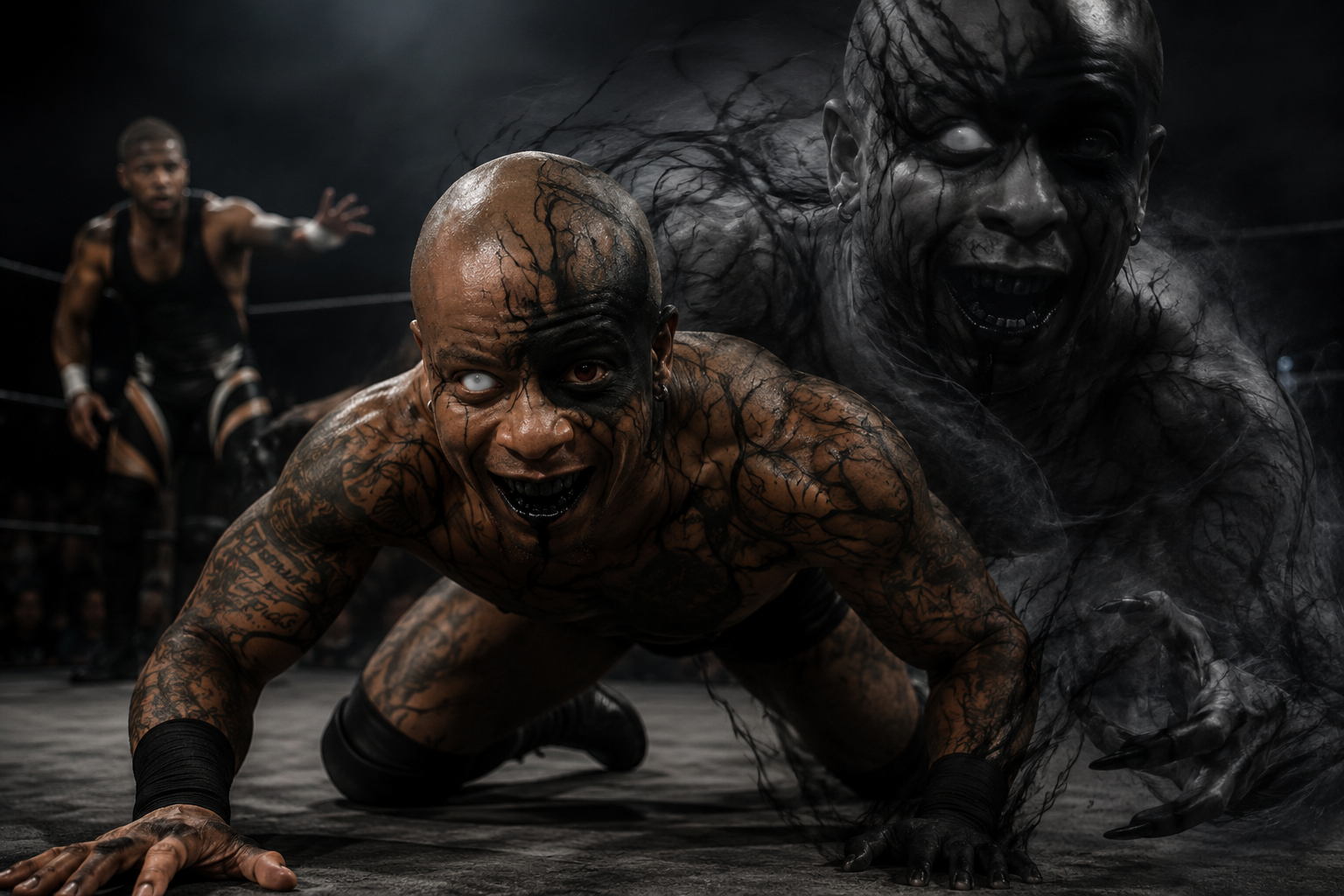
Lio Rush used to move faster than the story around him. That was the beauty of him and, for a long time, the limitation too. He was burst, arrogance, rhythm, speed in a flash. You saw the talent immediately. You saw the snap in the movement, the swagger in the body language, the sense that he could bend a match around his pace whenever he wanted. But what AEW and ROH have done since then is take that same speed and let something darker ride inside it. Blackheart is no longer just a striking presentation or an eerie twist on a gifted wrestler. Now it feels like the story of a man hearing something answer back inside himself and, little by little, letting it speak for him.
That is why this character has gotten stronger since the first real signs of it appeared on television.
The original appeal of Blackheart was simple enough to grasp even if the character itself was not. Lio did not look like he was headed to a wrestling match. He looked like he had wandered out of a cursed place and found a ring waiting for him. The crawl, the muttering, the wide-eyed stillness, the sudden lunges, the way he moved like somebody trying to share a body with a thing that does not quite understand how people are supposed to stand or breathe or blink — all of that gave Blackheart atmosphere right away. The easiest references were Gollum, Dr. Jekyll and Mr. Hyde, even a little Nosferatu. But the longer this has gone on, the better comparison might be possession itself: not a man playing monster, but a monster learning how to use the man.
That is where the Action Andretti story changed everything.
Because CRU did not just split. It decomposed.
That part matters. Wrestling breakups are usually loud, instant and clean. This was quieter and creepier than that. Andretti was not just losing a partner. He was trying to get a friend back and realizing the door was already half-shut. One of the strongest beats in the whole arc was not a match or a big turn at all. It was Andretti leaving that voicemail, trying to reach Lio, trying to talk to him, trying to get some version of the old connection back, and getting silence in return. That silence told the story better than any screaming argument could have. It suggested that Blackheart was not just something Lio turned on when the cameras were rolling. It was already affecting how he existed, how he communicated, how he withdrew.
And that is where the article needs more of Lio’s perspective, because the story has started to feel like he is disappearing in front of people who still want to believe he is standing right there.
That is the horror of it.
Not the crawl. Not the contacts. Not the posture.
The horror is Andretti looking for Lio Rush and only finding flashes.
There was that teasing beat where the “normal” version seemed to flicker into view for a moment, the kind of moment that makes the split feel less like a costume change and more like a fight for space inside the same frame. That is where the character stopped being just a strong visual and became a real narrative device. You are no longer just watching a wrestler try something different. You are watching a body become contested ground. That is a much richer story.
Then came the title match, and that is when Blackheart got a wound to feed on.
Lio walking into that ROH World Television Championship match against A.R. Fox already felt different than the early version of the persona. By then the look was darker, the aura heavier, the creepiness more complete. The arrival alone had a sense of finality to it, like the thing people were nervously watching in fragments had now fully stepped into the light. And then Andretti cost him the match. That was the real pivot. Once Andretti shoved him off the ropes and helped turn that title shot into a scar, CRU stopped being a useful footnote to Blackheart’s rise and became one of the reasons the character means something. Blackheart did not just get presentation out of that loss. It got betrayal. It got rejection. It got pain with a face attached to it.
That is what gives the whole act more personality now than it had at the beginning. It is not just unsettling. It is wounded.
And wounded things are more interesting than spooky things.
That is why the line, “We can’t let him do this to him… to me…” hits as hard as it does. It is the character telling on itself. It is confusion, fracture and self-awareness all colliding in one line. It suggests Lio can still see what is happening, can still maybe identify that something is taking over, but cannot fully separate himself from it anymore. That is where the gremlin imagery, the possession imagery, the Ring-style body horror of something slowly crawling closer all lock into place. Blackheart is not simply darker Lio Rush. It is Lio Rush becoming less sure of where he ends.
Andretti, meanwhile, became the audience surrogate in the best possible way.
He is the one who felt the loss before the audience was ready to name it. He is the one who kept reaching, kept trying to figure out what happened, kept standing close enough to the fire to realize this was not a mood or a slump or a phase. So when he finally snapped and declared CRU done, it felt less like random betrayal and more like exhaustion curdling into anger. He did not just turn on a partner. He gave up on trying to save one. That is a much better story. It makes the split feel tragic before it feels vicious, and that is why it sticks.
The smartest thing AEW did after that was refuse to make the aftermath too easy.
A lesser version of this would have Lio come out raging, shouting, immediately flattening the character into standard heel emotion. Instead, the story got more unsettling. The calm “everything is fine” version is scarier than the screaming version because it makes Blackheart feel settled in. Comfortable. The Nigel McGuinness segment worked for exactly that reason. Lio sounded normal enough to make you second-guess what you were seeing, and then the mask slipped again. That is the point where the possession imagery fully pays off. The demon is not strongest when it is loud. It is strongest when it can mimic the host well enough to make people hesitate.
That is also why this version of Lio feels more over now than any version of him has in a long time.
Not just because crowds react. Not just because people are sharing clips. Because this version lingers. It has identity now in a way that connects the entrances, the matches, the storyline beats and the emotional fallout. The original Blackheart presentation made you watch. This version makes you wonder how much of Lio is left when the camera cuts away. That is stronger. That is fuller. That is the kind of character work that turns a talented wrestler into somebody people genuinely invest in following. AEW’s official language around his entrances and matches already suggested they understood he was supposed to feel like a disturbance, not just a performer. ROH then gave that disturbance something to destroy. Together, that has made Blackheart feel less like an experiment and more like the most complete presentation of Lio Rush’s career.
And that is what makes the sequel to the original piece land.
Back then, the best line of thought was that Blackheart had turned speed into menace. That is still true. But now it has done more than that. It has turned friendship into collateral damage. It has turned silence into storytelling. It has turned one of Lio Rush’s biggest old strengths — that sense of motion and unpredictability — into something that feels less like athletic flair and more like a body reacting to the wrong soul inside it. The result is not just compelling television. It is character progression with actual consequences.
The old version of Lio Rush could light up a screen.
Blackheart stains it.
And right now, that is what makes this run feel so alive.
Make sure to subscribe to our Late Night Crew Wrestling YouTube Channel. Follow @yorkjavon, @kspowerwheels & @LateNightCrewYT on X.
I’m the quiet one until the bell rings then I’ve got takes. I live for WWE NXT and TNA, I want every promotion to succeed, and I will absolutely roast the bad decisions on sight (because someone has to). Anime taught me to respect long-term storytelling; wrestling taught me that sometimes the plan is “we panicked” and called it “unpredictable.” The Miz got me into all of this, so yeah I appreciate confidence, commitment, and the art of talking like you’re already the main event. Now I bring that same energy to the page as the main writer for Late Night Crew Wrestling because if you’re not here to be must-see and tell the truth, why are you here?!