
A great Money in the Bank match should make the briefcase feel worth fighting for. That sounds like a low bar until you watch a ring full of wrestlers spend more time arranging ladders than trying to climb them.
The stipulation has given WWE extraordinary athletic performances, ugly betrayals, overdue breakthroughs and some spectacular examples of a company getting in its own way. Its best matches turn the scramble into something you can follow emotionally. You know who is gaining ground, why an alliance matters and what a wrestler gives up by choosing revenge over the contract. Its weaker matches confuse constant activity with excitement, then rely on the winner’s name to make the ending seem important.
That distinction matters when ranking the best Money in the Bank matches. Edge’s first cash-in, Rob Van Dam’s victory at ECW One Night Stand and Seth Rollins’ intervention at WrestleMania 31 are enormous moments. They belong to the briefcase’s history. They do not automatically settle which ladder matches were the best.
The same standard applies to the women. IYO SKY’s 2023 victory and Tiffany Stratton’s 2024 win deserve to be judged alongside the strongest men’s matches because their action and storytelling earn that comparison. Putting them in a separate category would make this ranking less useful.
This is my combined top 10 of completed WWE Money in the Bank ladder matches through 2025, written ahead of the October 10, 2026 event. The order considers execution, pacing, character work, believable opportunities to win and the quality of the finish. A celebrated cash-in can add historical significance; a failed one cannot retroactively ruin a good match.
The top 10 Money in the Bank matches, ranked
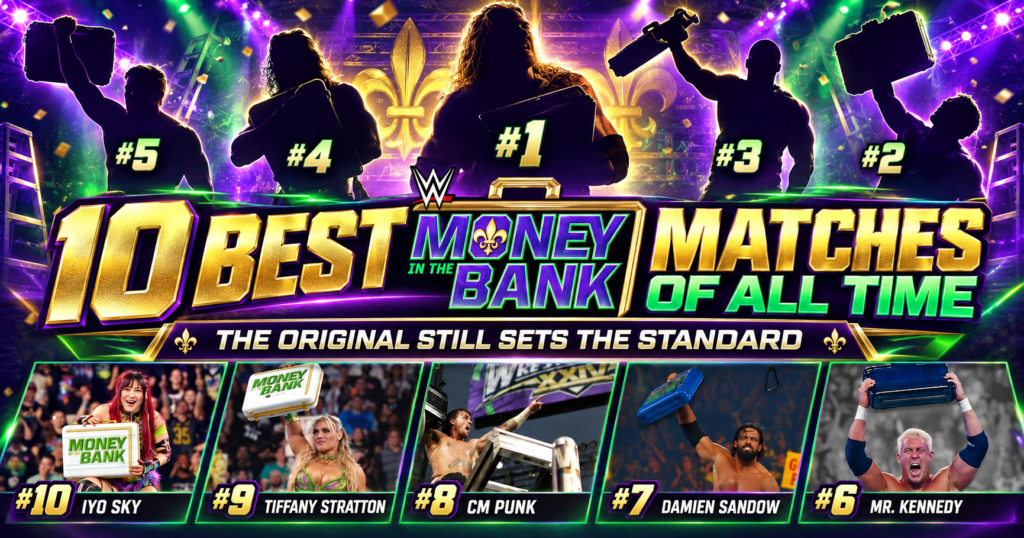
1. WrestleMania 21 — 2005. Original men’s match. Winner: Edge.
2. Money in the Bank 2016. Men’s match. Winner: Dean Ambrose.
3. Money in the Bank 2021. Men’s match. Winner: Big E.
4. Money in the Bank 2014. Contract ladder match. Winner: Seth Rollins.
5. Money in the Bank 2011. SmackDown’s World Heavyweight Championship contract match. Winner: Daniel Bryan.
6. WrestleMania 23 — 2007. Men’s match. Winner: Mr. Kennedy.
7. Money in the Bank 2013. World Heavyweight Championship contract match. Winner: Damien Sandow.
8. WrestleMania 24 — 2008. Men’s match. Winner: CM Punk.
9. Money in the Bank 2024. Women’s match. Winner: Tiffany Stratton.
10. Money in the Bank 2023. Women’s match. Winner: IYO SKY.
The countdown below explains why each match makes the cut, where it falls short and what separates it from the matches above it.
10. Money in the Bank 2023 — Women’s: IYO SKY makes the smartest climb
Date: July 1, 2023.
Participants: IYO SKY, Bayley, Becky Lynch, Trish Stratus, Zelina Vega and Zoey Stark.
Winner: IYO SKY.
The London women’s match understood something that too many multi-person matches ignore: relationships should change how people compete.
Trish Stratus and Zoey Stark had a shared interest in making Becky Lynch miserable. Bayley and IYO SKY were Damage CTRL teammates, although their cooperation had an obvious limit. There was one contract, and Bayley’s willingness to help SKY became much less convincing when SKY was close to taking it.
Those alliances gave the match two distinct tensions. Lynch had to chase the briefcase while navigating opponents already invested in stopping her. SKY had to decide whether working with Bayley was improving her chances or sacrificing them. The wrestling could advance both problems without needing an extended interruption to explain the story.
Zelina Vega deserves credit for supplying more than an extra body. Her Code Red on Stark onto a bridged ladder was a major contribution to the match’s physical intensity. SKY’s moonsault supplied another burst of athleticism. The field had enough variety that the punishment did not depend on six people repeating the same exchange.
Still, this was not an uninterrupted run of excellent execution. Some transitions were awkward, and the coordination became visible between the stronger sequences. Stratus and Stark were effective as obstacles for Lynch, but neither consistently felt as likely to win as the central contenders. The match was better at developing its relationships than at maintaining six equally persuasive routes to the briefcase.
The ending elevated everything around it.
After Bayley had already sabotaged her teammate’s opportunity, SKY used the handcuffs left attached to Lynch to connect Lynch and Bayley through the ladder. She then climbed over Bayley and retrieved the contract. Both obstacles remained in the ring, directly underneath the woman they wanted to stop. Neither could reach her.
That is an exceptionally good finish because the visual explains the outcome and the character decision at the same time. SKY does not simply benefit from everybody else disappearing. She solves a problem. Bayley’s betrayal gives her a reason to stop cooperating, and the handcuffs give her the means to act on it.
Climbing over Bayley adds the final insult. SKY literally uses the teammate who tried to hold her back to reach the opportunity above them. It is pointed without requiring a speech, a sudden faction breakup or a complicated explanation after the bell.
The contract eventually brought SKY a championship at SummerSlam, where she cashed in on Bianca Belair. The London match had already done something valuable: it presented her as capable of taking control of her own situation.
I have it at No. 10 because the finish is stronger than the match’s least polished stretches. The 2024 women’s match distributes its standout work more effectively and sustains a more convincing overall scramble. This one earns its place through a closing sequence that rewards everything established between SKY and Bayley. Few Money in the Bank endings use the ladder itself to tell a story this clearly.
9. Money in the Bank 2024 — Women’s: Chelsea Green’s fear makes the finish work
Date: July 6, 2024.
Participants: Tiffany Stratton, Chelsea Green, IYO SKY, Lyra Valkyria, Naomi and Zoey Stark.
Winner: Tiffany Stratton.
Chelsea Green’s fear of heights could have been a disposable comedy routine. Instead, it became the setup for the match’s most effective late opportunity.
That is what separates this women’s Money in the Bank match from a collection of impressive moves. The six competitors have distinct ways of contributing. Green brings character. Stratton supplies explosive athleticism and the confidence of somebody expecting to become a star. SKY understands how to move through the stipulation’s chaos. Valkyria’s exchanges with SKY give the match a competitive edge, while Naomi and Stark add offense that keeps the field from becoming a two-woman exhibition.
Green’s reluctance to climb initially makes her seem poorly equipped for the task. The match keeps returning to that limitation until she finally has a route to the briefcase. By then, her climb means something. A wrestler who has spent the match looking terrified is forcing herself upward because the reward is within reach.
That progression produces a better near-win than simply having another person slowly reach for the hook.
Around her, the match delivers enough inventive wrestling to justify its reputation. Naomi’s position between two ladders before taking Stark into a DDT is an especially good example of adapting an established athletic strength to the setting. Stratton’s climb along a ladder toward the corner, followed by her dive onto opponents outside, makes her agility useful within the match’s geography.
SKY and Valkyria bring a different kind of urgency. Their struggle on the ladder looks competitive rather than decorative. They use its rungs and awkward positioning to create reversals, making it feel like a place where an advantage can be won or lost.
The punishment eventually becomes severe. SKY taking Stark from the top of the ladder onto a bridge is one of the match’s defining images. It also exposes the uncomfortable side of this performance. Several landings are rough, and an earlier Stark sequence looks particularly awkward. Calling the match excellent should not mean pretending every dangerous attempt is executed cleanly.
The strongest praise belongs to how the final stretch converts the earlier work into a finish. After Green reaches the top and gets close to winning, Stratton sends her from the ladder through the two tables at ringside. Stratton then retrieves the briefcase.
Green’s fall is memorable because the match has made her ascent memorable first. Without that groundwork, it would be another wrestler taking another large bump. With it, the fall ends a little story that has developed throughout the contest.
Stratton benefits from that construction too. Her victory feels decisive. She removes the last obstacle herself and takes the contract, rather than standing underneath it while an outsider cleans up the field. The match supports her presentation as a potential leading star through action.
I give 2024 the edge over 2023 because more of its competitors leave a distinct impression before the ending. SKY’s handcuff finish is cleverer, but the Toronto match has the stronger combination of sustained invention, individual character and a final struggle that belongs to the winner.
The rough execution keeps it below the more complete matches ahead. It remains the best women’s Money in the Bank match on this list, with Green doing as much to make its finish matter as the woman who leaves with the case.
8. WrestleMania 24 — 2008: CM Punk wins a match full of credible alternatives
Date: March 30, 2008.
Participants: CM Punk, Chris Jericho, Shelton Benjamin, John Morrison, Carlito, MVP and Mr. Kennedy.
Winner: CM Punk.
WrestleMania 24’s Money in the Bank match has the valuable quality of feeling open. Chris Jericho is an established headliner. Mr. Kennedy won the previous year. MVP, John Morrison and CM Punk all look like wrestlers who could benefit from a change in status. Shelton Benjamin is already one of the stipulation’s defining performers.
The field gives the audience reasons to look beyond one favorite. That matters because Money in the Bank loses suspense when the entire match feels like a waiting room for a predetermined winner.
Morrison announces the match’s ambition with a moonsault to the floor while holding a ladder. The connection is not perfect, and that imperfection should be acknowledged. The idea still demonstrates how his athleticism can make familiar surroundings look different. He treats the ladder as something he can carry into an aerial attack rather than merely climb.
Benjamin once again supplies the kind of movement that makes the stipulation feel larger than its rules. His athletic recoveries and the violent fall onto the ladder outside are central to the spectacle. The tower-of-doom sequence involving Benjamin, Kennedy and Morrison adds another major collision without leaving the match entirely dependent on one person’s highlight.
There is a cost to that ambition. The exchanges do not always flow as smoothly as the strongest Money in the Bank matches. Some of the connective work looks like preparation for the next attraction. Benjamin’s biggest fall also removes a performer who has been doing considerable work to maintain the match’s energy.
Matt Hardy’s return gives the bout a different kind of payoff. He emerges to stop MVP and delivers a Twist of Fate from the ladder. An interruption that might otherwise feel arbitrary has a clear target and an established history. Hardy is settling an issue with the man responsible for his absence.
That does not make interference automatically good. It makes this interference legible. The audience knows why Hardy has arrived, who he intends to punish and how that punishment changes the immediate competition. He does not stay to dictate who must win.
The final exchange belongs to Punk and Jericho. Jericho appears close enough to retrieving the briefcase that Punk has to find an actual solution. Punk traps Jericho’s leg in the ladder’s rungs, leaving him unable to prevent the winning climb.
The finish is important to this placement. After all the aerial risks and elaborate collisions, Punk wins through a practical piece of improvisation. The ladder becomes a restraint, and the victory feels earned by what Punk does at the moment it matters.
His later cash-in on Edge helped transform his standing in WWE. The WrestleMania match had already given him a credible first step by allowing him to outmaneuver an established star in a competitive field.
WrestleMania 24 ranks below the 2013 World Heavyweight Championship contract match because its best sequences are more loosely connected. Its range of plausible winners, inventive offense and sharply constructed ending still make it a stronger overall choice than matches remembered mainly for the eventual champion.
7. Money in the Bank 2013 — World Heavyweight Championship Contract: Cody Rhodes makes you care, Damien Sandow makes you angry
Date: July 14, 2013.
Participants: Cody Rhodes, Damien Sandow, Dean Ambrose, Antonio Cesaro, Jack Swagger, Wade Barrett and Fandango.
Winner: Damien Sandow.
The less celebrated of the two 2013 Money in the Bank matches is the better one.
The All-Stars match has the bigger names and the more consequential connection to the WWE Championship. This opener has a clearer emotional progression. Cody Rhodes makes the audience want a particular outcome, and Damien Sandow takes it away at exactly the point when it feels available.
That achievement is especially striking because the field consists of heels. On paper, there is no obvious heroic center. In practice, the match allows one to develop through performance. Rhodes becomes the wrestler people want to see rewarded because he keeps fighting, creates openings and appears to be doing the work required to win.
The alliances make the early competition more interesting. Cesaro and Swagger can combine their strength as the Real Americans. Rhodes and Sandow enter with the history of Team Rhodes Scholars. Ambrose brings the possibility of Shield support. These are useful advantages, but none resolves the fundamental problem that one person gets the contract.
Cesaro and Swagger’s attempt to use Swagger’s shoulders as a platform for Cesaro to reach upward is a particularly effective bit of invention. It grows out of their partnership and physical strengths. Rhodes breaking up the attempt gives him another active contribution to the match’s direction.
The action is forceful without relying exclusively on the enormous falls associated with later versions. Cesaro’s strength, Barrett’s improvised use of a broken ladder rung and Ambrose’s unorthodox movement create different threats. Rhodes’ run of offense gradually becomes the main event within the match.
By the time he delivers consecutive Cross Rhodes and begins clearing his route, the crowd has a reason to invest. He is no longer merely one of seven participants. He is the wrestler gathering momentum toward a result the audience can picture.
The Shield interference complicates that progression. Seth Rollins and Roman Reigns try to help Ambrose, and the Usos arrive to fight them. It adds bodies to an already crowded situation and temporarily pulls attention away from the competitors chasing the contract. That is the match’s most obvious structural weakness.
The crucial difference is that the interference does not supply the final answer. Rhodes survives the disruption, sends Ambrose from the ladder into the gathering outside and creates another opportunity. Sandow then reappears, knocks his supposed friend down and takes the briefcase.
Keep reading with a free LNC Wrestling account
Every article is free. A free account keeps out spam and bots, and lets you join the forums and comment.

Comments
Sign in to join the conversation. Comments are for registered readers only. It keeps the spam out.
Sign in Create a free account