
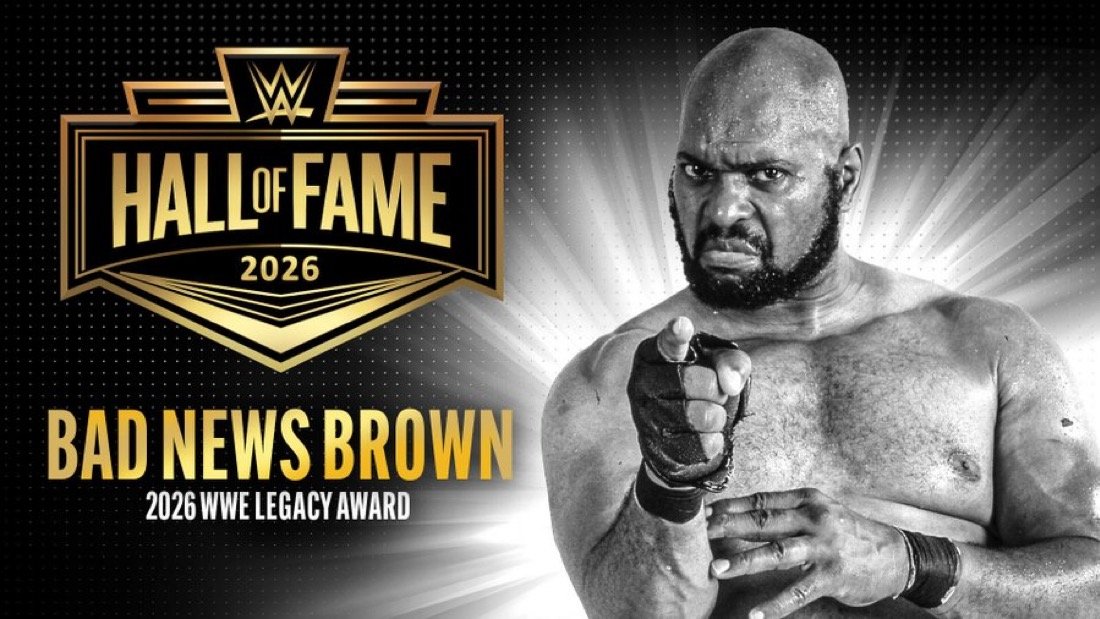
Triple H’s announcement that Bad News Brown will be inducted into the 2026 WWE Hall of Fame Legacy Class feels less like a surprise and more like a long overdue correction. From the moment WWE made it official, the news carries a different kind of weight because Allen Coage was never just another name from the late-1980s roster. He was one of the most legitimate athletes to ever enter the business, one of the toughest men of his era, and one of the few performers from that period whose presence still feels completely distinct decades later. Triple H framed the induction through the full arc of Brown’s career, from his Olympic medal in judo to his memorable run on WWE television, and that framing says everything about why this honor matters now.
What makes this announcement significant is that the Legacy Wing is not just about nostalgia. It is WWE’s way of recognizing figures whose influence and historical value are bigger than a standard list of title reigns or WrestleMania main events. In Brown’s case, that distinction fits perfectly. He was not defined by championship gold in WWE. He was defined by credibility, aura, attitude and impact. He felt dangerous in a way that few wrestlers of that era did, because fans understood there was nothing manufactured about his toughness. Before he ever became Bad News Brown on WWF television, Coage had already built a real athletic résumé that separated him from almost everybody around him. WWE has long highlighted his Olympic background, and that legitimacy became the foundation of everything that made him work in professional wrestling.
That is what made Brown such a compelling character. He was not a cartoon villain, not a comedy heel, and not a performer who needed a manager or a gimmick to explain his menace. He carried himself like a man who did not trust anybody, did not care who stood across from him, and did not need anyone’s approval. WWE itself has described him as ahead of his time, and that label still rings true because Brown’s character had shades of the anti-establishment, anti-authority edge that would become much more common years later. In an era built around bright heroes, broad villains and cleanly defined roles, Brown stood out as someone colder, meaner and more believable than almost anyone else on the screen.
His wrestling timeline only strengthens the case. Brown’s path through the sport was deeper than many casual fans remember. He was a decorated combat athlete, then an international wrestler, then a major force in Stampede Wrestling before arriving in WWE. By the time the national audience met him, he already had the kind of background that gave him instant authenticity. WWE later described him as a viable main event star in Stampede before his WWF run, and that matters because it shows he was not built from scratch on television. He arrived with a reputation. He arrived with weight behind him.
Once he hit WWE, Brown made an impression quickly. His biggest signature moment remains WrestleMania IV, where he won the battle royal in one of the most memorable undercard stories of the event. The match itself mattered, but what endured was the betrayal of Bret Hart and the image of Bret smashing Brown’s trophy afterward. It was a perfect Bad News Brown angle because it distilled the entire character into one sequence: opportunistic, selfish, hostile and impossible to trust. It also became one of the earliest signposts that Bret Hart could connect as a singles babyface, which gives Brown an underrated place in that chapter of WWE history too.
That Bret Hart rivalry is one of the defining narratives of Brown’s career. Their chemistry worked because Bret’s growing precision and pride were such a natural contrast to Brown’s bitterness and menace. But Brown’s résumé was never limited to one feud. WWE consistently positioned him opposite major names because he felt credible enough to make any program feel serious. He worked with Bret, Hulk Hogan, Randy Savage, Jake Roberts and Roddy Piper, and each feud showcased a different part of what made him effective. Against top stars, Brown did not feel like filler. He felt like a threat.
That is the biggest reason this Hall of Fame announcement lands so well. Brown’s career was not built around the usual Hall of Fame markers inside WWE, but his contribution was never ordinary. He helped define the upper-middle tier of late-80s WWF by giving top babyfaces someone who looked, talked and carried himself like real bad news. He was the kind of heel audiences did not simply boo because they were supposed to. They booed him because they believed him. Even years later, WWE’s own language around Brown still centers on that same idea: he was one of the last men you would ever want to meet in a dark alley. That kind of reaction is not created by catchphrases alone. It comes from presence.
There is also a larger historical layer to this induction. Brown represented something different, especially for his era. He was a Black star presented with authority, intimidation and legitimacy, not softened into something easier or more comfortable. He was abrasive, unapologetic and physically credible, and that made him stand out then just as much as it does now in hindsight. He was also respected by his peers, with WWE preserving comments from Edge crediting Brown as someone who helped him early in his career. That kind of respect tells its own story. Wrestlers knew what Brown was. Fans knew it too.
So what does this Legacy induction really mean? It means WWE is acknowledging Bad News Brown as a historically important figure, not merely a memorable heel from an old era. It means his legacy is being judged on the totality of his impact: Olympic pedigree, territorial success, undeniable toughness, unforgettable character work and a WWE run that left a stronger imprint than his accolades alone might suggest. More than anything, it means Allen Coage is finally being placed where he belongs in wrestling history. This is not a courtesy honor. It is recognition that one of the most believable, singular and ahead-of-his-time performers of his generation helped shape the texture of WWE in ways that lasted long after he was gone. And that is exactly what the Hall of Fame should be for.
Make sure to subscribe to our Late Night Crew Wrestling YouTube Channel. Follow @yorkjavon, @kspowerwheels & @LateNightCrewYT on X.
I’m the quiet one until the bell rings then I’ve got takes. I live for WWE NXT and TNA, I want every promotion to succeed, and I will absolutely roast the bad decisions on sight (because someone has to). Anime taught me to respect long-term storytelling; wrestling taught me that sometimes the plan is “we panicked” and called it “unpredictable.” The Miz got me into all of this, so yeah I appreciate confidence, commitment, and the art of talking like you’re already the main event. Now I bring that same energy to the page as the main writer for Late Night Crew Wrestling because if you’re not here to be must-see and tell the truth, why are you here?!