March is Women’s History Month, and the biggest lie wrestling ever told was that women’s wrestling “arrived” when a major promotion finally decided it was convenient. Women’s wrestling didn’t arrive. It endured. It innovated. It drew money. It got watered down. It got revived. It got re-invented — again and again — across countries, styles, and generations.
So here’s the full scoop, from the very beginning to right now, across the mainstream and the indies — tight, but not shallow.
1) The foundation: when women had to legitimize themselves in hostile territory (1930s–1950s)
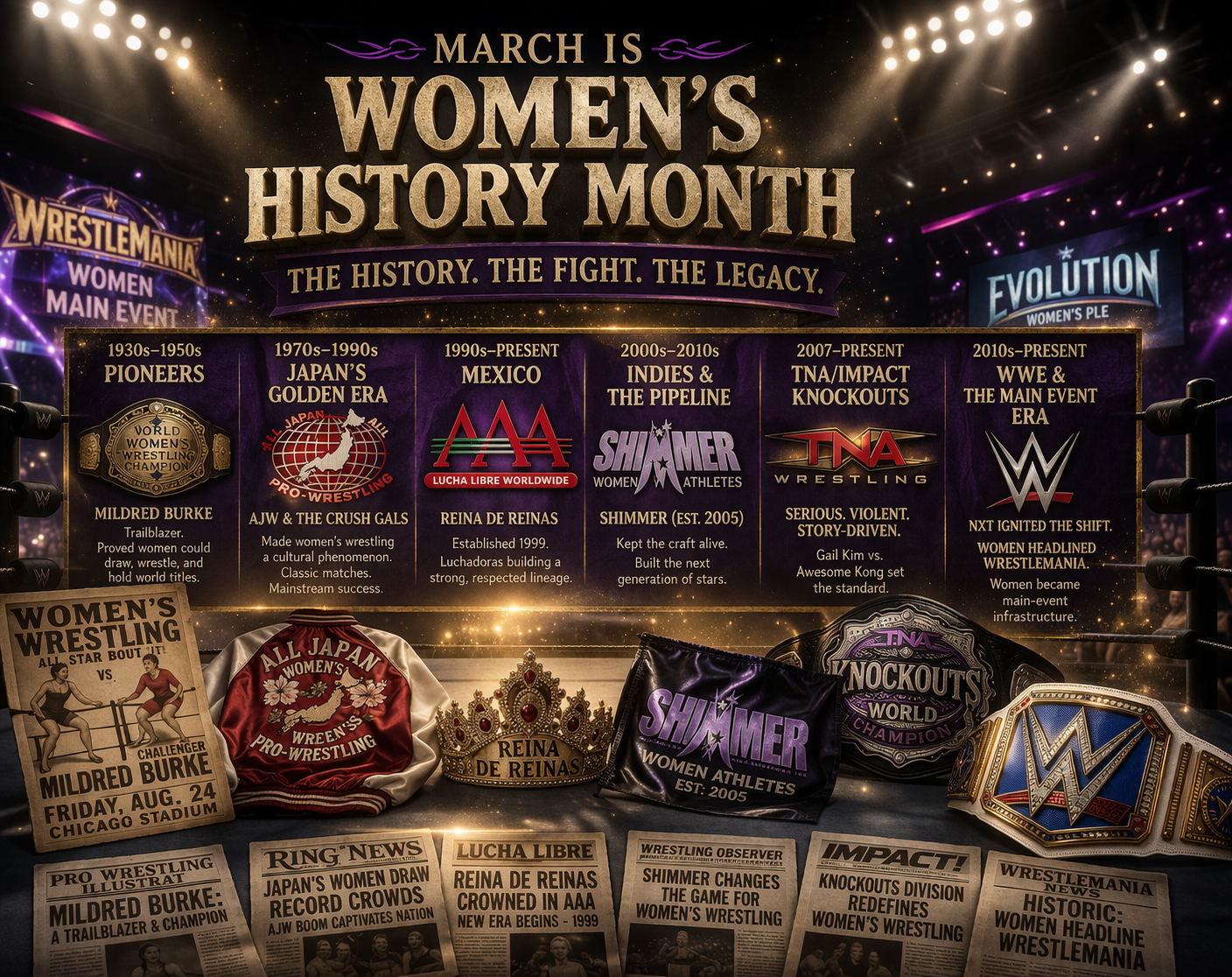
If you want a true starting point, it’s Mildred Burke — because her era proves the core argument: women could draw, wrestle, and carry championships even when promoters tried to frame them as an “attraction.” Burke’s legacy isn’t just “pioneer.” It’s business and structure: a long world-title reign in a time when women’s wrestling often lived on carnivals and tough circuits, where your credibility wasn’t protected by branding — only by what you could do and what crowds would pay to see.
Women’s History Month starts here because this is the original template: women get over, the industry tries to control it, and the ones who last are the ones who refuse to shrink.
2) The U.S. TV decades: talent existed, investment didn’t (1960s–1990s)
For a long stretch in the U.S., women’s wrestling didn’t lack wrestlers — it lacked consistent commitment. This is the era where women could be stars one week and afterthoughts the next, depending on the territory, promoter, and TV climate. It’s why American women’s wrestling history often feels like scattered highlights instead of sustained eras: too many ceilings, too many stop-start pushes, too many “now go do something humiliating” booking patterns.
This era matters because it explains why later breakthroughs felt revolutionary: women weren’t suddenly capable. They were finally being allowed.
3) Japan raises the ceiling: AJW makes women’s wrestling a cultural engine (1970s–1990s)
If you want the global proof that women’s wrestling could headline and feel monumental, Japan gave it to the world — especially through All Japan Women’s Pro-Wrestling (AJW).
The 1980s boom wasn’t niche. It was mainstream culture. The Crush Gals (Chigusa Nagayo & Lioness Asuka) weren’t just popular — they became teen-idol-level famous, combining wrestling, music, and a high-energy style that hooked a new audience. Their rivalry with Dump Matsumoto and her Atrocious Alliance is the kind of feud people still study because it fused violence, spectacle, and emotion into something that felt bigger than wrestling. Hair matches, TV ratings that were a real event, and a country watching women’s wrestling like it was prime-time drama.
Then the 1990s turned match quality into a weapon. The pace, stamina, and physicality of that era still shape what people call “classic” today. A lot of the modern women’s workrate language — the idea that women’s matches can be the best match on the card without an asterisk — has AJW DNA in it whether people realize it or not.
4) Mexico’s lane: luchadoras, tradition, and the Reina de Reinas marker (1990s–present)
Women’s wrestling history isn’t just U.S. and Japan. Mexico has its own lineage where women built careers inside lucha’s tradition — character-driven, rhythm-heavy, crowd-first, and athletic in a way that’s hard to fake if you don’t belong.
A modern landmark here is AAA’s Reina de Reinas, established in 1999. That matters because it created a long-running, recognizable women’s singles prize in a major lucha ecosystem — and it helped normalize the idea that women could be treated as a continuing title story, not a one-off showcase.
5) The modern U.S. pivot points: WWE’s evolution from “moments” to infrastructure (late 1990s–2010s)
WWE’s women’s history is complicated, and Women’s History Month shouldn’t sanitize it. There were years where women’s segments were treated like filler, punchlines, or marketing. But inside that, wrestlers still punched through — and every time WWE actually committed to stakes, women delivered.
The real shift came when women stopped being framed as a side division and started being booked like main-event infrastructure. NXT proving women could carry big matches consistently was a major turning point, and the mainstream ceiling finally got blown open with women headlining WrestleMania — the kind of moment that permanently changed what fans could demand going forward. After that, “women can’t main event” became an argument you couldn’t make with a straight face.
6) TNA/IMPACT’s Knockouts: the division that became a brand (2007–present)
If WWE is the biggest platform, TNA/IMPACT is the company that proved a women’s division can be a brand identity if you book it that way.
When the Knockouts era caught fire, it wasn’t because of one match — it was because the division got stories, stakes, and physicality as a weekly expectation. The feud everyone still references for a reason is Gail Kim vs. Awesome Kong: not “good for its time,” but legitimately foundational for what serious women’s wrestling looked like on American weekly TV when other companies weren’t always delivering that consistency.
The Knockouts mattered because it proved women didn’t need a “special episode” to be treated seriously — they needed a company willing to build.
7) The indies: the real backbone when the mainstream was inconsistent (2000s–2010s)
Women’s History Month has to salute the independent scene because the indies kept the craft sharp when mainstream TV didn’t always provide the runway.
The key landmark in North America is SHIMMER, founded in 2005 specifically to give women a serious, non-objectifying platform. That’s not trivia — it’s a historical correction. SHIMMER (and scenes around it) became a proving ground where reputations were earned, not handed out. A huge portion of today’s “major league” women built their credibility on cards like that, in environments where you couldn’t hide behind production.
In other words: women’s wrestling didn’t wait for the industry to catch up. The indies built the standard and made the industry follow.
8) Today’s era: women’s wrestling as a global ecosystem, not one-company permission (2019–now)
Here’s what makes the current era different from every era before it: women’s wrestling isn’t trapped inside one company’s definition anymore.
You’ve got:
- WWE presenting women as long-term tentpoles, not occasional headliners.
- AEW and ROH creating lanes for character-driven and workrate-driven women’s stories, including title reigns that feel historic.
- Japan’s modern joshi scene continuing to produce world-class performers at a relentless pace.
- Mexico maintaining a women’s title tradition with long lineage.
- Projects like NWA Empowerrr proving an all-women’s show can stand as a full concept event, not a novelty.
And the biggest “you can’t go back” change? Fans now argue women’s wrestling the same way they argue men’s: match quality, drawing power, character arcs, booking logic, and title lineage. That’s the real win — women’s wrestling becoming non-optional to the industry’s credibility.
Women’s History Month final word
If you want one clean sentence to end March with, it’s this:
Women’s wrestling didn’t wait to be legitimized.
It legitimized itself — in carnivals, in sold-out arenas, on indie DVDs, on global tours, and finally on the biggest stages — until the business had no choice but to follow.
That’s the real history. And it’s still being written.
Make sure to subscribe to our Late Night Crew Wrestling YouTube Channel. Follow @yorkjavon, @kspowerwheels & @LateNightCrewYT on X.
I’m the quiet one until the bell rings then I’ve got takes. I live for WWE NXT and TNA, I want every promotion to succeed, and I will absolutely roast the bad decisions on sight (because someone has to). Anime taught me to respect long-term storytelling; wrestling taught me that sometimes the plan is “we panicked” and called it “unpredictable.” The Miz got me into all of this, so yeah I appreciate confidence, commitment, and the art of talking like you’re already the main event. Now I bring that same energy to the page as the main writer for Late Night Crew Wrestling because if you’re not here to be must-see and tell the truth, why are you here?!