Thunder Rosa becoming officially dual-contracted with AEW and CMLL is big news on its own, but the bigger story is what it says about where AEW is right now. This is not just another crossover appearance and it is not one of those situations where a wrestler pops up elsewhere for a match or two and everyone acts like the industry has changed overnight. Rosa’s deal makes her the latest confirmed AEW name working under a real multi-company arrangement, and it drives home that AEW has quietly turned this into an actual roster-building strategy. Fightful reported that Rosa’s dual status was announced at CMLL’s April 3 event, and Rosa had already made it clear that this was not some brief stopover and that her work with CMLL is set to continue through the rest of 2026.
That is why this matters. Thunder Rosa is not just a familiar face adding another logo to the résumé. She is a former AEW Women’s World Champion, someone with real credibility on both sides of the border, and one of the few women on the roster whose presence in CMLL feels completely natural instead of forced. AEW did not just add another partner-promotion headline here. It added a wrestler who can actually help define what that relationship looks like on the women’s side. There is a difference between a name being useful for a crossover poster and a name being able to carry the identity of the crossover itself. Rosa is the second kind.
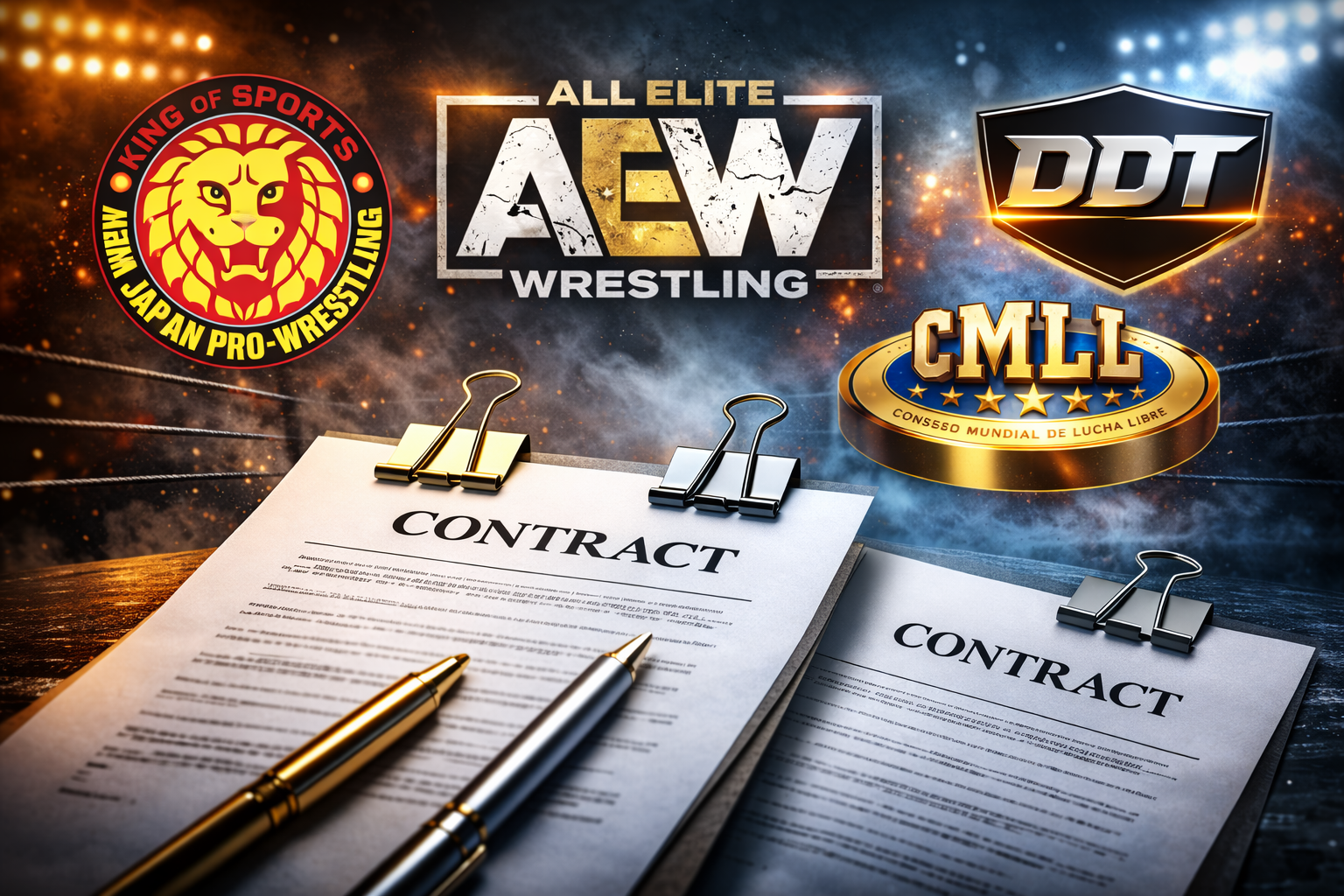
And Rosa is walking into a growing club. As of now, there are eight AEW wrestlers with confirmed multi-contract situations: Hechicero, Persephone, Máscara Dorada, Místico, Claudio Castagnoli, Thunder Rosa, Kevin Knight, and Konosuke Takeshita. Seven of them are working dual deals. Takeshita is the outlier with a triple-contract setup spanning AEW, NJPW, and DDT. Tony Khan said late last year that he wants more arrangements like these, and looking at the names involved now, it is obvious he was not talking in theory.
Hechicero
If there is one wrestler who really set the modern version of this in motion for AEW, it was Hechicero. He confirmed in September 2025 that he was under a “double multi-year” deal with AEW and CMLL, which immediately made his situation more concrete than the usual talent-sharing language that gets thrown around in wrestling. Hechicero had already spent months proving he could work in AEW, fit into stories, and stand out stylistically. Then the contract made it official. Since then, his stock has only gone up, especially with his March 2026 win over Claudio Castagnoli to regain the CMLL World Heavyweight Championship. That is important because it showed CMLL was not lending out a talent and watching him lose status back home. Hechicero became the proof that a wrestler could be important in both places at once.
Persephone
After that, the system started scaling. In January, CMLL announced that Persephone and Máscara Dorada were also under dual contracts with AEW. That was the point where this stopped feeling like a one-off arrangement reserved for one standout star. Persephone’s rise especially says a lot about how these deals seem to happen. She later explained that she treated every crossover opportunity like it might be her only shot, and that approach paid off when those appearances turned into a formal deal. Then came the biggest payoff of all: on March 6, she defeated Mercedes Moné to win the CMLL World Women’s Championship. That is not just a nice bullet point. That is a major title win that instantly made her one of the clearest success stories in this entire model.
Máscara Dorada
Máscara Dorada’s role is different, but no less important. He gives AEW an explosive, high-ceiling lucha star who already brings championship credibility with him. He is part of the current generation CMLL is clearly investing in, not just someone being loaned out for exposure. That matters because the strongest version of this model is not AEW poaching attention from partner promotions. It is both sides getting something real back. Dorada fits that perfectly: he gets a bigger stage, while CMLL keeps a young featured talent under contract and active in its title picture.
Místico
Then there is Místico, and that is where this story starts feeling even bigger. Místico became All Elite at Revolution in March after winning the AEW World Trios Titles with Kevin Knight and Mike Bailey, and Tony Khan later confirmed he would be splitting time between AEW and CMLL. That is a major statement because Místico is not just another strong worker from a partner promotion. He is one of the most recognizable names CMLL has. He came into AEW already carrying major weight too, having beaten MJF for the CMLL World Light Heavyweight Championship at the company’s 92nd Anniversary show last September. AEW did not sign him and then slowly figure out what to do with him. It made him a champion immediately. That tells you everything about how serious this is.
Claudio Castagnoli
Claudio Castagnoli’s case is maybe the most interesting because it works in the other direction. Most of these stories involve a CMLL talent adding AEW. Claudio was already a major AEW name and then formally added CMLL. By the time CMLL announced his dual contract in March, he was already the CMLL World Heavyweight Champion, having won the title in November 2025. That sequence matters. Claudio was not given a contract first and importance later. He was made important first, then officially folded into the structure. His title reign gave him fresh life, gave CMLL a credible world champion from AEW, and reinforced that this relationship is not one-sided. AEW is willing to let its own established talent matter somewhere else too.
Kevin Knight
Outside the CMLL side, Kevin Knight remains one of the best examples of this working with New Japan. He said in 2025 that when he signed with AEW, he also signed with NJPW, describing it as the best of both worlds. That was not empty talk. Knight had already built real value in New Japan, and AEW clearly saw enough in him to keep investing, with Fightful and F4W reporting that he re-signed with AEW this year on a new multi-year deal after initially signing a one-year contract in early 2025. What makes Knight’s case stand out is that the dual structure did not leave him floating between companies. It pushed him forward. He became more visible, more decorated, and more important in AEW while still retaining that NJPW identity.
Konosuke Takeshita
And then there is Takeshita, who still feels like the most extreme version of what this whole idea can become. NJPW formally announced in January 2025 that he was joining its roster on top of his AEW and DDT commitments, and Fightful has continued to describe him as triple-contracted. He later said he would remain with New Japan throughout 2026, which matters because it shows this was never some temporary publicity move. It also produced real results. Takeshita became IWGP World Heavyweight Champion, while still maintaining ties to AEW and DDT. That is the dream scenario for a company like AEW: a wrestler can leave, become even bigger somewhere else, and bring that aura right back to your TV.
That is why Thunder Rosa’s deal lands the way it does. On the surface, it is another signing. In reality, it is another piece of a blueprint that is already well underway. Rosa brings credibility, identity, and a badly needed sense of direction for what this could look like for AEW’s women’s division across promotions. And when you line her up next to Hechicero, Persephone, Máscara Dorada, Místico, Claudio, Kevin Knight, and Takeshita, the pattern is too clear to ignore. AEW is no longer just partnering with other promotions. It is building a roster model around them.
Make sure to subscribe to our Late Night Crew Wrestling YouTube Channel. Follow @yorkjavon, @kspowerwheels & @LateNightCrewYT on X.
I’m the quiet one until the bell rings then I’ve got takes. I live for WWE NXT and TNA, I want every promotion to succeed, and I will absolutely roast the bad decisions on sight (because someone has to). Anime taught me to respect long-term storytelling; wrestling taught me that sometimes the plan is “we panicked” and called it “unpredictable.” The Miz got me into all of this, so yeah I appreciate confidence, commitment, and the art of talking like you’re already the main event. Now I bring that same energy to the page as the main writer for Late Night Crew Wrestling because if you’re not here to be must-see and tell the truth, why are you here?!