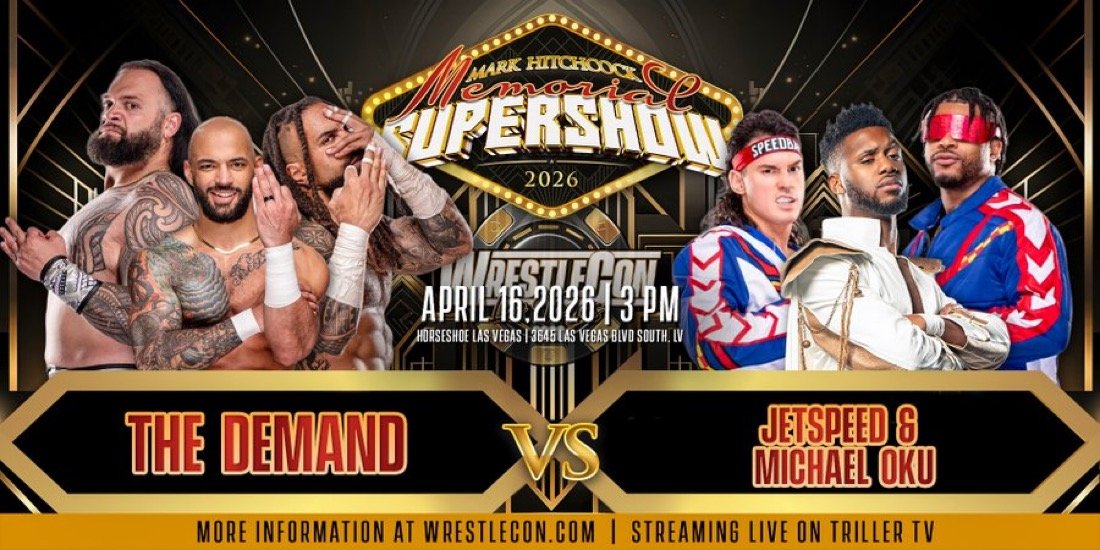
Today, the WrestleCon Mark Hitchcock Memorial Supershow lands in Las Vegas with the usual Mania-week promise of a one-night all-star card, but this year’s version is arriving with a little more chaos than usual. The show is set for Thursday, April 16 at Horseshoe Las Vegas and streams on TrillerTV+. On paper, it still looks like one of the more accessible cards of the week because it mixes current indie names, international talent, lucha, and nostalgia in one room. But the bigger story around today’s show is the late main-event pivot after Leon Slater was pulled from the originally advertised Ricochet singles match, forcing WrestleCon to rework the top of the card days before bell time.
Before getting into the rest of the show, the important card note is this: the best current full card is six matches, and that updated six-match version is what I’d treat as the working final lineup. The reason I’m phrasing it that way is because Triller’s official page still shows the older card, including Ricochet vs. Leon Slater, while newer reporting from POST Wrestling and the updated Cagematch listing reflect the changed main event and the six-match structure now being used. So for accuracy, the six-match card below is the strongest version to publish with.
Here is everything advertised for today’s show
- JetSpeed (Kevin Knight & Speedball Mike Bailey) and Michael Oku vs. The Demand (Ricochet, Bishop Kaun & Toa Liona)
- Bandido vs. Galeno del Mal
- The Swirl (Lee Johnson & Blake Christian) vs. Subculture (Mark Andrews & Flash Morgan Webster)
- Masato Tanaka vs. Mark Davis
- Heath & Rhyno vs. The Headbangers
- Starboy Charlie & Starman vs. Latigo & Toxin vs. Ben-K & Hyo vs. Joe Lando & Danny Black (Four-Way Elimination Tag Team Match)
The first thing that always needs to be understood about this show is that it is not built like a normal promotion card. The Mark Hitchcock Memorial Supershow is a WrestleCon attraction, not a weekly product with one storyline universe and one roster identity. That has always been the point. It is designed as a Mania-week supercard where multiple scenes overlap for one night. The event itself is named in memory of Mark Hitchcock, a wrestling fan and artist with deep roots in the convention and collector side of the scene, and WrestleCon has long positioned the show as a tribute in his honor. By 2018, WrestleCon had rechristened its Supershow under the Mark Hitchcock name, and Triller still presents the event as a memorial-style celebration of independent wrestling talent from around the world.
That history matters because it explains why the card often feels less cohesive than the promotion-specific shows around it and why that is not automatically a flaw. If Dragongate is trying to feel like Dragongate and TJPW is trying to feel like TJPW, this show is trying to feel like WrestleMania week itself. It is part of the wider GCW Collective/WrestleCon ecosystem at Horseshoe Las Vegas, and it works best when it functions like a sampler platter for the whole week rather than a locked-in narrative universe. The upside is accessibility. The downside is that when a late change hits, the cracks show faster because the card’s glue is attraction value more than ongoing storytelling.
That is exactly what happened with the main event. WrestleCon had pushed Ricochet vs. Leon Slater as a dream match, but POST Wrestling reported on April 11 that Slater was pulled and the match was replaced by Ricochet & The Demand vs. JetSpeed & Michael Oku. Fightful also covered the switch and quoted WrestleCon’s announcement that it took special exceptions and coordination to make the replacement happen. That late change immediately became the defining story of the show. In one move, the card lost its cleanest modern singles attraction and picked up a six-man that still has talent depth but carries a very different kind of energy.
From a narrative standpoint, that replacement cuts both ways. The bad news is obvious: Ricochet vs. Leon Slater had easy match-of-the-night upside and was one of the clearest “must-watch” pairings on the original lineup. The good news is that the replacement is not some lazy patch job. JetSpeed and Michael Oku vs. Ricochet, Bishop Kaun, and Toa Liona still feels like a major attraction, and it now ties directly into the broader inter-promotional tension that has been affecting multiple indie cards this week. POST explicitly linked the change to the wider issue of TNA talent being pulled from certain inter-promotional matches, so the Supershow now sits inside a larger WrestleMania-week industry story whether it wanted to or not.
That main event change has also shaped the fan reaction. The praise has gone to WrestleCon for finding a replacement that still looks big-league enough for this stage, and social posts about the announcement made it clear that some fans were just relieved the show still got a meaningful top match instead of a flat substitute. The criticism is just as real: there is no pretending the card did not lose a more exciting singles hook. Fans who were circling Ricochet-Slater specifically have a fair reason to feel disappointed, and the fact that Triller’s official page still hadn’t fully caught up only added confusion during an already chaotic week.
Beyond the main event, Bandido vs. Galeno del Mal now looks even more important because it feels like the card’s cleanest one-on-one attraction. Triller’s event page framed the match as a clash of spectacular offense and monster power, and that is the right read. Bandido is one of the easiest wrestlers in the world to drop onto a card like this because he immediately gives it credibility, pace, and highlight potential. Galeno del Mal brings the size and visual contrast that makes the pairing stand out. In a show that just lost one of its top pure singles hooks, this match now has a little more pressure on it to deliver.
Masato Tanaka vs. Mark Davis is the other match that jumps off the page if you are looking for something more substantial than novelty. Triller sold it as a heavyweight international dream match, and that tracks because it is one of the few bouts on the card that feels built on pure toughness and credibility rather than crossover attraction. For veteran fans, Tanaka still brings instant aura. Davis gives the match modern relevance and the kind of physical edge that makes this pairing easy to trust. It is the sort of match critics usually identify as a sleeper because it is not the loudest thing on the poster, but it has a real chance to be one of the strongest bell-to-bell bouts on the show.
The rest of the lineup fits the traditional Supershow formula. The Swirl vs. Subculture is exactly the kind of fast-moving tag match these cards need, and Fightful had already spotlighted it earlier in the build. It is not the match carrying the event’s identity, but it is the kind of bout that helps keep the pace sharp and gives the show a familiar modern indie rhythm. Then there is the four-way elimination tag, which leans fully into the international showcase concept. That match is less about deep story and more about color, speed, variety, and getting multiple scenes onto the same stage. It is classic Supershow booking for better and worse. When it clicks, it feels like a celebration of how broad Mania week can be. When it does not, it can feel like one of those matches people barely remember individually once the weekend ends.
The nostalgia lane is Heath & Rhyno vs. The Headbangers, and that tells you a lot about what this event still wants to be. A show like this has always worked by mixing fresh names with recognizable veterans and letting a Mania-week crowd respond to the blend. The praise for that kind of booking is that it broadens the appeal and makes the event easy for a mixed audience to sample. The criticism is that nostalgia matches can flatten the card if there are too many of them. Here, though, it is just one lane on a show that already has lucha, modern tag wrestling, a big six-man, and an international elimination showcase, so it feels more like variety than excess.
The larger media reaction to the Supershow has been a mix of appreciation and frustration. The appreciation comes from the event’s role in the week: it is still one of the easiest cards for a general wrestling audience to drop into because you do not need deep storyline knowledge to get it. The frustration comes from the same thing that has haunted this year’s indie week more broadly: card volatility, partner restrictions, and late changes. POST’s coverage of the replacement match made the Supershow part of a wider conversation about how outside promotional politics are affecting independent cards, and that gives this year’s edition an unusually messy backdrop compared with the cleaner “all-star party” vibe the event usually sells.
That is also where the significance of today’s show really sits. The Mark Hitchcock Memorial Supershow is not the most stylistically distinctive event of the week and it is not trying to be. Its job is to be broad, easy to watch, and representative of WrestleMania week’s larger independent ecosystem. That role still matters. In fact, it probably matters more in a year like this, when so many cards are being reworked on the fly and the week itself feels more politically tense than usual. If this show lands, it will be because it embraces exactly what it is: not the deepest card, not the most coherent card, but a genuine one-night supercard with enough names, contrast, and buzz to feel like an event.
Final thoughts
Today’s show is arriving with more baggage than it probably wanted, but the card still has enough real substance to matter. The late change from Ricochet vs. Leon Slater to a six-man tag is the story hanging over everything, and there is no use pretending otherwise. But Bandido vs. Galeno del Mal, Tanaka vs. Mark Davis, and the replacement main event still give the Supershow real hooks, while the rest of the card keeps the traditional WrestleCon all-star feel intact. That is what this show has always been at its best: a big convention-week snapshot of wrestling’s many lanes, all crammed into one room. Today’s version may be a little messier than usual, but it still looks like it has a strong chance to deliver the exact kind of controlled chaos this slot is supposed to provide.
Make sure to subscribe to our Late Night Crew Wrestling YouTube Channel. Follow @yorkjavon, @kspowerwheels & @LateNightCrewYT on X.
I’m the quiet one until the bell rings then I’ve got takes. I live for WWE NXT and TNA, I want every promotion to succeed, and I will absolutely roast the bad decisions on sight (because someone has to). Anime taught me to respect long-term storytelling; wrestling taught me that sometimes the plan is “we panicked” and called it “unpredictable.” The Miz got me into all of this, so yeah I appreciate confidence, commitment, and the art of talking like you’re already the main event. Now I bring that same energy to the page as the main writer for Late Night Crew Wrestling because if you’re not here to be must-see and tell the truth, why are you here?!