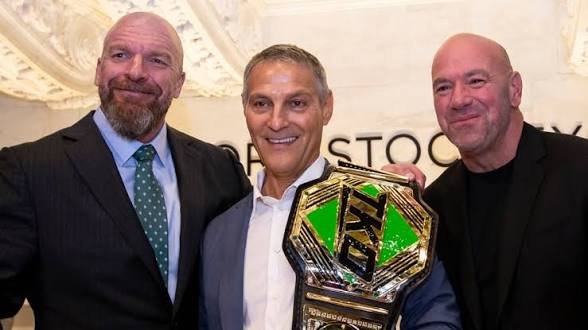
Mark Shapiro’s recent comments about WWE creative hit as hard as they did because they did not feel like polished corporate filler. They felt blunt. The TKO President said the company has “complete control” over WWE creative, then defended the celebrity-heavy direction and the broader business-first strategy that has pushed WWE further into crossover culture, bigger media platforms, and bigger mainstream visibility. That alone was always going to spark a reaction, but during a stretch where a lot of fans were already frustrated with the overbranding, the celebrity integration, and the feeling that some of WWE’s biggest moments are being shaped more for headlines than long-term storytelling, those remarks threw even more fuel on a fire that was already burning.
The biggest thing here is that Shapiro really did say it. This is not just another wrestling story built off message-board chatter and social media spin. The audio from his appearance at a University of Alabama class made the rounds quickly, and the quote at the center of all this has been consistent across the coverage: TKO has “complete control,” and because WWE now operates inside a public company, TKO is responsible for the direction of the product “good or bad, fact or fiction.” That is the part that changed the conversation, because he did not describe TKO as offering guidance or having input. He described TKO as being in control.
That is also why the Triple H discussion has gotten louder. For the last few years, Paul Levesque has been presented as the face of WWE’s creative turnaround. He is the one fans give credit to when the weekly shows feel more focused, when the undercard gets more attention, and when stories actually feel like they are going somewhere. TKO itself helped build that image. Shapiro publicly praised Levesque and his team in 2025, while Nick Khan had already made it sound like Levesque remained the central creative decision-maker after the merger. On the surface, WWE has worked hard to make it look like Triple H is the guy steering the ship.
The problem is that the public image and the behind-the-scenes reality have not always lined up. That is where the lawsuit-related reporting becomes important. Brandon Thurston’s reporting for POST Wrestling showed private messages between Levesque and Nick Khan that painted a much more complicated picture of WWE’s power structure during the merger era, especially when it came to Vince McMahon’s influence. Those messages made it clear that the people publicly presented as running the show were still dealing with outside power plays and internal tension behind closed doors. That matters because it showed that WWE’s creative structure was not nearly as clean or simple as the company wanted fans, media, and investors to believe.
That is why the scapegoat argument has caught on so quickly. Triple H is the one WWE puts in front of the cameras. Triple H is the one used to sell the idea that WWE is in a new era. Triple H is the one fans are supposed to associate with the weekly product, the long-term stories, and the creative direction of the company. So when the TKO President openly says the company has complete control, it immediately makes people question how much control Levesque actually has when it matters most. That is where the online reaction has really centered. A lot of fans now believe Triple H handles the weekly booking, the midcard, and the lower card, while the biggest main-event decisions at the major premium live events are being decided above him.
To be clear, that exact split has not been fully proven by the strongest wrestling reporting, and that distinction matters. The confirmed part is Shapiro saying TKO has complete control. The confirmed part is the reporting that has already shown WWE’s internal power structure has been more complicated than the public story suggested. The unconfirmed part is the harder claim that TKO is directly dictating every top-level PLE main event while Triple H is left to manage everything underneath it. That specific version of the story is still more interpretation than fact, but it is not hard to see why so many fans have gone there.
It also feels believable because Shapiro has spoken about WWE the way a corporate executive would. He has talked about growth, scale, event expansion, media distribution, and building bigger business around the brand. Fightful previously covered comments from Shapiro about WWE needing to move beyond the premium live events created during the Vince McMahon era and create new tentpole attractions. That kind of language tells you exactly how TKO views WWE. They do not just see it as a wrestling company. They see it as premium content, intellectual property, and a growth vehicle. Once that becomes obvious, fans are naturally going to wonder how many of WWE’s biggest creative choices are being made for wrestling reasons and how many are being made for business reasons.
That is where the criticism gets sharper. It is not just that TKO has influence. It is that more and more fans think that influence becomes most obvious at the very top of the card. Weekly TV often still feels like it has Levesque’s fingerprints on it. There is usually more patience, more structure, and more care in the middle of the card than there was a few years ago. But once WWE gets to its biggest shows, a growing part of the fanbase believes the product starts feeling less like the payoff to months of storytelling and more like a corporate content package built around sponsors, celebrity attachments, streaming partners, and mainstream visibility. That is the core of the scapegoat argument. Triple H becomes the face tied to the praise and the criticism, while the biggest decisions may be getting made in rooms he does not fully control.
That is why this story matters. It is bigger than one quote going viral on X. It gets right to the heart of what WWE is now under TKO. For years, fans were used to the idea that one wrestling mind had too much power. Now the concern for a lot of people is that WWE’s biggest creative choices may not be driven by one wrestling mind at all, but by a corporate structure that sees wrestling as content inventory first and a creative product second. If that is even partly true, then Triple H is in a rough spot. He can still shape the weekly television, the tone of the product, and the broader creative framework, but the closer WWE gets to its biggest stages, the more he risks being the public face for decisions that may not be fully his.
Make sure to subscribe to our Late Night Crew Wrestling YouTube Channel. Follow @yorkjavon, @kspowerwheels & @LateNightCrewYT on X.
I’m the quiet one until the bell rings then I’ve got takes. I live for WWE NXT and TNA, I want every promotion to succeed, and I will absolutely roast the bad decisions on sight (because someone has to). Anime taught me to respect long-term storytelling; wrestling taught me that sometimes the plan is “we panicked” and called it “unpredictable.” The Miz got me into all of this, so yeah I appreciate confidence, commitment, and the art of talking like you’re already the main event. Now I bring that same energy to the page as the main writer for Late Night Crew Wrestling because if you’re not here to be must-see and tell the truth, why are you here?!