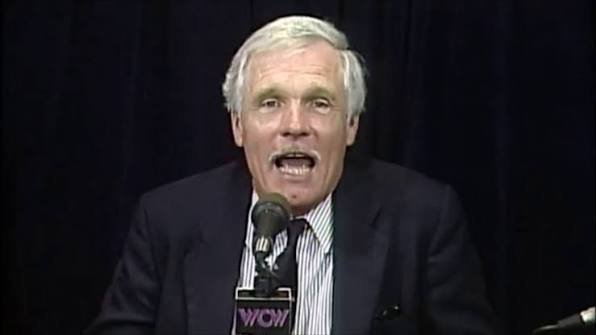
Ted Turner, the media mogul who founded CNN, built the Turner Broadcasting empire, turned WTBS into the SuperStation, launched TNT, and forever changed professional wrestling through his ownership of WCW, has died at 87. Turner’s death was announced Wednesday, May 6, 2026, through Turner Enterprises, with CNN and multiple major outlets confirming the news. No official cause of death was immediately given, though Turner had publicly revealed in 2018 that he was battling Lewy body dementia.
Turner was not just another rich television executive who happened to own a wrestling company. He was one of the few media figures who understood the value of professional wrestling before corporate television fully respected it. Long before wrestling became weekly prime-time appointment viewing, Turner saw what others dismissed: loyal audiences, live-event energy, regional identity, and a product that could fill hours of cable programming while building a passionate fanbase. That vision is why his name is permanently attached to the history of WCW, the Monday Night Wars, and the last true national wrestling war that forced WWE to get better.
Turner’s impact on television started far beyond the wrestling business. After buying a struggling Atlanta UHF station in 1970, he used satellite distribution to turn WTBS into the first “superstation,” putting Atlanta programming in homes across the country. He later launched CNN in 1980, creating the first 24-hour cable news network, and built a television empire that included TBS, TNT, Turner Classic Movies, Cartoon Network, sports programming, movie libraries, and other major entertainment properties.
For wrestling fans, though, Turner’s legacy begins with TBS. Throughout the 1980s, Jim Crockett Promotions aired on Turner’s network under the “World Championship Wrestling” banner. In 1988, with Crockett’s company struggling financially, Turner purchased the promotion and formed the company that became World Championship Wrestling. WWE’s own history of WCW credits Turner with launching WCW in 1988 and turning it from a southern wrestling property into the most popular sports-entertainment company in the world for a period of time.
That is the part of Turner’s legacy that still hits the hardest today. Without Ted Turner, there is no WCW as fans remember it. No WCW Nitro on TNT. No direct Monday night fight with WWE. No 84-week ratings streak. No New World Order becoming one of the hottest acts in wrestling history. No Goldberg streak turning into a mainstream phenomenon. No cruiserweight division giving national exposure to names and styles that helped influence modern wrestling. No real pressure on WWE to evolve into the Attitude Era version of itself.
Turner was mostly hands-off creatively, and that was probably both a blessing and a weakness. He did not book weekly television like Vince McMahon, but he gave WCW something most wrestling companies never get: real television power, real corporate resources, and real prime-time positioning. F4WOnline noted that Turner was always credited for seeing the value in wrestling programming while other media executives were quick to write it off, and that his support allowed WCW to grow on TBS and TNT until it overtook WWE during the Monday Night Wars.
The peak of that war came after WCW Monday Nitro debuted on September 4, 1995. Nitro went live from the Mall of America, immediately positioned itself as a direct threat to WWE Monday Night Raw, and changed the business almost overnight. Scott Hall’s arrival, Kevin Nash’s follow-up, Hulk Hogan’s heel turn at Bash at the Beach 1996, the launch of the nWo, Sting’s reinvention, Goldberg’s rise, and WCW’s 84-week ratings streak all happened under the umbrella of the Turner empire.
The criticism is also part of the story. WCW had money, television, stars, momentum, and cultural heat, but it eventually collapsed under bad creative, political chaos, bloated contracts, executive instability, and the corporate fallout of the AOL-Time Warner merger. Turner’s loss of control over his own company mattered. Once wrestling no longer had Ted Turner’s protection inside the Turner system, WCW became expendable to executives who did not value it the same way he did. F4WOnline noted that WCW stayed on TBS/TNT until 2001, when the promotion closed during the AOL-Time Warner fallout, with Turner no longer in charge of Turner Broadcasting at the time.
That is why Turner’s wrestling legacy cannot be reduced to “the billionaire who fought Vince McMahon.” That line is true, but it is too simple. Turner gave wrestling a second national power structure. He gave wrestlers leverage. He gave fans an alternative. He gave WWE the kind of competition that forced urgency, sharper characters, hotter television, and a boom period that still shapes the business today.
CNN’s official social account also acknowledged Turner’s passing Wednesday, while wrestling outlets and fans began connecting his broader media legacy back to WCW and the Monday Night Wars.
Dark Side of the Ring posted a short tribute tied to Who Killed WCW?, highlighting Turner’s lasting wrestling legacy through Teddy Turner and Eric Bischoff’s reflections.
Outside of wrestling and television, Turner was also a major sports owner and philanthropist. He owned the Atlanta Braves and Atlanta Hawks, helped build the Braves into a national brand through SuperStation exposure, donated $1 billion to United Nations causes, co-founded the Nuclear Threat Initiative, and became one of the largest private landowners in the United States.
Ted Turner’s passing closes the book on one of the most important figures in the history of television, cable news, sports broadcasting, and professional wrestling. He did not take bumps, cut promos, or stand in the ring every Monday night, but his fingerprints are all over one of wrestling’s greatest eras. WCW rose because Turner believed wrestling belonged on major television. WWE became stronger because Turner gave Vince McMahon a real fight. The wrestling business became bigger because Ted Turner was willing to bet on something other executives looked down on.
His legacy is complicated, loud, ambitious, flawed, and impossible to ignore — which, in a lot of ways, is exactly what WCW was at its best.
Make sure to subscribe to our Late Night Crew Wrestling YouTube Channel. Follow @yorkjavon, @kspowerwheels & @LateNightCrewYT on X.
I’m the quiet one until the bell rings then I’ve got takes. I live for WWE NXT and TNA, I want every promotion to succeed, and I will absolutely roast the bad decisions on sight (because someone has to). Anime taught me to respect long-term storytelling; wrestling taught me that sometimes the plan is “we panicked” and called it “unpredictable.” The Miz got me into all of this, so yeah I appreciate confidence, commitment, and the art of talking like you’re already the main event. Now I bring that same energy to the page as the main writer for Late Night Crew Wrestling because if you’re not here to be must-see and tell the truth, why are you here?!