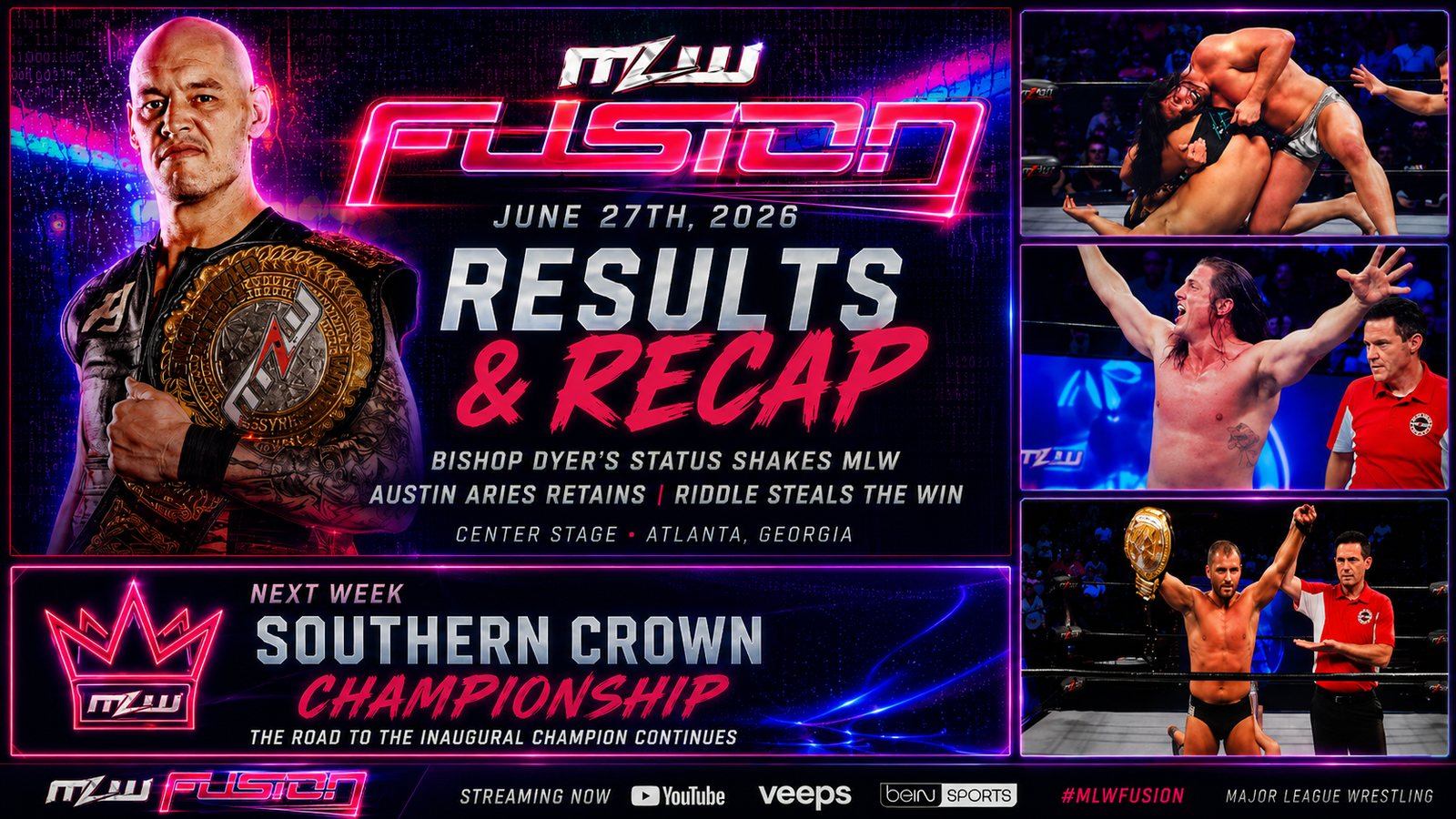
Tonight’s MLW Fusion came out of Center Stage in Atlanta with the kind of episode that did not need to be chaotic every second to matter. Instead, MLW used the hour to move several major pieces into position: Matt Riddle’s revenge path after Alex Hammerstone ruined his MLW World Heavyweight Championship opportunity, Austin Aries’ first real statement as MLW National Openweight Champion, Zamaya continuing to carve out her place in the women’s division, Paul Hauser stepping into the Fusion spotlight, and Bishop Dyer’s uncertain future suddenly hanging over the tag team championship scene. This was not MLW at its wildest, bloodiest, or most explosive, but it was a very deliberate reset episode after Fusion 200. It connected the World Title picture, the National Openweight Title scene, the Southern Crown Championship rollout, the MLW-CMLL relationship, and the strange alliance forming around Shotzi, the Good Brothers, and Mads Krule Krugger. The best parts of tonight’s show made the promotion feel unpredictable in the right ways. The weaker parts came when MLW leaned too heavily on teases, video packages, and short matches instead of letting some of these stories breathe inside the ring.
Here are the full results
- Zamaya defeated Priscilla Kelly
- Paul Hauser defeated Bryce Cannon
- Austin Aries (c) defeated Diego Hill (MLW National Openweight Championship)
- Matt Riddle defeated Trevor Lee
Breakdowns & Reactions
Opening: Bishop Dyer’s MLW Status Puts the Tag Team Division on Alert
Tonight’s Fusion opened with immediate attention on Bishop Dyer’s future, and that was the right way to frame the episode. Dyer is not just another name floating around MLW’s tag division. He is one-half of the MLW World Tag Team Champions with Donovan Dijak, and the Skyscrapers have been positioned as one of the most physically imposing acts in the company. When the show starts by making his contract status feel unstable, it instantly creates tension around the titles, Dijak, the Good Brothers feud, and the broader power vacuum inside MLW.
The actual story was simple: talks between Dyer and MLW were not in a clean place, his future was uncertain, and that uncertainty could reshape the tag team division. That worked because it did not require a fake dramatic backstage brawl or a convoluted authority figure segment. It was presented like a real issue with real consequences. A champion’s future being in question should matter, and MLW treated it like it mattered.
The problem is that contract-status stories can turn into wheel-spinning fast if they are not tied to an actual match, a title defense, a replacement, or a major betrayal. Tonight, the Dyer news created intrigue, but it also asked viewers to wait for the real fallout. That is fine for one episode. It cannot become the entire tag title story unless MLW has a sharp payoff ready.
Grade: B
What worked
- Bishop Dyer’s status immediately gave tonight’s show a bigger hook.
- It made the tag team division feel unstable without needing a match.
- The story gave Donovan Dijak and the Skyscrapers a new layer beyond just being big destroyers.
- It made the Good Brothers feud feel more complicated because the champions may not be on solid ground.
What didn’t work
- The segment raised more questions than it answered.
- Dyer’s future needs a clear direction soon or it risks becoming background noise.
- The tag titles were discussed more than they were physically represented tonight.
Zamaya vs. Priscilla Kelly
Zamaya defeating Priscilla Kelly was the first in-ring statement of the night, and MLW clearly designed it to make Zamaya look like a problem. This was not structured as a long, competitive women’s division showcase. It was built around the contrast between Kelly’s toughness and Zamaya’s overwhelming power.
Zamaya started by throwing her physicality around. Kelly tried to fight from underneath with strikes, quick movement, and enough fire to remind viewers that she is not easily intimidated. She fired back with forearms, used her body as a weapon, and had brief moments where it looked like she could frustrate Zamaya into making a mistake. But the match turned exactly where it should have turned: the moment Zamaya caught Kelly, shut down the comeback, and turned the bout into a power display.
The finish with Zamaya planting Kelly with the Choke Bomb was clean, emphatic, and the correct call. Zamaya needs decisive wins right now. She is still being established as the face of “Major League Z,” and that presentation only works if her victories feel destructive. Beating Priscilla Kelly matters because Kelly has credibility and history. It was not just Zamaya running through a random opponent.
That said, the match was too short to become anything special. Kelly is too good and too distinct to be used purely as a body in someone else’s rise. The quick structure helped Zamaya, but it limited the match’s ceiling. If this was meant to tell us Zamaya is dangerous, it succeeded. If it was meant to tell us where the MLW women’s division is going next, it only got halfway there.
The post-match moment with Zamaya refusing to give much away was probably the smartest part of the presentation. She does not need to explain everything yet. Her silence and physical presence say more than a forced promo would.
Grade: B-
What worked
- Zamaya looked powerful, focused, and dangerous.
- The Choke Bomb finish gave her win real impact.
- Priscilla Kelly’s brief offense made the victory feel more valuable.
- Zamaya’s quiet exit helped protect her aura.
What didn’t work
- The match was too short to fully use Kelly’s strengths.
- MLW still needs a clearer women’s division direction around Zamaya.
- The bout felt more like a showcase than a real grudge match.
MLW-CMLL Partnership Feature
MLW’s special look at its growing relationship with CMLL was one of those segments that works better for the larger direction of the company than it does for immediate television excitement. It gave tonight’s episode a sense of scale. MLW wants viewers to see Fusion as a place where American independent wrestling, lucha libre, international legends, and newer names can all collide under one roof.
That matters because CMLL’s influence has been all over MLW lately. Mistico’s presence, Blue Panther’s National Openweight Title story with Austin Aries, Diego Hill’s association with lucha credibility, and the constant tease of bigger international matchups all help Fusion feel different from a standard weekly wrestling show.
The issue is that the segment felt more like a corporate relationship update than a hot angle. Saying the partnership is important is one thing. Showing the audience exactly what it means next is stronger. MLW did enough to keep the CMLL connection alive, but this could have landed harder with a major match announcement, a new CMLL arrival, or a direct challenge.
Still, the segment had value. MLW’s identity is stronger when it embraces the international wrestling ecosystem instead of trying to look like a smaller version of WWE or AEW. The CMLL connection helps the company feel like its own thing.
Grade: C+
What worked
- The segment reinforced MLW’s international flavor.
- It kept CMLL tied to the future of Fusion.
- It helped explain why lucha talent remains so central to the product.
- It gave the episode broader context beyond the Atlanta taping.
What didn’t work
- It needed a stronger reveal or match announcement.
- The segment felt more informational than dramatic.
- Casual viewers may not have gotten enough reason to care immediately.
Austin Aries Issues an Open Challenge
Austin Aries came into tonight’s Fusion with the MLW National Openweight Championship and acted exactly like a man who believes the belt proves every arrogant thing he has ever said about himself. Aries did not present himself as a noble fighting champion. He presented himself as the smartest man in the room, the most experienced wrestler in the building, and someone using championship gold as a microphone for his ego.
That is the correct version of Aries for MLW. His character works best when he is smug, technical, dismissive, and just charming enough to make the arrogance sharper. The open challenge was not about giving opportunity. It was about daring someone to step into his world and get embarrassed.
Diego Hill answering the challenge gave the segment the emotional charge it needed. Diego had a reason to go after Aries because Aries’ title win over Blue Panther was not just a championship moment. It came with disrespect, manipulation, and Aries using Diego as part of the chaos around Panther. Diego stepping up was not random. It was personal enough to matter and simple enough for the audience to understand immediately.
The confrontation worked because Diego did not talk forever. He got in Aries’ face, refused to be dismissed, and made the champion pay attention. Aries treating Diego like he was not ready only made Diego’s response stronger. When Diego put hands on Aries, it gave the title match a spark before the bell ever rang.
Grade: B
What worked
- Aries instantly felt like a champion people should want to see lose.
- Diego Hill had a clear reason to challenge him.
- The open challenge gave the National Openweight Title immediate activity.
- The confrontation created heat without overcomplicating the story.
What didn’t work
- The segment moved very quickly into the match announcement.
- MLW could have replayed more of the Blue Panther/Diego fallout to give the challenge extra weight.
- Aries’ promo was effective, but the segment would have benefited from a little more time to let Diego’s anger breathe.
Satoshi Kojima Teaches LaBron Kozone the Lariat
The idea of Satoshi Kojima mentoring LaBron Kozone is excellent. The execution tonight was more uneven.
On paper, this should be a layup. Kozone is a newly signed powerhouse with size, presence, and potential. Kojima is a legend whose lariat carries history, credibility, and violence. Having Kojima teach Kozone how to throw a true lariat gives the younger talent a weapon, a mentor, and a story at the same time. It is smart character development because it gives Kozone something specific to build around.
The issue was the tone. The “learning tree” concept got a little too literal and a little too cartoonish. There is a version of this segment that feels like a serious fight-camp vignette: Kojima correcting Kozone’s stance, teaching him timing, showing how the hips and shoulder drive through the strike, and explaining that a lariat is not just a clothesline. That version could have made Kozone feel dangerous.
Instead, parts of the presentation leaned too playful. That does not ruin the segment, but it undercuts the point. Kozone should not feel goofy right now. He should feel like someone being sharpened into a weapon.
Still, the core idea is strong enough to survive the imperfect execution. If MLW follows this with Kozone actually knocking people down with a better, meaner lariat, this segment becomes useful background. If it stays as a one-off comedy beat, it will feel like a wasted opportunity.
Grade: C
What worked
- Kojima mentoring Kozone is a strong pairing.
- The lariat gives Kozone a clear identity point.
- The segment attempted to develop a newer MLW name instead of just throwing him into matches cold.
- The legend-and-prospect dynamic has real potential.
What didn’t work
- The tone was too goofy for what should have been a serious training segment.
- Kozone needs intensity more than comedy.
- The segment needed sharper production and less silliness.
- It only works long-term if Kozone’s lariat becomes a real protected finish.
Paul Hauser vs. Bryce Cannon
Paul Hauser defeated Bryce Cannon in a short match that was exactly what it needed to be and not much more. Hauser came in as a celebrity crossover name, but MLW did not ask him to work beyond his level. That was smart. The match was quick, controlled, simple, and designed to let him get through his offense without exposing him.
Hauser used basic strikes, a senton, a suplex, and ultimately finished Cannon with a Texas Cloverleaf. That was the right approach. A celebrity wrestler does not need to suddenly work like Bryan Danielson. He needs to look like he belongs enough for the audience to buy the appearance and short enough for the match not to overstay its welcome. MLW understood that.
The Texas Cloverleaf was a nice touch because it gave Hauser a more legitimate finish than a fluke roll-up or comedy punch. It suggested that he is not just in MLW for a cameo, even if the match itself still felt like a novelty attraction.
The downside is that there was almost no drama. Bryce Cannon was there to lose. Hauser was there to prove he could function in the ring. Once that happened, there was not much else to take from it. The crowd reaction and social conversation around Hauser’s involvement gave the match some extra energy, but the in-ring content was basic.
This was fine. It was not bad. It was not great. It was a safe celebrity debut segment, and sometimes safe is the right call.
Grade: C+
What worked
- Hauser was not overexposed.
- The match was short enough to protect everyone involved.
- The Texas Cloverleaf gave him a real finish.
- The segment added variety to the show.
What didn’t work
- The match had almost no suspense.
- Bryce Cannon felt like an obvious body for Hauser to beat.
- Hauser still needs a clearer story if he is going to keep appearing.
- The match was more functional than memorable.
Southern Crown Championship Direction
The Southern Crown Championship remains one of MLW’s most interesting new ideas because it fits the company’s current presentation. MLW has leaned into southern wrestling history, Center Stage atmosphere, old-school grit, and regional identity. A championship built around that legacy makes sense.
Tonight, the Southern Crown picture continued to take shape. The title was framed as a new battlefield, not just another belt to fill television time. That distinction matters. MLW already has multiple championships, so the Southern Crown needs a unique identity. It cannot just be another midcard title with a different name. It needs to feel rougher, more regional, more personal, and more connected to brawling, grudges, and southern wrestling pride.
The concept of crowning the first champion through a Bunkhouse Stampede is exactly the kind of idea that gives the title flavor right away. That match type fits the belt. It feels chaotic, old-school, and dangerous. It tells the audience this championship will not be about clean rankings and polite contenders. It will be about survival.
The concern is championship crowding. MLW has the World Heavyweight Championship, National Openweight Championship, Middleweight Title, Women’s Featherweight Title, Tag Team Titles, and now the Southern Crown. That can work if every title has a purpose. It becomes a problem if the audience cannot immediately explain why each belt matters.
The Southern Crown has a purpose on paper. Now MLW has to prove it in practice.
Grade: B
What worked
- The Southern Crown concept fits MLW’s current identity.
- The title has a clear southern wrestling hook.
- The Bunkhouse Stampede path gives it immediate personality.
- It gives more wrestlers something meaningful to chase.
What didn’t work
- MLW has to avoid title overload.
- The reveal still needed a bigger emotional punch on television.
- The title’s rules, hierarchy, and importance need to be defined quickly.
Austin Aries vs. Diego Hill — MLW National Openweight Championship
Austin Aries retaining the MLW National Openweight Championship over Diego Hill was the best complete wrestling segment of tonight’s show. It had a clear story, a defined champion, a hungry challenger, strong pacing, and a finish that protected Diego while making Aries look even worse in the best possible way.
The match opened with Aries trying to drag Diego into his kind of fight. Aries used positioning, mat control, veteran timing, and subtle frustration to slow Diego down. Diego had to make the match faster. When he got moving, the match became dangerous for Aries. Diego’s athleticism forced Aries to reset more than once, and the early exchanges made it clear that Aries could not just coast through this defense.
Diego’s offense gave the match its life. He brought the speed, the springboard movement, the quick counters, and the sense that one burst could change everything. His running spin kick, corner offense, springboard stunner, and top-rope 450 Splash gave him enough credible nearfalls to make the match feel like a real title fight instead of a formality.
Aries was excellent at making the viewer believe he was never fully comfortable. That is the art of a veteran heel champion. He did not wrestle like a dominant powerhouse. He wrestled like someone who could feel the match slipping and knew exactly when to cheat.
The finish was the entire character in one sequence. Aries used the referee situation to create the opening, blasted Diego with the championship, hit the brainbuster, and then made the extra choice that defined the whole match: he pulled Diego up. That was not survival. That was arrogance. Aries did not just want to retain. He wanted to teach Diego a lesson for stepping to him.
Then came the Last Chancery tease, the release, the second brainbuster, and the pin. That finishing stretch made Aries look like a man who is too smart, too mean, and too insecure to simply win clean. Diego lost, but he did not look like he failed. He looked like he got cheated by a champion who had to take the low road once the match got too close.
After the match, Aries calling out Mistico gave the title reign exactly the direction it needed. Aries versus Mistico feels like the right next major National Openweight Championship program because it connects Aries’ arrogance, the CMLL relationship, Diego’s lucha-adjacent story, and the champion’s need to prove he is bigger than the legends and icons around him.
Grade: A-
What worked
- Aries looked like a complete heel champion.
- Diego Hill came out of the loss looking better than he entered.
- The match had strong pacing and a believable challenger.
- The title belt finish protected Diego without feeling like pointless overbooking.
- Aries pulling Diego up at two was a great character detail.
- The Mistico callout gave the title scene immediate direction.
What didn’t work
- The referee bump and belt shot were familiar.
- Diego could have used a stronger pre-match video to deepen the emotional hook.
- Aries’ post-match direction was great, but Mistico’s presence could have made it feel even bigger.
Mads Krule Krugger, Shotzi, The Good Brothers, and CONTRA
The Shotzi, Good Brothers, and Mads Krule Krugger alliance remains one of the weirdest stories in MLW, and that is not automatically a bad thing. MLW is at its best when it lets parts of the show feel dangerous, strange, and outside the normal wrestling formula. Shotzi resurrecting Krugger, the Good Brothers aligning with them, and CONTRA lurking in the shadows gives Fusion a horror-fight-club energy that no other major weekly wrestling show is really doing.
Tonight’s issue was that this story felt more teased than advanced. The advertised hook was strong: Shotzi, the Good Brothers, and Krugger were supposed to feel like a monstrous new unit, while CONTRA’s mysterious presence added dread. But in the actual episode, the story did not fully take over the way it could have.
That is frustrating because the pieces are compelling. Shotzi has chaos built into her presentation. Krugger gives MLW a monster presence. The Good Brothers bring credibility, size, and a tag team connection to the Skyscrapers feud. CONTRA gives it a violent opposition force. There is enough here for a major faction war.
The show just needed one heavier beat. A backstage attack, a stronger promo, a name reveal, or a visual confrontation would have made the alliance feel more alive tonight. Instead, it mostly stayed in the atmosphere of the episode rather than becoming one of the night’s defining developments.
Grade: C+
What worked
- The alliance remains visually and conceptually interesting.
- Shotzi, the Good Brothers, and Krugger feel like an unusual MLW-specific unit.
- CONTRA’s shadow keeps the story dangerous.
- The story connects the tag title scene, women’s division energy, and monster mythology.
What didn’t work
- The episode teased more than it delivered.
- The alliance needed a stronger in-ring or backstage moment tonight.
- The story is cool, but it still needs clearer stakes.
Alex Hammerstone Joins Commentary
Alex Hammerstone joining commentary before the main event was one of the most important non-wrestling decisions of tonight’s Fusion. Hammerstone did not need to wrestle to dominate the atmosphere. His presence at the desk changed the way the main event felt before Matt Riddle and Trevor Lee even locked up.
Hammerstone has inserted himself into the MLW World Heavyweight Championship picture, and MLW is presenting him like a man who believes the entire company should reorganize around him. That is exactly how he should be used. He is not just trying to win matches. He is trying to force attention, force title opportunities, and force everyone else to react to him.
On commentary, Hammerstone became a constant reminder that Riddle’s issue was bigger than Trevor Lee. That helped the episode’s top storyline, but it also created one of the night’s problems: Trevor Lee became secondary in a match he was actively wrestling. That is not Lee’s fault. It is the risk of putting a major storyline distraction next to the ring.
Still, Hammerstone’s involvement made the main event feel connected to the larger title picture. His ego, his dismissive attitude, and his belief that both Riddle and Lee were beneath him gave the match more bite.
Grade: B
What worked
- Hammerstone’s presence elevated the main event stakes.
- He felt like a major force without needing to wrestle.
- His commentary kept the World Title picture alive.
- He gave Riddle a visible target throughout the match.
What didn’t work
- Trevor Lee became somewhat overshadowed.
- Commentary focus risked pulling attention away from the actual wrestling.
- Killer Kross should have had some kind of presence if the World Title scene was this central.
Matt Riddle vs. Trevor Lee
Matt Riddle defeating Trevor Lee was a strong main event with a finish that made Riddle look less heroic and more complicated, which is a good thing if MLW follows through on it.
The match itself had a solid structure. Riddle brought the heavier grappling, strikes, suplexes, and submission threats. Trevor Lee worked like a man trying to frustrate Riddle, target openings, and catch him with sudden momentum shifts. Lee attacked the arm, used quick counters, and refused to wrestle like someone who was just there to help Riddle rebound.
Riddle’s offense looked sharp. His penalty kick on the apron, fisherman’s suplex, exploder, senton, armbar attempt, standing powerbomb, and running knee all fit the version of Riddle MLW has been presenting: dangerous, physical, and always one exchange away from ending a match. Lee’s counters gave the match balance. His roll-up attempts, Spanish Fly, floor attack, and late-match comeback made it believable that he could steal the win if Riddle got too focused on Hammerstone.
And that was the central tension. Riddle was wrestling Trevor Lee, but emotionally, he was fighting Alex Hammerstone. Every look toward commentary, every jawing exchange, every moment of distraction told the viewer Riddle was not fully locked in. That made Lee’s nearfalls more believable.
The finish was the most interesting part of the match. Lee went for his big opening, Riddle used the referee’s position to protect himself, and then Riddle rolled him up while grabbing the tights. It was not clean. It was not heroic. It was not the kind of win that lets Riddle stand on moral high ground while complaining about Hammerstone ruining his title opportunity.
That is what made it work.
Riddle has every right to be furious at Hammerstone, but tonight he also cheated Trevor Lee. That adds hypocrisy, desperation, and edge to his character. Hammerstone calling him out for it made the moment land even more. Riddle’s response after the match — confronting Hammerstone and laying him out with a spinning back fist — gave the episode a strong closing image, but it did not erase the fact that Riddle stole the match.
That is a more interesting version of Matt Riddle than a clean-cut revenge babyface. He is angry. He is impulsive. He is talented enough to beat almost anyone, but he is also willing to cut corners when the match starts slipping. MLW should lean into that.
The only real downside is that Trevor Lee deserved a little more spotlight coming out of this. He wrestled well, he was protected by the finish, and he looked credible, but the ending became entirely about Riddle and Hammerstone. That is understandable, but Lee should not disappear from the conversation.
Grade: B+
What worked
- Riddle and Lee had strong chemistry.
- Lee looked credible and opportunistic.
- Riddle’s offense felt sharp and physical.
- The dirty finish added character depth.
- Hammerstone’s involvement tied the match into the bigger World Title story.
- Riddle knocking out Hammerstone was a strong final image.
What didn’t work
- Trevor Lee became secondary by the end.
- The finish protected Lee, but it also prevented the match from feeling fully satisfying.
- Killer Kross not appearing made the World Title picture feel incomplete.
- The commentary distraction occasionally competed with the match.
Fan, Social Media, and Wrestling Media Reaction
The social conversation around tonight’s Fusion seemed to center on four main points: Bishop Dyer’s status, Austin Aries’ championship direction, Zamaya’s presentation, and the Riddle-Hammerstone tension.
MLW’s own social push leaned hard into the idea that tonight was about uncertainty. The promotion framed Dyer’s future as a major issue, pushed Riddle vs. Trevor Lee as the main event, highlighted Zamaya’s Major League Z presence, and kept the Shotzi/Good Brothers/Krugger alliance positioned as something strange and dangerous. That helped tonight’s show feel bigger than the actual match count.
Fan reaction was strongest around Aries and Diego Hill because the match gave viewers something tangible to argue about. Aries cheating to retain was the kind of finish that works because it is supposed to annoy people. Diego had enough offense to make viewers believe he belonged, and Aries’ decision to punish him after already having the win made the champion look even more arrogant.
The Riddle-Hammerstone angle also gave the audience a clear closing talking point. Riddle cheating to beat Trevor Lee and then punching out Hammerstone created the right kind of split reaction. It gave Riddle momentum, but it also gave people a reason to question him. That is better than a flat heroic comeback.
The wider wrestling coverage around tonight’s Fusion treated the episode as a setup-heavy show, which is fair. The strongest praise belongs to Aries vs. Diego Hill and the closing Riddle-Hammerstone angle. The fairest criticism is that several stories were introduced or teased without fully landing tonight. That does not make the episode bad. It makes it a bridge episode. The question is whether next week rewards the setup.
Grade: B-
What worked
- The social conversation had clear focal points.
- Aries and Diego gave viewers the night’s best in-ring talking point.
- Riddle and Hammerstone gave the episode a strong closing visual.
- MLW’s social framing helped make the episode feel storyline-heavy.
What didn’t work
- Some advertised stories felt bigger online than they did on the episode itself.
- The Shotzi/Good Brothers/Krugger material needed more payoff.
- The Southern Crown reveal needed a stronger television punch.
Best Match and Segment of the Night
Best Match: Austin Aries vs. Diego Hill
Austin Aries vs. Diego Hill was the best match of tonight’s Fusion because it had the clearest beginning, middle, and end. Aries entered as the arrogant champion. Diego entered as the young challenger with a personal reason to fight. The match built around Diego’s speed and Aries’ experience. The finish protected the challenger, strengthened the champion’s heel identity, and gave the National Openweight Title a new direction with the Mistico callout.
This was exactly what a secondary championship match should do on weekly television. It made the title feel active, made the champion feel important, and made the challenger feel more valuable even in defeat.
Best Segment: Matt Riddle Knocks Out Alex Hammerstone
The best segment was the post-main-event confrontation between Matt Riddle and Alex Hammerstone. Riddle cheating to beat Trevor Lee could have been a flat finish if the show moved on too quickly. Instead, Hammerstone mocked him for it, Riddle confronted him, and the spinning back fist gave the episode a strong closing image.
The segment worked because it did not resolve anything. It made the issue hotter. Hammerstone still has a claim to the World Title conversation. Riddle still wants revenge. Killer Kross is still the champion waiting above the chaos. The punch gave Riddle a moment, but it did not end the problem.
What was announced for next week’s show
- The MLW Southern Crown Championship will take center stage as the title picture continues to unfold.
- Donovan Dijak vs. Karl Anderson was announced, continuing the Skyscrapers vs. Good Brothers issue.
- Teddy Long is set to appear.
- The Bishop Dyer contract situation is expected to remain a major storyline.
- Austin Aries’ callout of Mistico gives the National Openweight Championship scene a major direction going forward.
- The fallout from Matt Riddle laying out Alex Hammerstone should continue after tonight’s closing angle.
Final Thoughts
Tonight’s MLW Fusion was not a blow-away episode, but it was productive. It advanced the World Title picture through Matt Riddle and Alex Hammerstone. It gave Austin Aries a strong first chapter as National Openweight Champion. It made Diego Hill look like someone worth investing in. It kept Zamaya moving forward. It added more intrigue around Bishop Dyer and the tag team titles. It continued to position the Southern Crown Championship as a new prize with real identity.
The best thing about tonight’s episode was that it had direction. Even when the execution was uneven, the show rarely felt pointless. Aries vs. Diego had purpose. Riddle vs. Trevor Lee had purpose. Dyer’s status had purpose. The Southern Crown tease had purpose. The MLW-CMLL segment had purpose. The issue is that purpose does not always equal payoff, and tonight leaned heavily on setup.
The episode needed one more major moment to push it from good to great. Killer Kross should have appeared in some form. The Shotzi, Good Brothers, and Krugger alliance needed a stronger advancement. The Southern Crown reveal needed to feel more explosive. Priscilla Kelly and Zamaya needed more time. Those missing pieces kept tonight’s Fusion from feeling like a must-see episode from top to bottom.
Still, the highs were strong. Aries is already a valuable champion. Diego looked better after losing than some wrestlers look after winning. Riddle is more interesting when he is morally messy. Hammerstone feels like a real threat to everyone near the World Title. Zamaya has presence. The tag division has uncertainty. MLW has a lot of stories on the table.
Tonight’s Fusion did not answer everything. It made sure there were enough reasons to come back next week.
Overall Show Grade: B
Make sure to subscribe to our Late Night Crew Wrestling YouTube Channel. Follow @yorkjavon, @kspowerwheels & @LateNightCrewYT on X.
I’m the quiet one until the bell rings then I’ve got takes. I live for WWE NXT and TNA, I want every promotion to succeed, and I will absolutely roast the bad decisions on sight (because someone has to). Anime taught me to respect long-term storytelling; wrestling taught me that sometimes the plan is “we panicked” and called it “unpredictable.” The Miz got me into all of this, so yeah I appreciate confidence, commitment, and the art of talking like you’re already the main event. Now I bring that same energy to the page as the main writer for Late Night Crew Wrestling because if you’re not here to be must-see and tell the truth, why are you here?!