
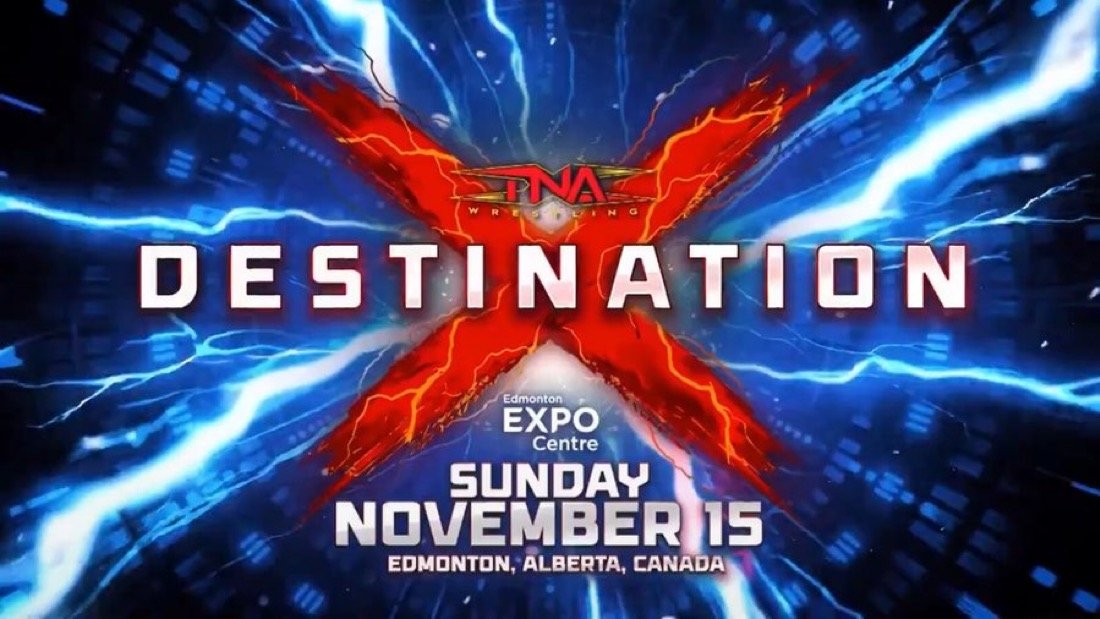
TNA used today’s Slammiversary to bring back one of the most important event names in company history, officially announcing that Destination X will return on Sunday, November 15, from the Edmonton EXPO Centre in Edmonton, Alberta, Canada.
For longtime TNA fans, this is not just another name being pulled out of the archive. Destination X carries real weight because of what it has represented at its best: the X-Division, Ultimate X, risk-taking match styles, rising stars being trusted in major spots, and the idea that TNA could build an entire event around the kind of wrestling that separated the company from everyone else.
That is why the announcement immediately feels bigger than a normal schedule reveal. Destination X is part of TNA’s identity. It is tied to the company’s most athletic, innovative and creatively distinct era. When fans think of the event, they think of cables hanging above the ring, X-Division championships being fought over in chaotic ways, AJ Styles, Christopher Daniels, Samoa Joe, Chris Sabin, Austin Aries, Ultimate X, Option C and a division that once felt like the heartbeat of the promotion.
The first Destination X took place in 2005, during a time when TNA was still trying to prove it could be more than a small alternative brand. Jeff Jarrett and Diamond Dallas Page headlined for the NWA World Heavyweight Championship, but the event’s soul was already pointing toward the X-Division. Christopher Daniels defeated AJ Styles, Ron Killings and Elix Skipper in an Ultimate X Challenge to win the X-Division Championship, setting the tone for what the event would become.
A year later, Destination X 2006 gave the series one of its defining matches when Christopher Daniels defeated Samoa Joe and AJ Styles in Ultimate X to capture the X-Division Championship. That match mattered because it brought together three of the names most responsible for shaping TNA’s in-ring reputation. Styles was the franchise athlete, Daniels was the veteran workhorse, and Joe was the monster who gave the division a different kind of violence and credibility. That was the kind of match that made the X-Division feel less like a cruiserweight-style side attraction and more like a main-event-level identity.
Over the years, Destination X continued to become a home for major X-Division moments. In 2009, Suicide won the X-Division Championship in Ultimate X, while AJ Styles also defeated Booker T for the Legends Championship on the same card. In 2010, the Motor City Machine Guns and Generation Me delivered the kind of high-speed Ultimate X match that showed how deep TNA’s tag and X-Division influences could run at the same time. In 2011, the event leaned even harder into nostalgia and identity, bringing back the six-sided ring for a show built around the X-Division, with AJ Styles defeating Christopher Daniels in the main event and Brian Kendrick winning the X-Division Championship from Abyss.
But the most important Destination X moment came in 2012.
That was the night Austin Aries cashed in what became known as Option C, vacating the X-Division Championship to challenge Bobby Roode for the TNA World Heavyweight Championship. Aries did not just win the title. He validated the entire concept. He proved that the X-Division Champion could be presented as more than a great worker holding a secondary belt. He could be a world title threat. He could headline. He could be the guy.
That win changed the meaning of Destination X. From that point forward, the event was no longer only about spectacle. It became about opportunity. The X-Division title could be a gateway to the top of the company, and Destination X became the night where that jump could happen.
Chris Sabin followed that same path in 2013, using Option C to defeat Bully Ray and win the TNA World Heavyweight Championship. That victory was emotional for a different reason. Sabin had battled injuries, spent years as one of TNA’s most respected homegrown names, and finally reached the top of the company at an event built around the division he helped define. Even if the title reign itself did not become what it could have been, the moment still remains one of Destination X’s most memorable.
The last Destination X took place in 2017, during the Global Force Wrestling/Impact era. That show featured Matt Sydal defeating Lashley to earn a championship shot of his choosing, Sonjay Dutt retaining the X-Division Championship against Trevor Lee in a ladder match, Sienna retaining the Knockouts Championship against Gail Kim, Dezmond Xavier winning the Super X Cup, and the returns of names like Jim Cornette, Petey Williams and Taryn Terrell. It was not the strongest version of Destination X, but it was still a reminder of what the event name meant: movement, change, returns, opportunities and an attempt to make the X-Division feel central.
That is why bringing Destination X back in 2026 is a smart move for TNA, but also one that comes with pressure.
The announcement sounds great on paper. Edmonton is a strong live-event market, and the Edmonton EXPO Centre gives the show enough size to feel meaningful without making it seem unrealistic. TNA has also been more aggressive with its 2026 event schedule, and adding Destination X back into the mix gives the calendar more personality. Slammiversary and Bound For Glory are the crown jewels, Lockdown brings the cage-match identity, and Destination X gives the company a true X-Division branded event again.
The issue is simple: if TNA is going to bring back Destination X, it has to mean something.
This cannot just be a regular TNA show with a familiar name attached. Destination X should feel different. It should feel faster, sharper, more dangerous and more centered around the X-Division. Ultimate X should be part of the conversation. Option C should be part of the conversation. The X-Division Championship should feel like one of the most important titles in the company that night, not just another match on the card.
That is where the creative challenge begins. TNA has enough talent to make Destination X exciting in the ring, but the company has to build the event with purpose. The X-Division needs clear stories, not just athletic matches. The champion needs direction. The challengers need stakes. The event should be used to elevate someone, not simply celebrate the past.
That balance is everything. Destination X should honor the history of AJ Styles, Samoa Joe, Christopher Daniels, Chris Sabin, Austin Aries, Alex Shelley, Sonjay Dutt, Petey Williams and the wrestlers who made the division matter, but it cannot live only on nostalgia. The best version of Destination X 2026 uses that history as a foundation while making the current roster feel like it belongs in the same conversation.
That is the real opportunity here. TNA has spent years trying to reconnect with its own identity, and Destination X is one of the event names that actually helps do that. It reminds fans of what made the company different in the first place. It gives the X-Division a bigger spotlight. It gives the schedule more structure. It gives Edmonton a show that feels like more than a stop between bigger pay-per-views.
The return of Destination X is a win because it is the right kind of nostalgia. It is not nostalgia for nostalgia’s sake. It is a reminder of a style, a philosophy and a division that helped define TNA at its peak.
Now the company has to deliver the part that matters most.
TNA brought back the name. Edmonton has the date. The X-Division has its stage again. By November 15, Destination X needs to feel less like a comeback and more like a statement.
Make sure to subscribe to our Late Night Crew Wrestling YouTube Channel. Follow @yorkjavon, @kspowerwheels & @LateNightCrewYT on X.
I’m the quiet one until the bell rings then I’ve got takes. I live for WWE NXT and TNA, I want every promotion to succeed, and I will absolutely roast the bad decisions on sight (because someone has to). Anime taught me to respect long-term storytelling; wrestling taught me that sometimes the plan is “we panicked” and called it “unpredictable.” The Miz got me into all of this, so yeah I appreciate confidence, commitment, and the art of talking like you’re already the main event. Now I bring that same energy to the page as the main writer for Late Night Crew Wrestling because if you’re not here to be must-see and tell the truth, why are you here?!