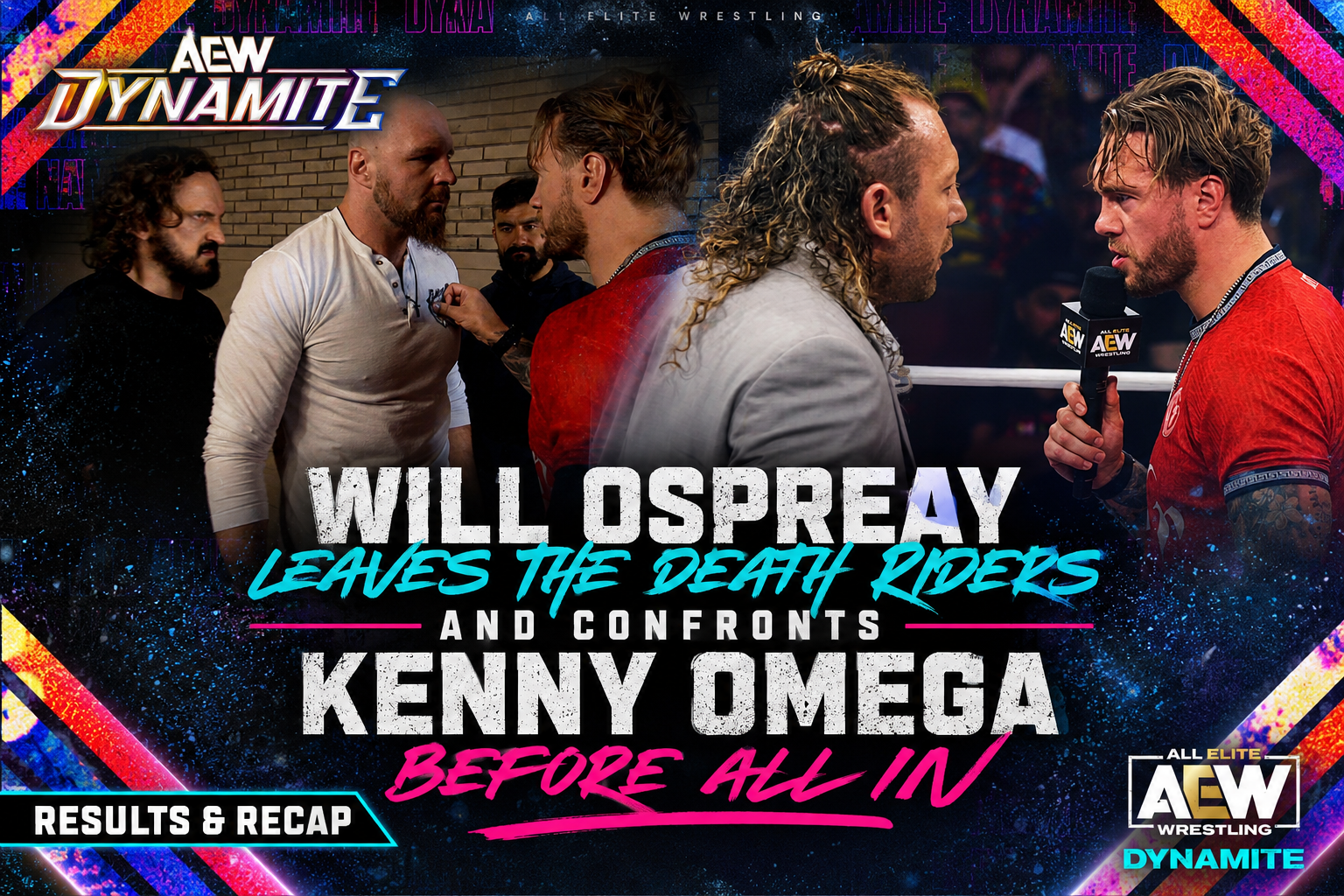
AEW Dynamite entered tonight with a difficult assignment. Redemption ended with Will Ospreay refusing to help the Death Riders destroy Kenny Omega, only for Omega to repay him with a One-Winged Angel. It was an ending designed to create intrigue, but it also left the AEW World Championship story buried beneath conflicting motivations, shifting alliances and enough moral ambiguity to make nearly everyone involved look unreasonable.
Tonight did not completely erase those problems. It did, however, give Ospreay and Omega the time they needed to explain them.
Ospreay formally walked away from the Death Riders, rejected an offer of support from a returning “Hangman” Adam Page and confronted Omega in an outstanding closing segment that finally placed their fractured friendship at the center of the road to All In. Omega accused Ospreay of hesitating while his supposed friend was being assaulted. Ospreay admitted that desperation, isolation and a loss of confidence pushed him toward Jon Moxley, but insisted he never accepted the Death Riders’ methods.
What had been an overcomplicated collection of swerves at Redemption became a much more understandable story about trust, insecurity and two elite wrestlers who care about each other while also resenting what the other represents.
Ospreay views Omega as the final mountain standing between him and the position he has spent his career chasing. Omega views Ospreay as a younger rival who repeatedly questions his commitment, disregards his advice and expects forgiveness after making reckless decisions. Neither man came out of tonight looking completely innocent, which can be effective if AEW continues giving them enough time to explain themselves instead of replacing character development with another faction attack.
The AEW World Championship rivalry was not the only major development.
The Demand defeated The Conglomeration to win the AEW World Trios Championship after interference from The Lethal Twist. Andrade El Idolo successfully defended the AEW National Championship against Nick Wayne and “Jungle” Jack Perry in the best match of the night. Willow Nightingale’s emotional championship celebration became a heated confrontation with Mercedes Moné, making their AEW Women’s World Championship match at All In official.
Maya World retained the TBS Championship against Persephone. Jon Moxley defeated Komander to retain the Continental Championship. “Speedball” Mike Bailey gained another measure of momentum before challenging Kyle Fletcher for the International Championship next week at Grand Slam: Mexico.
Tonight was a substantial improvement over the final stretch of Redemption because AEW allowed its major characters to speak clearly about what happened instead of expecting the audience to interpret every facial expression, hesitation and unexplained betrayal.
The episode still suffered from familiar problems. Another championship changed hands through interference. Several matches were connected to overcrowded faction stories. The Young Bucks’ sit-down conversation with Adam Copeland and Christian Cage was respectful to the point of feeling restrained. A large portion of the All In card remains undefined with only one month remaining before AEW returns to Wembley Stadium.
However, the most important rivalry finally felt worthy of AEW’s biggest event.
Here are the full results
- Andrade El Idolo (c) defeated Nick Wayne and “Jungle” Jack Perry (AEW National Championship)
- “Speedball” Mike Bailey, Bandido and Brody King defeated Kyle Fletcher, Brian Cage and Jake Doyle
- Maya World (c) defeated Persephone (AEW TBS Championship)
- Jon Moxley (c) defeated Komander (AEW Continental Championship)
- The Demand defeated The Conglomeration(c) to win the AEW World Trios Championship
Breakdowns & Reactions
Will Ospreay Leaves the Death Riders as Jon Moxley’s Warning Comes True
Grade: A-
Tonight opened with additional footage from the closing moments of Redemption.
The Death Riders were shown backstage watching Kenny Omega’s post-match attack on Will Ospreay. Jon Moxley had spent months warning Ospreay that Omega could not be trusted and believed Ospreay needed to strike before Omega eventually struck him.
When Omega delivered the One-Winged Angel, Moxley reacted as though the result had proved everything he had been trying to teach Ospreay.
That footage was important because it clarified Moxley’s perspective. He did not appear pleased that Ospreay had been attacked. He appeared frustrated that Ospreay had once again ignored his warning and allowed hesitation to leave him vulnerable.
Moxley called Ospreay the best wrestler in the world with nothing left to lose. It was not an insult. It sounded more like a final acknowledgment that Ospreay had reached the point Moxley always believed was necessary—the point where pain, betrayal and isolation would force him to stop relying on anyone else.
Ospreay then arrived at the building and immediately encountered the Death Riders.
Daniel Garcia attempted to confront him, but Ospreay dropped him before he could finish. PAC appeared prepared to retaliate until Moxley stopped the rest of the group from attacking.
That restraint made Moxley more interesting than he would have been if the Death Riders had simply beaten Ospreay down. Moxley gave Ospreay the opportunity to make his own decision. He asked whether Ospreay was certain, and Ospreay answered by returning his Death Riders patch.
Ospreay told Moxley that he did not have the right to pull the trigger for him.
That statement defined the entire episode.
Ospreay’s problem was not only that Moxley wanted Omega injured. His problem was that Moxley attempted to make the defining decision of Ospreay’s career on his behalf. Ospreay wants to defeat Omega, but he wants the victory to prove he is the better wrestler. He does not want to inherit a damaged champion or win because the Death Riders removed the obstacle for him.
The departure was handled well because Moxley did not beg, threaten or immediately retaliate. He allowed Ospreay to leave and essentially told him that he now had everything figured out.
It was a calm response carrying an obvious warning.
Ospreay may be finished with the Death Riders, but the Death Riders are not necessarily finished with him.
Significance
- Ospreay officially ended his association with the Death Riders.
- Moxley’s warnings about Omega appeared partially validated.
- Ospreay established that he wants to defeat Omega without assistance.
- Garcia became the first Death Rider to suffer Ospreay’s anger.
- Ospreay’s departure created the foundation for his Collision match against Garcia.
- Moxley remained dangerous without behaving like a one-dimensional faction leader.
What worked
- The additional Redemption footage gave Moxley’s reaction necessary context.
- Ospreay’s decision was direct and easy to understand.
- Moxley preventing an immediate group attack made him more compelling.
- Returning the patch created a clear visual ending to Ospreay’s membership.
- Ospreay’s statement about pulling the trigger established the theme of the entire episode.
- The segment moved quickly without becoming another prolonged faction brawl.
What didn’t work
- AEW waited until Dynamite to provide context that Redemption needed during the pay-per-view.
- Garcia again felt like the Death Rider selected to absorb humiliation for the larger story.
- Ospreay’s membership never lasted long enough to feel like a fully developed transformation.
- The audience is still being asked to reconcile several abrupt changes in Ospreay’s behavior.
- Leaving the group does not explain why Ospreay trusted Moxley so deeply after everything that happened between them.
“Hangman” Adam Page Returns and Offers Ospreay a Hand He Refuses to Take
Grade: B+
Ospreay walked away from the Death Riders only to encounter “Hangman” Adam Page.
Page had not returned to lecture Ospreay or demand an explanation. He said he recognized the isolation on Ospreay’s face because he had experienced it himself. Ospreay supported Page during his own pursuit of the World Championship, and Page wanted to return the favor.
It was a simple callback that made Page’s appearance feel connected to existing history rather than a random return designed to produce a reaction.
Ospreay declined.
He explained that the United Empire, the Death Riders and his damaged relationship with Omega had already left him with too much to manage. More importantly, Ospreay said that if he could no longer trust Omega, he could not trust Page either.
That conclusion was unfair to Page, but it accurately represented Ospreay’s emotional condition.
Ospreay has reached a point where every relationship appears dangerous. Moxley attempted to control him. Omega attacked him. His former United Empire partners are circling him. Accepting Page’s support would require the kind of trust he no longer possesses.
Page did not become angry. He told Ospreay that belief could become the deciding factor and expressed confidence that Ospreay could become the best version of himself at Wembley.
The appearance also raised questions about Page’s own direction.
He returned with a barbed-wire chair later in the show and attacked Jay Lethal after The Demand’s championship victory. That placed him near The Conglomeration, Brody King, The Lethal Twist and the new Trios Champions without establishing exactly what Page wants.
Page previously lost the ability to challenge for the AEW World Championship, so his road to All In requires a different destination. Jon Moxley’s Continental Championship is an obvious possibility, especially after Page’s amusement at Ospreay striking Garcia and leaving the Death Riders.
For now, Page is being used as the man who understands Ospreay’s isolation better than anyone else.
That is useful, but AEW cannot leave him functioning only as emotional support for another wrestler’s championship story.
Significance
- Page returned to AEW television.
- His history with Ospreay was acknowledged.
- Ospreay rejected help because he no longer trusts anyone connected to Omega.
- Page was reintroduced as a potential enemy of the Death Riders.
- His later involvement placed him near the Trios Championship story.
- Page remains without a confirmed match at All In.
What worked
- The interaction referenced meaningful history.
- Page did not attempt to make Ospreay’s crisis about himself.
- Ospreay’s rejection matched his current emotional state.
- Page’s calm response protected him from looking desperate.
- The return created several possible directions without forcing one immediately.
- Page’s encouragement gave Ospreay’s world-title pursuit another emotional layer.
What didn’t work
- Page’s personal objective remained unclear.
- Ospreay’s inability to trust Page was understandable but not entirely logical.
- AEW introduced Page into another crowded collection of rivalries later in the show.
- The segment risks turning Page into a supporting character unless he receives a defined All In direction.
- Page’s return deserved more explanation regarding where he has been and what he now wants.
Andrade El Idolo vs. Nick Wayne vs. “Jungle” Jack Perry — AEW National Championship
Grade: A-
Andrade’s first defense of the AEW National Championship was the strongest bell-to-bell match on tonight’s show.
Nick Wayne and Jack Perry initially attempted to neutralize the champion, but the cooperation disappeared almost immediately. Each challenger understood that the match could end without him being involved in the decision, creating the constant urgency required from a successful three-way match.
Andrade controlled the early exchanges with his combination of power, timing and confidence. He repeatedly interrupted Wayne and Perry just as either challenger appeared ready to take control.
The match became increasingly spectacular after the commercial break.
Perry removed Andrade from the apron with a hurricanrana. Wayne produced a frightening flip piledriver through the ropes. Perry launched himself through a series of dives before completing the sequence with a moonsault to the floor. Andrade responded with the physical offense that makes him more effective when he is not being presented primarily as a personality.
Wayne continued proving why AEW has invested so much television time in him. His Phoenix Splash created one of the match’s strongest near-falls, and his athletic counters allowed him to remain credible against two more experienced opponents.
Perry was the connective piece. He kept the pace moving, repeatedly broke up potential finishes and created the openings that allowed the match to escalate.
Andrade eventually knocked Perry out of position and caught Wayne with the DM to retain the championship.
The correct man won.
Andrade only captured the National Championship at Redemption, and immediately changing the title again would have reinforced the feeling that AEW has more championships than meaningful plans. Andrade needed a decisive first defense that made him look like the strongest wrestler in the match.
The problem remains the championship itself.
The National title still feels like an additional belt searching for a distinct identity. Andrade spoke about becoming the greatest National Champion, but the championship needs more than confident declarations. It requires rules, opponents and stories that separate it from the International, Continental and TNT Championships.
Andrade’s performance made the belt feel important tonight. AEW now has to ensure that importance extends beyond the quality of his matches.
Significance
- Andrade completed his first successful National Championship defense.
- Wayne remained protected through a competitive performance.
- Perry failed to become a two-time National Champion.
- Andrade maintained momentum after leaving the Don Callis Family.
- The champion moved closer to the AEW World Championship picture through the Casino Gauntlet announcement.
- The National Championship received one of its strongest television matches.
What worked
- The pace never became slow or repetitive.
- All three wrestlers contributed meaningful offense.
- Wayne looked credible against two established opponents.
- Perry’s dives gave the match a natural escalation.
- Andrade won through his own offense.
- The finish established Andrade rather than merely preserving him.
- The Detroit crowd treated the match like an important title defense.
What didn’t work
- Perry received another championship opportunity with limited explanation.
- The National Championship still lacks a clear identity.
- Some sequences entered familiar three-way territory where one wrestler waited outside while the other two worked.
- Wayne absorbed another loss during a period in which he needs victories.
- The championship’s crowded position beneath several other men’s singles titles remains a problem.
AEW Announces a Men’s Casino Gauntlet Match for All In
Grade: B+
Tony Schiavone interviewed Andrade after his successful defense and announced that a men’s Casino Gauntlet match will take place at All In.
The winner will receive a future AEW World Championship opportunity.
Andrade will compete next week at Grand Slam: Mexico in a qualifying match connected to the No. 1 entry position. His opponent was not revealed tonight.
The announcement gives All In another attraction while creating a practical way to feature several wrestlers who may not receive individual matches at Wembley. AEW’s roster is too large for everyone to receive a separate program, and the Casino Gauntlet has generally been one of the company’s more successful multi-person concepts.
The No. 1 position also carries unusual value because the Casino Gauntlet ends with the first fall. Entering first gives a wrestler more time to secure the victory before the field becomes overcrowded.
Andrade’s interest makes sense. He may hold the National Championship, but he has never hidden that he considers the AEW World Championship his ultimate objective.
The concern is that AEW frequently uses future championship opportunities without immediately establishing when the winner will receive the match. The Casino Gauntlet must lead somewhere specific enough to matter. Winning at Wembley should create a clear trajectory rather than another championship claim that disappears until creative needs a challenger.
The match also risks becoming storage space for every major wrestler without a defined All In program. MJF, Swerve Strickland, Kevin Knight, Darby Allin, Jay White and several others remain without confirmed matches. Filling the Gauntlet with major names would make it important, but it would also expose how much of the card AEW waited to organize.
Significance
- A fourth official attraction was added to All In.
- The winner will earn a future AEW World Championship match.
- Andrade entered the qualifying process for the most advantageous position.
- Grand Slam: Mexico gained another match with direct All In consequences.
- Several currently unassigned wrestlers now have a possible destination.
- The World Championship picture gained a pathway beyond Omega and Ospreay.
What worked
- The Casino Gauntlet suits AEW’s deep roster.
- The No. 1 entry position has legitimate strategic value.
- Andrade’s involvement connects the National Champion to the world-title picture.
- The announcement created stakes for next week.
- The match can produce surprise appearances without requiring forced stories.
- It gives All In another major spectacle.
What didn’t work
- Andrade’s opponent was not announced.
- The timing of the eventual title opportunity remains unclear.
- AEW already relies heavily on multi-person matches to accommodate its roster.
- The Gauntlet could become a substitute for developing individual All In rivalries.
- The announcement did little to explain the current hierarchy of contenders.
The Don Callis Family’s Internal Problems Become More Interesting Than Its Opponents
Grade: B
The Don Callis Family attempted to present a united front after Redemption, but nearly every line suggested the opposite.
Kyle Fletcher emphasized that he retained the International Championship without assistance and portrayed himself as the stable’s most dependable champion. Kevin Knight acknowledged losing to Kenny Omega but reminded everyone that he had competed in a pay-per-view main event against one of the greatest wrestlers of his generation.
Knight also warned Fletcher not to lose the International Championship to Mike Bailey next week.
The comment sounded supportive on the surface. It also sounded like a threat.
Knight remains the TNT Champion and clearly believes his performance against Omega elevated him beyond his position within the Family. Fletcher holds the International Championship and wants recognition as the group’s central singles star. Neither man appears interested in being treated as secondary to the other.
Kazuchika Okada then entered and said the International Championship would remain within the Family.
The wording was more important than the statement itself.
Okada did not specifically say Fletcher would retain. He said the championship would stay with the group. That leaves open the possibility that Okada believes he could take the title himself, especially as his tension with Fletcher continues growing.
The Don Callis Family has often suffered from having too many members and too few individual identities. Tonight, the group finally felt like an alliance held together by ambition rather than a collection of wrestlers waiting behind Callis during interviews.
That is a stronger direction.
The Family should not feel stable. It contains multiple champions, former champions and wrestlers who believe they deserve to lead. The eventual conflict between Fletcher, Knight, Okada and Konosuke Takeshita could become one of AEW’s strongest long-term stories if every disagreement is not immediately converted into another multi-person match.
Significance
- Fletcher and Knight’s tension continued after Redemption.
- Knight remained confident despite losing to Omega.
- Okada suggested the International Championship matters to him.
- The Don Callis Family’s internal hierarchy became less secure.
- Bailey’s championship challenge gained additional consequences.
- The possibility of a larger championship conflict continued developing.
What worked
- Each wrestler sounded motivated by individual ambition.
- Knight’s warning was subtle enough to remain open to interpretation.
- Okada’s wording created intrigue.
- Fletcher behaved like a champion threatened by everyone around him.
- The segment connected Redemption to Grand Slam: Mexico.
- The Family felt unstable without immediately breaking apart.
What didn’t work
- Brian Cage, Jake Doyle and other members continued feeling secondary.
- Don Callis manages so many wrestlers that individual conflicts can become crowded.
- AEW has teased internal Family problems several times without completing the story.
- The segment required viewers to track several championships and rivalries simultaneously.
- Knight’s TNT Championship still lacks a clearly confirmed All In direction.
“Speedball” Mike Bailey and Brodido vs. Kyle Fletcher, Brian Cage and Jake Doyle
Grade: B+
The six-man tag team match primarily existed to build Kyle Fletcher’s International Championship defense against Mike Bailey, but Bandido, Brody King, Brian Cage and Jake Doyle prevented it from becoming an extended preview disguised as a match.
Brody’s physical exchanges with Fletcher and Cage gave the match immediate weight. Bandido supplied the athletic counters and explosive offense. Doyle continued receiving opportunities to establish himself as a powerful prospect within the Don Callis Family.
Bailey and Fletcher remained the central focus.
Every time they entered together, the pace increased. Fletcher attempted to overwhelm Bailey with size and power, while Bailey relied on sudden counters and strikes to avoid being trapped.
The match wisely avoided giving away a decisive exchange between the champion and challenger.
Bailey eventually made a blind tag and caught Doyle in a sudden pinning combination after the action broke down. Pinning Doyle protected Fletcher while giving Bailey another victory entering Grand Slam: Mexico.
That result was predictable, but it served its purpose.
Bailey earned the International Championship opportunity by winning the ladder match at Redemption. He needed a television victory to prevent his title match from feeling like a challenger moving forward solely because of a stipulation.
The larger concern is that AEW continues using wrestlers such as Doyle as convenient fall guys. Protecting Fletcher made sense, but Doyle must eventually win meaningful matches if the audience is expected to view him as more than the Family member who absorbs defeats.
Brodido also deserve a clearer direction. Bandido and Brody have developed into an effective team, yet their role tonight was mostly to support Bailey’s rivalry.
Significance
- Bailey gained momentum before challenging Fletcher.
- Fletcher avoided taking the loss.
- Brodido remained connected to the International Championship story.
- Doyle absorbed the deciding fall.
- Tension within the Don Callis Family continued.
- Grand Slam: Mexico received a physical preview without giving away the singles match.
What worked
- The match maintained a strong pace.
- Brody and Cage provided convincing heavyweight exchanges.
- Bailey and Fletcher protected their major singles confrontation.
- Bandido’s offense added variety.
- Bailey scoring the fall strengthened the challenger.
- The blind-tag finish was logical.
What didn’t work
- The outcome was easy to predict once Doyle became the legal man.
- Brodido remained supporting characters in someone else’s rivalry.
- The match contained little personal hostility beyond Bailey and Fletcher.
- Doyle continues losing whenever a protected Family member needs to avoid defeat.
- AEW again used a multi-person match to advance several stories simultaneously.
Adam Copeland, Christian Cage and The Young Bucks Discuss Their All In Dream Match
Grade: B
Renee Paquette moderated a sit-down interview between AEW World Tag Team Champions Adam Copeland and Christian Cage and their All In challengers, The Young Bucks.
The segment began with mutual respect.
Both teams discussed their influence on tag-team wrestling. Copeland credited Matt and Nick Jackson with keeping tag wrestling relevant during a period when major promotions did not always treat the division as a priority.
The Young Bucks spoke about spending their careers being told they were too small, relied on too many superkicks and worked a style that could not succeed at the highest level. They framed the All In match as another opportunity to prove that their success was not accidental.
Copeland and Christian acknowledged the Bucks’ accomplishments while making clear that respect would not prevent them from winning.
The material was sensible, but the segment remained too polite for a match receiving such a prominent position at Wembley.
AEW is selling this as a generational dream match between two of the most influential teams of their eras. The discussion explained why the match matters historically, but it did not create enough emotional urgency around why these four men need to defeat each other now.
The Bucks earned the opportunity by defeating Jon Moxley and Ospreay at Redemption. Copeland and Christian retained against Claudio Castagnoli and PAC. Those victories established competitive legitimacy, but the rivalry still feels more like an exhibition between respected teams than a heated World Tag Team Championship program.
That can work at All In because the names are large enough to sell the match. It also places enormous pressure on the in-ring performance. Without a stronger personal conflict, the match must deliver at a dream-match level to justify its position.
The Bucks’ determination to become four-time champions added useful stakes. Copeland and Christian are also fighting against the perception that their best years are behind them.
AEW needs to lean further into that divide.
The champions should see the Bucks as an accomplished team that cannot match their experience in major stadium matches. The Bucks should see Copeland and Christian as stars from a previous generation occupying a division they helped rebuild.
That conflict was present beneath the surface tonight. It needs to become more direct.
Significance
- The All In Tag Team Championship match received its first extended verbal build.
- Both teams acknowledged their influence on tag wrestling.
- The Bucks emphasized their pursuit of a fourth title reign.
- Copeland and Christian addressed doubts about their age and current ability.
- The match was framed as an intergenerational test.
- Mutual respect remained the rivalry’s dominant tone.
What worked
- The participants explained why the match matters historically.
- Copeland’s acknowledgment of the Bucks felt credible.
- The Bucks connected the rivalry to criticism they have faced throughout their careers.
- The championship remained central.
- The sit-down format allowed everyone to speak without a forced brawl.
- The segment made the match feel prestigious.
What didn’t work
- The conversation was too respectful.
- No major emotional conflict emerged.
- The champions and challengers agreed on almost everything.
- The match still feels closer to an attraction than a rivalry.
- AEW relied heavily on career accomplishments rather than current hostility.
- The segment needed one sharper exchange to create urgency.
Maya World vs. Persephone — AEW TBS Championship
Grade: B+
Maya World’s first defense of the TBS Championship gave her a technically gifted opponent capable of forcing the new champion to wrestle at a faster and more creative pace.
Maya and Persephone began with counters, pinning combinations and mirrored evasions. Neither woman established immediate control, creating the impression that Persephone had arrived with a strategy rather than simply serving as the first challenger of a new reign.
Persephone increasingly targeted Maya’s legs and lower body. Maya responded with movement, a DDT on the floor and several explosive bursts of offense.
The match became strongest when both women stopped trading isolated moves and began countering each other’s preferred sequences.
Persephone produced a convincing near-fall with a bridging German suplex. Maya answered with a double stomp and her athletic offense from the ropes.
Then the outside involvement began.
Hikaru Shida appeared and attempted to introduce her kendo stick into the match. Kris Statlander intercepted it, creating another distraction. Persephone became focused on the activity outside the ring, allowing Maya to catch her with a bridging fallaway slam for the victory.
Maya retained, but the finish did not help her as much as a clean victory would have.
She had just defeated Shida for the championship at Redemption. Her first defense should have established that the title change represented the beginning of a serious reign. Instead, the final moments became more about Shida and Statlander than the champion and challenger.
The match was good enough to survive the booking. Maya looked confident, and Persephone proved she deserves more AEW opportunities.
The finish was another example of AEW protecting too many people at once. Persephone did not need extensive protection in a competitive championship loss. Maya needed a decisive first defense more than the surrounding story needed another distraction.
Significance
- Maya completed her first successful TBS Championship defense.
- Persephone delivered a credible challenge.
- Shida remained focused on the title she lost at Redemption.
- Statlander positioned herself against Shida.
- The TBS Championship picture expanded beyond a single rivalry.
- Maya’s reign began with an outside-influenced finish.
What worked
- Maya and Persephone displayed strong chemistry.
- The opening counters established competitive balance.
- Persephone looked capable of wrestling at the championship level.
- Maya’s offense remained explosive.
- The match received enough time to develop.
- The closing move looked decisive.
What didn’t work
- Shida and Statlander distracted from the champion.
- Maya’s first defense should have ended cleanly.
- Persephone’s loss did not require protection.
- The finish suggested that the surrounding rivalry mattered more than the match.
- AEW added more wrestlers to an already crowded championship picture.
- The interference pattern became repetitive across the episode.
Mark Davis Challenges Will Ospreay to Settle Their Score in Mexico
Grade: B-
Mark Davis addressed losing the AEW National Championship to Andrade at Redemption and redirected his anger toward Will Ospreay.
Davis argued that he and Ospreay are tied at one victory each, but Ospreay’s win carries an asterisk because of involvement from the Death Riders. He challenged Ospreay to settle the score at Grand Slam: Mexico and promised that the Don Callis Family would not interfere.
The match makes sense.
Davis and Ospreay share extensive history, and Ospreay’s separation from the Death Riders forces him to confront relationships he damaged while pursuing Moxley’s approval. Davis represents one of the people Ospreay left behind.
The no-outside-interference condition is necessary because Ospreay’s story has already been buried beneath faction involvement. A direct match with Davis gives Ospreay an opportunity to prove that leaving the Death Riders was more than a temporary emotional reaction.
It also gives Davis something meaningful after losing the National Championship.
The promo itself was less convincing than the match it announced. Davis communicated his anger, but the delivery did not match the intensity of the issue. His history with Ospreay is strong enough to support a more personal explanation of why he feels abandoned or betrayed.
The match will likely be excellent. The build needs to make it feel like more than a convenient rubber match placed on a themed Dynamite.
Significance
- Ospreay vs. Davis was announced for Grand Slam: Mexico.
- Outside interference will not be permitted.
- Their singles series was framed as tied at one victory each.
- Davis received a new direction after losing the National Championship.
- Ospreay’s former relationships continued becoming part of his road to All In.
- The match will test whether Ospreay can succeed without a faction.
What worked
- The match has logical history.
- Davis’s anger fits his recent losses.
- The no-interference stipulation addresses a major concern.
- Ospreay receives an important match before All In.
- The rubber-match framing creates clear stakes.
- Grand Slam: Mexico gained another meaningful attraction.
What didn’t work
- Davis’s promo lacked the emotional intensity the story deserved.
- The challenge focused more on the record than their damaged friendship.
- Ospreay was already involved in several stories tonight.
- Davis risks becoming an obstacle Ospreay defeats on the way to Omega.
- The announcement arrived quickly without an immediate response from Ospreay.
Willow Nightingale’s Championship Celebration Becomes Personal With Mercedes Moné
Grade: A
Willow Nightingale entered the ring surrounded by streamers and received the emotional championship celebration she earned at Redemption.
Willow spoke about the people who doubted that someone with her appearance, personality and energy could become AEW Women’s World Champion. She discussed suffering an injury after becoming one-half of the inaugural Women’s World Tag Team Champions and described how the setback pulled her into a dark period.
Her mother helped convince her that she had two choices: remain down or fight.
Willow fought.
She returned, won the Casino Gauntlet, defeated Thekla and became the AEW Women’s World Champion. Her message to anyone experiencing a difficult period was direct: continue fighting because the comeback can become better than the original dream.
The promo worked because Willow did not suddenly become a different person after winning the championship. She remained emotional, positive and slightly overwhelmed. The championship felt like a genuine culmination instead of another title changing hands because the calendar required a new direction.
Mercedes Moné then interrupted with a contract for All In.
Mercedes claimed she had arrived for business rather than to ruin Willow’s celebration. Willow signed the contract across Mercedes’ chest, immediately rejecting any suggestion that she would be intimidated by the challenger.
Their verbal exchange was excellent because it relied on history.
Willow reminded Mercedes that she ended her record-setting TBS Championship reign and now holds the one AEW championship Mercedes has never won.
Mercedes explained that Willow’s name appears throughout nearly every important chapter of her AEW career. When Mercedes was injured before their NJPW Strong Women’s Championship match, Willow benefited. When Mercedes arrived in AEW, Willow stood across from her. When Mercedes established herself as the greatest TBS Champion, Willow ended the reign.
Mercedes believes Willow’s greatest moments exist because she provided the stage.
That resentment is far more compelling than Mercedes simply wanting another championship.
Willow represents the one opponent Mercedes cannot remove from her story. Every time Mercedes attempts to establish complete control, Willow appears and disrupts it. The AEW Women’s World Championship has now become the final prize Mercedes believes she needs, and Willow is once again standing between her and the moment she considers inevitable.
Mercedes insisted that Willow would be nothing without her. She promised to take both the championship and Willow’s smile at All In.
Willow refused to accept that Mercedes created her success.
The conflict turned physical when Divine Dominion appeared and helped Mercedes overwhelm the champion. Megan Bayne and Lena Kross delivered a brutal double-team attack before Jamie Hayter and Alex Windsor made the save.
The closing beat connected the Women’s World Championship and Women’s Tag Team Championship stories without completely losing focus.
The segment also produced next week’s six-woman tag team match, with Mercedes and Divine Dominion facing Willow and the Brawling Birds.
This was the women’s division presented at the level it deserves. The champion received time to explain why the victory mattered. The challenger had a personal motivation. Their history was treated as essential rather than optional background information.
Significance
- Willow vs. Mercedes became official for All In.
- The championship match received a personal foundation.
- Willow’s injury and comeback became central to her reign.
- Mercedes explained why she resents Willow specifically.
- Divine Dominion aligned themselves with Mercedes.
- The Brawling Birds moved closer to challenging for the Women’s Tag Team Championship.
- A six-woman tag match was announced for Grand Slam: Mexico.
What worked
- Willow’s emotion felt genuine.
- The championship celebration focused on her journey.
- Mercedes’ interruption had a clear purpose.
- Their shared history gave the confrontation depth.
- Willow did not allow Mercedes to control the exchange.
- Mercedes explained her obsession with defeating Willow.
- The All In match felt larger after the segment.
- The Brawling Birds’ save advanced a connected story.
- The women received substantial television time.
What didn’t work
- Another segment ended with faction interference.
- Divine Dominion’s alliance with Mercedes needs further explanation.
- The beatdown briefly risked overshadowing Willow’s championship celebration.
- AEW must ensure the six-woman tag does not give away too much before All In.
- Thekla’s immediate direction after losing the championship remains uncertain.
Jon Moxley vs. Komander — AEW Continental Championship
Grade: B+
Komander entered the Continental Championship match with no realistic expectation of winning, but he wrestled with enough urgency to make Jon Moxley work for the defense.
Moxley attempted to control the match through holds, physical pressure and constant disruption. Komander used speed and rope-based offense to prevent the champion from establishing a comfortable pace.
The contrast worked.
Komander’s most impressive moments came when he forced Moxley to react rather than allowing him to dictate. A guillotine leg drop across the back of Moxley’s neck created a believable opening. Komander followed with dives and a 450 splash that produced one of the match’s strongest near-falls.
Moxley eventually avoided a rope-walk shooting star press and punished the mistake immediately. He connected with a stomp, followed with the Death Rider and forced Komander to submit in a sleeper hold.
The finishing sequence reinforced the difference between them.
Komander required movement and precision. Once one high-risk attempt failed, Moxley did not allow him another opportunity.
The match was good, but its result was never seriously in doubt. Komander’s recent performances have reminded viewers how valuable he can be, yet AEW continues using him primarily as an exciting challenger who loses to protected champions.
Moxley’s larger story was more important.
He spoke about the Continental Championship representing the sport he loves and welcomed the approaching Continental Cup. He suggested that if his reign ends through the violence and competition of that environment, he will accept it.
The concept was mentioned without enough explanation. AEW needs to define the Continental Cup, its format and how it affects Moxley’s championship before expecting the audience to treat it as a major destination.
Moxley also remains without a confirmed All In opponent. Page’s return and opposition to the Death Riders make him a natural possibility, but AEW did not officially create that match tonight.
Significance
- Moxley retained the Continental Championship.
- Komander delivered another competitive performance.
- The Continental Cup was positioned as a future threat to Moxley’s reign.
- Moxley remained central to Ospreay’s story despite their separation.
- A possible path toward Page continued forming.
- The champion remains without an official All In match.
What worked
- The contrasting styles produced a coherent match.
- Komander’s high-risk offense created convincing near-falls.
- Moxley punished one decisive mistake.
- The finishing sequence was strong.
- Komander looked competitive without weakening Moxley.
- Moxley’s championship philosophy matched his character.
What didn’t work
- The outcome was predictable.
- Komander continues being used as a talented challenger who rarely wins major matches.
- The Continental Cup was referenced without a complete explanation.
- Moxley’s All In direction remained uncertain.
- The championship defense felt disconnected from the show’s largest stories.
Mick Foley Joins the Bang Bang Gang’s Challenge to the Dogs and Death Riders
Grade: B-
Mick Foley appeared backstage with the Bang Bang Gang as Juice Robinson and Ace Austin addressed their continuing problems with the Dogs and the Death Riders.
The Bang Bang Gang challenged the combined groups to an eight-man tag team match on Collision.
Foley attempted to join their closing catchphrase and mistakenly used “Bang Bang” before being corrected with “Guns Up.”
The cameo was harmless and received the reaction AEW expected. Foley’s personality fit the chaotic energy of the Bang Bang Gang, and the mistake gave the segment a natural comedic ending.
The actual rivalry remains overly crowded.
The Bang Bang Gang, Dogs and Death Riders have spent weeks attacking each other through shifting combinations. Jay White’s absence also remains important, especially considering his personal history with David Finlay.
An eight-man tag match can produce entertaining television, but it is another large match being used to organize a story involving too many wrestlers.
The participants from the Death Riders were not specified during Dynamite. That uncertainty should be resolved before Collision.
Significance
- An eight-man tag match was announced for Collision.
- The Bang Bang Gang continued targeting the Dogs and Death Riders.
- Foley made a guest appearance.
- Jay White’s absence remained noticeable.
- The rivalry continued beyond Redemption.
- Collision gained another major faction match.
What worked
- Foley’s cameo was brief.
- The catchphrase mistake felt natural.
- Juice delivered the challenge with energy.
- The match logically continued the Redemption rivalry.
- The Bang Bang Gang received time to respond after repeated attacks.
What didn’t work
- The rivalry contains too many moving parts.
- The exact Death Riders representatives were not immediately specified.
- Foley’s appearance added entertainment but little substance.
- Jay White’s status was not addressed.
- AEW again relied on an eight-man match instead of focusing the conflict.
- The Dogs and Death Riders’ working relationship remains underexplained.
The Demand vs. The Conglomeration — AEW World Trios Championship
Grade: B+
The Demand attacked The Conglomeration before the bell, immediately turning the championship match into a ringside fight.
Ricochet, Bishop Kaun and Toa Liona needed this aggression.
The Demand has existed near the top of the Trios division without receiving enough victories to justify its confidence. Ricochet talks like a central figure, but the group has often felt more important in presentation than in results.
Tonight finally changed that.
The Conglomeration responded through its established chemistry. Kyle O’Reilly attacked limbs and created submission openings. Roderick Strong provided backbreakers, knees and physical transitions. Orange Cassidy disrupted the challengers through timing and unpredictability.
Kaun received several of the match’s strongest moments. He survived exchanges with multiple champions and demonstrated that he can become more than one-half of the power structure surrounding Ricochet.
Liona absorbed an Orange Punch and continued fighting, reinforcing his role as the group’s physical wall.
The match appeared to be moving toward a successful defense when The Lethal Twist interfered. A championship belt was used against Cassidy, allowing Ricochet to connect with the Spirit Gun and score the winning fall.
The Demand became the new AEW World Trios Champions.
The title change was overdue for the group. Ricochet, Kaun and Liona needed a concrete accomplishment, and the Trios Championship gives them a reason to remain together beyond acting as Ricochet’s protection.
The interference was unnecessary.
The Demand would have gained far more from defeating The Conglomeration cleanly. Ricochet pinning Cassidy after outside assistance immediately weakened what should have been a defining victory.
AEW protected the former champions, but The Conglomeration did not require protection. They have already established their credibility. The new champions needed the clean win more.
The post-match attack expanded the story further.
Brody King attempted to make the save but was overwhelmed. Page then arrived with a barbed-wire chair and hit Jay Lethal with the Buckshot Lariat.
The visual was exciting, but it created another overcrowded situation involving The Demand, The Conglomeration, The Lethal Twist, Brody King and Page.
Page’s role is particularly unclear. He began the episode offering support to Ospreay and ended it attacking Jay Lethal in a Trios Championship story. AEW may be setting up a larger conflict, but tonight introduced more possibilities than answers.
Significance
- The Demand won the AEW World Trios Championship.
- Ricochet pinned Cassidy.
- The Conglomeration’s reign ended.
- The Lethal Twist directly decided the championship.
- Brody King became involved.
- Page returned to physical action with the Buckshot Lariat.
- The Trios division gained new champions but an even more crowded rivalry.
What worked
- The pre-match attack gave The Demand urgency.
- Kaun and Liona looked powerful.
- The Conglomeration’s chemistry remained excellent.
- Ricochet finally gained a meaningful AEW championship accomplishment.
- The title change refreshed the division.
- Page’s Buckshot received a strong reaction.
- The post-match chaos created immediate challengers.
What didn’t work
- The new champions required outside interference.
- The Conglomeration did not need to be protected.
- The Lethal Twist’s involvement overshadowed The Demand.
- Too many wrestlers entered the post-match angle.
- Page’s reason for joining the fight was unclear.
- The Trios Championship story became more complicated than necessary.
- Another title result depended on someone outside the match.
Daniel Garcia Challenges Ospreay for Collision
Grade: B
The Death Riders responded to the Bang Bang Gang’s challenge and Ospreay’s departure in a pre-recorded promo.
Wheeler Yuta and PAC accepted the faction fight. Garcia focused on Ospreay, accusing him of leaving whenever situations become difficult and continuing to call him “Young Boy Billy.”
That accusation led directly to Garcia vs. Ospreay being announced for Collision.
The match is the correct immediate follow-up.
Garcia was the first Death Rider Ospreay attacked tonight. He also represents the group’s most outspoken criticism of Ospreay. Defeating Garcia would allow Ospreay to begin separating himself physically from the faction.
The concern is Garcia’s position.
He has repeatedly become the member used to take losses or absorb attacks when AEW wants to advance a story involving Moxley, Ospreay or another protected star. Garcia cannot continue insulting Ospreay, losing to him and returning the following week without consequences.
The match needs to accomplish more than giving Ospreay a victory before Grand Slam: Mexico.
Significance
- Ospreay vs. Garcia was announced for Collision.
- The Death Riders accepted the Bang Bang Gang’s challenge.
- Garcia became the first obstacle after Ospreay’s departure.
- Collision gained a match directly connected to the World Championship story.
- The Death Riders continued questioning Ospreay’s loyalty and courage.
- Ospreay will compete twice in less than one week.
What worked
- The match followed logically from the opening segment.
- Garcia’s criticism was consistent with his character.
- Ospreay receives an immediate consequence for leaving.
- Collision became important to the road to All In.
- The Death Riders responded without another live brawl.
What didn’t work
- Garcia risks becoming another guaranteed Ospreay victim.
- The “Young Boy Billy” insult has limited value if Garcia cannot back it up.
- Ospreay’s schedule is becoming crowded.
- The larger eight-man tag remains filled with unspecified combinations.
- Moxley still appears to be the real conflict while Garcia handles the match.
Kenny Omega and Will Ospreay Finally Explain What Happened at Redemption
Grade: A
Tony Schiavone introduced Kenny Omega for his first live statement since attacking Ospreay at Redemption.
Ospreay interrupted before Omega could begin.
Omega said the conversation was personal but accepted that Ospreay had brought it into the ring. He compared the situation to show and tell. At Redemption, Omega showed Ospreay how he felt by delivering the One-Winged Angel. Tonight, he intended to tell him why.
Omega said he cares about Ospreay and wants him to succeed.
He reminded Ospreay of their promise to pursue championship success and argued that he repeatedly placed their friendship ahead of his own ambitions. He allowed Ospreay to enter the Owen Hart Cup without him because Ospreay’s success brought him genuine happiness.
Omega then addressed the statement that changed their relationship.
Ospreay previously said Omega had given up on himself.
Omega explained how deeply that accusation affected him. He pointed to the AEW World Championship and asked whether he looked like someone who had surrendered.
This was Omega’s strongest material because it exposed the insecurity beneath the attack.
Omega did not strike Ospreay only because he hesitated during the Death Riders’ assault. He struck Ospreay because the hesitation confirmed every fear that had been developing between them.
Ospreay questioned Omega’s hunger. Ospreay ignored his warnings. Ospreay joined the man who injured him. Then, when Omega was trapped with a chair around his neck, Ospreay stood nearby debating whether to intervene.
Omega interpreted that moment as betrayal.
Ospreay responded with the most honest explanation he has offered throughout the story.
He admitted that he returned too early from neck surgery because revenge had consumed him. When he failed, he lost confidence in himself. His body failed him, his mission collapsed and he felt as though no one remained in his corner.
Kyle Fletcher was gone. Mark Davis was gone. Callum Newman was gone. Even Omega, the person Ospreay considered his hero, did not feel available.
Moxley offered him another path.
Ospreay admitted that he enjoyed being a Death Rider. He appreciated the training, companionship and feeling of traveling with dangerous wrestlers who protected each other. It reminded him of the bond he once experienced in Japan.
That admission mattered because it prevented Ospreay from pretending the entire association had been a misunderstanding. He willingly joined the group and found value in it.
However, Ospreay said he never accepted Moxley’s philosophy.
He believes he can become AEW World Champion by being the best wrestler, not by injuring Omega before All In. When he saw Omega trapped in the same kind of attack previously used against him, he could not allow someone he loved to experience it.
Omega remained unconvinced.
He described lying in the ring, exhausted after defending the championship, while the Death Riders attacked him. He felt the chair around his neck and believed he could no longer protect himself. He heard the crowd reacting and thought Ospreay had finally arrived to save him.
Then he realized how long Ospreay had waited.
Omega saw Ospreay standing with the championship and the torn plastic bag nearby. To Omega, the scene revealed that Ospreay had seriously considered allowing the attack to continue.
Worse, Omega believed Ospreay expected gratitude for eventually doing the right thing.
Ospreay denied creating the situation.
Omega slapped him and called him a liar.
The physicality escalated as Omega repeatedly slapped Ospreay and accused him of failing whenever the pressure becomes greatest. He told Ospreay that his inability to deliver in the most important moments is why he has always remained one step behind.
Ospreay finally struck back.
He warned Omega that love and respect would not prevent him from fighting if Omega touched him again.
Omega left the ring, allowing Ospreay to finish.
Ospreay spoke about traveling from the United Kingdom every week to prove AEW is where the best wrestle. He discussed sacrificing his body and neck for the opportunity to challenge for the World Championship.
Omega is the mountain he has wanted to climb for ten years.
Ospreay framed All In as the defining pressure moment of his career. He acknowledged England’s unfortunate history with penalty kicks but said the difference this time is that the ball belongs to him.
The question is whether he can pull the trigger.
Ospreay said he can.
He will not do it from behind like Omega did at Redemption. He will not injure Omega before the match like Moxley wanted. He wants Omega at his absolute best because defeating anything less would not complete the journey.
Ospreay promised that when he pulls the trigger at Wembley, Omega will see it coming.
This was the segment the rivalry needed.
It did not completely repair the strange logic of Redemption. Omega’s repeated slaps made him look far more antagonistic than Ospreay, and his claim that he always places friendship before championships does not perfectly match his actions. Ospreay’s decision to trust Moxley after their violent history still requires a generous interpretation.
However, the characters finally spoke like human beings instead of pieces being moved toward the next swerve.
Omega is hurt, insecure and unwilling to accept that Ospreay’s hesitation may have come from internal conflict rather than hatred.
Ospreay is desperate to prove that his failures do not define him, but his desperation has caused nearly every relationship around him to collapse.
The championship matters because it represents more than professional success to both men.
For Omega, retaining proves he remains the standard and that Ospreay was wrong to believe he surrendered his position.
For Ospreay, winning proves he can succeed in the defining moment without Moxley, the Death Riders, the United Empire or anyone else making the decision for him.
AEW should resist the temptation to add more people.
Omega vs. Ospreay does not need the Death Riders interfering every week. It does not need another temporary alliance. It does not need a contract signing ending in a ten-person fight.
The rivalry finally has enough emotional material to stand on its own.
Significance
- Omega explained why he attacked Ospreay.
- Ospreay admitted why he joined the Death Riders.
- Their friendship became the central issue in the World Championship rivalry.
- Omega accused Ospreay of failing under pressure.
- Ospreay promised to defeat Omega directly at All In.
- The “pull the trigger” theme received a clear conclusion.
- Both men entered All In with understandable but flawed motivations.
- The World Championship match finally felt worthy of Wembley.
What worked
- Both wrestlers acknowledged their mistakes.
- Ospreay’s explanation contained genuine vulnerability.
- Omega’s resentment was rooted in specific history.
- The ending of Redemption received necessary context.
- The championship remained central.
- The repeated slaps created believable tension.
- Ospreay’s closing declaration was strong.
- Neither man became a simple hero or villain.
- The segment created emotional stakes beyond determining the better wrestler.
- The rivalry ended tonight with a clear direction.
What didn’t work
- Redemption should have provided more of this explanation.
- Omega’s repeated slaps pushed him heavily toward the antagonist role.
- Some of Omega’s claims about always choosing friendship remain questionable.
- Ospreay’s decision to trust Moxley still feels abrupt.
- The story has required too many shifting alliances to reach this point.
- AEW must avoid introducing another unnecessary twist before All In.
- The segment repaired the rivalry but could not erase every contradiction.
The Road to AEW All In 2026
Kenny Omega vs. Will Ospreay Now Has the Story It Was Missing
Omega vs. Ospreay was always capable of selling All In through match quality alone.
Their history, athletic ability and international reputations guarantee enormous expectations. The problem was never whether the match could deliver. The problem was whether AEW could create a story coherent enough to justify the journey.
Tonight brought the rivalry closer to that point.
The issue is no longer simply whether Ospreay can defeat Omega. It is whether Ospreay can overcome his pattern of losing control when the pressure becomes greatest.
Omega’s criticism is cruel, but it is not completely baseless.
Ospreay has repeatedly sacrificed his body, rushed back from injury and allowed emotion to dictate his decisions. He joined the Death Riders because he no longer trusted his own instincts. At Redemption, he hesitated between the methods Moxley taught him and the person he still cared about.
Omega sees that hesitation as weakness.
Ospreay sees it as the moment he recovered himself.
That difference can carry the rivalry to Wembley without another betrayal.
Willow Nightingale vs. Mercedes Moné Became AEW’s Strongest Women’s Story
Willow and Mercedes have enough shared history to make the Women’s World Championship match feel inevitable rather than manufactured.
Mercedes believes Willow has benefited from her misfortune and used her name to create career-defining moments. Willow believes Mercedes cannot accept that someone she considers inferior continues defeating her.
The championship intensifies everything.
Mercedes has collected championships across multiple promotions, but the AEW Women’s World Championship remains outside her control. Willow now holds the one prize capable of exposing a limit to Mercedes’ dominance.
The division should remain focused on that relationship.
Divine Dominion and the Brawling Birds can add physical stakes, but Willow and Mercedes cannot become secondary figures in another faction conflict.
Copeland and Christian Cage vs. The Young Bucks Needs More Heat
The All In Tag Team Championship match carries historic value, but respect cannot remain the only emotion.
The Bucks should be offended by the suggestion that Copeland and Christian can enter AEW late in their careers and immediately occupy the top of the division they helped build.
Copeland and Christian should be insulted by the belief that their age makes them temporary champions waiting for a younger team to replace them.
Tonight explained why the match is important.
The next stage must explain why losing would be personally unbearable.
The Casino Gauntlet Helps the Card but Exposes Its Unfinished Areas
The men’s Casino Gauntlet gives AEW a place for several major wrestlers, but the company should not use it as an excuse to avoid building individual programs.
Swerve Strickland, MJF, Jay White, Kevin Knight, Darby Allin and other major names remain without confirmed All In matches.
Some may enter the Gauntlet. Others may receive separate programs.
AEW has one month to make those directions clear.
Jon Moxley and “Hangman” Adam Page Appear Destined to Collide
Page’s return placed him against the Death Riders philosophically and potentially physically.
Moxley holds the Continental Championship and welcomed the possibility of his reign ending through competition. Page cannot currently challenge for the AEW World Championship, creating a logical reason for him to pursue another major title.
The match has not been announced.
AEW should either begin building it immediately or provide both men with separate destinations. Page cannot spend the entire road to All In encouraging Ospreay, and Moxley cannot remain trapped in the background of a World Championship rivalry he no longer controls.
The Don Callis Family Is Moving Toward an Internal Collision
Fletcher, Knight and Okada all behaved like men who consider themselves the most important champion in the group.
Bailey could accelerate the conflict by defeating Fletcher in Mexico. Even if Fletcher retains, the language used by Knight and Okada suggests the International Championship will remain a source of tension.
The Family has the talent to support a major All In program.
AEW now needs to choose which conflict matters most instead of attempting to involve every member.
Current AEW All In 2026 Match Card
- Kenny Omega (c) vs. Will Ospreay (AEW World Championship)
- Willow Nightingale (c) vs. Mercedes Moné (AEW Women’s World Championship)
- Adam Copeland and Christian Cage (c) vs. The Young Bucks (AEW World Tag Team Championship)
- Men’s Casino Gauntlet match (Winner receives a future AEW World Championship opportunity)
What Was Announced for AEW Collision
AEW Collision will air as a special live episode on Thursday, July 30, 2026.
- Will Ospreay vs. Daniel Garcia
- The Bang Bang Gang vs. The Dogs and the Death Riders in an eight-man tag team match
What Was Announced for Next Week’s AEW Dynamite: Grand Slam Mexico
- Kyle Fletcher (c) vs. “Speedball” Mike Bailey (AEW International Championship)
- Will Ospreay vs. Mark Davis (No outside interference)
- Mercedes Moné & AEW Women’s World Tag Team Champions Divine Dominion vs. AEW Women’s World Champion Willow Nightingale & The Brawling Birds
- Andrade El Idolo will compete in a qualifier connected to the No. 1 entry position in the All In Casino Gauntlet
- The road to Omega vs. Ospreay at All In will continue
- The Don Callis Family’s internal tension will remain central to Fletcher’s championship defense
Best Match of the Night
Andrade El Idolo vs. Nick Wayne vs. “Jungle” Jack Perry
The National Championship match delivered the most complete in-ring performance of tonight’s episode.
All three wrestlers maintained a relentless pace without allowing the action to become completely structureless. Wayne supplied the most spectacular aerial offense. Perry kept the match moving through his dives and constant interruptions. Andrade provided the physical authority required from the champion.
Andrade retaining was the correct result.
He needed a decisive first defense after winning the championship at Redemption, and defeating two challengers in one match immediately gave his reign credibility.
Match Grade: A-
Best Segment of the Night
Kenny Omega and Will Ospreay Confront Each Other
Omega and Ospreay took a confusing pay-per-view ending and transformed it into a personal championship rivalry.
Omega explained that Ospreay’s hesitation felt like betrayal. Ospreay admitted that fear, isolation and lost confidence drove him toward the Death Riders. Both men acknowledged caring about each other while also exposing the resentment beneath their friendship.
Ospreay’s promise to defeat Omega at his best finally established the correct objective for All In.
The match is not about executing Moxley’s plan. It is not about another faction war. It is about Ospreay proving he can overcome the wrestler he has viewed as the final mountain of his career.
Segment Grade: A
Final Thoughts
Tonight’s AEW Dynamite was the follow-up Redemption needed.
The pay-per-view ended with a dramatic visual but failed to give the audience enough immediate context. Omega attacking Ospreay after being rescued created intrigue, yet the surrounding story had become so overloaded with the Death Riders, United Empire, Young Bucks and shifting loyalties that the emotional foundation was difficult to identify.
Tonight found it.
Omega feels betrayed because Ospreay questioned his commitment, ignored his warnings and hesitated while he was being attacked. Ospreay feels abandoned because his injury, failed revenge mission and lost confidence left him searching for guidance from the one man willing to offer it.
Moxley exploited that vulnerability, but Ospreay was not forced into the Death Riders. He chose them. Admitting that choice made his departure more meaningful.
The closing segment did not make every previous decision logical. It made the characters understandable.
That distinction matters.
Omega and Ospreay do not need to become a traditional hero and villain. Omega can be insecure, bitter and justified in feeling hurt. Ospreay can be sympathetic while remaining responsible for the decisions that placed him in this position.
AEW must now trust the rivalry.
Another surprise alliance or elaborate betrayal would only bury the progress made tonight. Omega and Ospreay have enough history, resentment and competitive pride to reach All In without weekly chaos.
Willow and Mercedes also delivered one of AEW’s strongest women’s segments of the year.
Willow’s celebration allowed the championship victory to breathe. Mercedes’ interruption was rooted in their shared history rather than generic championship ambition. The match now feels personal because Mercedes considers Willow’s success an insult to her own legacy.
The Women’s World Championship story may currently be more straightforward than the men’s.
The in-ring portion of the episode remained strong.
Andrade, Wayne and Perry delivered an outstanding opener. Bailey and Brodido produced an effective preview of the International Championship match. Maya and Persephone wrestled well before unnecessary outside involvement. Moxley and Komander created a convincing contrast of styles.
The Demand winning the Trios Championship was the correct decision executed through the wrong finish.
Ricochet, Kaun and Liona needed a victory that established them as legitimate champions. Instead, The Lethal Twist decided the match for them. AEW protected The Conglomeration at the expense of the new titleholders.
That problem appeared throughout the episode.
AEW remains too dependent on interference, faction distractions and post-match attacks. Nearly every championship picture contains multiple groups, temporary allies and wrestlers whose motivations require additional explanation.
The roster depth is impressive. The presentation does not always need to demonstrate all of it during the same episode.
The road to All In is clearer than it was before tonight, but much of the card remains unfinished.
Omega vs. Ospreay, Willow vs. Mercedes and Copeland and Christian vs. The Young Bucks provide three major championship matches. The Casino Gauntlet gives the event another attraction.
Moxley, Page, Swerve, MJF, White, Knight, Darby, Andrade, Maya, Thekla and several others still need defined destinations.
AEW has enough talent to create an outstanding Wembley card. The next month must be about discipline.
Choose the strongest rivalries. Explain the motivations. Stop protecting everyone through interference. Allow victories and defeats to matter.
Tonight showed what happens when AEW gives its wrestlers time to explain the story instead of relying entirely on chaos.
Ospreay left the Death Riders. Omega exposed the resentment beneath their friendship. Willow and Mercedes made their history personal. The Demand finally captured championship gold. Andrade began establishing his reign.
The road to All In is no longer waiting to begin.
Now AEW has to keep it from becoming unnecessarily complicated again.
Overall Grade: B+
Make sure to subscribe to our Late Night Crew Wrestling YouTube Channel. Follow @yorkjavon, @kspowerwheels & @LateNightCrewYT on X.
I’m the quiet one until the bell rings then I’ve got takes. I live for WWE NXT and TNA, I want every promotion to succeed, and I will absolutely roast the bad decisions on sight (because someone has to). Anime taught me to respect long-term storytelling; wrestling taught me that sometimes the plan is “we panicked” and called it “unpredictable.” The Miz got me into all of this, so yeah I appreciate confidence, commitment, and the art of talking like you’re already the main event. Now I bring that same energy to the page as the main writer for Late Night Crew Wrestling because if you’re not here to be must-see and tell the truth, why are you here?!