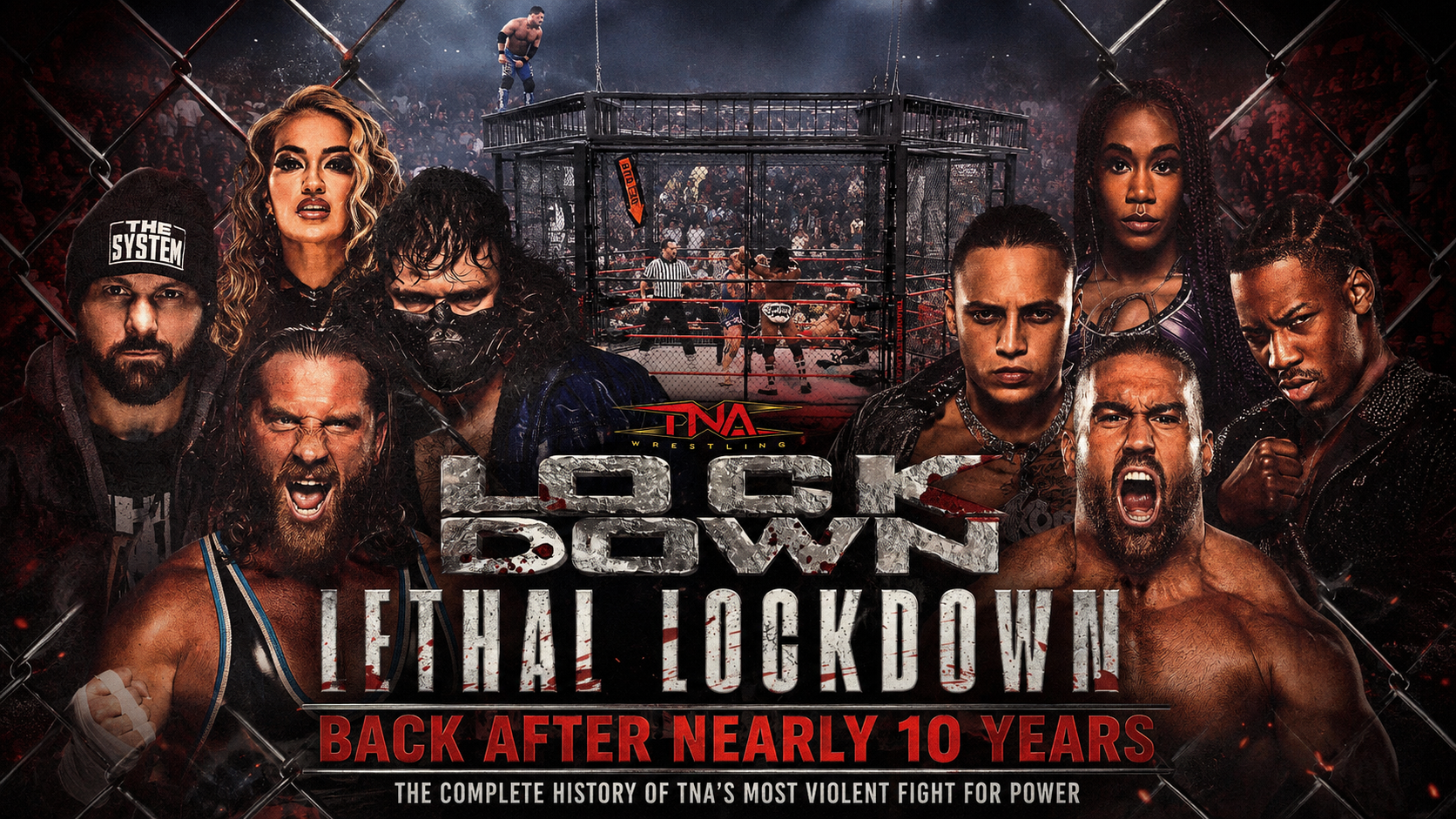
There are wrestling stipulations built around championships, stipulations built around settling personal grudges and stipulations that exist mostly because somebody needed another way to put a table, ladder or steel cage on a poster. Lethal Lockdown has always been something different.
For most of its 21-year history, Lethal Lockdown has been the match TNA reaches for when the fight becomes bigger than a championship.
It has been about control.
Power.
Faction supremacy.
Generational warfare.
Outsiders trying to take over the company.
Veterans trying to hold onto it.
Young wrestlers trying to prove the promotion belongs to them next.
That is why bringing Lethal Lockdown back at TNA Lockdown 2026 means more than dusting off another recognizable piece of the company’s past. Nearly 10 years after the stipulation disappeared, The System will step inside the steel cage against KC Navarro, Ricky Sosa, Fabian Aichner and Jada Stone in the 18th Lethal Lockdown match in TNA history.
It is an appropriately old-school conflict for an old-school TNA stipulation.
Eddie Edwards, Brian Myers, Bear Bronson and Alisha Edwards have openly positioned The System as TNA’s gatekeepers. They don’t view themselves as four wrestlers trying to protect their spots. They see themselves as quality control. In their minds, they are the standard, and anybody coming through TNA should have to prove they belong on the other side of them.
Navarro, Sosa, Aichner and Stone represent exactly the kind of wrestlers that mentality is designed to challenge.
That gives Sunday’s match something Lethal Lockdown desperately needs if TNA wants its return to matter beyond nostalgia: a reason to exist.
The cage cannot be the story.
The weapons cannot be the story.
The fact that TNA hasn’t held one since 2016 cannot be the entire story.
The real story is whether one of the most violent matches in company history can once again do what its best versions did—turn a faction fight into a battle over who gets to define TNA.
Lethal Lockdown Was TNA’s Answer to WarGames, but It Became Something of Its Own
There is no point pretending Lethal Lockdown does not share obvious DNA with WarGames. It does, and TNA has never needed to hide that.
Two teams go to war inside a steel cage. One wrestler from each side begins the match. After an opening period, another competitor enters, temporarily creating a numerical advantage. Entrants continue alternating until everyone has joined the fight.
That basic structure is familiar.
What TNA did was mutate it.
Instead of two rings, Lethal Lockdown used one.
Instead of the traditional WarGames setup, TNA placed the match inside its own Six Sides of Steel during the company’s most visually distinctive era.
Weapons were legal.
Then TNA added the element that permanently changed what Lethal Lockdown looked like: once all competitors entered, a roof descended onto the cage with weapons hanging beneath it.
That became the moment when the match shifted gears.
The staggered-entry portion was about surviving the numbers.
Then the ceiling dropped.
The weapons arrived.
The entire structure became a battlefield.
Before long, wrestlers were not merely fighting under the roof. They were finding ways onto it.
That was when Lethal Lockdown stopped feeling like TNA simply doing its version of WarGames and started developing its own visual language.
Six sides.
A descending ceiling.
Weapons hanging overhead.
Bodies fighting inside, around and eventually above the cage.
That version of Lethal Lockdown could only have come from mid-2000s TNA, a promotion that frequently operated somewhere between inspired creativity and complete recklessness.
Sometimes that combination was disastrous.
With Lethal Lockdown, it created something people are still talking about two decades later.
2005: TNA Creates the Prototype
The first Lethal Lockdown took place at the inaugural Lockdown on April 24, 2005.
Even the larger concept behind that show was ridiculous in the most TNA way possible. Every match took place inside the Six Sides of Steel. Instead of protecting the cage for one feud, TNA built an entire pay-per-view around it.
Lethal Lockdown was one of the new concepts introduced that night.
Team Nash consisted of Diamond Dallas Page, Sean Waltman and BG James after Kevin Nash was unable to compete. Across from them stood Team Jarrett: Jeff Jarrett, Monty Brown and The Outlaw.
Team Nash won.
More important than the result was what the match represented.
The 2005 version was still a prototype. The weapon-covered descending roof that eventually became synonymous with Lethal Lockdown was not yet part of the formula. TNA had the staggered team entries, the cage and the chaos, but the stipulation had not fully discovered its identity.
That happened one year later.
2006: AJ Styles Helps Turn a Match Into a TNA Signature
If 2005 created Lethal Lockdown, 2006 created the version people remember.
Sting’s Warriors—Sting, AJ Styles, Rhino and Ron Killings—faced Jeff Jarrett’s Army of Jarrett, Scott Steiner, Chris Harris and James Storm.
The larger story fit a pattern that would follow Lethal Lockdown for years. Sting had returned to oppose Jarrett’s grip over TNA, and the match became the battlefield for that resistance.
But the lasting importance of 2006 came from the structure itself.
Once all eight competitors entered, the ceiling descended onto the cage with weapons attached underneath.
Now Lethal Lockdown had its defining second act.
And AJ Styles made sure nobody forgot it.
Styles and James Storm eventually fought their way onto the roof. A table was set up above the cage. A ladder followed.
Then Styles climbed the ladder, reached above himself and grabbed the arena’s overhead support structure.
He hung there.
Above the cage.
Above the ladder.
Above James Storm.
Then he dropped through Storm and the table.
It was the kind of spot that perfectly captured that era of TNA because it was equal parts incredible and completely insane.
There was no subtlety to it.
There didn’t need to be.
AJ gave TNA an image that could explain Lethal Lockdown without anybody saying a word.
By the time Sting forced Chris Harris to submit, the stipulation had found its personality.
The 2005 match created the format.
The 2006 match created the mythology.
2007: TNA Loads the Cage With an Almost Absurd Amount of Talent
The 2007 version showed how quickly Lethal Lockdown had grown.
Team Angle featured Kurt Angle, Samoa Joe, Rhino, Sting and Jeff Jarrett.
Team Cage had Christian Cage, AJ Styles, Scott Steiner, Abyss and Tomko.
Read those names again.
Angle.
Joe.
Sting.
Jarrett.
Christian.
Styles.
Steiner.
Abyss.
It feels less like a team match now and more like somebody randomly selected ten of the most important wrestlers from that period of TNA.
TNA also expanded the match into five-on-five warfare and attached another incentive: whoever scored the deciding fall would earn a future world championship opportunity.
Harley Race served as special enforcer.
The match again used the descending roof, weapons and above-the-cage insanity. AJ Styles and Kurt Angle ended up fighting on top. Bodies spilled outside. Thumbtacks entered the equation. The match turned into controlled disorder.
Sting ultimately scored the fall for Team Angle.
What 2007 established was scale.
Lethal Lockdown could hold some of the biggest personalities in the company without reducing everyone to interchangeable bodies swinging weapons. There were individual grudges, competing agendas, distrust within the teams and championship implications layered over the faction war.
That should still be the standard.
A good Lethal Lockdown cannot simply be eight people doing hardcore spots simultaneously.
The chaos has to have a reason.
2008: The Roof Becomes a Second Ring
Christian Cage captained Christian, Sting, Kevin Nash, Rhino and Matt Morgan against Tomko, AJ Styles, James Storm and Team 3D.
By this point fans knew the formula.
They also knew to look up.
The cage roof had effectively become another performance space.
Christian and Styles eventually fought above the ring with a ladder and table involved. James Storm tipped the ladder, sending Christian and Styles crashing through the table on the roof.
Rhino eventually put Storm away with the Gore to win for Team Cage.
This is where the legacy of Lethal Lockdown creates a difficult problem for the 2026 version.
TNA spent years conditioning fans to expect somebody to do something stupidly dangerous above the cage.
That does not mean anybody Sunday should feel obligated to recreate what AJ, Christian or Storm did two decades ago.
They shouldn’t.
Wrestling has already taken enough years off enough careers chasing the next GIF.
But the returning match still needs its own visual identity.
There has to be something from the 2026 Lethal Lockdown that people remember without needing to look up who won.
That doesn’t require somebody diving from the arena ceiling.
It requires imagination.
2009: Lethal Lockdown Becomes a Generational Battlefield
By 2009, the stipulation had found perhaps its most natural storytelling purpose.
Team Jarrett featured Jeff Jarrett, AJ Styles, Christopher Daniels and Samoa Joe.
Team Angle consisted of Kurt Angle, Booker T, Kevin Nash and Scott Steiner.
This was happening against the backdrop of TNA’s larger conflict with the Main Event Mafia, a storyline built around decorated veterans asserting their superiority over the wrestlers who had built TNA or represented its future.
That is almost a perfect Lethal Lockdown premise.
The match works best when the two teams do not simply dislike each other.
It works when the two sides have different answers to the same question:
Who should this company belong to?
The Main Event Mafia story gave the cage ideological stakes. The established stars believed their accomplishments entitled them to dictate the hierarchy. The TNA side was fighting for its own legitimacy.
Team Jarrett won.
And TNA had discovered something bigger than the gimmick itself.
Lethal Lockdown was becoming the company’s civil-war match.
No Surrender 2009: Lethal Lockdown Leaves Lockdown
There is another important moment from 2009 that gets overlooked because it did not happen at the Lockdown pay-per-view.
Beer Money and Team 3D faced members of the Main Event Mafia and British Invasion at No Surrender.
Beer Money and Team 3D won.
On the surface, it is nowhere near as historically important as some of the annual Lockdown versions. In the bigger picture, however, the match proved something.
Lethal Lockdown no longer needed Lockdown.
It had become its own stipulation.
That matters because people sometimes treat “Lockdown” and “Lethal Lockdown” as if they are interchangeable. They aren’t.
Lockdown is the event.
Lethal Lockdown is the team warfare stipulation that grew out of it.
TNA would continue proving that distinction over the years.
2010: The Six-Sided Identity Changes
The 2010 Lockdown match pitted Team Hogan—Abyss, Jeff Hardy, Jeff Jarrett and Rob Van Dam—against Team Flair—Desmond Wolfe, James Storm, Robert Roode and Sting.
Hulk Hogan and Ric Flair were the figureheads hanging over the conflict, giving TNA another faction war built around competing power centers.
There was also an obvious visual difference.
The six-sided ring was gone.
TNA had returned to a traditional four-sided ring at the beginning of 2010, meaning Lethal Lockdown no longer took place inside the structure that had helped make it instantly identifiable as a TNA creation.
The match survived.
But something had changed.
Six Sides of Steel had looked like TNA.
A conventional four-sided cage could exist almost anywhere.
That doesn’t destroy a stipulation, but wrestling is visual. Presentation matters. Part of Lethal Lockdown’s early mystique came from seeing an already-unusual cage transformed into something even more excessive when the weapon-covered ceiling descended.
Team Hogan won when Abyss put away Wolfe.
The match remained violent.
It remained chaotic.
But the promotion around it was entering another era.
Bound for Glory 2010: Lethal Lockdown Invades TNA’s Biggest Stage
TNA used Lethal Lockdown again later that year at Bound for Glory.
EV 2.0—Tommy Dreamer, Raven, Rhino, Sabu and Stevie Richards—faced Fortune’s AJ Styles, James Storm, Kazarian, Matt Morgan and Robert Roode.
The ECW veterans defeated Fortune.
Again, the match worked because there was a generational argument underneath the violence.
The twist was that the veterans were now the outsiders trying to preserve their relevance while Fortune represented a younger TNA faction looking to establish its own dominance.
Lethal Lockdown had become flexible enough to reverse the traditional roles without losing the basic idea.
It was still about ownership of the future.
Just from a different direction.
2011: Fortune vs. Immortal Shows Why Story Matters More Than Weapons
Fortune’s Christopher Daniels, James Storm, Kazarian and Robert Roode faced Immortal’s Abyss, Bully Ray, Matt Hardy and Ric Flair at Lockdown 2011.
This is one of the versions that should be required viewing for anybody trying to understand why Lethal Lockdown worked when TNA got it right.
There was plenty of violence.
There were weapons.
There were dangerous positions on and around the structure.
But the most valuable pieces were attached to characters.
AJ Styles had been taken out heading into the match. When he returned during the chaos and went after Bully Ray, the building reacted because it meant something beyond a surprise body entering a cage.
Then came the finish.
Robert Roode forced Ric Flair to submit.
That image mattered.
Flair represented wrestling royalty.
Roode represented the TNA generation still trying to prove that its stars deserved to stand beside the legends the company had spent years importing.
Roode didn’t merely survive Flair.
He made him quit.
That is how you use a match like Lethal Lockdown correctly.
The weapons enhance the story.
They are not the story.
That lesson should be hanging over the 2026 version.
2012: The Match Becomes a Family Power Struggle
The 2012 edition revolved around Garett Bischoff’s war with his father, Eric.
Team Garett consisted of AJ Styles, Austin Aries, Garett Bischoff, Mr. Anderson and Rob Van Dam.
Team Eric featured Bully Ray, Christopher Daniels, Eric Bischoff, Gunner and Kazarian.
Garett eventually pinned Eric.
The stipulation carried storyline consequences tied directly to Eric’s standing in TNA.
It was not the most historically important Lethal Lockdown, but it illustrated both the versatility and danger of repeatedly using a signature match.
Once a stipulation becomes reliable, wrestling promotions have a habit of using it because it is available rather than because the feud truly requires it.
That is how special matches become normal matches with elaborate furniture.
Lethal Lockdown was always at its best when there was no cleaner way to resolve the war.
2013: Team TNA Goes to War With Aces & Eights
If somebody wanted one storyline to understand the purpose of Lethal Lockdown, Team TNA against Aces & Eights might be it.
Aces & Eights had spent months attacking wrestlers, infiltrating the company and destabilizing TNA.
So TNA responded by putting together a literal Team TNA.
Sting.
Samoa Joe.
Magnus.
James Storm.
Eric Young.
Across from them stood Devon, Mr. Anderson, DOC, Knux and Garett Bischoff.
There was nothing complicated about the central idea.
These people had attacked the company.
Now the company was fighting back.
Team TNA won when Eric Young came from the top of the cage and eventually pinned Knux.
For a moment, TNA had beaten back the invasion.
Then the larger story delivered the knife twist.
Later that night, Bully Ray defeated Jeff Hardy for the TNA World Championship and revealed himself as the leader of Aces & Eights.
Team TNA had won the battle.
Aces & Eights had still managed to capture the most important championship in the company.
That contrast made the Lethal Lockdown victory almost feel like a false finish to the war.
It also reinforced the idea that the match was no longer just about settling a feud.
It had become part of the larger struggle for TNA itself.
The Forgotten 2013 Lethal Lockdown
There is a Lethal Lockdown that tends to disappear from casual histories because it wasn’t part of the annual Lockdown continuity.
TNA taped another one on December 29, 2013, for the One Night Only: Hardcore Justice 3 special that aired in January 2014.
Kurt Angle, Samoa Joe, James Storm and Abyss defeated Bobby Roode, Robbie E, Jessie Godderz and Magnus.
It was not a pivotal chapter in company history.
It does, however, matter if we’re going to call this the complete history.
More importantly, its relative obscurity proves how widely TNA had begun using the concept.
What started as a once-a-year centerpiece had become portable.
That increased its usefulness while slowly eating away at its exclusivity.
2014: Eddie Edwards Enters Lethal Lockdown on the Opposite Side of History
The 2014 match is one of the most important to revisit before Sunday’s return.
Team MVP consisted of MVP, Davey Richards, Eddie Edwards and Willow.
Team Dixie had Bobby Roode, Austin Aries, Robbie E and Jessie Godderz.
The stakes were enormous in storyline terms.
Control of TNA wrestling operations.
Bully Ray served as special referee and eventually turned against Dixie’s side. MVP pinned Roode, giving his team control.
Now look at Eddie Edwards.
In 2014, Eddie entered Lethal Lockdown as one of the wrestlers fighting the entrenched power structure.
He was part of the next wave.
The Wolves were new to TNA. They were hungry. They were being positioned as part of what came next.
Eddie helped overthrow the establishment.
Twelve years later, Eddie is the establishment.
That may be the most interesting historical detail in Sunday’s match.
The young wrestler fighting the gatekeepers eventually lived long enough to become one.
There is nothing wrong with that. In fact, that is how wrestling is supposed to work.
Every generation eventually becomes the group standing in somebody else’s way.
The fascinating question is whether Eddie recognizes it.
The System calls itself TNA’s quality control.
Its members call themselves the gatekeepers.
In 2014, those are exactly the kind of people Eddie would have been fighting.
Sunday, he is one of them.
2015: Lethal Lockdown Survives Even as Lockdown Shrinks
By 2015, TNA’s world looked very different.
Lockdown was no longer being presented as one of the company’s traditional pay-per-views. It became a themed Impact Wrestling television special.
But Lethal Lockdown survived.
Team Angle—Kurt Angle, Austin Aries, Gunner and Lashley—faced the Beat Down Clan of MVP, Kenny King, Samoa Joe and Low Ki.
Lashley entered last for Team Angle, Speared MVP and secured the victory.
The platform had changed.
The match remained.
That says something about the strength of the concept.
TNA could lose the annual pay-per-view version of Lockdown and still see value in Lethal Lockdown as a faction-war payoff.
But the promotion was also entering a period in which many of the traditions fans associated with its peak years were disappearing or being reconfigured.
Lethal Lockdown was surviving on borrowed time.
Winner Take All 2015: Eddie Edwards Defends TNA From Brian Myers
Then came perhaps the most important historical connection to Sunday’s match.
Later in 2015, TNA held a Winner Take All Lethal Lockdown between Team TNA and Global Force Wrestling.
The prize was control of TNA.
Team TNA featured Drew Galloway, Lashley, Bram and The Wolves, Davey Richards and Eddie Edwards.
Team GFW consisted of Jeff Jarrett, Eric Young, Sonjay Dutt, Chris Mordetzky and Brian Myers.
Team TNA won.
Drew Galloway pinned Myers.
Think about what that means in 2026.
Eddie Edwards and Brian Myers are now standing on the same side of a Lethal Lockdown.
In 2015, Eddie was defending TNA from a faction that included Myers.
Myers was the outsider trying to help take control of the promotion.
Today Myers is part of The System and considers himself one of the men responsible for deciding who belongs in TNA.
That is an incredible reversal.
Eddie went from fighting the establishment to becoming it.
Myers went from invading TNA to gatekeeping it.
Now both men are trying to stop a younger group from pushing through.
You could not manufacture a cleaner illustration of how wrestling generations turn over.
2016: The Knockouts Make Lethal Lockdown History
The February 2016 Lockdown television special produced another first.
The Dollhouse—Jade, Marti Bell and Rebel—faced Gail Kim, Velvet Sky and Maria in the first women’s Lethal Lockdown.
Maria ultimately abandoned the other side, leaving Gail and Velvet at a disadvantage, and The Dollhouse won.
That match matters more historically than it is sometimes given credit for.
For more than a decade, Lethal Lockdown had been exclusively male faction warfare.
The Knockouts changed that.
Sunday’s match takes that evolution another step.
Alisha Edwards and Jada Stone are not being placed in a separate women’s version.
They are integral members of opposing teams.
That matters because it makes their participation part of the faction war instead of a novelty attached to it.
Jada isn’t there because TNA needed one woman on each side.
She fits the premise.
She’s exactly the kind of rising wrestler The System claims it has the right to judge.
September 2016: The Lethal Lockdown Everybody Forgets Was Actually the Last One
This is where the history needs to be corrected.
The women’s Lethal Lockdown at the February 23, 2016 Lockdown special was not the final Lethal Lockdown before 2026.
TNA used the stipulation one more time.
The match was taped on August 17 and aired on the September 29, 2016 Road to Glory edition of Impact Wrestling.
Team Lashley featured Bobby Lashley, Drew Galloway, Mike Bennett and Maria.
Team EC3 consisted of Ethan Carter III, Moose, Aron Rex and Gail Kim.
The winning captain earned the right to choose the stipulation for the upcoming TNA World Championship match between Lashley and EC3 at Bound for Glory.
Lashley eventually trapped EC3 in a choke and rendered him unable to continue.
Team Lashley won.
Lashley chose No Holds Barred.
Then Lethal Lockdown vanished.
Not for a year.
Not for three.
For nearly a decade.
That makes Sunday’s return more historically significant than simply bringing back another cage match.
There are wrestlers on the current TNA roster who have gone through entire major portions of their careers without the company using what was once one of its most recognizable stipulations.
Lethal Lockdown Was Never Formally Killed—TNA Simply Became a Different Company
There was no dramatic retirement ceremony for Lethal Lockdown.
No announcement that TNA was permanently shelving the stipulation.
It disappeared because the company around it changed.
Lockdown had already been removed from the traditional pay-per-view schedule and converted into television specials. TNA changed networks, ownership structures, creative directions, rosters and eventually even its primary branding.
For years, it wasn’t TNA anymore.
It was Impact Wrestling trying to establish what Impact Wrestling was supposed to be.
Some old TNA concepts survived.
Some were revived occasionally.
Others were left behind.
Lethal Lockdown fell into that final category.
That distinction matters because Sunday’s match shouldn’t be sold as a gimmick TNA randomly remembered.
Modern TNA has increasingly embraced the idea that it does not need to run from its history.
There was a period when the company seemed embarrassed by certain parts of its own identity. There were understandable reasons for wanting distance from some of the baggage attached to old TNA, but throwing away everything that made the promotion distinctive was never the answer.
Ultimate X is TNA.
The X Division is TNA.
The Knockouts division is TNA.
Six-sided imagery is TNA.
Lockdown is TNA.
And Lethal Lockdown is TNA.
The job now is not to recreate 2006.
It is to remember why those ideas worked and find out whether they can still work in 2026.
The Numbers Tell Their Own Story
Seventeen Lethal Lockdown matches were completed between 2005 and 2016.
Sunday is scheduled to be No. 18.
James Storm is the iron man of the stipulation with eight appearances. That makes sense when you look at how many different eras he lived through: America’s Most Wanted, Beer Money, Fortune and the broader faction wars that repeatedly ran through TNA.
AJ Styles and Jeff Jarrett each made six appearances.
Bobby Roode also appeared six times.
Sting and Samoa Joe each competed in five.
Rhino quietly owns one of the most impressive records in the history of the match at 4-0.
Sting went 4-1.
Joe went 4-1.
Lashley never lost a Lethal Lockdown, finishing 3-0.
At the opposite end is Scott Steiner, who somehow went 0-4 despite being exactly the kind of person you would expect to thrive in a cage full of weapons.
Then there are two records that matter Sunday.
Eddie Edwards is 2-0.
Brian Myers is 0-1.
If The System wins, Eddie moves to 3-0 in a match he first entered as a rising star fighting against the establishment.
If The System loses, Myers remains winless in the stipulation 11 years after he was the man pinned in the Winner Take All war against Team TNA.
Those aren’t just trivia numbers.
They give Sunday’s match history beneath the history.
AJ Styles May Be the Wrestler Most Closely Associated With Lethal Lockdown’s Insanity
James Storm has the most appearances.
Sting has one of the strongest records.
Jeff Jarrett is tied to the political and factional DNA of the early matches.
But if somebody asks which wrestler best represents the physical insanity of Lethal Lockdown, AJ Styles has a strong argument.
The 2006 dive above the cage is the obvious example, but it wasn’t a one-night relationship with the structure.
AJ repeatedly treated the roof as if the purpose of a steel cage was to find increasingly dangerous ways to get outside and above it.
That’s part of why those early matches remain memorable.
Styles was not simply wrestling inside Lethal Lockdown.
He was helping teach viewers what a Lethal Lockdown was supposed to feel like.
Dangerous.
Unpredictable.
A little reckless.
Distinctly TNA.
Nobody Sunday should try to be 2006 AJ Styles.
They should try to accomplish what AJ accomplished: create something the match owns.
Sting Was the Captain Lethal Lockdown Needed
Sting’s role was different.
He wasn’t there primarily to perform the craziest stunt.
Sting was the general.
That made him almost perfect for the stipulation.
So many Lethal Lockdown stories needed a recognizable leader who could stand in the middle of TNA and say enough.
Enough of Jarrett.
Enough of an invading faction.
Enough of another power structure.
Enough of somebody else deciding what the company should be.
Sting’s 4-1 record reflects how often TNA trusted him to captain that resistance.
The match benefited from his credibility because the cage felt like the place the larger war was finally being forced to end.
James Storm Is Lethal Lockdown’s Iron Man
Eight appearances tell the story by themselves.
Storm was there in 2006 with America’s Most Wanted.
He was there during Beer Money.
He was there through Fortune.
He appeared alongside different partners, under different faction banners and in completely different periods of company history.
His 4-4 record almost feels appropriate.
Storm didn’t dominate Lethal Lockdown.
He survived it repeatedly.
His history inside the match is practically a condensed history of TNA’s faction scene.
That is why the old match has emotional weight modern stipulations cannot manufacture overnight.
You need years for that.
Lethal Lockdown’s Real Legacy Is Not the Weapons
The easiest way to market Lethal Lockdown is also the shallowest.
Cage.
Weapons.
Violence.
Blood.
Chaos.
All of that is part of it.
None of it explains why the match lasted.
Look at the stories TNA repeatedly put inside the structure.
Sting opposing Jarrett’s power.
TNA’s generation fighting the Main Event Mafia.
Hogan’s side against Flair’s.
Fortune against Immortal.
Team TNA against Aces & Eights.
MVP’s side against Dixie’s.
Team TNA against GFW for control of the promotion.
Again and again, Lethal Lockdown was used when the conflict became institutional.
Who runs this place?
Who represents this place?
Who belongs here?
Who gets to decide what TNA looks like tomorrow?
That is Lethal Lockdown’s actual identity.
It is TNA’s civil-war match.
Once you understand that, the 2026 booking makes considerably more sense.
The System Has Accidentally Made Itself the Perfect Lethal Lockdown Villain
The System could have treated Navarro, Sosa, Aichner and Stone as four annoying opponents.
Instead, Eddie Edwards gave the feud a thesis.
The System considers itself quality control.
The group has called itself the gatekeepers of TNA Wrestling.
That language changes everything.
A gatekeeper doesn’t merely want to beat you.
A gatekeeper believes he has the authority to determine whether you are allowed through the gate.
That makes The System an almost perfect antagonist for a Lethal Lockdown match.
Eddie and Myers are established.
They have history.
They have tenure.
They have championship résumés.
They have survived enough wrestling locker rooms to believe experience gives them the right to set the standard.
There is even some truth in that.
That’s what makes the argument work.
Veterans should have standards.
Younger wrestlers should have to prove themselves.
Nothing is gained by treating every new face like a future world champion before he or she has earned anything.
The problem is when “protecting the standard” becomes another way of saying “protecting our position.”
That is the line The System keeps crossing.
The gatekeeper eventually stops testing the next generation and starts blocking the door.
Eddie Edwards Is the Most Interesting Person in Sunday’s Match
Nobody in this match carries more historical irony than Eddie.
He won Lethal Lockdown with Team MVP in 2014.
He won again with Team TNA in 2015.
The first time, he helped fight against an entrenched power structure.
The second time, he fought an outside faction trying to seize control of TNA.
Now Eddie is part of the faction claiming the authority to decide who belongs.
The kid at the gate grew up and got the keys.
That is not a criticism of Eddie’s character.
It is the point.
This is what long-term wrestling history is supposed to create.
A wrestler doesn’t remain the promising new arrival forever.
Eventually he becomes the veteran somebody else is measuring himself against.
Eventually his accomplishments become somebody else’s obstacle.
Sunday gives Eddie a chance to use that history to elevate the wrestlers across from him.
That doesn’t necessarily mean losing.
Putting somebody over is not synonymous with staring at the lights for three seconds.
Eddie can spend 25 minutes making somebody’s life miserable and still make that person look more important for surviving him.
The question is whether TNA understands that the younger team must leave the cage with something it didn’t have when the door closed.
Brian Myers Has Made the Exact Opposite Journey
Myers’ history may be even stranger.
His first Lethal Lockdown came in 2015.
He wasn’t representing TNA.
He was invading it.
Myers entered as part of GFW in a match where control of TNA was on the line.
Team TNA beat his side.
Drew Galloway pinned him.
Eleven years later, Myers is no longer an outsider trying to seize TNA.
He is telling other people that he is one of TNA’s gatekeepers.
That is wrestling history coming all the way around.
The outsider became part of The System in more ways than one.
Myers also enters Sunday with something concrete in his favor.
On the final Impact before Lockdown, he defeated Fabian Aichner after using a low blow behind the referee’s back and then hitting the Roster Cut.
That victory earned The System the entry advantage.
The heels aren’t merely talking about controlling TNA.
For portions of Lethal Lockdown, they will literally control the numbers.
TNA needs to make that hurt.
The Numbers Advantage Cannot Be Cosmetic
One of the easiest ways to ruin this kind of match is to treat the advantage like trivia.
The System earned it.
Use it.
When the second System member enters, the lone opponent should suffer.
When another babyface finally arrives, that entrance should feel like relief.
Then The System should regain the numbers.
Then the next countdown matters again.
The format creates its own suspense if everyone stops trying to outsmart it.
There should be stretches when the younger team looks overwhelmed.
There should be moments when fans are counting down because another entrant is the only thing preventing a complete beating.
The System calls itself the group in control.
Give it control.
Then make the other team take it away.
That’s wrestling.
Fabian Aichner Should Be the Match’s Physical Anchor
Aichner already has history with Eddie and The System dating back months.
He has been beaten down by their numbers.
He has fought alongside people targeted by them.
Now Myers stole the advantage match with a low blow and handed The System the most useful structural advantage available Sunday.
That gives Aichner unfinished business before the cage door even closes.
Physically, he is also perfectly suited to this environment.
Aichner can work as the powerhouse without being reduced to the slow big man waiting for everybody else to do the interesting stuff. He’s athletic enough to participate in the spectacle and strong enough to become the guy who changes the atmosphere when he enters.
Thursday gave Myers the immediate victory.
Sunday gives Aichner the opportunity to make that victory expensive.
Ricky Sosa Represents the Philosophical Heart of the Feud
Sosa matters because The System’s issue with him has never simply been that he is standing across the ring from them.
He refused their vision.
That’s more interesting.
The System believes being accepted by the right people should mean something.
Sosa’s refusal effectively rejected the hierarchy itself.
That made him a problem.
And that’s the kind of conflict Lethal Lockdown was built for.
Sosa doesn’t need to pin Eddie and suddenly become a world-title contender Sunday night.
He needs to leave the match looking like someone who belongs in major TNA stories.
There is a difference.
Sometimes wrestling gets so obsessed with who should win that it forgets the more important question:
Who should matter more afterward?
Sosa should.
KC Navarro Needs One Moment the Audience Remembers
KC has already proven he can beat Eddie.
His victory over Edwards on Impact became part of the chain of events that led to the Lethal Lockdown announcement when The System attacked afterward and Aichner, Stone and Sosa came to his aid.
Now the assignment changes.
A multi-person cage match is not the place for everybody to have 15 minutes of carefully constructed individual offense.
KC needs a moment.
One save.
One burst of speed.
One creative weapon sequence.
One ridiculous escape from a beatdown.
One near fall.
One sequence that belongs to him.
That’s how young wrestlers benefit from ensemble matches.
You don’t need to own the entire movie.
You need the scene people remember.
Jada Stone May Have More Momentum Than Anyone on Her Team
Jada enters Lockdown with another major opportunity already waiting for her.
On the go-home Impact, she defeated Heather by Elegance to advance to the final of the tournament to crown the inaugural TNA Knockouts Television Champion.
That matters.
TNA is clearly putting Jada into situations where she can establish herself as more than another name filling television time.
Now she enters one of the promotion’s historically significant stipulations opposite Alisha Edwards and the rest of The System.
The temptation will be to isolate Jada and Alisha into their own miniature women’s match while the men do everything else.
TNA should resist that.
The whole point of this version is that everybody is part of the same faction war.
Jada should interact with the match.
Alisha should interact with the match.
Their inclusion should feel integrated rather than accommodated.
The first women’s Lethal Lockdown happened in 2016.
Ten years later, the stronger evolution is not another separate women’s version.
It is reaching the point where women can be part of the central faction warfare without the match treating that as unusual.
Lethal Lockdown Cannot Survive on Nostalgia in 2026
This is the uncomfortable part.
Professional wrestling has spent the last decade making extreme violence feel ordinary.
WWE has WarGames every year.
AEW has Blood & Guts.
Hell in a Cell still exists.
Elimination Chamber still exists.
Every promotion has cage matches.
Every promotion has no-disqualification matches.
Everybody has tables.
Everybody has chairs.
Everybody has kendo sticks.
Everybody has seen wrestlers jump from stupid heights.
A weapon-filled cage is not inherently shocking anymore.
That’s a problem for Lethal Lockdown if TNA thinks the nostalgia itself is enough.
It isn’t.
Nobody should care in 2026 simply because a kendo stick is hanging from some steel.
The match needs structure.
Character.
Escalation.
A reason for every entrant.
A reason for the advantage.
A reason the feud needed this stipulation.
The good news is that TNA has one.
The System wants to be the wall separating established TNA from the people trying to become established TNA.
Lock them inside.
See which side still believes that after the fight.
That’s enough.
Do Not Try to Recreate 2006
TNA also needs to understand the difference between honoring history and impersonating it.
AJ Styles hanging above the cage before crashing through James Storm and a table worked because nobody had that exact memory yet.
If somebody Sunday climbs a ladder onto the roof, grabs something above the structure and tries to recreate AJ’s dive because “that’s what Lethal Lockdown is,” TNA will have completely misunderstood why the original mattered.
You cannot recreate spontaneity.
You can only create another moment.
The 2026 match needs something that belongs to 2026.
Maybe it is Aichner’s power.
Maybe it is Jada doing something nobody expects.
Maybe Sosa survives a System beatdown that should have finished him.
Maybe KC produces the highlight.
Maybe Eddie turns the violence into something genuinely ugly.
Maybe Myers’ advantage becomes the entire spine of the match.
Whatever it is, when TNA inevitably puts together the video package for the next Lethal Lockdown, there needs to be footage from Sunday that doesn’t look like filler between clips from 2006 and 2011.
That is the standard.
TNA Also Has to Know When Enough Is Enough
There is another side to reviving an old TNA gimmick.
Not everything needs to come back permanently.
Lockdown returning is interesting because it has been gone.
Lethal Lockdown returning is interesting because it has been gone.
If TNA runs another one in October, another in January and two next summer, the value disappears almost immediately.
This stipulation needs conflict worthy of it.
TNA already learned this lesson the first time.
There were years when Lethal Lockdown felt essential.
There were years when it felt like April arrived, therefore somebody needed to find four teammates.
Those are not the same thing.
If Sunday’s match works, resist the urge to immediately do it again.
Make people miss things.
Scarcity is still one of the easiest ways to create value in wrestling, yet promotions repeatedly behave as if audiences forget gimmicks unless they see them every six weeks.
We didn’t forget Lethal Lockdown.
It has been almost 10 years.
We’re still talking about it.
There’s your answer.
The System Does Not Necessarily Need to Lose, but the Young Team Cannot Afford to Leave Unchanged
There is a very easy assumption to make with Sunday’s story.
Veteran gatekeepers versus rising wrestlers.
Therefore, rising wrestlers win.
Maybe.
But the booking should be judged by something deeper than the final three-count.
The System can win and still elevate everyone across from it.
The younger team can win and still come out worse if TNA treats the victory like a random upset that is forgotten Thursday.
What matters is consequence.
Does Sosa feel more important?
Does Navarro feel more dangerous?
Does Jada feel closer to becoming a central Knockouts player?
Does Aichner gain another layer?
Does The System become more desperate?
Does Eddie have to confront the possibility that his version of protecting TNA has turned into protecting himself?
Does Myers react differently if the younger wrestlers survive the advantage he earned?
Where does the story go?
If the answer to all of that is “everybody moves on,” then why did we need Lethal Lockdown?
A signature stipulation should change something.
Otherwise it is just expensive scenery.
The Best Lethal Lockdowns Changed the Balance of Power
That is the thread running through 21 years of history.
Sting’s Warriors against Jarrett’s Army.
Team Angle against Team Cage.
TNA’s generation against the Main Event Mafia.
Fortune against Immortal.
Team TNA against Aces & Eights.
MVP against Dixie’s regime.
Team TNA against GFW.
Lashley against EC3’s side with Bound for Glory leverage at stake.
The details changed.
The larger idea kept returning.
Power.
Who has it?
Who wants it?
Who deserves it?
Who is abusing it?
That is why Sunday’s match is more appropriate than it initially looks.
The System says it knows what TNA should be.
The other side represents wrestlers trying to become part of what TNA will be.
There is no world championship hanging over the cage.
There doesn’t need to be.
Lethal Lockdown has rarely needed a belt to make the conflict important.
Its currency has always been control.
TNA’s Past Should Be a Foundation, Not a Crutch
There is a broader question surrounding Lockdown 2026.
How much of old TNA should modern TNA bring back?
The answer shouldn’t be everything.
Old TNA produced brilliant wrestling ideas.
Old TNA also produced things that deserved to stay buried.
Nostalgia becomes dangerous when a company stops distinguishing between the two.
Lethal Lockdown belongs in the first category.
Not because everything about it aged perfectly.
It didn’t.
Some of the old matches were overbooked.
Some relied too heavily on spectacle.
Some used dangerous spots that would be irresponsible to expect performers to reproduce now.
Some versions existed because the calendar said Lockdown rather than because the story genuinely demanded one.
But the core concept remains useful.
A faction war.
A cage.
Staggered entry.
A numbers advantage.
Weapons.
Escalation.
One decisive victory.
That framework still works because wrestling has not evolved beyond good conflict.
TNA simply needs to stop treating the past like a museum exhibit and start using it as a tool.
The Most Important People in Lethal Lockdown 2026 Are the Ones Who Have Never Been in One
Eddie Edwards doesn’t need Lethal Lockdown to prove he belongs in TNA history.
Brian Myers has been around long enough to know who he is.
The System already has credibility.
That’s exactly why the match should be about what happens to the people on the other side.
KC Navarro.
Ricky Sosa.
Fabian Aichner.
Jada Stone.
Years from now, if TNA does this correctly, somebody should be able to write about the 2026 Lethal Lockdown as the night one of those wrestlers changed.
Maybe it is the night Sosa stopped looking like a prospect and started looking like somebody TNA could trust with bigger stories.
Maybe it is the night Jada’s rise stopped feeling theoretical.
Maybe Aichner becomes one of TNA’s most credible physical threats.
Maybe KC steals the match.
Maybe several of them do.
That should be the point.
A heritage match has no value if it only benefits the heritage acts.
Final Thoughts: TNA’s Civil-War Match Is Back
Lethal Lockdown has never been perfect.
Neither has TNA.
That’s almost part of the charm.
The match was born from a company willing to take an already excessive concept—an entire pay-per-view inside a steel cage—and ask how it could possibly make the cage match even more excessive.
The answer was staggered team warfare.
Then weapons.
Then a roof.
Then weapons hanging from the roof.
Then wrestlers climbing on the roof.
Then AJ Styles apparently deciding the roof wasn’t high enough.
It was ridiculous.
It was dangerous.
At its best, it was brilliant.
But the reason Lethal Lockdown deserves to return in 2026 isn’t AJ’s dive.
It isn’t Sting.
It isn’t Kurt Angle.
It isn’t Samoa Joe, Christian Cage, Jeff Jarrett, James Storm, Bobby Roode, Ric Flair, Bully Ray or any other name from TNA’s past.
Those people gave the match history.
They cannot give Sunday’s match relevance.
That responsibility belongs to the wrestlers inside the cage now.
For 21 years, Lethal Lockdown has been at its best when TNA uses it to answer one question:
Who gets to decide what this company becomes next?
The System believes it already knows the answer.
Eddie Edwards has gone from the young wrestler fighting TNA’s establishment to one of the veterans guarding its doors.
Brian Myers has gone from an outsider trying to take TNA to an insider deciding who belongs.
Across from them are four wrestlers who don’t have the luxury of 15 years of TNA history behind their names.
They have to create theirs.
That is why this match matters.
Not because Lethal Lockdown is back.
Because if TNA does this correctly, somebody should walk out of that cage more important than when they walked in.
The greatest tribute TNA can pay to Lethal Lockdown isn’t recreating 2006.
It’s giving us a reason, 10 years from now, to remember 2026.
Make sure to subscribe to our Late Night Crew Wrestling YouTube Channel. Follow @yorkjavon, @kspowerwheels & @LateNightCrewYT on X.

I’m the quiet one until the bell rings then I’ve got takes. I live for WWE NXT and TNA, I want every promotion to succeed, and I will absolutely roast the bad decisions on sight (because someone has to). Anime taught me to respect long-term storytelling; wrestling taught me that sometimes the plan is “we panicked” and called it “unpredictable.” The Miz got me into all of this, so yeah I appreciate confidence, commitment, and the art of talking like you’re already the main event. Now I bring that same energy to the page as the main writer for Late Night Crew Wrestling because if you’re not here to be must-see and tell the truth, why are you here?!