
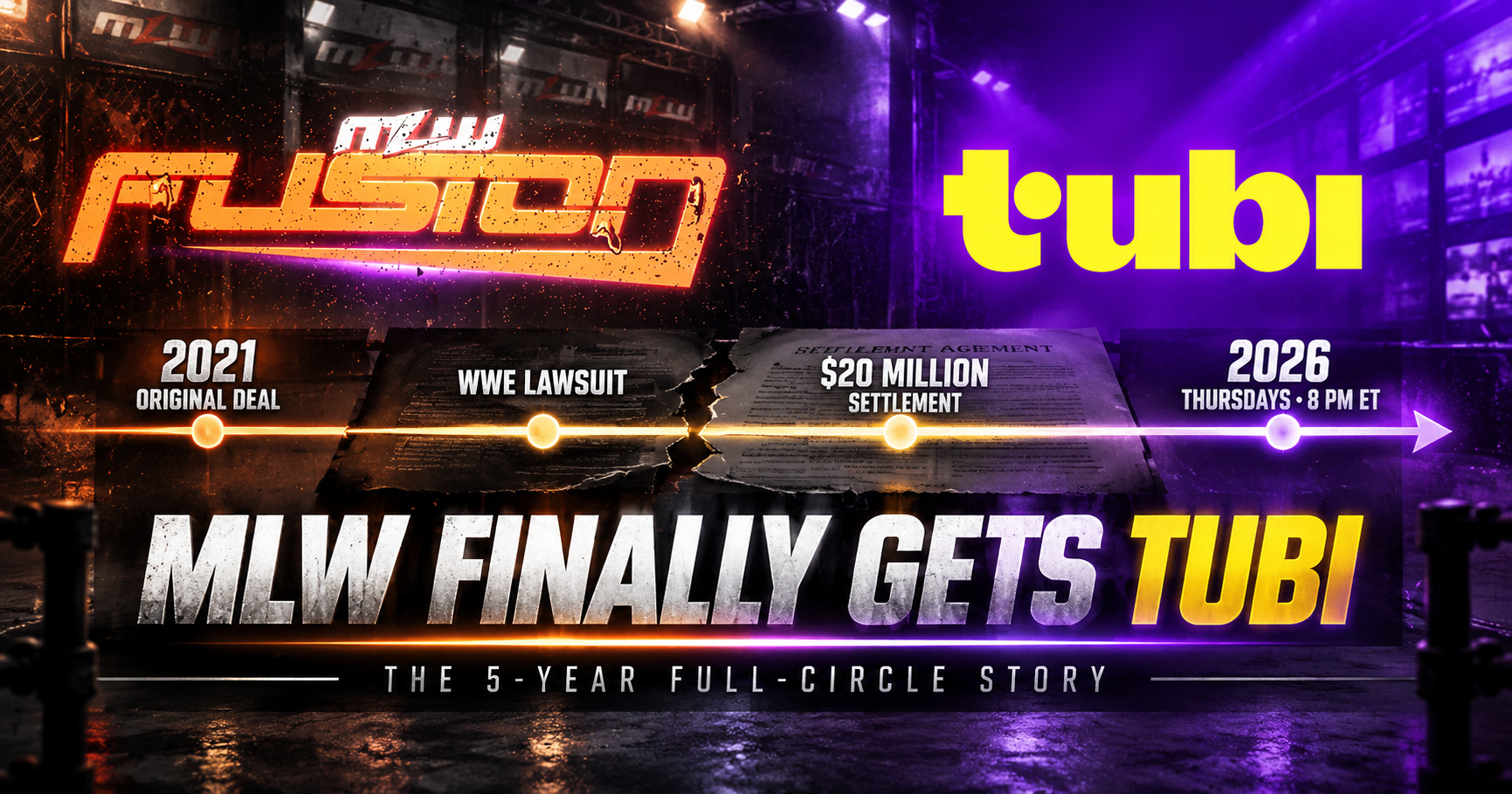
The MLW Tubi deal is finally real, five years after Major League Wrestling’s original agreement with the platform was terminated before launch and eventually became one of the central allegations in MLW’s antitrust lawsuit against WWE.
Tony Maglio of The Hollywood Reporter first reported Thursday that new episodes of MLW Fusion will begin streaming free on Tubi tonight, September 17, at 8 p.m. ET. New episodes will continue every Thursday in the same time slot.
This is a new streaming distribution agreement, not a revival of the old 2021 contract.
But there is no getting around what makes this deal different.
MLW says it had Tubi secured five years ago. That agreement disappeared one day before it was supposed to be announced. MLW accused WWE of interfering, filed a federal antitrust lawsuit, had its original complaint dismissed, rebuilt the case, survived WWE’s next attempt to throw it out and ultimately reached a $20 million settlement.
Now MLW Fusion is finally arriving on the platform sitting at the center of the entire dispute.
The Original MLW Tubi Deal Was Already in Place
The original MLW Tubi deal was not merely a conversation about potentially doing business together.
According to MLW’s January 2022 complaint, the promotion entered into a license agreement with Tubi on July 22, 2021.
Tubi was already owned by Fox Corporation, which mattered because WWE Friday Night SmackDown aired on Fox at the time.
MLW alleged that the Tubi agreement would substantially increase its valuation, strengthen its brand recognition and make the promotion more attractive to wrestling talent.
The company said it began preparing for the deal by hiring staff for Azteca Underground, adding editors, bringing in public-relations and marketing help, signing wrestlers and increasing salaries. MLW also alleged that it stopped pursuing other potential media partners.
This was supposed to lead somewhere.
MLW alleged that it and Tubi planned to issue a joint announcement on August 10, 2021, ahead of a September 11 launch.
The announcement never came.
What MLW Accused WWE of Doing
MLW alleged that WWE learned about the Tubi agreement before it could be announced.
According to the complaint, then-WWE executive Stephanie McMahon spoke with a Tubi executive on or around August 9.
MLW alleged that McMahon initially pressured Tubi not to give MLW a time slot that would compete head-to-head with WWE NXT and ultimately pressured Tubi and senior Fox executives to terminate MLW’s agreement entirely.
MLW said it received a termination letter from Tubi on August 9 — one day before the planned announcement.
That is the allegation that has followed this story for five years.
It is also where the language has to stay precise.
WWE later acknowledged in its court filing that McMahon spoke with a Tubi executive on August 9, 2021.
WWE denied that she pressured Tubi to terminate MLW’s agreement.
The conversation was acknowledged.
MLW’s explanation for what happened because of that conversation remained disputed.
There was never a trial verdict deciding the issue.
Vice TV Made the Lawsuit About More Than Tubi
Tubi became the headline-grabbing part of MLW’s case, but it was not the only media relationship MLW accused WWE of disrupting.
MLW also pointed to Vice TV.
The promotion had reached an agreement for Vice to carry archival MLW programming while the two sides discussed expanding their relationship to new content.
MLW alleged that after WWE learned about the relationship, a WWE senior vice president contacted a Vice executive and conveyed that WWE wanted Vice to stop carrying MLW.
According to MLW, Vice ultimately aired only one archival MLW program and stopped negotiations over additional content.
Putting Vice and Tubi together changed the scope of MLW’s argument.
MLW was not simply claiming that two television opportunities went badly.
The promotion alleged WWE was using its position and relationships in the media business to restrict a smaller wrestling company’s access to distribution.
That became the foundation of the federal lawsuit.
MLW Takes WWE to Federal Court
MLW filed its lawsuit against WWE on January 11, 2022, in the United States District Court for the Northern District of California.
The case ultimately included monopolization and attempted-monopolization claims under Section 2 of the Sherman Act, along with claims involving intentional interference with contractual relations, intentional interference with prospective economic advantage and California’s unfair-competition law.
WWE denied wrongdoing and moved to dismiss.
Initially, WWE succeeded.
On February 13, 2023, Judge Edward J. Davila granted WWE’s motion to dismiss MLW’s complaint.
But he granted MLW leave to amend.
That difference was everything.
MLW had lost that round. It had not lost the lawsuit.
The promotion filed its first amended complaint on March 6 and tried again with expanded allegations about the professional wrestling media-rights market, WWE’s alleged market power, barriers to entry and the conduct MLW said damaged its ability to compete.
WWE moved to dismiss again.
This time, WWE did not get the result it wanted.
MLW’s Amended Lawsuit Survives
On June 15, 2023, Judge Davila denied WWE’s motion to dismiss the first amended complaint.
That was a significant procedural win for MLW.
It was not a finding that WWE had actually committed an antitrust violation.
The court was deciding whether MLW had pleaded legally sufficient claims to continue the case, not whether MLW had proven its accusations.
That distinction is critical.
MLW had not won a judgment against WWE.
WWE had failed to end the amended lawsuit at the pleading stage.
The case could continue.
For a promotion the size of MLW, simply keeping a federal antitrust case alive against WWE after the original complaint had already been dismissed was significant.
But the case would never reach a trial.
The WWE-MLW Lawsuit Ends for $20 Million
The legal fight ended in December 2023.
On December 22, WWE and MLW notified the court that they had entered into a settlement agreement and stipulated that the lawsuit should be voluntarily dismissed with prejudice.
The case was dismissed with prejudice on December 26.
TKO Group Holdings later disclosed the settlement amount as $20 million.
That is where the legal record ends.
There was no jury verdict finding WWE liable.
There was no final ruling that WWE caused Tubi to terminate MLW’s agreement.
There was no judgment declaring that WWE illegally monopolized the professional wrestling media-rights market.
A settlement ended the case before those questions could be decided at trial.
But dismissing the significance of the result would be just as misleading.
MLW began 2023 with its original complaint thrown out. It amended the lawsuit, survived WWE’s second dismissal attempt and ultimately resolved the dispute for $20 million.
The lawsuit was finished.
The strange part was that MLW still had never actually gotten onto Tubi.
MLW Rebuilds Fusion Before Another Distribution Change
By 2026, MLW was again trying to establish Fusion as a dependable weekly wrestling program.
The company relaunched the series on May 30 with a special two-hour premiere and established a Saturday schedule on YouTube, VEEPS and beIN Sports.
In June, MLW expanded Fusion’s footprint through a partnership with New Japan Pro-Wrestling that brought the series to NJPW World.
Then another major part of MLW’s distribution setup disappeared.
MLW had informed beIN Sports that it would not enter renewal negotiations. The existing agreement expired at the end of August, ending an eight-year relationship between MLW and the network.
That left an obvious question for a promotion that had only recently rebuilt Fusion as a weekly show.
What was the next distribution move?
The answer was almost too perfect.
Tubi.
The MLW Tubi Deal Finally Happens
Beginning tonight, new episodes of MLW Fusion will stream free on Tubi every Thursday at 8 p.m. ET.
Tubi announced in August that it had reached 110 million monthly active users.
That does not mean 110 million people are suddenly going to watch MLW.
It means MLW is placing Fusion on a free service with enormous existing reach and essentially no financial barrier between a curious viewer and the show.
That distinction matters.
Fusion episodes also remain available through VEEPS and NJPW World.
More importantly, MLW now has an extremely simple message to sell:
Thursday night.
8 p.m. ET.
Tubi.
Free.
For a company whose programming has bounced through different outlets, schedules and distribution models over the years, simplicity has value.
What the MLW Tubi Deal Does — And Does Not — Mean
The MLW Tubi deal matters.
It should not be turned into something larger than the information currently supports.
No financial terms were announced publicly.
No contract length was announced publicly.
There is no basis right now for calling this a massive rights-fee windfall or claiming that one streaming agreement suddenly changes MLW’s place in the wrestling business.
What Tubi gives MLW is opportunity.
Reach.
Accessibility.
Consistency.
Those things are valuable, particularly for a wrestling promotion that has spent years trying to make its weekly television product easier to find.
But distribution cannot fix everything.
MLW has repeatedly had talented wrestlers, interesting international relationships and individual matches worth watching. The larger challenge has been turning those pieces into a weekly product with enough consistency and momentum that viewers feel they need to come back.
Tubi can put Fusion in front of more people.
Tubi cannot make those people care.
That part is still on MLW.
And after everything attached to this particular platform, that is what makes tonight more than another distribution announcement.
MLW spent years arguing over the opportunity it believed disappeared in 2021.
It finally has another one.
Final Thoughts
The MLW Tubi deal brings one of the strangest wrestling-business stories of the last five years back to the exact platform where it began.
According to MLW’s lawsuit, the promotion entered into its original Tubi license agreement on July 22, 2021.
A joint announcement was planned for August 10.
The launch was scheduled for September 11.
The agreement was terminated before the announcement.
MLW accused WWE of interfering.
WWE denied the interference allegations while later acknowledging that Stephanie McMahon spoke with a Tubi executive on August 9.
MLW sued WWE in January 2022.
Its original complaint was dismissed with leave to amend.
The amended lawsuit survived WWE’s next dismissal attempt.
The parties eventually settled for $20 million without a trial verdict deciding MLW’s underlying allegations.
Now, five years after the original Tubi situation, MLW Fusion is finally streaming on Tubi.
That does not prove what MLW alleged happened in 2021.
It does not guarantee this new MLW Tubi deal becomes a breakthrough.
What it does is put the opportunity back in MLW’s hands.
For years, Tubi was part of the explanation for what MLW believed it lost.
Starting tonight, it becomes part of what MLW actually has.
The lawsuit is history.
MLW finally got Tubi.
Now it has to make the deal matter.
Make sure to subscribe to our Late Night Crew Wrestling YouTube Channel. Follow @yorkjavon, @kspowerwheels & @LateNightCrewYT on X.

I’m the quiet one until the bell rings then I’ve got takes. I live for WWE NXT and TNA, I want every promotion to succeed, and I will absolutely roast the bad decisions on sight (because someone has to). Anime taught me to respect long-term storytelling; wrestling taught me that sometimes the plan is “we panicked” and called it “unpredictable.” The Miz got me into all of this, so yeah I appreciate confidence, commitment, and the art of talking like you’re already the main event. Now I bring that same energy to the page as the main writer for Late Night Crew Wrestling because if you’re not here to be must-see and tell the truth, why are you here?!