WWE Main Event is leaving YouTube, but the bigger story is not really Main Event. It is another example of WWE turning virtually every piece of programming it owns into separate streaming inventory — and another reminder that watching the entire WWE product in the United States continues to become less convenient even as the company creates more distribution partners.
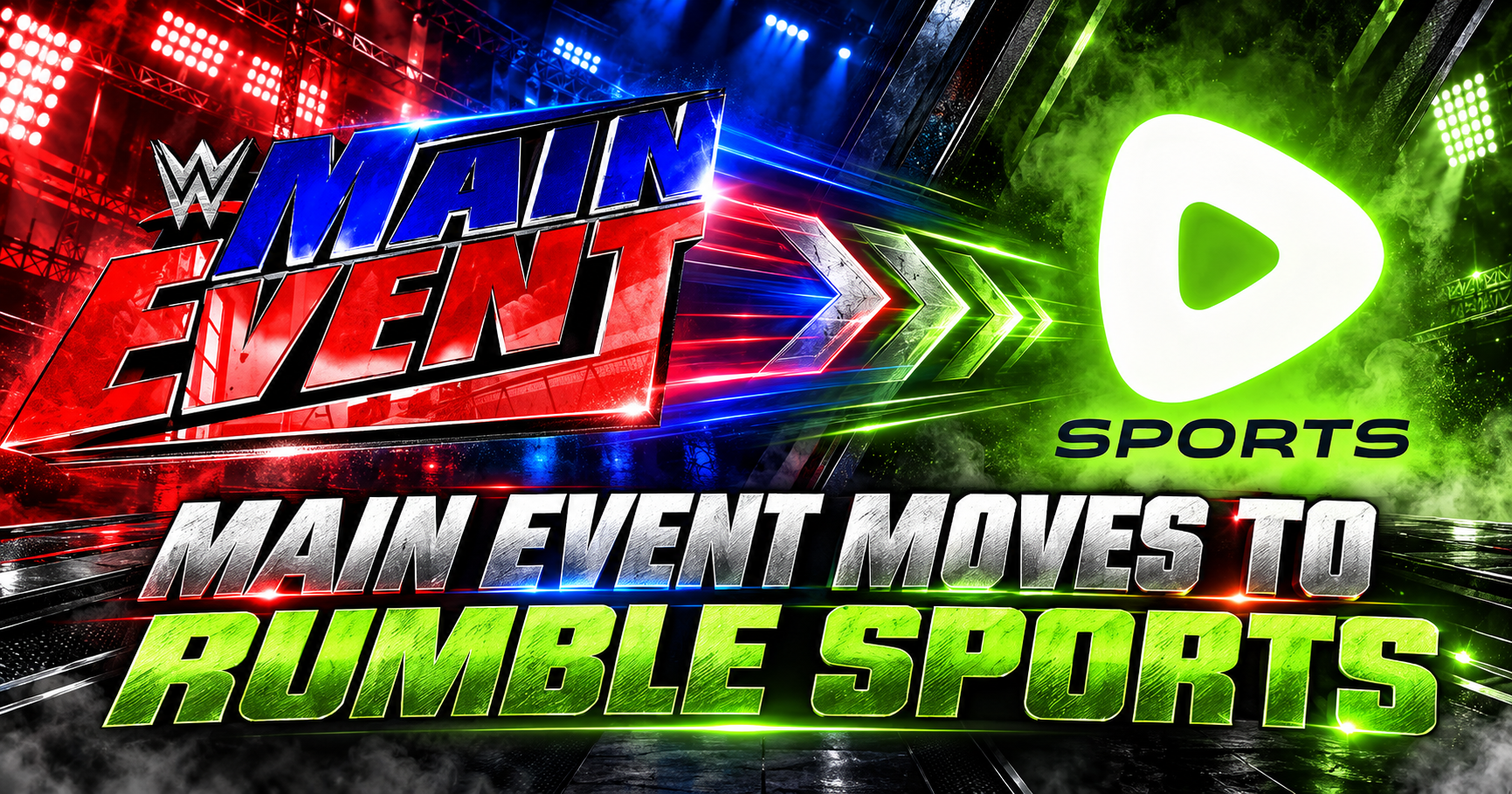
According to Variety’s exclusive report, WWE Main Event moves to Rumble beginning Wednesday, October 14. The weekly show will stream at 8 p.m. ET/5 p.m. PT through Rumble.com/WWE and the platform’s mobile and connected-TV apps as part of Rumble Sports.
Main Event has aired on YouTube since the beginning of 2026.
Now WWE is asking its audience to follow it somewhere else again.
WWE Main Event Is Leaving YouTube
Main Event has never been WWE’s most important weekly program, but its distribution history almost perfectly reflects how dramatically the wrestling media business has changed.
The show launched on Ion Television in 2012 before eventually appearing across Hulu, WWE Network, Peacock and YouTube. Rumble becomes its latest destination.
That makes Main Event an almost ideal experiment for WWE.
The company can test a new platform without putting one of its core television properties at risk. Main Event still carries the WWE logo, regularly features talent from Raw, SmackDown and NXT and gives Rumble legitimate weekly WWE programming without WWE handing over something essential to its business.
There is very little downside for WWE if the experiment does not work.
The bigger burden falls on Rumble to prove that WWE fans will actually follow.
Why Rumble Wants WWE
Rumble has spent years trying to expand beyond the identity that originally fueled much of its growth.
Variety notes that the platform experienced a significant rise in popularity beginning in 2020 as conservative figures who said they were being censored elsewhere increasingly used the service. Rumble has since pushed further into sports, entertainment, artificial intelligence and infrastructure.
WWE gives that expansion something valuable: a recognizable mainstream entertainment brand producing new content every week.
Rumble chief content officer Claudio Ramolo called WWE Main Event a “key pillar” of the platform’s growing sports lineup.
That description is telling.
Main Event may be supplemental programming inside WWE, but WWE can be premium inventory for Rumble.
There is a major difference between being another wrestling show sitting inside YouTube’s endless content machine and being one of the recognizable properties a smaller platform wants to build around.
What WWE Gains — And What It Gives Up
There is legitimate business logic behind WWE Main Event moving to Rumble.
WWE gets another distribution partner. Rumble gets WWE. And Main Event potentially receives far greater prominence inside its new platform than it ever received on YouTube.
But there is also an obvious tradeoff.
YouTube is where people already are.
Rumble is somewhere WWE will have to convince them to go.
That matters considerably for a show like Main Event because it is supplemental by nature. Dedicated viewers will follow almost anything WWE puts somewhere else, but casual viewers are much less likely to chase a secondary show across another platform.
WWE is betting that placement and partnership value can compensate for losing some of YouTube’s effortless discovery.
We do not know whether that bet is financially worthwhile because no rights fee, contract value or agreement length was disclosed.
Another Platform, Another Piece of WWE
That is where this story becomes bigger than Main Event.
Taken individually, moving one secondary wrestling show to another free video platform is hardly earth-shattering.
Taken as part of WWE’s larger distribution philosophy, it says plenty.
WWE has become extremely effective at treating its programming as separate pieces of valuable inventory. If one company wants one show, another company wants another and a third platform sees value in something smaller, WWE has shown little hesitation about spreading the product around.
That can maximize WWE’s business.
It does not necessarily maximize convenience for WWE fans.
Every new destination means another platform to remember. Another schedule. Another app. Another place where one piece of the same wrestling universe lives.
Main Event moving to Rumble will not suddenly make following WWE impossible. Main Event simply is not important enough for that.
The concern is accumulation.
There is a difference between having enormous distribution reach and having a coherent distribution strategy from the viewer’s perspective.
Rumble’s Identity Comes With the Partnership
There is also no reason to pretend Rumble arrives without baggage.
Its rise was closely associated with conservative political personalities and its public positioning as an alternative to larger technology platforms. That history will inevitably become part of the discussion surrounding WWE’s decision.
A streaming agreement is not a political endorsement.
But platforms have identities, audiences and reputations, and companies know that when they choose distribution partners.
For Rumble, landing WWE helps broaden that identity. Professional wrestling gives the service recognizable entertainment programming capable of attracting viewers who may otherwise have little reason to use it.
That may ultimately be one of the biggest reasons this relationship matters.
WWE is not simply entering Rumble’s existing ecosystem.
Rumble is hoping WWE helps expand it.
What This Means for the Wrestling Industry
The real long-term question is whether WWE Main Event on Rumble is the beginning of something larger.
Professional wrestling is unusually attractive streaming content. It produces hours of programming constantly, creates loyal repeat viewers and generates an endless supply of clips, interviews, highlights and discussion.
If Rumble decides wrestling works, WWE does not have to be the end of that expansion.
Independent promotions need distribution. Smaller wrestling companies need revenue. Wrestling libraries need homes. Live events need platforms.
Another serious buyer entering that market creates another option.
That is good leverage for wrestling companies.
It also risks making an already scattered wrestling landscape even more scattered for the people actually trying to watch everything.
Final Thoughts
WWE Main Event moving to Rumble is not one of WWE’s biggest media deals.
It might be one of its more revealing ones.
WWE gets a low-risk experiment. Rumble gets a recognizable global wrestling brand it can present as an important piece of its sports expansion. Neither company has to gamble its most valuable property to find out whether the relationship works.
Now comes the part that actually matters.
Can WWE make people leave the convenience of YouTube and deliberately follow Main Event to Rumble?
If it can, Rumble becomes another legitimate destination for wrestling content.
If it cannot, Main Event will simply have added another platform to a distribution history already full of them.
Either way, WWE has found another company willing to build around its content.
Wrestling fans have found another app to remember.
Make sure to subscribe to our Late Night Crew Wrestling YouTube Channel. Follow @yorkjavon, @kspowerwheels & @LateNightCrewYT on X.
I’m the quiet one until the bell rings then I’ve got takes. I live for WWE NXT and TNA, I want every promotion to succeed, and I will absolutely roast the bad decisions on sight (because someone has to). Anime taught me to respect long-term storytelling; wrestling taught me that sometimes the plan is “we panicked” and called it “unpredictable.” The Miz got me into all of this, so yeah I appreciate confidence, commitment, and the art of talking like you’re already the main event. Now I bring that same energy to the page as the main writer for Late Night Crew Wrestling because if you’re not here to be must-see and tell the truth, why are you here?!