
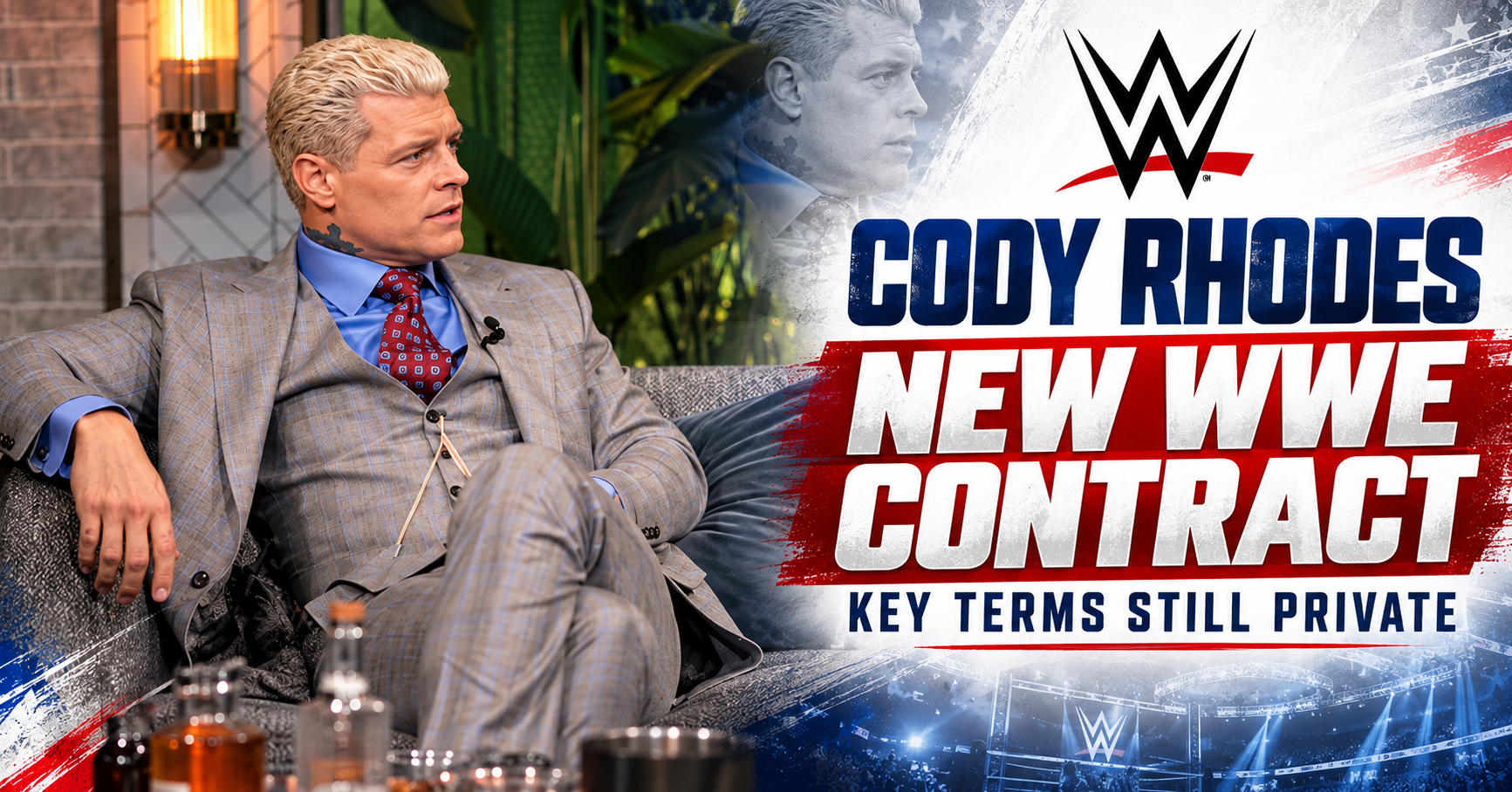
Cody Rhodes has confirmed that he recently re-signed with WWE and intends to finish his wrestling career with the company. The announcement makes his preferred destination clear, but the deal’s length, financial value and expiration date remain undisclosed.
The 41-year-old revealed the deal during an interview released Wednesday, October 7, while discussing retirement, outside projects and the demands of raising a family alongside a wrestling career.
“I just re-signed with WWE,” he said.
His explanation went beyond staying on the roster. Rhodes described being able to pursue other work, collaborate with WWE around those opportunities and return to the company. He also spoke about eventually being more consistently present for his two daughters.
Those remarks give the announcement its significance. Cody Rhodes is committing to the company where he achieved his biggest wrestling breakthrough while considering how that relationship can accommodate the rest of his life.
In the full interview below, Cody Rhodes explains how the new agreement fits into the career he wants to build from here.
Five Key Facts About Cody Rhodes’ New WWE Contract
● He confirmed that he recently re-signed with WWE in the interview released October 7.
● He intends to end his wrestling career with the company.
● The contract’s duration, financial terms and expiration date were not disclosed.
● He described flexibility to pursue outside projects in collaboration with WWE.
● He did not announce a retirement date, a final match or a specific reduced wrestling schedule.
What the Contract Announcement Actually Establishes
Cody Rhodes’ announcement puts an agreement in place after months of discussing what his next WWE deal might mean. His stated wish to stay now has a completed renewal behind it.
The public announcement should not be mistaken for a signing date. Rhodes described the agreement as recent; October 7 is when audiences heard the confirmation. He did not identify when it was completed or when its terms take effect.
Private terms are routine in wrestling. Their absence here leaves readers with a confirmed renewal and his description of what he wants from the relationship, rather than a complete account of the agreement’s obligations.
The distinction matters most in the retirement discussion. Rhodes has identified where he expects to finish, while leaving the timing open. Those are two separate parts of his career planning, and the announcement answers the first much more clearly than the second.
How Cody Rhodes’ Contract Position Has Changed Since 2024
This announcement follows a sequence of increasingly clear statements about his plans.
In March 2024, Cody Rhodes publicly confirmed a multi-year WWE extension. At the time, he explained that the agreement carried him beyond his 40th birthday, moving him past an earlier ambition to retire at that age.
He was 38 when he discussed that extension. His explanation included the feeling that his strongest career run had arrived relatively late, making a previously imagined stopping point less practical.
That was an important adjustment. A retirement target formed before a wrestler reaches the position he has spent years pursuing can look different once he actually gets there. Rhodes was approaching WrestleMania 40 with a chance to win the championship that had defined his return.
In November 2025, he said his next WWE contract would probably be his last and that he expected to finish his wrestling days with the company. The possibility of another agreement was already part of his public planning.
On February 25, 2026, Cody Rhodes again discussed expecting his next WWE deal to be his last while making clear that he had no fixed date for the end of his career.
The October announcement now confirms a new agreement after those earlier statements. It fits the direction he had described, but it still does not establish that another extension could never follow.
A wrestler can expect a deal to be his final one without announcing the precise circumstances under which he will stop competing. Health, family needs, outside opportunities and the work itself can all influence that decision.
The chronology also prevents an easy misunderstanding about the 2024 contract. Saying that it extended beyond his 40th birthday did not identify that birthday as its expiration date. Cody Rhodes turned 40 in June 2025, but his comments about passing that milestone were never a complete disclosure of the agreement’s term.
The Value Cody Rhodes Built Before This Agreement
The new deal follows a career transformation that began well before his current WWE run.
Cody Rhodes left WWE in 2016 and rebuilt his identity outside the company. By 2019, he was an executive vice president and a central figure in the launch of AEW. His profile grew through work that placed him in front of different audiences and gave him responsibilities beyond performing matches.
That experience matters when assessing his return. He came back with an established identity and a substantial history elsewhere in wrestling. WWE was bringing in someone whose career had developed during the six years he spent away.
After departing AEW in February 2022, he returned at WrestleMania 38 on April 2 and defeated Seth Rollins. The American Nightmare presentation provided a clear connection between the wrestler audiences had followed outside WWE and the performer now appearing on its biggest stage.
His first months back also demonstrated the physical cost of the career he was rebuilding. He competed against Rollins inside Hell in a Cell with a torn pectoral muscle in June 2022, then spent months away recovering.
Cody Rhodes returned to win the 2023 Royal Rumble, lost to Roman Reigns at WrestleMania 39 and won the Royal Rumble again in 2024. On April 7, 2024, he defeated Reigns at WrestleMania 40 to capture the Undisputed WWE Championship.
That sequence gave his second WWE run an unusually clear progression: a major return, a serious injury, a comeback, a failed championship challenge and the eventual title victory.
It also explains why renewing Cody Rhodes carries more significance than retaining a familiar name. WWE has invested prominent television and WrestleMania programs in him, and those programs have produced an established central performer.
His return has already delivered the championship breakthrough that once seemed uncertain. The contractual question has consequently shifted toward how long the relationship can continue and what form his career takes after that achievement.
What Cody Rhodes’ Pay Comments Reveal About WWE
The contract discussion led into a broader conversation about wrestling compensation.
Cody Rhodes said that the availability of other places to wrestle had changed the industry’s economy. He spoke positively about current earnings, described guaranteed contracts as a responsibility and credited Nick Khan and TKO with helping the highest level of WWE pay become comparable with mainstream sports.
He was talking about the highest earning level when making the sports comparison. He did not reveal his own salary.
When asked about newer wrestlers, Rhodes acknowledged that he did not know the developmental details. He mentioned six-figure money before deferring to Khan’s explanation of different earning levels. That exchange leaves the developmental pay question unresolved; it does not confirm a universal six-figure minimum.
Cody Rhodes is discussing the business from a position few wrestlers reach. His assessment offers insight into how a leading performer sees the current market, with a clear limitation: satisfaction at the top cannot establish how compensation works throughout the roster.
WWE’s broader finances provide useful context. The company generated $620.9 million in revenue in the second quarter of 2026, up 12% from the same period in 2025. Media rights, production and content accounted for $359.7 million of that quarterly total.
Higher media rights fees were the largest contributor to the increase. Consumer products and partnerships also grew. Live events and hospitality revenue, however, fell from $185.7 million to $152 million, with the decline driven mainly by lower WrestleMania 42 ticket sales.
WWE also incurred higher talent, production and other event costs. The figures show a growing business investing more in its operations, alongside a decline in one important revenue category.
That mix matters when assessing broad claims about WWE’s success. Higher rights fees and weaker ticket sales can occur in the same quarter. Overall growth does not describe every part of the business equally, just as one headliner’s pay assessment does not describe every wrestler’s experience.
The financial results provide context for Rhodes’ remarks without establishing his individual value to the company or the size of his new deal. Those figures remain undisclosed.
Why Competition Belongs in the Contract Discussion
Rhodes’ reference to other places to wrestle is notable given his own career.
Cody Rhodes spent years working outside WWE and helped establish AEW before returning. His career provides a concrete example of how a performer’s standing can change through opportunities with other employers.
In practical terms, having alternatives can matter in negotiations because a wrestler has more than one possible destination for his work. That principle helps explain the relevance of his remarks about the wider wrestling economy.
It does not prove that Cody Rhodes negotiated this agreement against a competing offer. He did not reveal an AEW proposal, describe a bidding process or identify another promotion that pursued him during these talks.
The distinction keeps the story grounded. The existence of competition is a feature of the industry; the circumstances of this particular negotiation remain private.
There is also a useful historical point here. His decision to remain with WWE does not erase the work he did elsewhere. That work helped create the performer WWE welcomed back in 2022.
The current agreement extends a relationship that became possible after that earlier departure and rebuilding period. It is a reminder that leaving a company and later committing to it can be parts of the same career, particularly when the wrestler returns with a different position and a clearer sense of what he wants.
Outside Projects Are Becoming Part of His Career Planning
Cody Rhodes’ comments about flexibility arrived as he promotes Street Fighter, in which he plays Guile. The film is scheduled to reach theaters on October 16.
That gives the discussion an immediate example. Acting is already part of his professional life, and he described a relationship with WWE that allows him to pursue other projects while remaining connected to wrestling.
His explanation suggests that outside work could influence how his career develops. A performer who can accommodate another project without ending his wrestling relationship has more ways to organize the years ahead.
The effect on his wrestling schedule remains open. Cody Rhodes did not outline an appearance count or identify a future absence, so his description of flexibility cannot yet be translated into a specific calendar.
For WWE, a recognizable wrestler appearing in other entertainment can create additional publicity opportunities. Whether that attention produces new wrestling viewers, ticket sales or merchandise purchases has to be demonstrated; participation in a film alone does not establish those outcomes.
The more immediate significance is professional flexibility. Cody Rhodes is discussing a career that can include wrestling and acting, with collaboration between those commitments.
That is relevant to longevity because staying associated with WWE need not require every future year to look identical to the years that brought him to WrestleMania 40. The announcement leaves room for his work to evolve, even though the specific arrangements remain undisclosed.
Family Priorities Explain Why Retirement Remains Unscheduled
Cody Rhodes’ discussion of his two daughters gives the retirement question a more personal context.
He recalled how consistently his parents attended the activities and events that mattered to him as he grew older. He wants to provide that kind of presence for his own children.
“I’d love that for my two girls,” he said.
That ambition has appeared alongside his contract planning for years. When discussing the 2024 extension, he also spoke about eventually needing to be home and reflected on watching his father continue wrestling at an older age.
The consistency is worth recognizing. Passing his earlier target of retiring at 40 did not remove the family considerations behind it. His professional circumstances changed while the desire to be present remained.
There is a practical tension in that position. Wrestling and acting can both involve travel and lengthy commitments. A more varied career may offer different opportunities, but it does not automatically create more time at home.
How Cody Rhodes manages that balance will depend on the work he accepts and the schedule he ultimately follows. The new contract announcement does not provide that calendar.
He also pointed to Bobby Roode and Michael Hayes as examples of people whose involvement in wrestling developed through different roles. Their careers help explain why retiring from matches and withdrawing from the industry can be different decisions.
Cody Rhodes did not announce a future producer position or another specific job after his wrestling career. He described possibilities and influences, leaving the eventual transition open.
His Current WWE Storyline Still Needs Its Own Payoff
The business announcement comes while Cody Rhodes remains involved in an active television conflict with Randy Orton.
On the October 2 episode of SmackDown, Cody Rhodes faced Kevin Owens and Johnny Gargano in the final men’s Money in the Bank qualifying match. After Rhodes hit Owens with Cross Rhodes, Orton pulled the referee from the ring.
Rhodes had a chance to return to the match, but chose to attempt a Punt on Orton instead. Gargano interrupted with a dive to the outside. Owens ultimately pinned Gargano following a Pop-up Powerbomb while Orton prevented Rhodes from returning to the ring.
The outcome cost Rhodes the qualifying opportunity and continued the conflict with Orton. It also illustrates the difference between a wrestler’s business standing and the immediate direction of his character.
A renewed contract provides continuity. The Orton rivalry still has to make that continuity compelling on television.
Orton’s interference also gives the audience a concrete reason to follow the rivalry: it took an opportunity from Rhodes. The next developments need to build on that cost. Repeated attacks will become harder to justify if they merely return both wrestlers to the same argument.
For Cody Rhodes, continued prominence means continued scrutiny. Audiences will judge the renewal’s wrestling value through the opponents and programs that follow.
What WWE Gains From Keeping Cody Rhodes
WWE retains a performer whose second run has included major returns, consecutive Royal Rumble victories and a WrestleMania championship win over Roman Reigns.
Those achievements give WWE an established history to draw on. His outside work could also broaden the settings in which audiences encounter him, while his experience offers possibilities for programs with wrestlers at different stages of their careers.
Retention has a straightforward planning benefit: WWE can continue developing stories around someone who has confirmed his commitment to the company.
The creative value of that commitment still depends on the work that follows. A familiar headliner can provide continuity across a roster, but recurring prominence alone does not make each new rivalry distinctive.
The opportunity is to use what Cody Rhodes has already established to build meaningful stakes with the people around him. An opponent’s role should extend beyond keeping an established star occupied until the next championship program.
His WrestleMania 40 victory produced a major destination for his return story. Continuing from there requires relationships and conflicts that remain interesting after that destination has been reached.
The contract provides a basis for that work to continue. Its eventual importance will be measured through the matches, stories and professional choices made during it.
Final Thoughts
Cody Rhodes has confirmed a new WWE deal after repeatedly describing the company as the place where he expects to finish wrestling.
His comments also show how his planning has expanded: he is considering outside projects, future family time and the possibility of staying involved in wrestling through different roles.
The missing terms prevent a precise assessment of the deal’s financial value or duration. The confirmation nevertheless resolves his immediate future after months of discussing another agreement.
WWE has retained a major performer. Rhodes has renewed a relationship that delivered his biggest championship breakthrough. The next test is how well that relationship serves his evolving career and the stories audiences are being asked to follow.
Make sure to subscribe to our Late Night Crew Wrestling YouTube Channel. Follow @yorkjavon, @kspowerwheels & @LateNightCrewYT on X.
I’m the quiet one until the bell rings then I’ve got takes. I live for WWE NXT and TNA, I want every promotion to succeed, and I will absolutely roast the bad decisions on sight (because someone has to). Anime taught me to respect long-term storytelling; wrestling taught me that sometimes the plan is “we panicked” and called it “unpredictable.” The Miz got me into all of this, so yeah I appreciate confidence, commitment, and the art of talking like you’re already the main event. Now I bring that same energy to the page as the main writer for Late Night Crew Wrestling because if you’re not here to be must-see and tell the truth, why are you here?!