A great Money in the Bank match should make the briefcase feel worth fighting for. That sounds like a low bar until you watch a ring full of wrestlers spend more time arranging ladders than trying to climb them.
The stipulation has given WWE extraordinary athletic performances, ugly betrayals, overdue breakthroughs and some spectacular examples of a company getting in its own way. Its best matches turn the scramble into something you can follow emotionally. You know who is gaining ground, why an alliance matters and what a wrestler gives up by choosing revenge over the contract. Its weaker matches confuse constant activity with excitement, then rely on the winner’s name to make the ending seem important.
That distinction matters when ranking the best Money in the Bank matches. Edge’s first cash-in, Rob Van Dam’s victory at ECW One Night Stand and Seth Rollins’ intervention at WrestleMania 31 are enormous moments. They belong to the briefcase’s history. They do not automatically settle which ladder matches were the best.
The same standard applies to the women. IYO SKY’s 2023 victory and Tiffany Stratton’s 2024 win deserve to be judged alongside the strongest men’s matches because their action and storytelling earn that comparison. Putting them in a separate category would make this ranking less useful.
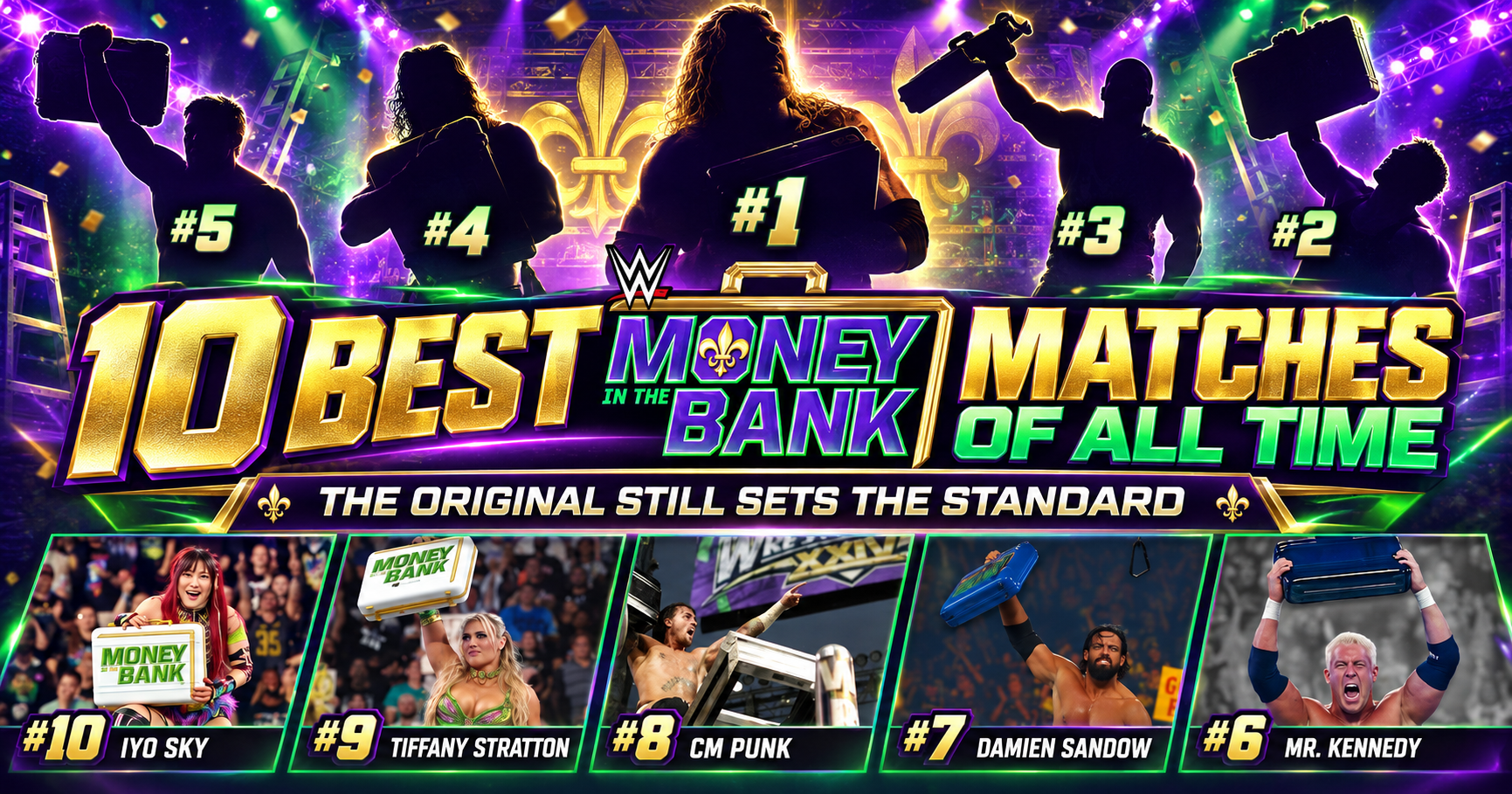
This is my combined top 10 of completed WWE Money in the Bank ladder matches through 2025, written ahead of the October 10, 2026 event. The order considers execution, pacing, character work, believable opportunities to win and the quality of the finish. A celebrated cash-in can add historical significance; a failed one cannot retroactively ruin a good match.
The top 10 Money in the Bank matches, ranked
1. WrestleMania 21 — 2005. Original men’s match. Winner: Edge.
2. Money in the Bank 2016. Men’s match. Winner: Dean Ambrose.
3. Money in the Bank 2021. Men’s match. Winner: Big E.
4. Money in the Bank 2014. Contract ladder match. Winner: Seth Rollins.
5. Money in the Bank 2011. SmackDown’s World Heavyweight Championship contract match. Winner: Daniel Bryan.
6. WrestleMania 23 — 2007. Men’s match. Winner: Mr. Kennedy.
7. Money in the Bank 2013. World Heavyweight Championship contract match. Winner: Damien Sandow.
8. WrestleMania 24 — 2008. Men’s match. Winner: CM Punk.
9. Money in the Bank 2024. Women’s match. Winner: Tiffany Stratton.
10. Money in the Bank 2023. Women’s match. Winner: IYO SKY.
The countdown below explains why each match makes the cut, where it falls short and what separates it from the matches above it.
10. Money in the Bank 2023 — Women’s: IYO SKY makes the smartest climb
Date: July 1, 2023.
Participants: IYO SKY, Bayley, Becky Lynch, Trish Stratus, Zelina Vega and Zoey Stark.
Winner: IYO SKY.
The London women’s match understood something that too many multi-person matches ignore: relationships should change how people compete.
Trish Stratus and Zoey Stark had a shared interest in making Becky Lynch miserable. Bayley and IYO SKY were Damage CTRL teammates, although their cooperation had an obvious limit. There was one contract, and Bayley’s willingness to help SKY became much less convincing when SKY was close to taking it.
Those alliances gave the match two distinct tensions. Lynch had to chase the briefcase while navigating opponents already invested in stopping her. SKY had to decide whether working with Bayley was improving her chances or sacrificing them. The wrestling could advance both problems without needing an extended interruption to explain the story.
Zelina Vega deserves credit for supplying more than an extra body. Her Code Red on Stark onto a bridged ladder was a major contribution to the match’s physical intensity. SKY’s moonsault supplied another burst of athleticism. The field had enough variety that the punishment did not depend on six people repeating the same exchange.
Still, this was not an uninterrupted run of excellent execution. Some transitions were awkward, and the coordination became visible between the stronger sequences. Stratus and Stark were effective as obstacles for Lynch, but neither consistently felt as likely to win as the central contenders. The match was better at developing its relationships than at maintaining six equally persuasive routes to the briefcase.
The ending elevated everything around it.
After Bayley had already sabotaged her teammate’s opportunity, SKY used the handcuffs left attached to Lynch to connect Lynch and Bayley through the ladder. She then climbed over Bayley and retrieved the contract. Both obstacles remained in the ring, directly underneath the woman they wanted to stop. Neither could reach her.
That is an exceptionally good finish because the visual explains the outcome and the character decision at the same time. SKY does not simply benefit from everybody else disappearing. She solves a problem. Bayley’s betrayal gives her a reason to stop cooperating, and the handcuffs give her the means to act on it.
Climbing over Bayley adds the final insult. SKY literally uses the teammate who tried to hold her back to reach the opportunity above them. It is pointed without requiring a speech, a sudden faction breakup or a complicated explanation after the bell.
The contract eventually brought SKY a championship at SummerSlam, where she cashed in on Bianca Belair. The London match had already done something valuable: it presented her as capable of taking control of her own situation.
I have it at No. 10 because the finish is stronger than the match’s least polished stretches. The 2024 women’s match distributes its standout work more effectively and sustains a more convincing overall scramble. This one earns its place through a closing sequence that rewards everything established between SKY and Bayley. Few Money in the Bank endings use the ladder itself to tell a story this clearly.
9. Money in the Bank 2024 — Women’s: Chelsea Green’s fear makes the finish work
Date: July 6, 2024.
Participants: Tiffany Stratton, Chelsea Green, IYO SKY, Lyra Valkyria, Naomi and Zoey Stark.
Winner: Tiffany Stratton.
Chelsea Green’s fear of heights could have been a disposable comedy routine. Instead, it became the setup for the match’s most effective late opportunity.
That is what separates this women’s Money in the Bank match from a collection of impressive moves. The six competitors have distinct ways of contributing. Green brings character. Stratton supplies explosive athleticism and the confidence of somebody expecting to become a star. SKY understands how to move through the stipulation’s chaos. Valkyria’s exchanges with SKY give the match a competitive edge, while Naomi and Stark add offense that keeps the field from becoming a two-woman exhibition.
Green’s reluctance to climb initially makes her seem poorly equipped for the task. The match keeps returning to that limitation until she finally has a route to the briefcase. By then, her climb means something. A wrestler who has spent the match looking terrified is forcing herself upward because the reward is within reach.
That progression produces a better near-win than simply having another person slowly reach for the hook.
Around her, the match delivers enough inventive wrestling to justify its reputation. Naomi’s position between two ladders before taking Stark into a DDT is an especially good example of adapting an established athletic strength to the setting. Stratton’s climb along a ladder toward the corner, followed by her dive onto opponents outside, makes her agility useful within the match’s geography.
SKY and Valkyria bring a different kind of urgency. Their struggle on the ladder looks competitive rather than decorative. They use its rungs and awkward positioning to create reversals, making it feel like a place where an advantage can be won or lost.
The punishment eventually becomes severe. SKY taking Stark from the top of the ladder onto a bridge is one of the match’s defining images. It also exposes the uncomfortable side of this performance. Several landings are rough, and an earlier Stark sequence looks particularly awkward. Calling the match excellent should not mean pretending every dangerous attempt is executed cleanly.
The strongest praise belongs to how the final stretch converts the earlier work into a finish. After Green reaches the top and gets close to winning, Stratton sends her from the ladder through the two tables at ringside. Stratton then retrieves the briefcase.
Green’s fall is memorable because the match has made her ascent memorable first. Without that groundwork, it would be another wrestler taking another large bump. With it, the fall ends a little story that has developed throughout the contest.
Stratton benefits from that construction too. Her victory feels decisive. She removes the last obstacle herself and takes the contract, rather than standing underneath it while an outsider cleans up the field. The match supports her presentation as a potential leading star through action.
I give 2024 the edge over 2023 because more of its competitors leave a distinct impression before the ending. SKY’s handcuff finish is cleverer, but the Toronto match has the stronger combination of sustained invention, individual character and a final struggle that belongs to the winner.
The rough execution keeps it below the more complete matches ahead. It remains the best women’s Money in the Bank match on this list, with Green doing as much to make its finish matter as the woman who leaves with the case.
8. WrestleMania 24 — 2008: CM Punk wins a match full of credible alternatives
Date: March 30, 2008.
Participants: CM Punk, Chris Jericho, Shelton Benjamin, John Morrison, Carlito, MVP and Mr. Kennedy.
Winner: CM Punk.
WrestleMania 24’s Money in the Bank match has the valuable quality of feeling open. Chris Jericho is an established headliner. Mr. Kennedy won the previous year. MVP, John Morrison and CM Punk all look like wrestlers who could benefit from a change in status. Shelton Benjamin is already one of the stipulation’s defining performers.
The field gives the audience reasons to look beyond one favorite. That matters because Money in the Bank loses suspense when the entire match feels like a waiting room for a predetermined winner.
Morrison announces the match’s ambition with a moonsault to the floor while holding a ladder. The connection is not perfect, and that imperfection should be acknowledged. The idea still demonstrates how his athleticism can make familiar surroundings look different. He treats the ladder as something he can carry into an aerial attack rather than merely climb.
Benjamin once again supplies the kind of movement that makes the stipulation feel larger than its rules. His athletic recoveries and the violent fall onto the ladder outside are central to the spectacle. The tower-of-doom sequence involving Benjamin, Kennedy and Morrison adds another major collision without leaving the match entirely dependent on one person’s highlight.
There is a cost to that ambition. The exchanges do not always flow as smoothly as the strongest Money in the Bank matches. Some of the connective work looks like preparation for the next attraction. Benjamin’s biggest fall also removes a performer who has been doing considerable work to maintain the match’s energy.
Matt Hardy’s return gives the bout a different kind of payoff. He emerges to stop MVP and delivers a Twist of Fate from the ladder. An interruption that might otherwise feel arbitrary has a clear target and an established history. Hardy is settling an issue with the man responsible for his absence.
That does not make interference automatically good. It makes this interference legible. The audience knows why Hardy has arrived, who he intends to punish and how that punishment changes the immediate competition. He does not stay to dictate who must win.
The final exchange belongs to Punk and Jericho. Jericho appears close enough to retrieving the briefcase that Punk has to find an actual solution. Punk traps Jericho’s leg in the ladder’s rungs, leaving him unable to prevent the winning climb.
The finish is important to this placement. After all the aerial risks and elaborate collisions, Punk wins through a practical piece of improvisation. The ladder becomes a restraint, and the victory feels earned by what Punk does at the moment it matters.
His later cash-in on Edge helped transform his standing in WWE. The WrestleMania match had already given him a credible first step by allowing him to outmaneuver an established star in a competitive field.
WrestleMania 24 ranks below the 2013 World Heavyweight Championship contract match because its best sequences are more loosely connected. Its range of plausible winners, inventive offense and sharply constructed ending still make it a stronger overall choice than matches remembered mainly for the eventual champion.
7. Money in the Bank 2013 — World Heavyweight Championship Contract: Cody Rhodes makes you care, Damien Sandow makes you angry
Date: July 14, 2013.
Participants: Cody Rhodes, Damien Sandow, Dean Ambrose, Antonio Cesaro, Jack Swagger, Wade Barrett and Fandango.
Winner: Damien Sandow.
The less celebrated of the two 2013 Money in the Bank matches is the better one.
The All-Stars match has the bigger names and the more consequential connection to the WWE Championship. This opener has a clearer emotional progression. Cody Rhodes makes the audience want a particular outcome, and Damien Sandow takes it away at exactly the point when it feels available.
That achievement is especially striking because the field consists of heels. On paper, there is no obvious heroic center. In practice, the match allows one to develop through performance. Rhodes becomes the wrestler people want to see rewarded because he keeps fighting, creates openings and appears to be doing the work required to win.
The alliances make the early competition more interesting. Cesaro and Swagger can combine their strength as the Real Americans. Rhodes and Sandow enter with the history of Team Rhodes Scholars. Ambrose brings the possibility of Shield support. These are useful advantages, but none resolves the fundamental problem that one person gets the contract.
Cesaro and Swagger’s attempt to use Swagger’s shoulders as a platform for Cesaro to reach upward is a particularly effective bit of invention. It grows out of their partnership and physical strengths. Rhodes breaking up the attempt gives him another active contribution to the match’s direction.
The action is forceful without relying exclusively on the enormous falls associated with later versions. Cesaro’s strength, Barrett’s improvised use of a broken ladder rung and Ambrose’s unorthodox movement create different threats. Rhodes’ run of offense gradually becomes the main event within the match.
By the time he delivers consecutive Cross Rhodes and begins clearing his route, the crowd has a reason to invest. He is no longer merely one of seven participants. He is the wrestler gathering momentum toward a result the audience can picture.
The Shield interference complicates that progression. Seth Rollins and Roman Reigns try to help Ambrose, and the Usos arrive to fight them. It adds bodies to an already crowded situation and temporarily pulls attention away from the competitors chasing the contract. That is the match’s most obvious structural weakness.
The crucial difference is that the interference does not supply the final answer. Rhodes survives the disruption, sends Ambrose from the ladder into the gathering outside and creates another opportunity. Sandow then reappears, knocks his supposed friend down and takes the briefcase.
It is a betrayal committed by a participant pursuing the actual prize. Sandow has benefited from Rhodes’ effort and uses their relationship to make the theft feel personal. Rhodes’ reaction afterward gives the ending its sting. The match has changed what the audience wants for him, even though he has lost.
Sandow’s subsequent failed cash-in against John Cena remains a disappointing use of the opportunity. It does not erase this performance. If eventual booking determined match quality, the list would become a ranking of title reigns with ladders attached.
I place this above WrestleMania 24 because the final act is more tightly connected to the competition preceding it. The interference holds it below WrestleMania 23 and the strongest six-person matches. Its central accomplishment survives all of that: a crowded ladder match turns one wrestler into a sympathetic figure and another into the reason his moment is stolen.
6. WrestleMania 23 — 2007: Jeff Hardy sacrifices the contract, and the match becomes bigger
Date: April 1, 2007.
Participants: Mr. Kennedy, Edge, Randy Orton, CM Punk, King Booker, Finlay, Jeff Hardy and Matt Hardy.
Winner: Mr. Kennedy.
WrestleMania 23 expanded Money in the Bank to eight competitors and used the larger field to broaden the match’s personality.
Edge and Randy Orton give it established main-event credibility. The Hardy brothers bring experience in ladder matches and a history with Edge that can overwhelm their judgment. King Booker and Finlay add distinct characters. CM Punk represents an emerging possibility, while Kennedy has the confidence and position to make a victory feel like a plausible next step.
The most famous sequence is also the match’s most revealing decision.
Jeff Hardy has access to the contract but chooses, with Matt’s encouragement, to launch himself onto Edge on a ladder outside the ring. The leg drop destroys the ladder and removes both men from the contest. Jeff trades a possible world-title opportunity for the chance to punish an old enemy.
That is the reason the stunt still works as more than a demonstration of risk. It changes the competition through a choice. Jeff is capable of winning, but the urge to settle a score proves stronger than his ability to concentrate on the prize.
The match allows other personalities to interfere with rational strategy too. Booker’s concern for Sharmell becomes leverage. Finlay’s connection to Hornswoggle leads to a different kind of disruption. Kennedy dealing with Hornswoggle through a Green Bay Plunge from the ladder is absurd, physically ambitious and entirely consistent with the match’s willingness to let character complicate the scramble.
Not every viewer will appreciate those diversions equally. The Hornswoggle material is the easiest part to find excessive, and the field sometimes looks too crowded for all eight wrestlers to sustain a meaningful presence. The match is less economical than the original. There are more elements competing for attention, and Jeff’s fall is so spectacular that it can overshadow everything afterward.
Orton’s RKOs and the recurring climbing attempts help keep the actual contest alive. Punk remains a convincing late threat. Kennedy ultimately stops him with a ladder shot and retrieves the briefcase, giving the match an ending centered on two wrestlers still trying to claim the opportunity.
Kennedy’s victory also serves the stipulation’s original purpose. Established champions are in the field, but the contract goes to a wrestler who has not reached their level. The match can make somebody appear ready for a larger role without requiring him to defeat every former champion individually.
What followed is frustrating. Kennedy did not get the cash-in the win seemed to promise, and Edge eventually took the contract from him. That failure belongs to the follow-through. It cannot make the WrestleMania performance disappear.
This is the best of the larger WrestleMania Money in the Bank fields because the extra participants bring motives as well as moves. Its excess is also why it stops at No. 6. The 2011 SmackDown match maintains a more consistent sense of urgency, while the top four have stronger control over their central stories.
WrestleMania 23 remains an essential example of how to make a major ladder spot matter: let the wrestler have something to lose by doing it.
5. Money in the Bank 2011 — SmackDown: Daniel Bryan earns a breakthrough without being handed the match
Date: July 17, 2011.
Participants: Daniel Bryan, Cody Rhodes, Heath Slater, Justin Gabriel, Kane, Sheamus, Sin Cara and Wade Barrett.
Winner: Daniel Bryan.
CM Punk and John Cena dominate the memory of Money in the Bank 2011. The opening SmackDown ladder match is one of the reasons the event was already working before the main event began.
Its strength comes from urgency and uncertainty. Bryan is an appealing potential winner, but the match does not behave as though everybody else has been invited to witness his coronation. Barrett, Rhodes and Sheamus have credible claims to the opportunity. Kane is an established obstacle, and the aerial wrestlers give the action enough speed to prevent the heavier exchanges from defining its entire rhythm.
That balance is important to Bryan’s win. He looks like a wrestler who can succeed in this field, rather than a future legend receiving an obvious historical checkpoint. The victory means more because other possibilities remain alive.
Sin Cara and Justin Gabriel add a kind of athletic movement the larger wrestlers cannot duplicate. Gabriel’s 450 splash from a ladder positioned across the ropes onto Kane is one of the match’s strongest illustrations of that contrast. The smaller competitors have to find ways to make their offense register against men who can end an exchange through size alone.
Sheamus powerbombing Sin Cara through the ladder at ringside makes the physical imbalance brutally clear. The sequence is memorable because it interrupts the possibility that speed and invention can solve every problem. A wrestler can be moving well and still find himself removed through one overpowering attack.
Sheamus subsequently taking his own punishing fall onto a ladder gives the match a sense of consequences circulating through the field. Dominance does not grant immunity. The next interruption can come from somebody the previous exchange seemed to have neutralized.
There are occasional stretches where the eight-person structure becomes apparent. Some competitors contribute their sequence and then spend too long outside while the next configuration takes over. Slater and Gabriel are useful to the athletic work without becoming as convincing as the strongest possible winners. The match is busy enough that a few transitions lack the clarity of the top-ranked six-person editions.
The final confrontation compensates for those limitations. Bryan has to contend with Rhodes and Barrett before he can reach the contract. He does not arrive after an outsider has removed his rivals. He fights at the ladder, kicks Barrett away and creates the opening himself.
The result is a genuine advancement in his WWE career, but the match does not need knowledge of WrestleMania 30 to justify the reaction. A talented wrestler who has not been consistently positioned at the top has secured an opportunity that changes his immediate future.
His December cash-in on Big Show adds another chapter. It is not the reason this ladder match belongs at No. 5.
The pace, stylistic variety and competitive finish put it ahead of WrestleMania 23’s more sprawling production. I keep it below the 2014 contract match because Rollins and Ambrose give that contest a more sustained personal center, despite the problems with its finish.
Bryan’s victory is one of Money in the Bank’s clearest demonstrations that surprise does not require randomness. The winner can be unexpected and still emerge through a struggle that makes sense.
4. Money in the Bank 2014 — Contract Ladder Match: Rollins and Ambrose give every opening a personal cost
Date: June 29, 2014.
Participants: Seth Rollins, Dean Ambrose, Dolph Ziggler, Kofi Kingston, Rob Van Dam and Jack Swagger.
Winner: Seth Rollins.
The 2014 contract match begins with an advantage most Money in the Bank fields do not have: one rivalry is so fresh and combustible that almost every interaction between its central wrestlers carries meaning.
Rollins had recently betrayed the Shield. Ambrose wanted revenge, and the contract gave him another reason to keep Rollins within reach. Winning would improve Ambrose’s future. Preventing Rollins from winning would also deny a reward to the man who had turned on him.
The overlap makes Ambrose’s behavior convincing. He is chasing the briefcase and pursuing Rollins, with those objectives repeatedly helping and obstructing each other. The match does not have to invent personal stakes because the audience already understands them.
Rollins has the opposite problem. He wants the prize associated with his new position beside the Authority, but Ambrose refuses to let the competition become a clean route upward. His former teammate keeps turning ambition into a fight.
The supporting field prevents the match from becoming a singles feud with four bystanders. Van Dam’s ladder offense gives it experience and variety. Kingston uses his balance and agility to turn a tipped ladder into another attack. Swagger’s physicality creates obstacles, while Ziggler’s late opportunity provides a convincing alternative outcome.
That last contribution is easy to underestimate. If only Rollins and Ambrose appear capable of winning, the other participants become scenery. Ziggler briefly makes the audience believe the central rivalry could cost both men while somebody else takes advantage.
Ambrose’s superplex on Rollins from the ladder is the match’s signature collision. It grows out of the conflict instead of feeling like an unrelated obligation. The punishment is personal, and it also changes the immediate availability of the contract.
Ambrose being taken away for medical attention, then returning, adds another escalation. His absence gives Rollins room to operate. His return takes that comfort away. The match uses a familiar device effectively because the audience has a particular reason to want him back.
Then Kane arrives, and the ending becomes both appropriate to the story and weaker as competition.
His attack on Ambrose allows Rollins to claim the contract with the Authority’s help. That supports Rollins’ character and makes Ambrose’s frustration sharper. It also means that one of the competitors most responsible for the match’s quality loses his opportunity through somebody outside the field.
Both judgments can be true. A finish does not become satisfying simply because it fits a faction’s behavior. Kane makes the story more coherent while making the ladder match’s final resolution less rewarding.
That is why I stop at No. 4. The wrestling and central rivalry could support a higher placement. The ending leaves Rollins benefiting from a solution supplied to him, whereas the top three give their winners a more direct role in completing the climb.
Rollins’ WrestleMania 31 cash-in made the contract legendary. It did not need to rescue this match. The hostility between Rollins and Ambrose, the supporting performances and the escalating attempts to stop one another had already produced one of the best Money in the Bank matches.
Its greatness survives the interference. It does not excuse it.
3. Money in the Bank 2021 — Men’s: Big E’s win rewards a match that earns its crowd
Date: July 18, 2021.
Participants: Big E, Seth Rollins, Kevin Owens, Drew McIntyre, Riddle, Ricochet, John Morrison and Shinsuke Nakamura, competing as King Nakamura.
Winner: Big E.
The return of a full pay-per-view crowd after the ThunderDome period gave Money in the Bank 2021 an unusual atmosphere. This men’s match deserves credit for doing enough with that atmosphere to remain excellent after the novelty wears off.
There are eight participants, but the field does not feel interchangeable. Morrison and Ricochet can make the ladders part of aerial combinations. Owens commits to punishment with the intensity the stipulation demands. McIntyre supplies a heavyweight threat. Riddle’s offense and Nakamura’s presence add different routes through the scramble. Rollins carries established credibility and an insistence that the opportunity should belong to him.
Big E gives the match its most satisfying potential destination. He has the strength to compete with the larger wrestlers and the audience connection to make a breakthrough matter. The challenge is to let him win through the competition rather than merely receive the celebration everybody has anticipated.
The match’s standout athletic sequence belongs to Ricochet. When his ladder is tipped toward the ropes, he lands on the top rope and launches himself into the wrestlers outside. The recovery converts a defensive crisis into offense. It looks spectacular, but it also makes sense as an attempt to avoid being taken out.
Owens’ fall after Rollins powerbombs him over the ropes onto a bridged ladder provides the opposite kind of spectacle. There is no graceful escape. The impact clears an opponent through violence, and Rollins’ involvement keeps the damage tied to an active contender.
The strongest stretches move between those approaches without making the field feel divided into separate exhibitions. Athletic ingenuity, heavyweight offense and sudden reversals overlap. The audience can respond to an individual sequence while still tracking who is becoming a threat.
The removal of McIntyre is the major exception. Jinder Mahal, Veer and Shanky arrive and take him out of the match. Their interference serves a separate feud and deprives the ladder match of one of its most credible competitors. It is unnecessary baggage in a contest already capable of creating its own complications.
Some of the elaborate setups also reveal the difficulty of coordinating eight people. The match occasionally asks the audience to accept an extended arrangement because the eventual collision will be worth it. Most are worthwhile. The need to build them still gives 2016 an advantage in overall control.
Big E’s finish is what makes the final assessment so strong. He delivers the Big Ending to Rollins from the ladder, then climbs and takes the contract. The victory has a decisive physical action attached to it. He defeats the last obstacle through his own offense.
That is considerably better than winning because the other contenders happen to leave an empty ring. The crowd gets the outcome it wants after the match has supplied a convincing reason for it.
Big E later cashed in on Bobby Lashley to win the WWE Championship. The briefcase victory already felt like a substantial advancement, independent of how the reign would unfold.
I put this at No. 3 because its athletic peaks and emotional payoff are exceptional, while the outside removal of McIntyre and occasional visible setup keep it behind 2016. It is proof that crowd enthusiasm can amplify a great match without being the only thing holding it up.
2. Money in the Bank 2016 — Men’s: Six wrestlers keep the prize at the center
Date: June 19, 2016.
Participants: Dean Ambrose, Kevin Owens, Sami Zayn, Cesaro, Chris Jericho and Alberto Del Rio.
Winner: Dean Ambrose.
Money in the Bank 2016 is the strongest example of the stipulation’s modern form because it has enough stories to make the action personal without allowing any of them to replace the competition.
Owens and Zayn bring a rivalry that can turn any encounter into a fight. Ambrose and Jericho have their own recent history. Cesaro and Del Rio add strength, technique and credible opposition. All six have something useful to do, and none exists solely to fill the ring before the winner’s final sequence.
The smaller field helps, but numbers alone do not explain the quality. WWE has produced six-person ladder matches that still feel disjointed. Here, the competitors repeatedly disrupt one another’s progress, making the match feel like a struggle developing in the ring rather than a procession of assigned showcases.
Cesaro’s giant swing on Jericho into a ladder adapts a signature move to the environment. Del Rio’s armbar on Cesaro atop the ladder creates a different threat. The offense does more than incorporate metal for emphasis; it forces opponents into positions that affect their ability to continue climbing.
Owens contributes one of the nastiest stretches of punishment. His frog splash onto Ambrose on a ladder is substantial on its own. Zayn’s Michinoku Driver on Owens onto another ladder gives that violence a personal answer.
The Owens-Zayn rivalry improves the match because the additional aggression has consequences. They are capable of damaging each other beyond what is necessary to stop a climb, and that can leave somebody else with an opening. The stipulation makes their inability to leave one another alone strategically costly.
Ambrose does not have to dominate every phase to remain an important contender. He survives enough of the changing configurations to be available when the closing struggle develops. That is a useful distinction between protecting a winner and making the winner look absent until the outcome is due.
The final ladder arrangement is elaborate. Multiple ladders and bridges create a structure that allows the whole field to contest the case. It is also the clearest weakness in an otherwise exceptionally controlled match: the construction can look too deliberately prepared, and the subsequent falls depend on everybody reaching particular positions.
The wrestlers make the sequence work through the number of believable interruptions. Nobody simply disappears to grant Ambrose the victory. The field thins through confrontations, and Owens remains the last major obstacle.
Ambrose knocks Owens from the ladder onto the bridge and retrieves the contract. The finish belongs to a participant who has endured the competition and completed the decisive action himself. There is no late arrival handing him the answer.
The same-night cash-in creates an extraordinary historical footnote. Roman Reigns, Rollins and Ambrose all hold the WWE Championship at different points during the event. Ambrose’s involvement completes the Shield’s movement through the title that night.
That is valuable context, but the ladder match ranks this highly before the cash-in happens. Its strengths are already present in the exchanges, rivalries and finish.
The original retains the advantage in economy and the way its final attack pays off damage established earlier. For a longer, more elaborate version of Money in the Bank, however, 2016 is the benchmark. Its strongest achievement is making six individual performances feel like one competition.
1. WrestleMania 21 — 2005: The original understands what every climb should mean
Date: April 3, 2005.
Participants: Edge, Chris Jericho, Christian, Shelton Benjamin, Kane and Chris Benoit.
Winner: Edge.
The first Money in the Bank match remains the best because it is remarkably clear about what each competitor contributes and how the punishment changes the result.
Later editions have bigger constructions, more participants and more extreme falls. WrestleMania 21 has a stronger sense of proportion. It introduces the stipulation, establishes its possibilities and reaches a finish that grows directly out of the action without exhausting the audience along the way.
Kane is the physical obstacle the field cannot casually ignore. Jericho gives the contest experience and a believable claim to the opportunity. Christian looks for shortcuts, with Tyson Tomko adding another way to gain an advantage. Edge approaches the match as a chance he cannot afford to miss. Benjamin expands what the ladders seem capable of allowing.
Benoit’s involvement makes revisiting the match uncomfortable; assessing the performance does not excuse his crimes. His role in the match’s construction nevertheless has to be described accurately, especially because the injured arm becomes essential to the finish.
That attention to damage is one of the original’s greatest strengths. The punishment is not merely a temporary excuse to leave someone outside while another wrestler performs. It accumulates and supplies a vulnerability that can be exploited later.
Benjamin’s run up the angled ladder into a clothesline on Jericho is the defining athletic moment. The sequence is astonishing without looking detached from the competition. Jericho is climbing, and Benjamin finds a route to stop him that nobody expects.
It also establishes something important about Benjamin’s legacy in this match type. He does not need to win to become indispensable to its identity. His movement demonstrates possibilities that other wrestlers will spend years developing, while the match gives those possibilities a clear purpose.
Christian’s use of Tomko and the efforts to manage Kane provide different kinds of obstacles. The field has to account for size, assistance, athleticism and opportunism. That variety means the match can move briskly without making every exchange feel alike.
The final climb brings the accumulated punishment into focus. Benoit has a chance to win, but the damaged arm makes him vulnerable. Edge attacks that arm with a chair, removes him from the ladder and takes the briefcase.
The finish is simple enough to understand immediately and specific enough to reward the match preceding it. Edge does not need an authority figure to arrive and clear the ring. He sees the weakness, attacks it and takes the opportunity.
That action also gives the winner a character the briefcase can strengthen. Edge’s later reputation as an opportunist is not pasted onto the result after the fact. The winning behavior is already there in the ladder match.
His January 2006 cash-in on John Cena after the Elimination Chamber demonstrates how powerful the contract can become when it is attached to the right wrestler. It does not create the quality of the WrestleMania performance. It extends a trait the performance has already established.
There are imperfections. Some early stretches involve several wrestlers recovering outside, and the novelty of the stipulation gives the match an advantage no sequel can reproduce. Neither issue undermines how efficiently the major sequences connect.
WrestleMania 21 wins this ranking because its spectacle, character work and finish reinforce one another. Benjamin’s athleticism changes the possibilities of the contest. The damaged arm changes the final climb. Edge’s decision changes his future.
More than two decades later, that remains the standard: the ladders should affect the struggle, the struggle should expose the wrestlers and the winner should emerge through a decision the audience understands.
The strongest matches outside the top 10
Money in the Bank 2013 — WWE Championship All-Stars match
Randy Orton, CM Punk, Daniel Bryan, Rob Van Dam, Christian and Sheamus make this a formidable contender. Van Dam’s return in Philadelphia and Bryan’s surge supply two strong sources of investment. The final act is the problem. Curtis Axel takes Bryan out of contention, then Paul Heyman betrays Punk, allowing interference to determine too much of the outcome. Orton’s eventual cash-in is enormously important to WWE history, but the World Heavyweight Championship contract match on the same card tells its central story more effectively.
Money in the Bank 2017 — Men’s match
AJ Styles and Shinsuke Nakamura’s confrontation is one of the best individual moments in the stipulation’s history. Their decision to set aside the ladder and face each other gives the crowd something worth anticipating. Owens and Zayn also bring considerable intensity. Baron Corbin attacking Nakamura before the match and returning to spoil the late opportunity makes sense for his character. The lengthy structure and the way the ending interrupts the strongest developing exchange keep it just outside this list.
Money in the Bank 2019 — Men’s match
There is terrific work from Ali, Andrade, Finn Bálor and Ricochet, among others. The match’s athletic ambition deserves recognition. Brock Lesnar arriving at the end to take the briefcase is the decisive flaw. The competitors create the entertainment and absorb the punishment, only for the result to belong to somebody who has bypassed that struggle. A surprise appearance can get a reaction while making the preceding competition feel less valuable.
Money in the Bank 2018 — Women’s match
Alexa Bliss wins a substantial improvement on the women’s 2017 debut. Becky Lynch’s late opportunity, Charlotte Flair’s presence and the athletic contributions of Naomi and Ember Moon give the field genuine depth. It is a credible alternative to the two women’s matches selected here. I favor 2023’s more precise character payoff and 2024’s stronger distribution of memorable sequences. The 2018 match deserves to be discussed on quality, rather than remembered only as a necessary step forward.
WrestleMania 22 — 2006
Rob Van Dam’s victory is deserved and historically significant. Ric Flair’s ladder superplex and return provide strong drama, while Benjamin again adds outstanding athleticism. The match is too compressed to develop its field as fully as the best editions. Van Dam’s cash-in against Cena at One Night Stand is a better argument for ranking his use of the contract than for moving this particular ladder match into the top 10.
Money in the Bank 2010 — SmackDown
Kane’s victory comes from a match with a sensible central problem: the smaller wrestlers must contain Kane and Big Show before they can think seriously about winning. Kingston’s Boom Drop on Drew McIntyre through the announce table is a major highlight. The oversized ladder and the lengthy stretches of arranging the action hurt the pace. It is a strong match whose structure becomes cumbersome too often to displace the selections above.
Money in the Bank 2023 and 2024 — Men’s matches
The 2023 field benefits from a loud London crowd and strong investment in LA Knight. Damian Priest’s win is defensible, but the awkward Ricochet–Logan Paul table sequence is part of an uneven performance.
The 2024 match has excellent invention from Andrade, Carmelo Hayes and Chad Gable, and Drew McIntyre wins through his own actions. Its shorter scramble leaves less room for the participants to develop sustained struggles. McIntyre’s failed cash-in later in the show is not the reason it misses this ranking.
Money in the Bank 2025 — Men’s match
Penta, Andrade and the rest of the field supply exciting work, and Jacob Fatu turning on Solo Sikoa gives the finish a substantial story development. The problem is how much of the ending belongs to people outside the match, including Bron Breakker and Bronson Reed. Rollins leaves with the contract after the closing stretch increasingly becomes a collision between surrounding factions. The story moves forward, but the ladder match loses control of its own resolution.
Why the original still wins
The best Money in the Bank matches make the contract feel valuable before anybody cashes it in.
That is why this list includes Sandow despite what happened afterward, puts Bryan’s 2011 match above more star-heavy fields and gives the women’s 2023 and 2024 performances places in a combined ranking. The question is what the wrestlers deliver while the briefcase is still hanging above them.
The original answers that question with the least wasted motion. The match reveals Benjamin’s extraordinary possibilities, makes its accumulated damage relevant and lets Edge win through the opportunism that will define his use of the contract.
WWE has expanded the scale many times since. WrestleMania 21 still has the clearest understanding of why somebody climbing a ladder should matter.
Make sure to subscribe to our Late Night Crew Wrestling YouTube Channel. Follow @yorkjavon, @kspowerwheels & @LateNightCrewYT on X.

I’m the quiet one until the bell rings then I’ve got takes. I live for WWE NXT and TNA, I want every promotion to succeed, and I will absolutely roast the bad decisions on sight (because someone has to). Anime taught me to respect long-term storytelling; wrestling taught me that sometimes the plan is “we panicked” and called it “unpredictable.” The Miz got me into all of this, so yeah I appreciate confidence, commitment, and the art of talking like you’re already the main event. Now I bring that same energy to the page as the main writer for Late Night Crew Wrestling because if you’re not here to be must-see and tell the truth, why are you here?!