
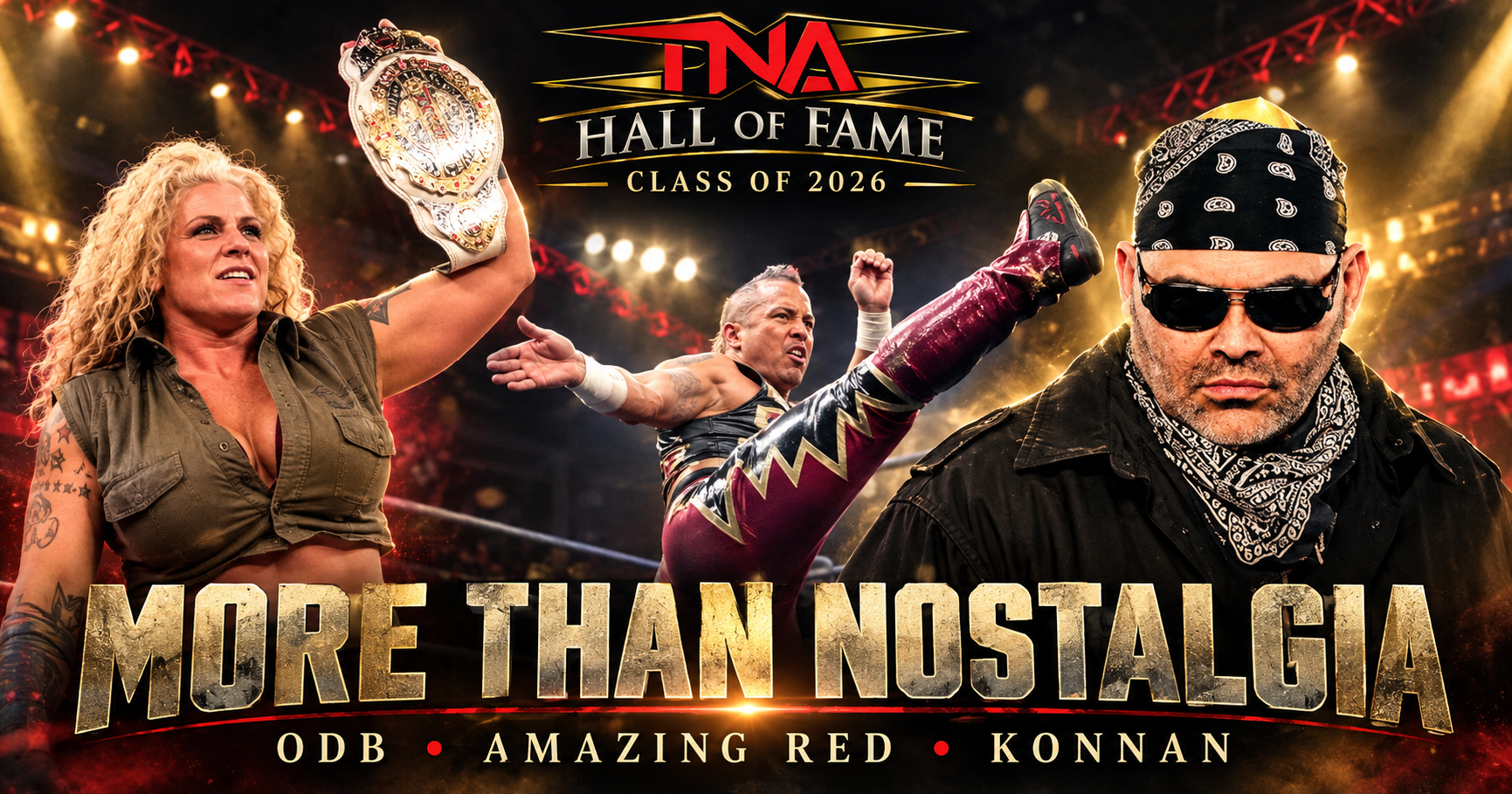
The TNA Hall of Fame 2026 class brings together three people who helped give this company a reason to exist beyond being another wrestling promotion. ODB helped make the Knockouts division a place where a woman with a loud personality, physical presence and unconventional presentation could become a legitimate championship contender. Amazing Red gave the early X-Division some of its most inventive wrestling. Konnan turned experience, an unmistakable voice and an eye for talent into two distinct generations of LAX. Their inductions at Bound For Glory on October 11, 2026, are deserved. The more interesting question is whether their careers will be remembered with the detail they have earned.
A championship count alone will not do that. ODB won four Knockouts singles titles, but some of those victories came with decisions that weakened the achievement. Red became a three-time X-Division champion, yet his influence spread much further than TNA’s commitment to featuring him. Konnan won tag team gold himself before becoming more valuable as the man helping other wrestlers establish their identities. There are great matches, memorable characters and important accomplishments throughout these careers. There are also interruptions, neglected championships and relationships that broke down.
That is what makes this class worth examining properly. TNA can celebrate its history without smoothing over the decisions that made that history frustrating to follow.
The TNA Hall of Fame 2026 class at a glance
The induction ceremony is scheduled for October 11, 2026, at the Yuengling Center in Tampa, Florida, as part of Bound For Glory.
| Inductee | First TNA appearance and defining arrival | Induction participants |
| ODB | Early 2003 appearances against Trinity on Xplosion; established Knockouts arrival at Bound For Glory on October 14, 2007 | Inducted by Al Snow and Traci Brooks; presented by Earl Hebner |
| Amazing Red | July 24, 2002, against Low Ki on TNA’s sixth weekly pay-per-view | Inducted by Frankie Kazarian |
| Konnan | June 19, 2002, in the Gauntlet for the Gold on TNA’s inaugural pay-per-view | Inducted by Cruz Montana, formerly Mike Santana |
ODB’s selection was announced at Rebellion on April 11, 2026. Amazing Red and Konnan were announced at Slammiversary on June 28, 2026. Each announcement connected an established part of TNA’s history to the company’s current programming.
ODB’s TNA story began before the Knockouts championship existed
ODB, whose real name is Jessica Kresa, had appeared in TNA years before the run most fans associate with her. She wrestled Trinity on Xplosion in early 2003, with that encounter appearing in the March 1, 2003, episode records. Further appearances followed in 2004, including work under the name Poison.
Her place in the company changed at Bound For Glory on October 14, 2007. ODB participated in the ten-woman gauntlet that established TNA’s women’s championship, with Gail Kim becoming the inaugural champion. ODB was part of the division’s foundation, although she did not win its first title.
That distinction matters because the Knockouts division did not become interesting through one wrestler or one match. Gail Kim supplied an exceptional standard in the ring. Awesome Kong gave the division a dominant threat. The Beautiful People developed a recognizable act built around vanity and cruelty. ODB brought a rougher personality and a willingness to look completely comfortable in a fight.
Her flask, mannerisms and crowd interaction made her immediately identifiable. The character also had physical credibility. ODB could take punishment, throw an opponent around and make a confrontation feel different from the division’s other rivalries. Her personality gave people an entry point; her ability to work with different opponents gave TNA a reason to keep using her.
The early matches against Kong were especially important. ODB challenged her at Against All Odds on February 10, 2008, and was involved in the championship three-way with Kong and Gail Kim at Destination X on March 9, 2008. At Lockdown on April 13, 2008, ODB and Kim defeated Kong and Raisha Saeed.
Those matches established her as someone who could stand across from the division’s most imposing wrestler and make the fight believable. She did not need to beat Kong every time to earn that position. She needed the audience to believe she would keep coming at her.
ODB’s complete TNA championship record
ODB’s championship record consists of four Knockouts singles reigns and one Knockouts tag team reign with Eric Young. The singles championship has changed names over time; all four victories belong to the same title lineage.
| Championship victory | Date and event | How the title was won |
| First Knockouts singles reign | August 16, 2009 Hard Justice | ODB and Cody Deaner defeated Angelina Love and Velvet Sky, with Deaner pinning Sky to win Love’s championship for ODB |
| Second Knockouts singles reign | September 20, 2009 No Surrender | Defeated Cody Deaner for the vacant championship |
| Third Knockouts singles reign | January 4, 2010 Impact | Defeated Tara |
| Fourth Knockouts singles reign | September 12, 2013, taping; broadcast September 19, 2013 Impact Wrestling | Defeated Mickie James |
| Knockouts Tag Team Championship | February 28, 2012, taping; broadcast March 8, 2012 Impact Wrestling | ODB and Eric Young defeated Gail Kim and Madison Rayne |
The first reign remains a particularly awkward piece of history. ODB finally became champion at Hard Justice, but Deaner scored the deciding pin over Velvet Sky while Angelina Love was the titleholder. The subsequent argument over who had actually earned the championship led to the title being vacated and ODB having to defeat Deaner at No Surrender.
ODB was capable of carrying the comedy. That does not make it a strong way to crown her. The division had already established women who could generate interest through competition, and her first championship became the center of an argument involving a male partner. A milestone that should have strengthened ODB’s standing instead needed another match to settle its basic legitimacy.
Her second reign offered a more substantial example of what she could do as champion. At Bound For Glory on October 18, 2009, she retained against Awesome Kong and Tara in a three-way match. Surviving those two opponents on TNA’s biggest annual event gave her a championship achievement with considerably more weight.
Tara ended that reign at Final Resolution on December 20, 2009. ODB regained the title on the January 4, 2010, Impact broadcast, a major episode associated with Hulk Hogan’s arrival and TNA’s attempt to challenge WWE on Monday television. Tara then won the championship back at Genesis on January 17, 2010. ODB’s third reign lasted thirteen days.
The fourth victory came against Mickie James in a match taped on September 12, 2013, and broadcast on September 19. It returned ODB to the top of the division after the singles championship had spent several years elsewhere. The opportunity was brief. Gail Kim won the title in the three-way with ODB and Brooke at Bound For Glory on October 20, 2013.
Four reigns show that TNA repeatedly trusted ODB in its championship picture. Their individual histories also show how often that trust produced a short turn with the belt rather than an extended run built around her.
The Eric Young partnership was memorable; the tag division paid the price
ODB and Eric Young were a natural pairing for TNA’s brand of comedy. Both could commit to an absurd situation without appearing embarrassed by it, and their on-screen relationship gave the audience a reason to follow them beyond the result of a match.
Their Knockouts Tag Team Championship victory aired on March 8, 2012. The reign continued until June 20, 2013, when Brooke Hogan stripped them of the titles because Young was a male wrestler.
The chronology exposes the weakness of the decision. TNA allowed Young to win a women’s tag team championship, kept the pairing as champions for more than fifteen months, and eventually used his eligibility to end the reign. The problem had existed from the moment the match was booked.
ODB and Young did defend the titles, including against Sarita and Rosita at Lockdown on April 15, 2012. Nevertheless, the championship gradually became less useful as the center of a competitive division. The long reign is part of ODB’s record, but its length should not be mistaken for fifteen months of sustained attention to women’s tag team wrestling.
That criticism belongs with the company’s handling of the championship. ODB and Young made their act recognizable. TNA still had to provide opponents, meaningful defenses and a reason for the belts to matter.
This chapter captures a recurring tension in ODB’s career. Her ability to get unusual material over made her valuable. It also made it easy to keep asking her to rescue a joke instead of giving her stronger competitive material.
ODB’s accomplishments extend beyond the five championship reigns
ODB won an eight-Knockout gauntlet on the January 3, 2008, Impact episode, establishing her position in the division’s contender rankings. At Lockdown on April 19, 2009, she won Queen of the Cage against Daffney, Madison Rayne and Sojo Bolt.
She also won the New Year’s Knockout Eve tournament broadcast on December 31, 2009. Her route included victories over Traci Brooks, Awesome Kong and Hamada, earning the title opportunity she converted against Tara on January 4, 2010. Although some career lists attach 2010 to the tournament, the competition aired at the end of 2009.
In 2014, ODB was part of the victorious Team Young in TNA’s One Night Only World Cup of Wrestling. The winning group consisted of Eric Young, Bully Ray, Eddie Edwards, Gunner and ODB. The event was taped on April 12, 2014, and broadcast on September 5, 2014. That was a team tournament achievement, separate from her championship reigns.
Her later appearances kept connecting her to different generations of the Knockouts division. She competed in Total Nonstop Deletion in December 2016, returned to the title picture against Rosemary in 2017, and challenged Deonna Purrazzo at Sacrifice on March 13, 2021.
Purrazzo defeated her. ODB could still function as an established opponent whose history made a victory useful to a newer champion. That is a meaningful role for a returning veteran.
At Rebellion on April 11, 2026, ODB teamed with Mickie James and Taryn Terrell against The Elegance Brand in a Hardcore Country match. Her team lost, and the Hall of Fame announcement followed.
Her induction should account for all of this: the early appearances, the launch of the division, the tournament wins, the title matches and the later work with newer opponents. The flask is an easy image to remember. The career underneath it explains why people cared when she raised it.
Amazing Red helped the X-Division establish its appeal
Amazing Red, whose real name is Jonathan Figueroa, debuted in TNA against Low Ki on July 24, 2002. Low Ki won the match on the company’s sixth weekly pay-per-view. Red was twenty years old.
That debut placed him in the company during its earliest effort to build an audience around the X-Division. TNA had recognizable veterans, but its smaller, faster wrestlers gave viewers something they could not assume they would get from the rest of the card.
Red’s value came from how he moved. His rapid changes of direction, aerial attacks and counters could make a familiar wrestling exchange look newly possible. The Code Red became his most recognizable contribution, but reducing him to the move overlooks the speed and timing that made his matches exciting.
His work with Jose and Joel Maximo as The S.A.T. added another part of that early identity. A six-man match against the Flying Elvises on August 7, 2002, put Red and the Maximos into the kind of energetic multi-person wrestling that helped establish TNA’s different styles.
The danger in discussing an innovator is making claims larger than the evidence. Red did not invent aerial wrestling or create every characteristic of the modern X-Division. He belonged to a group of wrestlers expanding what audiences expected from it. His contribution was distinctive enough that later performers could identify exactly whose work had influenced them.
Amazing Red’s complete TNA championship record
Red won the X-Division Championship three times and the NWA World Tag Team Championship once with Jerry Lynn during TNA’s NWA affiliation.
| Championship victory | Date and event | Opponent or team defeated |
| NWA World Tag Team Championship | April 16, 2003 — weekly TNA pay-per-view | Jerry Lynn and Red defeated Triple X’s Christopher Daniels and Elix Skipper |
| First X-Division Championship | April 30, 2003 — weekly TNA pay-per-view | Kid Kash |
| Second X-Division Championship | October 5, 2009, taping; broadcast October 8, 2009 — Impact | Samoa Joe |
| Third X-Division Championship | September 23, 2010 — New York live event | Jay Lethal |
The partnership with Lynn matters because Red was being placed beside a wrestler who helped establish the division’s standards. Their title victory over Daniels and Skipper made Red a world tag team champion before he won his first X-Division title.
For a brief period after April 30, 2003, he held both championships simultaneously. That overlap is one of the clearest accomplishments of his first TNA run.
Neither reign lasted long. Daniels regained the tag titles for Triple X in a handicap match on May 7, 2003. Chris Sabin defeated Red and Lynn in a three-way on May 14, 2003, to take the X-Division Championship.
Those short reigns should not erase what the victories established. Red was already being used alongside the wrestlers central to TNA’s identity. They do, however, help explain why his reputation has always been larger than his time holding championships.
His ROH tag team championship with AJ Styles belongs to his wider career, rather than this TNA title count. His April 2010 appearance as Matt Morgan’s replacement partner in a successful TNA tag title defense also did not give him a separately recognized reign in the TNA World Tag Team Championship lineage.
Red was part of Impact’s beginning as well as the weekly pay-per-view era
Red’s early importance carried into TNA’s move onto television. On the first Impact broadcast, June 4, 2004, he teamed with Sonjay Dutt and Hector Garza to defeat Team Canada’s Petey Williams, Bobby Roode and Eric Young.
That gives him a place in two important beginnings: TNA’s original year and the launch of the television program that became its central platform.
His matches offered evidence of the company’s strengths. The challenge was turning that evidence into a career with continuity. Knee injuries interrupted his progress, and his TNA appearances came in separate stretches rather than one uninterrupted ascent.
That context matters when judging what the company could reasonably have done with him. Physical setbacks affected his availability. His career cannot be explained entirely through creative decisions.
There is still room to examine the opportunities he received when he was available. An exciting wrestler needs more than occasional matches that remind everyone he is exciting. Rivalries, a clear place on the program and sustained attention give those performances somewhere to lead.
The 2009 comeback produced Red’s most substantial championship run
Red returned to TNA in 2009, teaming with Suicide in the Team 3D Invitational tournament before working his way back into the X-Division title picture.
His championship victory over Samoa Joe was taped on October 5, 2009, and broadcast on October 8. Bobby Lashley’s distraction contributed to Joe’s defeat, so the win should be remembered with its actual circumstances.
It was still a significant moment. Joe was an established threat, and Red’s second championship gave his return an immediate purpose. Don West’s association with him also supplied an enthusiastic advocate who could communicate why audiences should pay attention.
At Bound For Glory on October 18, 2009, Red retained in Ultimate X against Homicide, Christopher Daniels, Suicide, Alex Shelley and Chris Sabin. That defense deserves a prominent place in his Hall of Fame story. He entered TNA’s biggest annual event as champion and left it with the title after facing a field closely associated with the division.
Further successful defenses included Homicide at Turning Point on November 15, 2009, and Brian Kendrick at Genesis on January 17, 2010. Doug Williams ended the reign in a match taped on January 19, 2010, and broadcast on January 28.
This was the run that gave Red the strongest combination of championship status and notable defenses. He was doing more than supplying a spectacular moment for someone else’s segment. The division had a champion whose appeal came directly from what he could deliver in the ring.
The final title reign and Sangriento left opportunities unfinished
Red’s third X-Division championship came at the Hammerstein Ballroom in New York on September 23, 2010, when he defeated Jay Lethal. Lethal regained the belt in Rahway, New Jersey, on September 25.
A championship change at a live event can make the audience feel it witnessed something special. This one gave Red a title victory in New York and gave fans a reason to believe changes could happen outside television. It also lasted only two days.
That third reign adds to his record without adding much to his development as a featured champion. It is a useful example of why three reigns can mean less than the number initially suggests.
In 2011, TNA also used Red under a mask as Sangriento. The short-lived presentation gave an already recognizable wrestler another identity without producing an enduring role. For a performer whose individual style was his strongest asset, the reinvention did little to establish a clear direction.
His departure was announced on August 4, 2011. By then, TNA had received memorable matches, championship victories and years of work from Red, but the company had never established a lasting position for him on television.
His influence continued elsewhere. Will Ospreay has identified Red’s TNA work against Low Ki as an important early inspiration. Trey Miguel has described discovering Red through his work against Kurt Angle and seeing him as evidence that a smaller wrestler could belong at a high level.
Those are concrete connections. They explain how TNA performances can matter well after the promotion stops featuring the wrestler who delivered them.
The 2026 return gave Red a fitting moment of recognition
Red returned for the Ultimate X championship match at Slammiversary on June 28, 2026. The match placed him alongside a newer generation, and Frankie Kazarian delivered the surprise Hall of Fame announcement afterward.
Kazarian is a sensible choice to induct him. Their careers intersected during the X-Division’s early years, and Kazarian was present for the announcement that made the induction public.
Red’s own account also complicates the assumption that TNA simply ignored him until 2026. He has explained that the company approached him about the Hall of Fame before and that he declined. He was uncomfortable with the scale of the recognition and the sense of finality attached to it while he still considered himself an active wrestler.
That deserves to remain part of the story. The length of time before an induction cannot automatically be treated as proof that a company refused to acknowledge someone.
The stronger criticism concerns his career while he was working there. TNA had a wrestler whose matches could influence future stars, yet frequently used that value in brief bursts. The Hall of Fame can recognize the work he produced. It cannot supply the continuity his television career often lacked.
Konnan’s TNA career started on the company’s first event
Konnan, whose real name is Charles Ashenoff, debuted in TNA on June 19, 2002, participating in the inaugural Gauntlet for the Gold. He arrived with substantial experience from Mexico, WCW and other promotions.
The importance of his TNA run would come from how he used that experience. He could wrestle, speak for a group and help less established performers understand how to make an impression. As his role changed, his ability to give other wrestlers a stronger identity became central to his value.
His early TNA work also involved bringing a lucha libre perspective into the company’s conversations about the X-Division. That connection helped position TNA’s athletic wrestling within a broader history of performers and styles.
Then came 3 Live Kru, with Ron Killings and B.G. James. The group combined three distinct personalities into an act that could entertain the crowd and work within TNA’s developing tag team scene.
Konnan’s recognizable delivery was an asset, but the group also depended on Killings’ athleticism and James’ audience connection. Their chemistry gave TNA a popular act with more than one way to carry a segment.
Konnan’s complete personal championship record in TNA
Konnan’s own TNA championship record is two NWA World Tag Team Championship reigns with 3 Live Kru.
| Championship victory | Date and event | Details |
| First NWA World Tag Team Championship reign | November 26, 2003 — weekly TNA pay-per-view | 3 Live Kru defeated Simon Diamond, Johnny Swinger and Glenn Gilberti in a six-man match for the vacant titles |
| Second NWA World Tag Team Championship reign | November 7, 2004 — Victory Road | Konnan and B.G. James defeated Team Canada’s Bobby Roode and Eric Young |
The group’s title history recognizes its members under the Freebird Rule, allowing different combinations to defend the championship. Konnan’s first reign therefore belongs to the collective 3 Live Kru record; the second victory specifically featured him and James.
Winning at the inaugural Victory Road put the group into a significant stage of TNA’s development. The company was moving from weekly pay-per-views to a monthly three-hour event model, and 3 Live Kru won championship gold on that first major monthly card.
The group later expanded to 4 Live Kru with Kip James. The change intensified existing tensions, and Konnan attacked B.G. and Kip at Turning Point on December 11, 2005.
That breakup provided the opening for his most important TNA act. The familiar entertainment of 3 Live Kru gave way to a faction built around hostility, pride and confrontation.
LAX made Konnan’s experience useful to a new generation
The version of LAX built around Konnan, Homicide and Hernandez became one of TNA’s strongest acts in 2006.
Homicide brought speed, aggression and an established reputation. Hernandez supplied size and explosive power. Konnan gave them a voice that made their grievances and threats feel personal.
His management worked because it added a reason to care about the team. He could explain what LAX wanted, provoke an opponent and make a title match feel like a confrontation with consequences. Homicide and Hernandez then had to deliver the wrestling that supported those promises.
Their rivalry with AJ Styles and Christopher Daniels gave the group an ideal test. LAX first won the NWA World Tag Team Championship on the August 24, 2006, Impact broadcast. Styles and Daniels regained it in Ultimate X at No Surrender on September 24. LAX took it back inside Six Sides of Steel at Bound For Glory on October 22.
The different match formats allowed the rivalry to develop through distinct challenges. Ultimate X favoured a particular kind of athleticism. The cage made the confrontation feel more confined and violent. Both teams had the ability and personalities to make those changes useful.
Konnan also spoke openly during that period about helping Homicide and Hernandez with the details of succeeding in wrestling: handling audiences, navigating the business and making decisions in the ring. His role involved passing on knowledge as well as delivering promos.
The political language around LAX gave the act intensity, although some of TNA’s material relied on broad national and ethnic conflict. The strongest parts were the personalities and their sense of grievance. Those supplied enough substance without needing every angle to become an exaggerated confrontation over a flag.
The championships won by LAX belong to the wrestlers who won them
Konnan’s managerial accomplishments expand his TNA legacy, but they should be kept separate from his personal championship record.
| LAX team associated with Konnan | Championship accomplishments |
| Homicide and Hernandez in the original LAX era | Two NWA World Tag Team Championship reigns in 2006 |
| Santana and Ortiz in the 2017–2019 LAX era | Four Impact World Tag Team Championship reigns, beginning on the March 30, 2017; January 4, 2018; June 21, 2018; and April 28, 2019, broadcasts or events |
| Santana and Ortiz during the 2017 GFW integration | One GFW Tag Team Championship reign, followed by unification with the Impact tag title |
Homicide and Hernandez’s later TNA tag title victories belong to their careers and should not all be credited to Konnan’s original managerial run. Likewise, Santana and Ortiz’s four reigns describe the team’s record during that later LAX era. The story included changes in leadership, particularly King’s involvement in 2018.
That precision makes Konnan’s case stronger. His contribution can be assessed through the identities he helped develop and the programs he helped carry. The wrestlers’ championship victories provide evidence of the teams’ success without turning their accomplishments into additional personal titles for their manager.
Konnan’s departure and return make the history more complicated
Konnan left TNA in 2007. The relationship subsequently moved into legal disputes in 2008, with the parties resolving their claims in 2009.
His return in 2017 therefore followed a serious break with the company. It carried more weight than a routine appearance by a familiar veteran.
On the March 16, 2017, Impact Wrestling broadcast, LAX returned with Konnan, Homicide, Santana, Ortiz and Diamante. Santana and Ortiz became the team central to the new version.
Konnan’s presence connected the group to its earlier identity, while Santana and Ortiz gave it different personalities and a different style in the ring. That balance was essential. An established name can help a new act get noticed, but the new wrestlers still need room to make it their own.
Their first Impact tag title victory aired on March 30, 2017. Further reigns followed, and their rivalry with oVe gave the group a sustained conflict during that period.
Konnan helped give the new LAX credibility without needing to become its main wrestler. The team’s success showed that his value to TNA could extend across generations rather than depend on recreating one particular lineup.
The OGz feud and the Lucha Brothers rivalry gave the later LAX its own history
The conflict with King, Homicide and Hernandez as the OGz made LAX’s history part of an active story. Santana and Ortiz were fighting over the identity and authority of the faction they represented, with Konnan caught at the center of that struggle.
At Bound For Glory on October 14, 2018, Konnan teamed with Santana and Ortiz to defeat King, Homicide and Hernandez in the Concrete Jungle Death Match.
The stripped ring and exposed boards made the presentation severe. The stronger reason to care was the relationship between the people involved. The original LAX wrestlers, the newer team and the veteran associated with both generations were placed in direct conflict.
The later rivalry with the Lucha Brothers offered another kind of test. Santana and Ortiz could demonstrate their standing against a team with exceptional international credibility. At Rebellion on April 28, 2019, they defeated Pentagon Jr. and Rey Fenix in Full Metal Mayhem to begin their fourth Impact tag title reign.
That match gave the later LAX a major achievement of its own. The faction had moved beyond relying on memories of the 2006 team.
Cruz Montana’s role in Konnan’s 2026 induction brings that relationship back into focus. As Mike Santana, he developed within LAX before becoming a TNA World Champion. His participation allows the induction to connect Konnan’s work with a wrestler whose own career continued to grow after that partnership.
What TNA needs to get right about the recognition
TNA got the selections right. The ceremony should give viewers a clear understanding of why these careers belong in the Hall of Fame.
The advertised Bound For Glory schedule places the ceremony thirty minutes before the main pay-per-view. With three inductees and several speakers, TNA has given itself a narrow window. The company should make room for the people involved to explain the work and relationships behind the familiar footage.
The same care should extend beyond the ceremony. An accessible match selection, proper career profiles and accurate championship histories would help newer fans understand these contributions. Red’s 2003 title victories and 2009 defenses deserve that treatment. So do ODB’s early fights with Kong and both generations of LAX.
That is also where a promotion can be honest about its own history. ODB’s first title win involved a confusing dispute. Red’s career was affected by injuries and uneven opportunities. Konnan’s departure led to legal conflict before the relationship recovered enough for another important run. Those details explain the careers; removing them makes the story less useful.
Final Thoughts
The TNA Hall of Fame 2026 class has a strong case built on the work these three people actually did for the company.
ODB gave the Knockouts division an identity audiences could recognize and a contender they could believe in against very different opponents. Red’s wrestling reached future stars even when his own place on the program remained uncertain. Konnan helped turn two sets of talented wrestlers into successful LAX teams.
The titles are part of that case. The performances, rivalries and influence make it complete.
TNA should give this class enough attention for those achievements to carry their full weight. ODB earned more than a joke about a flask. Red earned more than a collection of spectacular moves. Konnan earned more than a replay of his most familiar lines.
The company has plenty of material to work with. It should tell the story properly.
Make sure to subscribe to our Late Night Crew Wrestling YouTube Channel. Follow @yorkjavon, @kspowerwheels & @LateNightCrewYT on X.
I’m the quiet one until the bell rings then I’ve got takes. I live for WWE NXT and TNA, I want every promotion to succeed, and I will absolutely roast the bad decisions on sight (because someone has to). Anime taught me to respect long-term storytelling; wrestling taught me that sometimes the plan is “we panicked” and called it “unpredictable.” The Miz got me into all of this, so yeah I appreciate confidence, commitment, and the art of talking like you’re already the main event. Now I bring that same energy to the page as the main writer for Late Night Crew Wrestling because if you’re not here to be must-see and tell the truth, why are you here?!