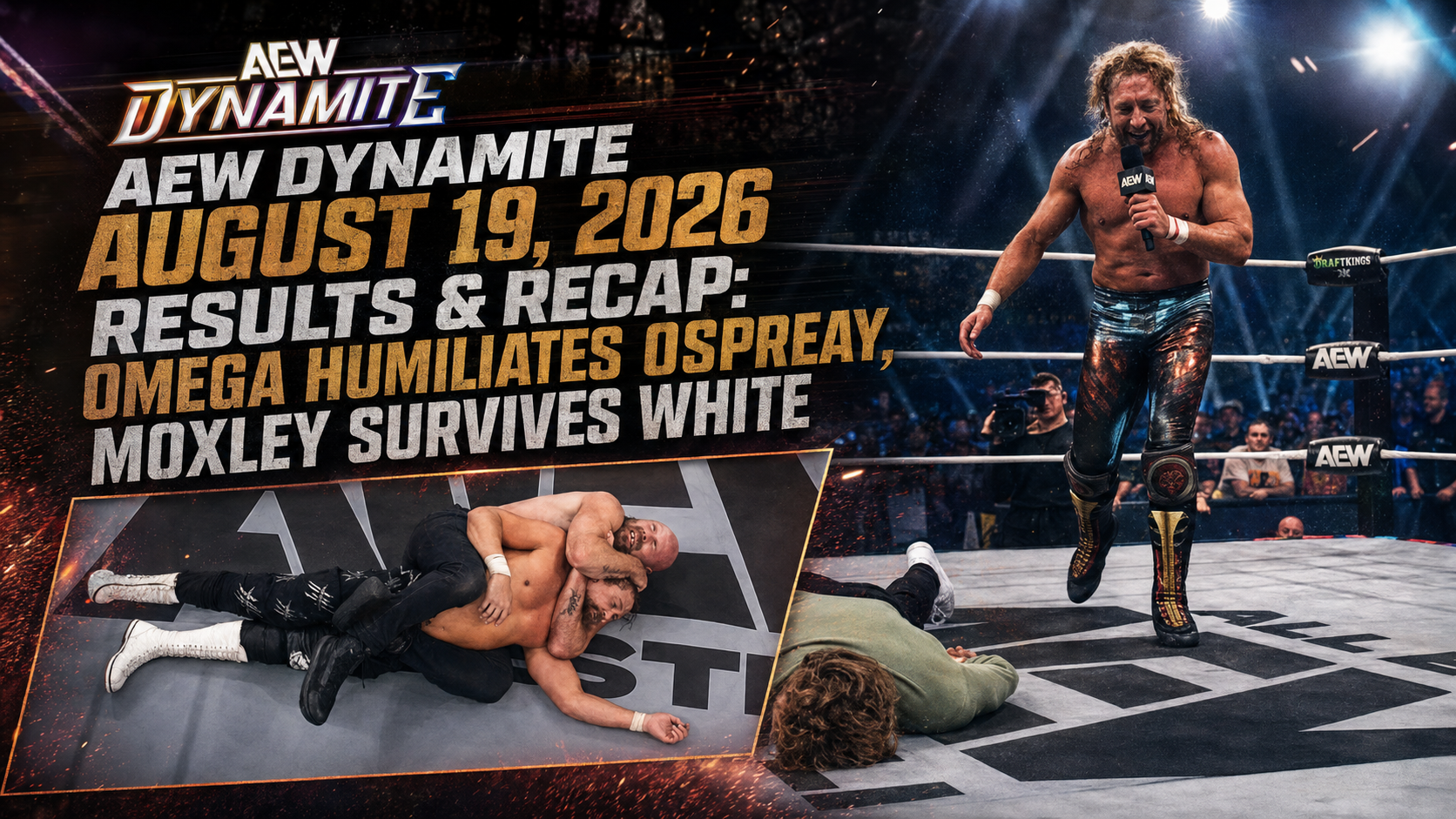
Last night’s AEW Dynamite was the kind of episode AEW needed with All In London rapidly approaching because, for once, the biggest takeaway was not simply that the company has a ridiculous amount of wrestling talent capable of producing great matches. Everybody already knows that. The more important development was that several of those matches finally started feeling like fights that actually need to happen at Wembley. Kenny Omega and Will Ospreay went from competitive resentment to something considerably uglier, with Omega digging directly into Ospreay’s lingering insecurity over their Forbidden Door history, bringing his family into the conversation and ultimately putting him through a table with the One-Winged Angel. Jon Moxley finally defeated Jay White one-on-one in the best match of the night, but White was protected by never tapping or being pinned. Nigel McGuinness dragged an injured left heel through Hechicero and is now one victory away from reaching the Continental Challenge Cup final in his home country. Konosuke Takeshita returned from the G1 and immediately exposed how little the Don Callis Family’s constant talk about loyalty actually means. Willow Nightingale and Mercedes Moné stopped pretending they could coexist inside a controlled interview. Kevin Knight turned Darby Allin’s own appetite for danger against him. Maya World continued proving that her TBS Championship reign deserves to be taken seriously.
AEW still managed to get in its own way at times. Gabe Kidd’s return should have been given considerably more room to breathe instead of immediately becoming one more development inside a crowded faction scene. The closing stretch eventually landed exactly where it needed to land with Omega standing over Ospreay, but AEW had to move through another pile of Don Callis Family involvement, the Young Bucks, Adam Copeland and Christian Cage before allowing the world championship rivalry to become the sole focus. The Continental Challenge Cup continues producing compelling wrestling, but its random-draw format sacrifices the easy bracket forecasting that usually makes tournaments fun to obsess over from one round to the next. None of those issues ruined last night. They simply prevented a strong Dynamite from being as clean and focused as it could have been.
What mattered most is that All In London felt substantially hotter when the show ended than it did when Dynamite began. Eleven days before Wembley, that was the job.
Here Are the Full Results
- The United Empire defeated The Don Callis Family
- Maya World (c) defeated Kris Statlander, Hikaru Shida and CMLL World Women’s Champion Persephone (TBS Championship)
- AEW Continental Champion Jon Moxley defeated Jay White (Continental Challenge Cup Quarterfinal)
- Andrade defeated Jonathan Cruz in a brief singles match.
- Nigel McGuinness defeated Hechicero (Continental Challenge Cup Quarterfinal)
- The Elite defeated The Don Callis Family
Breakdown & Reactions
United Empire Reunites as Ospreay Opens the Night With Momentum
AEW opened last night by putting Will Ospreay beside HENARE and Francesco Akira, and that detail mattered more than the result itself.
They were not simply three babyfaces thrown together because AEW needed an opening six-man tag.
They represented United Empire.
They represented the version of Ospreay that existed before AEW became the center of his wrestling life.
They represented history.
That became especially important as the rest of the episode unfolded because Kenny Omega spent much of last night trying to convince Ospreay that, when the pressure reaches its highest point, he is still the younger wrestler chasing something Omega already owns.
Opening the show beside Akira and HENARE quietly pushed against that idea.
Ospreay has history.
Ospreay has people.
Ospreay has built something.
He is not simply Kenny Omega’s successor waiting for approval.
The match itself did not need to become a twenty-minute war.
That would have been unnecessary this close to Wembley.
Brian Cage and Lance Archer supplied the obvious size advantage for the Don Callis Family side. HENARE gave United Empire enough physical credibility that everything did not need to run through Ospreay’s speed. Akira brought the kind of quickness that naturally complements Ospreay without simply duplicating him.
Rocky Romero occupied the correct role.
He was the talker.
The irritant.
The wrestler most likely to get caught when the match accelerated.
That is exactly what happened.
Romero found moments to frustrate Ospreay, but once he allowed himself to celebrate instead of finishing the job, the opening appeared.
Ospreay did not waste it.
Hidden Blade.
Three count.
That is exactly how AEW should be handling Ospreay on television this close to the biggest match of his AEW career.
He does not need to barely survive.
He does not need outside help.
He does not need a convoluted finish.
He needs to win.
There is a recurring temptation in AEW to turn every match into a miniature pay-per-view epic. Last night’s opener was better because it understood its place on the show.
It was energetic.
It featured enough recognizable personalities.
It gave Ospreay momentum.
Then it moved on.
Grade: B
What worked
- Ospreay received an immediate major reaction.
- HENARE and Akira gave the match more storyline meaning than random partners would have.
- The United Empire connection reinforced Ospreay’s history heading into Wembley.
- Cage and Archer supplied a believable physical contrast.
- HENARE’s presence kept the match from becoming entirely built around speed.
- Ospreay scored the decisive pin himself.
- The Hidden Blade gave the Wembley challenger a clean, uncomplicated victory.
What didn’t work
- Romero taking the pin was easy to predict.
- The Don Callis Family trio never felt especially likely to win.
- Cage and Archer largely functioned as useful opposition rather than characters with meaningful individual stakes.
- The match did its job without becoming particularly memorable.
Okada and Fletcher Talk About Family Until Takeshita Exposes the Truth
One of the better creative decisions last night was allowing Kazuchika Okada and Kyle Fletcher to expose themselves without forcing either man to deliver an obvious “the family is falling apart” speech.
Okada talked about loyalty.
He talked about keeping the AEW International Championship inside the Don Callis Family.
He talked about Konosuke Takeshita as though Takeshita were the selfish one.
Then Okada immediately undermined the entire argument.
His position was essentially that he would be happy if Fletcher retained the championship at Wembley.
But if Okada wins?
Fletcher should be happy for him.
Fletcher should raise his hand.
Fletcher should accept it because family comes first.
That is not loyalty.
That is selfishness dressed up as loyalty.
Fletcher followed with his own version of exactly the same hypocrisy.
The International Championship is his.
He has carried it.
He believes his reign matters.
Therefore, if Okada really cares about family, Okada should understand that protecting Fletcher is what matters most.
Both men were effectively asking the other to sacrifice his own ambition.
Neither had any intention of sacrificing anything himself.
Then, somehow, they agreed Takeshita was the selfish one.
That is where the segment became interesting.
Takeshita had been away competing in the G1.
He came back with absolutely no interest in listening to Fletcher dismiss what he had accomplished.
The confrontation escalated quickly.
Fletcher initially gave as much as he received.
That was important because Fletcher should not suddenly look terrified of Takeshita simply because the latter returned from Japan.
But Takeshita kept coming.
The offense escalated.
Blue Thunder Bomb.
Poisonrana.
Power Drive Knee.
Raging Fire.
Then Takeshita stood over Fletcher with the AEW International Championship.
The most important person in the segment by the end was arguably Okada.
Not because of what he did.
Because of what he did not do.
Fletcher had just talked about family.
He had just argued that Okada should have his back.
Takeshita destroyed Fletcher.
Okada never came to save him.
That silence told the entire story.
If keeping the championship “in the family” were truly the priority, Okada should have protected Fletcher.
He did not.
Because a damaged Fletcher entering Wembley helps Okada.
There is no real family here.
There are three elite wrestlers temporarily occupying the same faction while wanting the same championship.
That is far more interesting than pretending the match is built around friendly competition.
Grade: A-
What worked
- Okada exposed his own hypocrisy naturally.
- Fletcher revealed that his definition of loyalty is equally self-serving.
- Neither man needed to explicitly announce that the faction is cracking.
- Takeshita’s return immediately mattered.
- Fletcher and Takeshita’s physical exchange was intense without becoming an entire match.
- Takeshita looked dangerous immediately after returning.
- Raging Fire gave the segment a definitive ending.
- Okada refusing to help Fletcher told the story better than another speech would have.
What didn’t work
- Takeshita could have used slightly more time to address what his G1 run meant.
- Don Callis increasingly feels like the nominal leader of a group he cannot truly control.
- AEW should avoid overexplaining the dissension next week because last night already made it obvious.
Kenny Omega Finds the Insecurity Ospreay Still Hasn’t Escaped
The sit-down interview with Kenny Omega and Will Ospreay was the best segment from last night’s Dynamite because it finally explained why this Wembley match matters beyond the obvious.
Everybody already knows Omega and Ospreay can have an extraordinary wrestling match.
That was never the problem.
Their previous matches proved it.
Their résumés prove it.
Their reputations prove it.
Wembley itself gives the match scale.
The AEW World Championship gives the match stakes.
What the rivalry needed was something more personal than two elite wrestlers respectfully acknowledging that the other is elite.
The interview finally delivered it.
The discussion moved backward through their shared history.
Ospreay remembered himself as the younger wrestler who was not remotely ready to stand on Omega’s level.
Omega acknowledged seeing talent in him without pretending he immediately saw an equal.
That distinction is the psychological foundation of the entire rivalry.
Ospreay spent years climbing.
Omega spent years deciding whether Ospreay deserved to stand beside him.
That imbalance matters.
When Ospreay eventually became one of the most important wrestlers in New Japan after Omega left, Omega still found a way to make the story about himself.
His argument was merciless.
New Japan needed Kenny Omega to return because Omega could create the attention that Ospreay could not.
That is exactly the kind of comment capable of cutting through Ospreay because it reduces years of work to another chapter in Omega’s story.
Ospreay pushed back.
He talked about what happened during the pandemic era.
He talked about the pressure of carrying the company through circumstances Omega did not have to experience in the same way.
This stopped being two wrestlers trading compliments.
They were arguing about whose accomplishments actually carried more weight.
Then the conversation reached Forbidden Door 2023.
That was the most important part of the entire interview.
Ospreay beat Omega.
Officially, that is the result.
But Don Callis interfered.
The screwdriver became part of the match.
The victory that was supposed to validate Ospreay instead created another argument.
Did he really beat Omega?
Could he have done it without help?
Ospreay admitted that those questions still bother him.
That admission gave Omega exactly what he needed.
Omega did not simply accuse Ospreay of cheating.
He did something more effective.
He acted like he forgave him.
Then he used Ospreay’s own insecurity as evidence that the victory did not really count.
In Omega’s mind, they are not 1-1.
He is effectively 2-0.
That is manipulative.
It is also brilliant within the story.
Omega does not need his argument to be objectively correct.
He needs Ospreay to believe there is enough truth inside it to hurt.
Ospreay spent years chasing Omega.
Then he finally beat him.
And somehow he still did not receive the validation that victory was supposed to deliver.
That is why Wembley matters.
Ospreay is not simply trying to win the AEW World Championship.
He is trying to remove the asterisk.
No Don Callis.
No screwdriver.
No excuse.
No argument.
He needs to beat Omega cleanly at the biggest possible stage and force Omega to acknowledge the result.
Then the interview moved toward their bodies.
Omega survived diverticulitis.
Ospreay rebuilt himself after severe neck problems.
Both men have reached a point where their bodies are no longer abstract concepts.
They matter.
Omega argued that surviving his physical problems forced him to become smarter.
He questioned whether Ospreay’s neck can survive the pressure he intends to put on it at Wembley.
That added another layer.
This is not just about who was better in 2023.
It is about which version of each man has adapted better in 2026.
Then Omega found the one subject that made Ospreay stop thinking like a competitor.
Family.
Ospreay warned him away from talking about his mother.
Omega backed off.
Then he found something sharper.
Ospreay’s seven-year-old son.
The implication was that after watching his father lose at Wembley, the kid might need another hero.
That was where the segment stopped feeling like normal competitive promotion.
Omega knew what he was doing.
He had spent the entire interview identifying Ospreay’s insecurities.
The disputed victory.
The repaired neck.
The pressure of wrestling at home.
The expectations of family.
Then he pushed the one button that could turn anxiety into anger.
Fan reaction immediately reflected that shift.
The conversation after the segment was no longer primarily about whether Omega and Ospreay would have another classic.
It became about whether Omega had crossed the line.
Whether his behavior had shifted him into clear antagonist territory.
Whether Ospreay now needed to beat him for something more personal than championship gold.
That is exactly what this program needed eleven days before Wembley.
Grade: A+
What worked
- Their history was used as character material rather than trivia.
- Ospreay admitting that the Forbidden Door victory still bothers him was essential.
- Omega’s effective “2-0” argument attacked the right insecurity.
- The injury discussion added physical stakes.
- Ospreay finally explained why beating Omega cleanly matters so deeply.
- Omega gradually became more arrogant and cruel throughout the conversation.
- The family comment gave the rivalry the emotional edge it had been missing.
- Renee Paquette allowed the segment to breathe without dominating it.
- The interview directly established the emotional context for the closing angle later in the night.
- Fan reaction shifted toward the rivalry’s personal stakes rather than expected match quality.
What didn’t work
- The segment was long.
- Some of the earliest historical discussion could have been tighter.
- Viewers unfamiliar with the New Japan history had more context to process.
- AEW now has to remain consistent with Omega’s behavior instead of softening him immediately next week.
Maya World Survives Three Former Champions
The TBS Championship four-way was important for Maya World because winning a title and establishing a title reign are two different things.
Maya had already become champion.
Last night she needed to prove that she could survive credible opposition without the title feeling temporary.
Kris Statlander, Hikaru Shida and Persephone gave her three completely different problems.
Statlander brought power.
Shida brought championship experience.
Persephone brought speed and unpredictability.
Maya could not simply control the match from beginning to end.
She should not have.
That is what made the defense work.
The match became about survival.
Temporary alliances formed and disappeared almost immediately.
Nobody could trust anybody because only one woman could leave with the championship.
Statlander repeatedly looked like the biggest physical threat in the match.
That mattered because Maya’s eventual victory needed to feel like she escaped danger rather than simply overwhelmed a stronger opponent.
Shida remained credible throughout.
Persephone continued showing that she can exist comfortably beside established AEW names without looking out of place.
The finish fit Maya’s identity.
Statlander appeared ready to finish the champion with Staturday Night Fever.
Maya escaped.
She did not suddenly overpower Statlander.
She did not need outside interference.
She found the opening.
Roll-up.
Three count.
Some fans will always view a roll-up as a weak championship finish.
That is too simplistic here.
Maya’s value is not that she physically dominates everyone.
Her identity is increasingly becoming that she survives.
She reads situations.
She takes advantage of mistakes.
That can become a legitimate championship identity if AEW remains consistent.
The biggest criticism is that the match ended just as the closing stretch felt ready to become something more.
The pace had increased.
Statlander was gaining momentum.
Shida and Persephone still had believable routes back into the match.
Then it was over.
Another few minutes could have pushed the match from good to genuinely memorable.
Still, Maya pinned Statlander herself.
No outside interference.
No disqualification.
No shortcut beyond recognizing an opening.
That matters.
Grade: B+
What worked
- All four women had clearly different roles.
- Maya wrestled like a champion who understands her limitations.
- Statlander looked like the biggest physical threat.
- Shida remained credible throughout.
- Persephone continued looking comfortable against established AEW talent.
- The finish fit Maya’s opportunistic survival style.
- No outside interference was needed.
- Maya gained credibility by surviving three former champions.
What didn’t work
- The match ended slightly before the final stretch felt complete.
- The four-way format created a few sequence-heavy moments.
- Maya’s All In direction remains less clear than several other champions.
- A little more time could have made the title defense feel bigger.
The Brawling Birds Keep Their Message Simple
Jamie Hayter and Alex Windsor did not need a complicated segment last night.
Their job was straightforward.
They are going to Wembley.
They are challenging Megan Bayne and Lena Kross for the AEW Women’s World Tag Team Championship.
They are British.
The crowd is going to care.
AEW does not need to manufacture ten additional layers on top of that.
Hayter and Windsor work best when they sound like two wrestlers who simply enjoy fighting.
That is their credibility.
That is their chemistry.
That is what AEW should continue leaning into.
The segment accomplished that.
The problem is that the rivalry still lacks one defining angle capable of making the championship match feel essential on a card this loaded.
The wrestling should deliver.
The home-country reaction should be strong.
But compared with Omega and Ospreay, Willow and Mercedes, or the International Championship three-way, the women’s tag title program still feels like it needs one major image before Wembley.
Grade: B-
What worked
- The promo was concise.
- Hayter and Windsor sounded natural.
- The British home-field angle remained central.
- The undefeated-team dynamic gives the match credibility.
- AEW kept the women’s tag championships visible.
What didn’t work
- The rivalry still lacks one defining angle.
- Divine Dominion remain defined more by dominance than personality.
- The match remains overshadowed by several hotter All In stories.
- AEW needs one more strong moment before Wembley.
Jon Moxley Finally Beats Jay White Without Making White Look Lesser
Jon Moxley vs. Jay White was the best match from last night’s Dynamite.
It was also the strongest example so far of what the Continental Challenge Cup should be.
The first thing that mattered was history.
Moxley had never beaten White one-on-one.
That immediately created doubt.
White was not simply another tournament opponent.
He was somebody Moxley had previously failed to solve.
That changed the match before the bell even rang.
White approached Moxley like a strategist.
He did not immediately try to stand in front of him and trade.
That would have been playing Moxley’s game.
The opening was built around positioning.
White wanted control.
Moxley wanted escalation.
As the match progressed, White’s attacks became increasingly focused around Moxley’s head and neck.
Moxley responded with chokes.
That gave the match tactical consistency.
They were not simply taking turns performing offense.
There was a thread running through the entire thing.
White gradually increased the pressure.
The more comfortable he became, the more believable the upset felt.
That was important.
Tournament wrestling stops working when viewers believe the favorite cannot possibly be eliminated.
For a stretch last night, White looked like he could end Moxley’s run.
Then came the Blade Runner.
White finally hit it.
Moxley rolled outside.
That was one of the smartest spots in the match.
White’s finishing move worked.
Moxley did not magically kick out.
He survived because of ring positioning.
White had done what he needed to do.
He simply could not capitalize quickly enough.
That protects White far more effectively than another dramatic 2.9 count would have.
White brought Moxley back into the ring.
That gave Moxley time.
Moxley eventually hit the Death Rider.
White kicked out.
Then Moxley did something professional wrestling should use more often.
He did not stop and stare at White in disbelief.
He did not spend twenty seconds performing shock for the hard camera.
He immediately attacked again.
Rear-naked choke.
White fought.
He tried to escape.
He refused to submit.
Eventually his body stopped responding.
He passed out.
That was the correct finish.
White never tapped.
White was not pinned.
He lost because Moxley physically reached a point where White could no longer continue.
That protects White while simultaneously strengthening Moxley.
It also reinforces what Moxley is becoming inside this tournament.
His run is not about pretty victories.
It is about attrition.
You do not necessarily have to submit to him.
Eventually, your body may simply stop answering.
That is an identity.
That is what tournaments need.
The random draw is where the complicated conversation begins.
Moxley vs. White felt like a match that easily could have happened in Glasgow or even at Wembley.
Instead, it happened in the quarterfinals.
Some fans loved the unpredictability.
Others understandably hated losing White this early.
Both reactions are fair.
That is the tradeoff AEW made with the format.
The random draw gives viewers matches they might not expect to get early.
It also eliminates stars before fans are ready to lose them.
White is now gone.
That matters.
Grade: A+
What worked
- White’s previous success against Moxley created genuine uncertainty.
- The opening wrestling established a tactical foundation.
- White’s head-and-neck offense had a clear purpose.
- Moxley’s choke-based responses created a coherent counter-story.
- The Blade Runner spot was excellent.
- Moxley rolling outside protected White’s finish.
- White kicking out of the Death Rider increased the drama.
- Moxley immediately returning to the choke was smart.
- White passed out rather than tapping.
- The finish protected White while making Moxley look dangerous.
- The match felt like tournament elimination rather than normal television wrestling.
- The result genuinely changed the tournament.
What didn’t work
- Jay White being eliminated this early removes one of the tournament’s most credible possible winners.
- The random draw can burn through potential semifinal or final matches too early.
- Fans invested in a deep White run have a legitimate reason to be disappointed.
- AEW now has to make sure the remaining field feels just as important without White.
Gabe Kidd Returns and AEW Immediately Crowds the Moment
The aftermath of Moxley vs. White was where last night became too busy.
Moxley left.
The Dogs attacked White.
Orange Cassidy and Kyle O’Reilly arrived.
Then Gabe Kidd returned.
That should have been the moment.
Kidd had been away competing in Japan.
His return immediately strengthened The Dogs and the wider orbit around the Death Riders.
That should have been enough to carry the scene for a while.
Instead, AEW kept adding people.
Roderick Strong became involved.
Hangman Page and Brodido entered the picture.
The Demand appeared.
The Lethal Twist entered the equation.
Suddenly Gabe Kidd’s return was competing with the entire trios division.
The eventual destination was good.
Hangman and Brodido are not sitting out Wembley.
They are the AEW World Trios Champions.
If anybody wants those championships, answer the challenge.
That is simple.
That works.
The mystery immediately generated fan speculation because “anyone” is one of the most useful words a champion can say in professional wrestling.
The problem was not the challenge.
The problem was how much clutter AEW put around it.
Kidd’s return deserved its own reaction.
Hangman’s challenge deserved its own reaction.
Instead, multiple potentially strong developments competed for attention inside one scene.
AEW does this too often.
The company sometimes appears afraid that one interesting thing is not enough.
It is.
Sometimes the correct decision is to stop adding.
Grade: B
What worked
- Gabe Kidd’s return was a legitimate surprise.
- The Dogs immediately became more dangerous.
- Hangman and Brodido were presented like fighting champions.
- The open challenge gave the World Trios Championship a Wembley direction.
- “Anyone” immediately generated fan speculation.
- Several existing faction stories were connected.
What didn’t work
- Kidd’s return was not allowed to breathe.
- Too many wrestlers entered the picture.
- The trios division temporarily became harder to follow.
- Multiple meaningful developments competed against one another.
- AEW once again added more when less would have been stronger.
Willow Keeps Her Promise to Maya
Willow Nightingale’s interaction with Maya World was straightforward continuity.
That is a compliment.
Willow had previously promised Maya a world championship opportunity if she became AEW Women’s World Champion.
Willow won the title.
Maya kept winning.
Last night Willow kept her word.
This Saturday on Collision, Maya gets the championship match.
Simple.
Logical.
Connected to something that happened before.
Wrestling needs more of that.
Maya’s reaction made the segment better because she did not behave like somebody simply grateful to be included.
She pointed out the obvious assumption surrounding All In.
Everybody is already talking about Willow vs. Mercedes at Wembley.
What happens if Maya wins first?
That is exactly how Maya should approach it.
She holds the TBS Championship.
She had just defeated Statlander, Shida and Persephone.
Why should she behave like Willow has already beaten her?
The promotional reality makes the probable direction easy to understand.
The characters do not have to acknowledge that reality.
Maya believing she can change Wembley is part of what makes the match worth watching.
Grade: B+
What worked
- AEW remembered an earlier storyline promise.
- Willow behaved consistently.
- Maya behaved like a champion rather than a placeholder.
- Collision gained a meaningful world championship match.
- The match directly connects to the All In story.
- Maya’s confidence continued growing naturally.
What didn’t work
- Wembley advertising naturally limits some suspense.
- A Maya loss creates another booking decision for the TBS Champion.
- AEW has to make sure Maya does not feel like collateral damage in the Willow-Mercedes program.
Andrade Destroys MJF’s Messenger While MJF Stays Home
Jonathan Cruz entered the ring carrying MJF’s insults.
That was essentially his entire purpose.
He mocked Andrade.
He questioned him.
He acted like Andrade had no reason to be in Baltimore.
Then Andrade appeared.
The match barely lasted.
That was correct.
Nobody needed a competitive ten-minute match here.
Cruz was the messenger.
Andrade was the punishment.
Día de los Muertos.
DM.
Three count.
Done.
The actual story came afterward.
Andrade wanted MJF.
MJF’s music played.
MJF appeared remotely from home.
That was entirely consistent with the character.
MJF found out Andrade would be in Baltimore and decided there was no reason to physically put himself in the same building.
Why would he?
He can insult Andrade from a safe distance.
He can force somebody else to take the beating.
He can still remind Andrade that their actual conflict begins at Wembley.
The Casino Gauntlet entry order is the key.
Andrade starts first.
MJF starts second.
They cannot avoid one another.
They cannot spend the opening portion of the match waiting for someone else to enter.
Their problem starts immediately.
That gives the Casino Gauntlet a built-in story before the chaos of later entrants begins.
Grade: C+
What worked
- Andrade looked dominant.
- The squash was exactly as short as it needed to be.
- MJF staying away from Baltimore fit his character.
- Andrade and MJF starting the Casino Gauntlet first and second gives that match an immediate conflict.
- Andrade’s frustration felt natural.
What didn’t work
- Cruz existed primarily as a disposable messenger.
- The segment did not dramatically advance beyond the tension already established.
- MJF’s physical absence limited the possible escalation.
- The story still feels more like setup for Wembley than a major television feud on its own.
Willow and Mercedes Stop Pretending This Can Stay Civil
If Omega and Ospreay produced the strongest verbal segment last night, Willow Nightingale and Mercedes Moné delivered the strongest pure grudge segment.
This rivalry works because the history predates the current championship.
Mercedes remembers being injured against Willow.
She remembers Willow succeeding in moments connected to her pain.
And she has taken Willow’s defining personality trait and turned it into something ugly.
The smile.
To everyone else, Willow’s smile represents optimism.
Joy.
Authenticity.
Mercedes sees mockery.
She sees somebody smiling while bad things happen to her.
That is excellent heel logic because Mercedes does not need to be objectively correct.
She needs to believe it.
Willow attacked the other side of Mercedes’ identity.
Mercedes has championships.
Money.
Celebrity.
Fashion.
Status.
The CEO presentation.
Willow’s argument was that none of those things can manufacture the genuine connection she has with wrestling fans.
That is where the segment became more than two wrestlers saying they dislike each other.
Willow attacked the one thing Mercedes cannot simply collect.
Organic affection.
Mercedes can win another championship.
She can add another expensive outfit.
She can create another entrance.
She cannot force people to love her in the same uncomplicated way they love Willow.
That is the wound.
The interview was never surviving after that.
Willow essentially told Mercedes to find her.
Mercedes did.
They fought.
Backstage.
Toward the ramp.
Into the ring.
Security tried separating them.
They escaped.
Security tried again.
They escaped again.
That matters.
Too many wrestling pull-aparts feel like performers politely allowing security to restrain them while pretending to be furious.
This one had enough desperation that the audience bought the hatred.
The crowd wanted the officials out of the way.
That is exactly what AEW needed this close to Wembley.
The championship now feels like something larger than a trophy.
For Mercedes, winning would validate everything she believes about herself.
For Willow, winning would prove that Mercedes’ image and résumé still cannot manufacture the authenticity Willow receives naturally.
That is a stronger story than simply arguing about who is better.
Grade: A+
What worked
- Mercedes weaponized Willow’s smile in a character-specific way.
- Willow attacked Mercedes’ insecurity over authentic fan connection.
- Their existing history gave the argument depth.
- Neither sounded like they were delivering generic championship dialogue.
- The physical fight felt like the natural end of the interview.
- Security repeatedly losing control increased the intensity.
- The crowd wanted the fight to continue.
- Fan reaction treated the rivalry as one of the hottest parts of the All In build.
- The championship now represents proof of their competing identities.
What didn’t work
- Very little.
- AEW should avoid adding unnecessary characters to the feud next week.
- The program is already strong enough without another stipulation or elaborate angle.
- The best decision now is restraint.
Swerve Hears Hangman Say “Anyone”
This segment did not need much time.
Hangman said anyone.
Swerve Strickland heard him.
That was enough.
Prince Nana questioned the wording.
Swerve appeared.
Did Hangman really mean anyone?
Then came the warning.
Do not say it if you do not mean it.
That works because Hangman and Swerve already possess years of emotional baggage.
AEW does not need another history package every time they interact.
Fans know what those two men have done to each other.
The mystery comes from what Swerve intends to do with the opening Hangman created.
Is he entering the trios title picture?
Is he assembling partners?
Is he simply trying to get inside Hangman’s head?
AEW did not answer.
That was the correct decision.
Mystery is useful when the eventual answer is worth waiting for.
Grade: B+
What worked
- Extremely efficient storytelling.
- Existing history did almost all the work.
- Swerve instantly made the open challenge more dangerous.
- The segment created speculation without falsely confirming anything.
- The brevity kept the tease from becoming overexplained.
What didn’t work
- Nothing concrete was announced.
- The eventual payoff has to justify the tease.
- If the answer to the open challenge is underwhelming, this segment will retroactively feel more important than the payoff.
Nigel McGuinness Limps Into the Final Four
Nigel McGuinness probably should not have been able to beat Hechicero last night.
That is exactly why the match worked emotionally.
Nigel entered badly compromised.
The left heel was injured.
He had reportedly spent much of the day in a walking boot.
Hechicero is one of the most technically sophisticated wrestlers in the tournament.
Everyone knew where the match was going.
The heel.
Nigel knew too.
The psychology was established quickly.
Hechicero attacked the injury.
Nigel threatened the mask.
That gave Nigel a believable survival mechanism.
He was not going to outwrestle Hechicero at full capacity.
He could not move normally.
He could not plant the same way.
He could not rely on his usual base.
So the match became about survival.
Could Nigel stay alive long enough for Hechicero to make one mistake?
Hechicero repeatedly attacked the damaged area.
The ropes became part of the attack.
The submissions became more dangerous because Nigel was already compromised before they were applied.
Every burst of Nigel offense looked temporary.
That was important.
If Nigel had suddenly begun wrestling as though the injury did not matter, the entire story would have collapsed.
Instead, Hechicero looked like he was slowly dismantling him.
Then Nigel found the opening.
He trapped Hechicero.
Submission.
That is the kind of finish an injured veteran needed.
Nigel did not suddenly become stronger.
He did not dominate.
He survived long enough to find the one position he needed.
The medical attention afterward mattered just as much.
AEW cannot spend an entire match telling viewers that Nigel’s heel is damaged and then have him walking around normally after the bell.
The injury is now part of the tournament.
Every future opponent knows where to attack.
Every fan knows what to watch.
Nigel knows the clock is running.
One more victory in Glasgow sends him to Wembley.
That is the emotional story.
The veteran can finally see the finish line.
His body is threatening to stop him before he reaches it.
There is a legitimate criticism.
Hechicero is an active world champion and an elite technical wrestler.
Losing to an older opponent working through a serious injury can make Hechicero look unnecessarily foolish if the story is not handled carefully.
Nigel catching him instead of dominating him helps.
The concern still exists.
Emotionally, the result works.
Competitively, it requires the audience to stretch.
Both things can be true.
Grade: B+
What worked
- Nigel’s injury defined the entire match.
- Hechicero intelligently attacked the weakness.
- Nigel threatening the mask gave him a believable counter-strategy.
- Nigel never looked physically dominant.
- The finish came from finding one opening rather than overpowering Hechicero.
- Medical attention afterward preserved the injury story.
- Glasgow now has a major emotional hook.
- Nigel’s possible Wembley run has become one of the tournament’s strongest stories.
What didn’t work
- Hechicero losing to a severely compromised veteran is debatable.
- Nigel’s injury has to remain consistent in Glasgow.
- AEW cannot suddenly have him moving normally next week.
- The emotional story occasionally requires competitive logic to bend in Nigel’s favor.
Kevin Knight Turns Darby’s Own World Against Him
Kevin Knight had a problem entering last night.
He is the TNT Champion.
Darby Allin still felt like the more dangerous man.
That cannot be the dynamic heading into a Falls Count Anywhere match.
Darby’s entire identity is built around accepting levels of violence most wrestlers avoid.
Simply telling Darby “I’m going to hurt you” means almost nothing.
Everybody says that.
Knight needed to prove that he could create danger instead of simply reacting to Darby’s.
Last night he did.
Knight called Darby out.
Then he made Darby prove he was not carrying weapons.
That was the first indication Knight had already designed the environment.
Darby showed that he was empty-handed.
Then the explosive trap went off.
Knight attacked immediately.
The violence continued.
Darby ended up trapped.
Knight placed a chair around his neck.
Then came the coast-to-coast attack.
That was the visual that mattered most.
Darby eventually needed a neck collar.
He left on a stretcher.
Steven Borden became involved in the emotional aftermath.
Knight continued antagonizing him afterward.
The segment accomplished something important.
Darby no longer owns the psychological advantage automatically.
Knight has proven he can be every bit as deliberate about violence as Darby is reckless with it.
That is how AEW should sell Falls Count Anywhere.
Do not spend five minutes explaining there are no rules.
Show viewers why no rules should be terrifying.
Before last night, the stipulation sounded like Darby’s natural playground.
After last night, Knight has proven he can build the playground himself.
Grade: A-
What worked
- Knight controlled the setup from the beginning.
- The explosive trap created immediate shock.
- Darby proving he was weaponless reinforced that Knight had planned everything.
- The chair-assisted coast-to-coast looked vicious.
- Darby leaving on a stretcher gave the attack consequence.
- Steven Borden’s involvement added another emotional wrinkle.
- Knight finally looked independently dangerous.
- The angle directly justified the Falls Count Anywhere stipulation.
What didn’t work
- AEW now has to preserve the consequences of the attack.
- Darby cannot appear completely unaffected next week.
- The level of violence raises expectations for Wembley considerably.
- If the eventual match does not escalate beyond this angle, the build risks overshadowing the payoff.
The Elite Win the Main Event While Everyone Waits for Ospreay
The actual main event was perfectly good wrestling.
It was also obviously not the reason viewers were waiting for the end of the show.
Kenny Omega reunited with Matt and Nick Jackson against Mark Davis, Jake Doyle and El Clon.
The Elite’s chemistry remains natural.
They have wrestled together long enough that the timing does not feel forced.
Matt became the isolated babyface.
Nick brought the speed.
Omega eventually received the hot tag.
El Clon continued looking like someone AEW should invest in more aggressively.
His athleticism allows him to stand out even in matches already filled with wrestlers who can do ridiculous things.
Mark Davis supplied the power.
Jake Doyle eventually became the obvious wrestler isolated for the finish.
The result never felt seriously uncertain.
That was the biggest limitation.
The Don Callis Family side existed primarily to give Omega a victory before the actual world-title story resumed.
Omega hit Doyle with the V-Trigger.
Then the One-Winged Angel.
Three count.
The important part was not simply that Omega won.
It was that the One-Winged Angel would become the final image of the entire night a few minutes later.
Grade: B
What worked
- The Elite’s chemistry remains excellent.
- El Clon continued standing out.
- Davis provided believable physical opposition.
- The match accelerated well late.
- Omega winning with the One-Winged Angel reinforced the move before All In.
- The crowd remained engaged through the overrun.
What didn’t work
- The result was predictable.
- Doyle was the obvious pin candidate.
- The match existed primarily as setup for the closing angle.
- The Don Callis Family never felt like genuine winners.
- Viewers were waiting for Ospreay rather than emotionally investing in the result.
Omega Humiliates Ospreay to Close Last Night’s Dynamite
The closing angle completed everything the earlier sit-down interview started.
The Don Callis Family attacked The Elite.
Adam Copeland arrived.
Christian Cage eventually became involved.
The Young Bucks accidentally superkicked Christian.
Copeland became angry.
More fighting followed.
This was the part AEW could have simplified.
The eventual destination was excellent.
The journey was cluttered.
Once the rest of the chaos moved away, the show finally returned to the two men who actually needed the closing minutes.
Ospreay came back.
He wanted Omega to answer for bringing his seven-year-old son into the rivalry.
Omega did not apologize.
He called security.
Ospreay initially left.
Then Omega deliberately insulted him again.
That was the trap.
Omega wanted him angry enough to come back.
Ospreay did.
He attacked.
Security restrained him.
Omega took advantage.
V-Trigger.
That was cheap.
It was also clearly intentional.
Then Omega threw security aside because he no longer needed them.
That detail mattered.
He used them when they were useful.
Once Ospreay was vulnerable, he discarded them.
Omega dragged Ospreay toward the apron.
Made him look at the AEW World Championship.
Then hit the One-Winged Angel through the table.
That closing image removed whatever ambiguity remained about the emotional direction of the feud.
Omega may still claim that he respects Ospreay as a wrestler.
His behavior last night was antagonistic.
Manipulative.
Vindictive.
He identified Ospreay’s insecurities during the interview.
He brought Ospreay’s family into the rivalry deliberately.
He used security to create the opening.
Then he physically humiliated him.
That is no longer competitive respect.
That is a champion who appears personally offended by the suggestion that Ospreay has reached his level.
That is why the angle worked.
Ospreay’s Wembley story is no longer simply about winning the AEW World Championship.
He has to prove Omega wrong.
Without Don Callis.
Without the screwdriver.
Without an asterisk.
Without Omega being able to explain away the result afterward.
That is the main event AEW needed to build.
Last night finally built it.
Grade: A+
What worked
- The closing angle directly paid off the earlier interview.
- Ospreay had a logical reason to confront Omega.
- Omega refusing to apologize reinforced his attitude.
- Omega deliberately baiting Ospreay back was effective.
- Security restraining Ospreay gave Omega a cheap advantage.
- The V-Trigger while Ospreay was restrained made Omega intentionally cruel.
- Omega discarding security afterward emphasized that he had only used them.
- The One-Winged Angel through the table gave the episode a definitive final image.
- The AEW World Championship was incorporated into Ospreay’s humiliation.
- The angle completely changed the emotional tone of the Wembley main event.
- Fan discussion centered heavily on Omega’s behavior and Ospreay’s need for revenge.
What didn’t work
- Too many other wrestlers were involved before Omega and Ospreay became the focus.
- The Don Callis Family, Copeland, Christian and Young Bucks material temporarily competed with the world-title feud.
- AEW could have reached the same excellent ending more efficiently.
- Omega’s exaggerated behavior after the attack may have been slightly too theatrical for some viewers.
Best Match and Segment of the Night
Best Match: Jon Moxley vs. Jay White
Moxley vs. White was the strongest complete wrestling match from last night because everything inside it had a purpose.
White’s previous success against Moxley created genuine doubt.
The head-and-neck targeting mattered.
The chokes mattered.
The Blade Runner mattered.
Moxley rolling outside mattered.
The Death Rider mattered.
White refusing to submit mattered.
The finish changed the tournament.
Moxley is going to Glasgow.
White is not.
White leaves protected because he was never pinned and never tapped.
Moxley leaves having finally beaten a wrestler who had previously owned their singles history.
That is progression.
That is tournament wrestling.
Best Match Grade: A+
Best Segment: Kenny Omega and Will Ospreay Sit-Down Interview
The table spot gave last night the better highlight.
The sit-down gave the table spot meaning.
Omega found the exact insecurity Ospreay has carried since Forbidden Door and attacked it.
The history mattered.
The injuries mattered.
The family mattered.
By the time Ospreay returned after the main event, the audience already understood why he was furious.
That is what allowed the closing violence to feel like payoff rather than random spectacle.
Best Segment Grade: A+
Runner-Up Segment: Willow Nightingale and Mercedes Moné
On most episodes, Willow and Mercedes would have taken this category.
Their history made the argument believable.
Their opposing personalities gave it depth.
The brawl felt inevitable rather than attached because AEW needed a physical ending.
The crowd wanted security out of the way.
The world championship feud is exactly where it should be eleven days before Wembley.
Runner-Up Segment Grade: A+
What Was Announced for This Saturday’s AEW Collision and Next Week’s AEW Dynamite?
This Saturday’s AEW Collision — August 22
- Willow Nightingale (c) vs. TBS Champion Maya World (AEW Women’s World Championship)
- Eddie Kingston vs. Claudio Castagnoli (Continental Challenge Cup Quarterfinal)
- Orange Cassidy vs. Kyle O’Reilly (Continental Challenge Cup Quarterfinal)
- The Kingston-Claudio winner and Cassidy-O’Reilly winner will join Jon Moxley and Nigel McGuinness in the Continental Challenge Cup semifinals.
Kingston vs. Claudio brings years of history into an elimination setting where neither man can afford a mistake.
Orange vs. O’Reilly creates a completely different emotional problem. They are allies. That does not matter inside a single-elimination tournament. O’Reilly already had to eliminate Roderick Strong. Now another friend stands between him and Glasgow.
Willow vs. Maya gives Collision a world championship match while directly touching the Wembley program with Mercedes. Maya has every reason to believe she can change what everybody assumes the All In title match will be.
Next Week’s AEW Dynamite — August 26 in Glasgow
- Eddie Kingston or Claudio Castagnoli will claim another semifinal position.
- Orange Cassidy or Kyle O’Reilly will claim the final semifinal position.
- Glasgow is AEW’s final Dynamite before All In London.
Nigel is the obvious emotional story heading into Glasgow.
One more victory sends him to Wembley.
With the damaged heel now central to his run, AEW does not need to manufacture anything more complicated than that.
AEW Continental Challenge Cup Tournament Bracket and Current Standings
The Continental Challenge Cup is a 16-man single-elimination tournament contested under Continental rules.
The important structural difference is that this is not a traditional fixed bracket where fans can map every possible path from the opening round to Wembley.
The opening matches were determined through a random draw.
The quarterfinals were also drawn from the surviving field.
The four quarterfinal winners advance to Glasgow for the semifinals before the tournament concludes at All In London.
That unpredictability is exactly how Jon Moxley and Jay White ended up meeting in Baltimore instead of being protected until Glasgow or Wembley.
It is both the strength and weakness of the concept.
AEW can create major matches without telegraphing them weeks in advance.
Fans lose some of the traditional fun of studying a fixed bracket and tracing possible finals.
First Round and Quarterfinal Paths
Jon Moxley defeated Jungle Jack Perry.
Jay White defeated David Finlay.
Quarterfinal: Jon Moxley defeated Jay White.
Jon Moxley advances to the semifinals.
Nigel McGuinness defeated Katsuyori Shibata.
Hechicero defeated Brian Cage.
Quarterfinal: Nigel McGuinness defeated Hechicero.
Nigel McGuinness advances to the semifinals.
Eddie Kingston defeated Jake Doyle.
Claudio Castagnoli defeated Ace Austin.
Quarterfinal this Saturday: Eddie Kingston vs. Claudio Castagnoli.
The winner advances to Glasgow.
Orange Cassidy defeated Matt Sydal.
Kyle O’Reilly defeated Roderick Strong.
Quarterfinal this Saturday: Orange Cassidy vs. Kyle O’Reilly.
The winner advances to Glasgow.
Continental Challenge Cup Semifinals — August 26 in Glasgow
- Jon Moxley
- Nigel McGuinness
- Eddie Kingston or Claudio Castagnoli
- Orange Cassidy or Kyle O’Reilly
Semifinal 1: TBD vs. TBD
Semifinal 2: TBD vs. TBD
Continental Challenge Cup Final — August 30 at All In London
Semifinal Winner vs. Semifinal Winner
The winner leaves Wembley with the Continental Challenge Cup and the AEW Continental Championship.
Current Continental Challenge Cup Standings
- Jon Moxley: 2-0 — Semifinalist
- Nigel McGuinness: 2-0 — Semifinalist
- Eddie Kingston: 1-0 — Quarterfinalist
- Claudio Castagnoli: 1-0 — Quarterfinalist
- Orange Cassidy: 1-0 — Quarterfinalist
- Kyle O’Reilly: 1-0 — Quarterfinalist
- Jay White: 1-1 — Eliminated
- Hechicero: 1-1 — Eliminated
- Jungle Jack Perry: 0-1 — Eliminated
- David Finlay: 0-1 — Eliminated
- Katsuyori Shibata: 0-1 — Eliminated
- Brian Cage: 0-1 — Eliminated
- Jake Doyle: 0-1 — Eliminated
- Ace Austin: 0-1 — Eliminated
- Matt Sydal: 0-1 — Eliminated
- Roderick Strong: 0-1 — Eliminated
Moxley and Nigel now represent two completely different versions of the same tournament.
Moxley is the competitive center.
He entered holding the Continental Championship.
He has survived two rounds.
Jungle Jack Perry could not stop him.
Jay White could not stay conscious.
Whoever gets Moxley next is not simply trying to advance.
He is trying to remove the champion from a tournament built around taking his championship.
Nigel is the emotional center.
He is not the physical favorite.
He is the veteran whose body is beginning to fail him while Wembley comes into view.
The damaged heel now matters in every match.
Opponents know it.
Fans know it.
Nigel knows it.
One victory in Glasgow sends him home to Wembley.
That is the kind of story AEW does not need to overcomplicate.
Kingston vs. Claudio gives Saturday the tournament’s most personal remaining quarterfinal.
Their history already existed.
The Continental Challenge Cup simply gives the next chapter immediate consequences.
One advances.
One does not.
Cassidy vs. O’Reilly creates a completely different issue.
They are allies.
The tournament does not care.
O’Reilly has already eliminated Strong.
Now another friend stands between him and the final four.
No betrayal is necessary.
Competition is enough.
That is why the tournament has worked even when the random draw makes the structure harder to forecast.
It forces relationships and major names into matches AEW might otherwise protect.
The downside is that viewers cannot trace a fixed route toward Wembley.
The upside is that nobody can safely assume which major match AEW is saving.
Moxley vs. White proved that.
Final Thoughts
Last night’s AEW Dynamite was not flawless.
AEW still crowded moments that would have benefited from space.
Gabe Kidd’s return disappeared into a sea of wrestlers far too quickly.
The main-event aftermath had to move through several different stories before finally reaching Omega and Ospreay.
The Continental Challenge Cup remains more unpredictable than satisfying as a traditional bracket.
But last night accomplished something considerably more important.
All In London finally felt alive.
Moxley advanced.
Nigel advanced.
Takeshita returned.
Maya survived three challengers and earned an opportunity at Willow.
Knight turned Darby’s own appetite for danger against him.
Willow and Mercedes stopped talking like wrestlers promoting a match and started behaving like two people who genuinely cannot stand one another.
And Kenny Omega finally gave Will Ospreay something the Wembley main event had been missing.
A reason to hate him.
Ospreay has spent a decade chasing Omega.
First, he wanted to be noticed.
Then he wanted to become Omega’s equal.
Then he wanted to beat him.
Ospreay technically accomplished that final goal three years ago.
The problem is that Omega still has an answer.
Don Callis.
The screwdriver.
The tainted victory.
Last night Omega weaponized that doubt.
Then he weaponized Ospreay’s family.
Then he used security.
Then he put Ospreay through a table.
That completely changes Wembley.
Ospreay is no longer trying to produce another classic with Kenny Omega.
He is trying to eliminate the asterisk.
No Don Callis.
No screwdriver.
No excuse.
No debate.
Beat Kenny Omega at Wembley Stadium with the AEW World Championship on the line and finally force Omega to acknowledge what he has spent years refusing to accept.
Will Ospreay is no longer trying to catch Kenny Omega.
He is trying to pass him.
The same thing happened across the rest of the card in smaller ways.
Willow and Mercedes stopped arguing about who deserves the title and started attacking what the other woman represents.
Knight stopped being the young champion trying to survive Darby’s world and proved he can create a violent environment of his own.
Fletcher, Takeshita and Okada stopped pretending that family means anything once one championship sits between them.
Nigel’s injured heel turned the Continental Challenge Cup into something emotional as well as competitive.
That is what AEW needed from Dynamite.
Not another collection of good matches.
Not another episode where commentators repeatedly tell viewers that All In will be huge.
The stories needed to make Wembley feel unavoidable.
Last night finally did.
Overall Grade: A-
Make sure to subscribe to our Late Night Crew Wrestling YouTube Channel. Follow @yorkjavon, @kspowerwheels & @LateNightCrewYT on X.
I’m the quiet one until the bell rings then I’ve got takes. I live for WWE NXT and TNA, I want every promotion to succeed, and I will absolutely roast the bad decisions on sight (because someone has to). Anime taught me to respect long-term storytelling; wrestling taught me that sometimes the plan is “we panicked” and called it “unpredictable.” The Miz got me into all of this, so yeah I appreciate confidence, commitment, and the art of talking like you’re already the main event. Now I bring that same energy to the page as the main writer for Late Night Crew Wrestling because if you’re not here to be must-see and tell the truth, why are you here?!