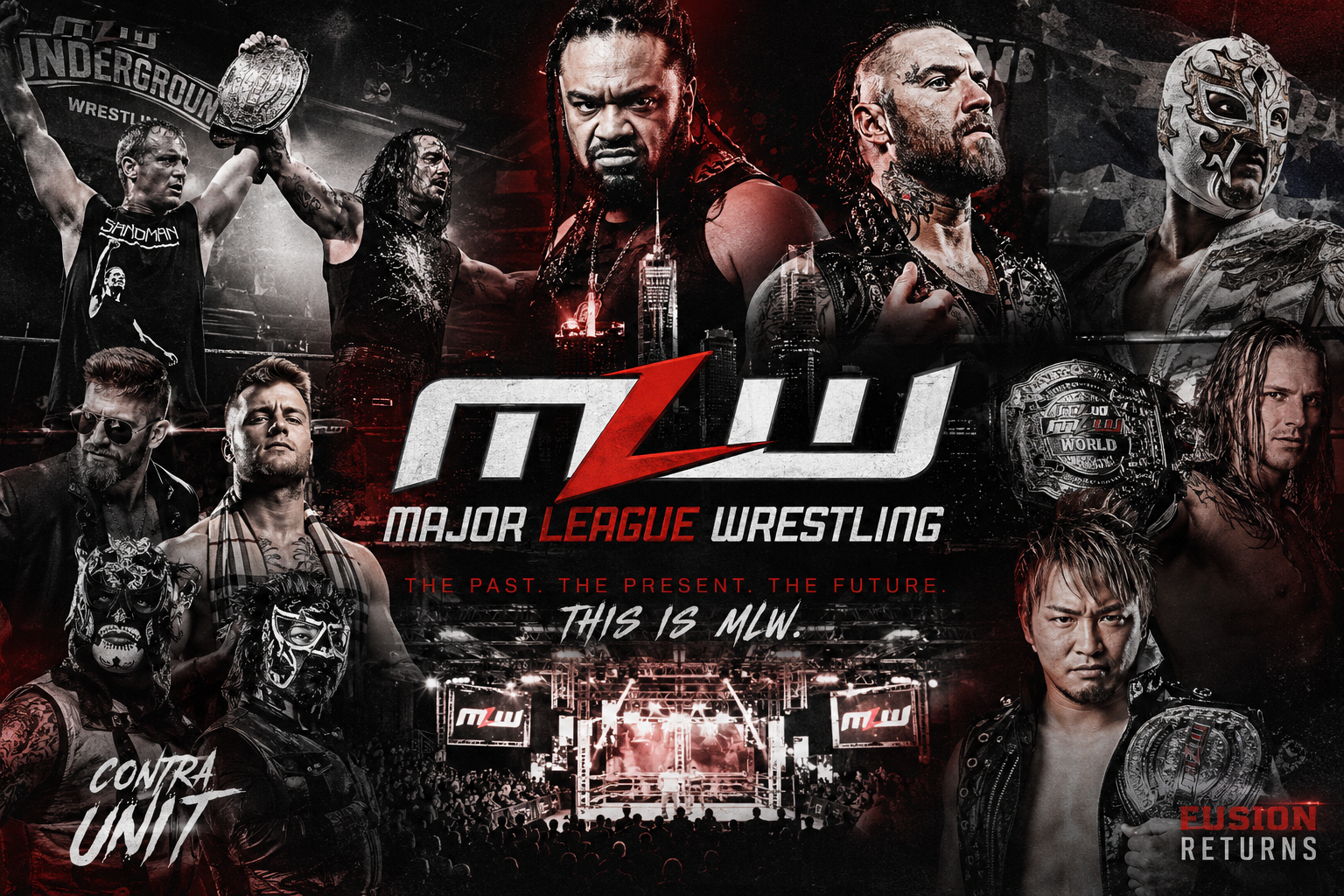
Major League Wrestling has never needed to become another version of WWE, AEW or TNA to justify its existence.
MLW has always been at its most interesting when it leans into the things that make it feel different: a gritty presentation, a deep appreciation for wrestling history, an open-door approach to talent, a willingness to blend styles and an ability to create a world where a decorated luchador from Arena México, a Japanese legend, a former UFC fighter, a violent heavyweight, an emerging prospect and a recognizable name with experience on national television can all coexist on the same card without the promotion losing its identity.
That identity is especially important tonight. MLW Fusion returns with a special two-hour season premiere after the company spent an extended period presenting major events and taped specials rather than a traditional weekly episodic show. The return of Fusion is not simply another programming announcement. It is MLW restoring the heartbeat of the promotion.
To understand why that matters, it is necessary to understand what Major League Wrestling has been, what it has survived and why the company has quietly carved out a valuable place in the modern wrestling landscape.
The Ownership and Corporate Structure of MLW
Major League Wrestling was founded by Court Bauer, the former WWE creative team member who has remained the central decision-maker behind the company since its original launch in 2002.
MLW is not owned by WWE, TKO Group Holdings, AEW, Warner Bros. Discovery, Anthem Sports & Entertainment or another larger wrestling corporation. Bauer remains MLW’s owner and CEO. The public-facing business has described itself as a sports media holding company focused on professional wrestling events, television programming, digital content and ancillary entertainment.
The corporate terminology can become confusing because MLW, LLC and MLW Media LLC have both appeared publicly in connection with the company. MLW Media LLC was the named plaintiff in the antitrust lawsuit filed against WWE in 2022. The most important practical point is much simpler: MLW remains an independently controlled wrestling business built around Bauer’s vision rather than a subsidiary of one of the three largest promotions in North America.
That independence is a major part of the company’s appeal. MLW does not have the financial reach or media footprint of WWE or AEW, and it does not have TNA’s long-running cable television presence. What it does have is the freedom to create a wrestling product that does not need to fit neatly into somebody else’s corporate ecosystem.
The First Era: MLW’s Original Run From 2002 to 2004
Major League Wrestling launched in 2002 during a strange and important transitional period for professional wrestling.
WCW and ECW had both disappeared as nationally recognized promotions in 2001. WWE had acquired the assets of both companies and stood alone at the top of the North American wrestling industry. At the same time, a new independent wrestling movement was beginning to take shape. Promotions such as TNA Wrestling, Ring of Honor, Pro Wrestling Guerrilla and CHIKARA emerged with different philosophies and different audiences.
MLW entered that environment with an identity built around “hybrid wrestling.”
The company did not attempt to copy WWE’s sports-entertainment presentation. It wanted to blend multiple forms of professional wrestling under one roof: Japanese strong style, lucha libre, technical wrestling, heavyweight fights, hardcore violence, emerging independent talent and recognizable veterans from ECW, WCW and WWE.
MLW held its first event, Genesis, on June 15, 2002, in Philadelphia. Shane Douglas became the inaugural MLW World Heavyweight Champion by defeating Vampiro and Taiyo Kea in a three-way tournament final. Douglas was later stripped of the championship, opening the door for Satoshi Kojima to defeat Jerry Lynn for the vacant title in New York on September 26, 2002.
Kojima’s involvement immediately gave MLW a different flavor. The company was not merely using wrestlers with name recognition from American television. It was attempting to build an international wrestling identity at a time when access to promotions such as All Japan Pro Wrestling and New Japan Pro-Wrestling was far more limited for many American fans than it is today.
The original era featured an unusually deep collection of talent. Terry Funk, Steve Corino, Sabu, Shane Douglas, Mike Awesome, Vampiro, LA Park, Christopher Daniels, CM Punk, Bryan Danielson, Sonjay Dutt, Chris Hero, Jerry Lynn, Steve Williams, Dusty Rhodes, Raven, The Sandman and several other notable names appeared during the company’s first run.
MLW Underground TV premiered in 2003 and aired on Sunshine Network. Joey Styles, the unmistakable voice of ECW, helped establish the tone of the program. Underground TV used matches taped at live events and gave MLW a television platform that felt closer to a dangerous underground fight league than a polished sports-entertainment production.
The most memorable rivalry of the original era revolved around Steve Corino, Terry Funk and The Extreme Horsemen. That story captured the company’s early personality. Corino was arrogant, polished and calculating. Funk represented grit, pride and the willingness to keep fighting long after most people would have walked away. The feud blended personal animosity with the old-school intensity that MLW wanted to preserve.
The World Heavyweight Championship also moved through an unusual sequence at Hybrid Hell in June 2003. Mike Awesome defeated Kojima to win the title, only for Steve Corino to capitalize almost immediately and take the championship from Awesome. Corino held the belt until the original promotion closed in 2004.
MLW’s first run was ambitious, historically interesting and packed with talent. It was also financially difficult to sustain. The company stopped promoting events in 2004.
That could have been the end of the story. It was not.
The Years Between Eras and the MLW Radio Network
MLW did not completely disappear after its original wrestling promotion stopped running events.
The company found a second life through the MLW Radio Network, which became an influential home for professional wrestling podcasts. Bauer used the platform to remain connected to the industry while building an audience around wrestling discussion, personalities and long-form audio programming.
That period is easy to overlook because it did not involve live wrestling events. It was still important. The podcast network preserved the MLW brand, kept it relevant within wrestling media and created a foundation for the eventual relaunch.
When MLW returned to promoting live wrestling in 2017, it did not feel like somebody randomly reviving an old logo. It felt like an independent wrestling brand re-entering the marketplace with a clearer understanding of modern media.
The Revival: One-Shot, Fusion and the Return to Weekly Television
MLW returned with One-Shot in Orlando on October 5, 2017.
The comeback arrived with a mixture of veterans, established independent wrestlers and emerging stars. The promotion did not immediately attempt to run large arenas or overextend itself. It rebuilt gradually.
That approach paid off in 2018 when MLW secured a television agreement with beIN Sports for a weekly series called MLW Fusion.
Fusion premiered on April 20, 2018. The main event between Pentagon Jr. and Rey Fenix was an ideal statement of purpose. MLW was back, and the promotion wanted fans to see a style of wrestling that felt fast, international and unpredictable.
The Lucha Bros became one of the defining acts of the early Fusion era. Pentagon Jr. and Rey Fenix won the MLW World Tag Team Championship and were central to a storyline involving Konnan, Salina de la Renta and Promociones Dorado. Salina emerged as one of MLW’s most valuable television characters because she did not feel like a generic wrestling manager. She gave MLW’s lucha libre presentation its own mythology and political structure.
The revived MLW roster also included Shane “Swerve” Strickland, Low Ki, “Filthy” Tom Lawlor, Sami Callihan, Mance Warner, Davey Boy Smith Jr., Teddy Hart, Brian Pillman Jr., Alexander Hammerstone, Richard Holliday, MJF, Jacob Fatu, Josef Samael, Simon Gotch, LA Park and many others who helped establish the identity of the new era.
Strickland became the first World Heavyweight Champion of the revived promotion by defeating Matt Riddle in the finals of an eight-man tournament in April 2018. Low Ki defeated Strickland for the championship later that year. Tom Lawlor followed by defeating Low Ki at SuperFight in February 2019.
Each champion represented a different side of MLW. Strickland was a rising star with charisma and creativity. Low Ki brought a legitimate combat-sports aura. Lawlor was a former UFC fighter who could make the company’s hybrid-wrestling branding feel natural rather than forced.
Then CONTRA Unit arrived.
CONTRA Unit and Jacob Fatu’s Historic Rise
Few factions have defined a modern wrestling promotion as clearly as CONTRA Unit defined MLW.
Jacob Fatu, Josef Samael and Simon Gotch emerged as an invading force in 2019. Their attacks were presented as more than ordinary wrestling beatdowns. CONTRA interrupted broadcasts, hijacked segments, threw fire and treated MLW like territory to be conquered.
The faction’s presentation gave the promotion a sense of danger. CONTRA did not feel like another heel group built around matching shirts and interference spots. It felt like a hostile organization attacking the structure of the company itself.
Jacob Fatu became the centerpiece.
Fatu defeated Tom Lawlor for the MLW World Heavyweight Championship in July 2019 and held the title for 819 days. It remains the longest World Heavyweight Championship reign in MLW history.
That reign was transformative. Before arriving in MLW, Fatu was respected by people who followed independent wrestling closely. During his run with the company, he developed into a genuine main-event attraction. His combination of size, explosiveness, athleticism and presence made him one of the most captivating heavyweights outside WWE and AEW.
MLW deserves real credit for recognizing what it had in Fatu and building around him.
The CONTRA story became even more effective during the COVID-19 pandemic. MLW used the real-world interruption of its schedule as part of the fictional universe, presenting CONTRA’s takeover of the company as the storyline explanation for the shutdown. When MLW returned with “The Restart,” the promotion had an obvious central conflict: somebody needed to take the company back.
Alexander Hammerstone became the man to do it.
The Dynasty, The Hart Foundation and Hammerstone’s Journey
Before Hammerstone became the heroic figure capable of ending Jacob Fatu’s reign, he was one-third of The Dynasty alongside MJF and Richard Holliday.
The Dynasty was one of the strongest factions of the revived Fusion era. MJF played the smug, entitled loudmouth long before he became one of AEW’s biggest stars. Holliday added an old-money arrogance that fit the group perfectly. Hammerstone gave the faction muscle and credibility.
Their rivalry with The Hart Foundation — Teddy Hart, Davey Boy Smith Jr. and Brian Pillman Jr. — helped establish MLW’s weekly storytelling rhythm. The feud had championship stakes, personality conflicts and enough history behind the Hart name to make it feel meaningful.
MJF and Holliday captured the MLW World Tag Team Championship. Hammerstone became the inaugural MLW National Openweight Champion in 2019. The group eventually fractured, but its importance should not be understated. MLW gave MJF a platform to sharpen the character work that later became central to his success in AEW.
Hammerstone’s evolution was equally important.
He went from The Dynasty’s powerhouse to one of MLW’s most complete homegrown stars. At Fightland in October 2021, Hammerstone defeated Jacob Fatu in a title-versus-title match to end Fatu’s historic 819-day reign and capture the MLW World Heavyweight Championship.
That match was the payoff to one of MLW’s best long-term stories. It was not a random title switch or a rushed attempt to create a moment. Hammerstone had been protected, developed and positioned as the wrestler capable of surviving CONTRA’s violence.
His World Heavyweight Championship reign lasted 644 days before Alex Kane defeated him at Never Say Never in July 2023.
Alex Kane and the Rise of BOMAYE Fight Club
Alex Kane’s rise represented another side of MLW’s strength.
Kane initially gained momentum in the National Openweight Championship picture before creating BOMAYE Fight Club, a group built around his personality, confidence and suplex-heavy offense. He won Battle Riot in 2023, earned a World Heavyweight Championship opportunity and forced Hammerstone to submit to capture the title.
The victory mattered because MLW did not position Kane as a placeholder. The company allowed his character to grow organically. BOMAYE became a rallying cry, and Kane’s connection with the audience gave MLW another homegrown act who felt distinct from everybody else on the roster.
MLW has always been most valuable when it gives wrestlers a real chance to establish an identity before they are absorbed into a larger system. Fatu, Hammerstone, Kane, Holliday, MJF and Strickland are different performers, but each benefited from having meaningful space on MLW television.
The World Heavyweight Championship Lineage
The MLW World Heavyweight Championship has never been treated like a secondary attraction. Its lineage tells the story of the promotion.
The major champions include:
- Shane Douglas
- Satoshi Kojima
- Mike Awesome
- Steve Corino
- Shane “Swerve” Strickland
- Low Ki
- “Filthy” Tom Lawlor
- Jacob Fatu
- Alexander Hammerstone
- Alex Kane
- Satoshi Kojima for a second reign
- Matt Riddle
- Mads Krule Krügger
- Killer Kross
Several reigns stand out for different reasons.
Kojima gave the original promotion international legitimacy and later returned more than two decades later to win the championship again. Fatu’s 819-day reign remains the defining title run of the modern era. Hammerstone’s 644-day reign validated a multi-year character arc. Kane’s win showed that MLW could continue creating new main-event talent. Matt Riddle brought recognizable star power and a legitimate combat-sports background.
The current World Heavyweight Champion, Killer Kross, won the championship at Battle Riot VIII after entering the match at No. 1 and outlasting the field. His victory was not simply another championship change. It placed one of the most recognizable names on the roster at the center of MLW’s relaunch.
Kross addressing the press during tonight’s Fusion premiere gives the new season an obvious focal point. The company needs a strong World Heavyweight Championship direction, and Kross is positioned to establish it.
The Other Championships and the International Identity of MLW
MLW’s championship structure reflects the company’s hybrid philosophy.
The World Tag Team Championship has been held by teams such as The Lucha Bros, The Hart Foundation, The Dynasty, Ross and Marshall Von Erich and the current champions, The Skyscrapers: Bishop Dyer and Donovan Dijak.
The Skyscrapers are an ideal MLW act. Dyer and Dijak are enormous heavyweights with national television experience, but the team does not feel like a nostalgia act. Their size gives the division a clear obstacle for every challenger trying to climb toward the titles.
The World Middleweight Championship gives MLW a platform for faster-paced wrestling with a 205-pound limit. The title’s history has included wrestlers such as MJF, Teddy Hart, Myron Reed, Lio Rush, Tajiri, Místico, Templario and the current champion, KUSHIDA.
KUSHIDA’s current presentation is especially interesting because he captured the title and aligned with the modern version of CONTRA Unit. A wrestler known throughout his career for technical precision and fan support has become part of MLW’s most dangerous faction.
The National Openweight Championship has served as an important bridge between the midcard and the main-event picture. Hammerstone became its inaugural champion. The championship has also been held by Alex Kane, Davey Richards, Jacob Fatu, John Hennigan, Rickey Shane Page, Bad Dude Tito, Matthew Justice, Último Guerrero and the current champion, Blue Panther.
Blue Panther winning an MLW championship at Arena México was significant. It represented more than a recognizable legend adding another belt to his résumé. It demonstrated what MLW’s partnership model can accomplish when the company treats international wrestling as a meaningful part of the product instead of a novelty.
The women’s division has also continued to develop through the MLW Women’s World Featherweight Championship. Taya Valkyrie became the inaugural champion. Delmi Exo, Janai Kai and Shoko Nakajima have all helped give the title an identity. Nakajima currently stands as champion, and the new STARDOM partnership gives MLW a clear opportunity to expand the division with fresh matchups.
Television and Streaming Deals: A Complicated but Important History
MLW’s media history has been one of the most important and most complicated parts of the company’s story.
The original Underground TV aired on Sunshine Network in 2003 and 2004.
The revived promotion secured its most important foundational agreement with beIN Sports in 2018. Fusion gave MLW a weekly television presence and created the structure needed for storylines, championships and wrestlers to gain momentum over time.
MLW expanded its reach through several additional partnerships over the years.
The company reached a streaming agreement with DAZN in 2020. It also secured distribution on Fubo Sports Network. During that period, MLW used a mixture of linear television, digital distribution and streaming services to widen its audience.
In 2021, MLW programming appeared on Vice TV. The partnership included Fusion reruns and the Fightland special built around Hammerstone defeating Fatu in the title-versus-title main event. Fightland airing after Dark Side of the Ring gave MLW an opportunity to reach wrestling fans who may not have been following the company weekly.
In 2022, MLW announced additional distribution arrangements involving Ayozat TV in the United Kingdom, beIN Sports XTRA and Pro Wrestling TV.
In 2023, MLW Underground Wrestling premiered on Reelz. The run was notable but brief. Reelz programming was also made available through Peacock, but MLW’s show was blacked out on Peacock because of WWE’s existing exclusivity arrangement with the streaming service.
Later in 2023, MLW expanded its relationship with FITE, now known as TrillerTV, to present live specials for FITE+ subscribers. Fusion also returned to YouTube, providing fans with a free and easily accessible way to follow the weekly product.
That accessibility remains one of MLW’s biggest strengths.
The company has now partnered with VEEPS, the streaming platform owned by Live Nation Entertainment. Fusion will stream weekly on VEEPS as part of a Saturday night programming strategy. MLW and VEEPS are also expected to work together on quarterly pay-per-view events, exclusive merchandise collections and additional direct-to-fan experiences.
Tonight’s special two-hour Fusion premiere is scheduled to air free on YouTube and VEEPS at 6:05 p.m. ET, with an encore airing later tonight at 10 p.m. ET on beIN Sports.
The 6:05 p.m. ET start time is not random. It is a deliberate callback to the Saturday-evening wrestling tradition associated with the old studio-wrestling era. MLW is using history as part of its identity without turning the product into a museum piece.
The WWE Antitrust Lawsuit and the $20 Million Settlement
MLW’s media history cannot be discussed honestly without mentioning its antitrust lawsuit against WWE.
MLW Media LLC filed the lawsuit in January 2022, alleging that WWE interfered with MLW’s potential media relationships and engaged in anticompetitive conduct. The case included allegations involving a prospective streaming agreement with Tubi and negotiations involving Vice TV.
WWE denied wrongdoing.
The legal battle continued through amended filings and court rulings before the parties reached a settlement. A TKO Group Holdings filing later disclosed that WWE paid $20 million to settle the lawsuit.
The settlement did not transform MLW into a direct competitor to WWE. That was never realistic. What it did was underline how difficult the wrestling media marketplace can be for a smaller independent promotion attempting to secure meaningful distribution.
MLW survived that period and continued operating.
That matters.
Attendance Records, Sellouts and Box-Office Momentum
MLW’s attendance growth needs to be discussed with precision.
The company has publicly announced multiple attendance and gate records over the years, but MLW does not consistently publish audited paid-attendance figures for every event. A sellout, an attendance record and a box-office gate record are not automatically the same thing.
The original attendance benchmark frequently cited for MLW was Hybrid Hell on June 20, 2003, which drew a reported 1,536 fans in Florida.
When MLW returned to Cicero Stadium for Fightland in November 2018, the company announced that the event broke its previous attendance and gate records. The exact attendance figure was not publicly released, but the Chicago market immediately became a major part of MLW’s touring strategy.
For 2018 as a whole, MLW reportedly drew 9,322 fans across 13 events, averaging 717 fans per show. The company’s second-half average increased to 1,008 fans per event as it expanded beyond Orlando.
The momentum continued in 2024.
MLW announced that Intimidation Games at New York City’s Melrose Ballroom set a new company attendance and box-office record for the market. The company later announced that Azteca Lucha at Cicero Stadium sold out and broke its all-time box-office gate record.
Lucha Apocalypto in November 2024 became another milestone. MLW announced that the Cicero Stadium event sold out, marked the company’s 11th consecutive sellout of the year and would welcome the largest crowd in MLW’s United States history with expanded seating.
In 2025, MLW announced that Battle Riot VII sold out in the greater Los Angeles area and generated the biggest gate in company history. Demand led to the event moving to the larger Thunder Studios Arena in Long Beach.
The important takeaway is not that MLW is suddenly drawing WWE-sized crowds. It is not. The meaningful point is that MLW has found markets where its product connects with fans and where the company can generate sustainable momentum without pretending to be something it is not.
Chicago, New York, Philadelphia and the greater Los Angeles market have all played important roles in that growth.
Partnerships: MLW’s Most Valuable Competitive Advantage
MLW’s international relationships are not decorative. They are central to the promotion’s identity.
The company has worked with AAA, New Japan Pro-Wrestling, Consejo Mundial de Lucha Libre, Tokyo Joshi Pro-Wrestling, Revolution Pro Wrestling and other organizations at different points in its history.
The CMLL relationship has been especially valuable.
MLW and CMLL have presented talent exchanges, championship matches and crossover events. MLW championships have been defended at Arena México. CMLL stars have appeared on MLW events in the United States. Lucha Apocalypto has given MLW a natural platform for presenting major lucha libre matches without forcing them into an unrelated card.
MLW, NJPW and CMLL also collaborated on FantasticaMania USA in Charleston, South Carolina, in April 2026. That event represented an important milestone: three respected wrestling organizations working together on an American event built around international wrestling culture.
The recently announced STARDOM alliance adds another major opportunity. The partnership is expected to focus on talent exchange and creative collaboration. For MLW, that could significantly strengthen the women’s division. For STARDOM, it creates additional opportunities to feature talent in front of American audiences.
These relationships give MLW something that many promotions struggle to develop: a legitimate global identity.
MLW does not need to sign every international wrestler to an exclusive long-term contract. It can create meaningful matchups through collaboration.
MLW as a Launchpad and Destination
One of the strongest arguments for watching MLW is the company’s track record with talent.
Several wrestlers who appeared in MLW before becoming major names elsewhere later moved on to WWE, AEW or TNA.
The list includes:
- CM Punk
- Bryan Danielson
- Swerve Strickland
- MJF
- Jacob Fatu
- Pentagon Jr., now known as Penta
- Rey Fenix
- Brian Pillman Jr., now known as Lexis King
- Sami Callihan
- Alexander Hammerstone
- Taya Valkyrie
- Mance Warner
- Christopher Daniels
- Sonjay Dutt
- LA Park
- Brody King
- Ricky Starks
- Eddie Kingston
- Lio Rush
- Myron Reed
- Richard Holliday
- Davey Boy Smith Jr.
The point is not that MLW “created” every wrestler who has appeared on its shows. That would be inaccurate. Many arrived with experience and reputations developed elsewhere.
The point is that MLW has repeatedly provided wrestlers with a meaningful television platform, room to develop characters and opportunities to work prominent matches before or between runs with larger companies.
MJF’s time in The Dynasty mattered. Swerve Strickland winning the revived World Heavyweight Championship mattered. Jacob Fatu’s 819-day reign mattered. The Lucha Bros holding the Tag Team Championship mattered.
MLW did not merely book those wrestlers for random appearances. It made them important parts of the promotion.
The Current Roster and the Names Driving the New Era
MLW enters the return of Fusion with a roster built around recognizable names, international talent, established champions and prospects.
The featured names include:
- MLW World Heavyweight Champion Killer Kross
- Scarlett Bordeaux
- Matt Riddle
- Místico
- Satoshi Kojima
- “Filthy” Tom Lawlor
- The Good Brothers: Doc Gallows and Karl Anderson
- MLW World Tag Team Champions The Skyscrapers: Bishop Dyer and Donovan Dijak
- Alex Hammerstone
- Austin Aries
- Trevor Lee
- Shotzi Blackheart
- Lady Frost
- Shoko Nakajima
- KUSHIDA
- Blue Panther
- Mads Krule Krügger
- Joe Coffey
- Mark Coffey
- Wolfgang
- Big Damo
- Ikuro Kwon
- Okumura
- Diego Hill
- ZAMAYA
- Josh Bishop
- Jay Bishop
- Brick Savage
- Priscilla Kelly
- Aleah James
- Carolina Cruz
- Jesus Rodriguez
- Paul Walter Hauser
The roster is not designed like WWE’s, AEW’s or TNA’s. Some wrestlers are core MLW acts. Some are featured regularly. Some appear through partnerships or the company’s open-door policy. Some are recognizable names using MLW as a platform to re-establish themselves. Others are prospects being introduced to a wider audience.
That mixture is the point.
The company can place Trevor Lee against Austin Aries, showcase Shotzi Blackheart against Priscilla Kelly, build around Kross as World Heavyweight Champion, feature Místico through its CMLL relationship and still make room for emerging talent such as ZAMAYA and Diego Hill.
The Current Factions and Power Structures
Factions have always mattered in MLW because the promotion frequently presents itself as a world controlled by competing power structures.
CONTRA Unit remains the most important faction in company history. The modern version has evolved from the group that originally launched Jacob Fatu into stardom. KUSHIDA’s championship victory and alignment with CONTRA added a new layer to the faction. Ikuro Kwon and Okumura help preserve the group’s international identity.
The Skyscrapers are a force within the tag team division. Bishop Dyer and Donovan Dijak give MLW two imposing heavyweights with enough presence to make every confrontation feel important.
BOMAYE Fight Club remains one of the most meaningful factions of the recent era because of what it represented during Alex Kane’s rise.
The Dynasty and The Hart Foundation are no longer central to the current product, but their rivalry remains essential to understanding the first major chapter of the revived Fusion era.
Promociones Dorado and Salina de la Renta helped define MLW’s lucha libre storytelling. Cesar Duran later expanded the company’s mythology through Azteca Underground and his unpredictable authority-figure role.
MLW works best when these groups feel like they exist beyond a single match. The company’s fictional universe becomes more compelling when alliances have history, betrayals have consequences and factions are fighting for control rather than simply filling television time.
The Road to Tonight’s Return of MLW Fusion
Tonight’s Fusion premiere is the beginning of a new chapter.
The weekly series returns with a special two-hour episode before moving into its regular Saturday-night rhythm. MLW has spent months strengthening its roster, expanding its international partnerships and building a new distribution strategy around free access and a consistent timeslot.
The importance of tonight’s premiere goes beyond the individual matches and segments advertised for the show. MLW is restoring the weekly television format that gave the modern version of the company its identity. Fusion has always been the place where MLW’s larger world comes together: the championships, factions, international partnerships, rising prospects, established veterans and long-term stories that make the promotion feel different from everything else in North American professional wrestling.
The premiere has enough variety to immediately reinforce that identity. The show will feature established names, heavyweight fights, women’s division matches, tag team action, emerging talent and major developments surrounding the World Heavyweight Championship picture. Killer Kross will address the press after his championship victory at Battle Riot VIII. Matt Riddle is also scheduled to appear. CONTRA Unit will deliver a new manifesto as the faction continues to establish its presence in the latest era of MLW.
Rather than turning this historical deep dive into a full preview of tonight’s show, readers can find the complete advertised card, storyline breakdowns, match-by-match analysis and everything else they need to know heading into the return of Fusion in our full MLW Fusion May 30th, 2026 Preview on LNC Wrestling.
Tonight is not simply another episode of television. It is MLW reclaiming the weekly structure that helped turn the company into one of the most distinctive alternatives in professional wrestling.
Why MLW Should Be Viewed as an Alternative
MLW should not be evaluated by asking whether it can defeat WWE, AEW or TNA.
That is the wrong question.
WWE is a global sports-entertainment giant operating inside TKO Group Holdings. AEW has major financial backing, a large national television footprint and a deep roster. TNA has more than two decades of history and an established weekly television structure.
MLW exists on a different scale.
The better question is whether MLW gives wrestling fans something they cannot consistently find anywhere else.
The answer is yes.
MLW combines old-school studio-wrestling sensibilities with modern independent wrestling, international partnerships, lucha libre, Japanese wrestling, heavyweight fights, prospects, recognizable veterans and factions that exist inside a wider fictional universe.
It is also accessible. A free weekly show on YouTube and VEEPS lowers the barrier for fans who are curious but do not want another subscription immediately.
The company has weaknesses. Its programming strategy has changed several times. The movement between weekly television, streaming services, specials and taped events has sometimes made the product harder to follow than it should be. The roster can feel fluid because MLW’s open-door philosophy is both a strength and a limitation. Maintaining consistent storyline momentum will be essential now that Fusion is returning weekly.
Those are real concerns.
They do not erase the company’s value.
MLW does not need to be perfect to be worth watching. It needs to be consistent, accessible and confident in its own identity.
Final Thoughts
Major League Wrestling has survived because it understands something important: there is still room in professional wrestling for a promotion with its own voice.
MLW has lived through two distinct eras, the collapse of its original promotion, a long period without live events, a successful relaunch, a pandemic shutdown, an antitrust lawsuit, a complicated media landscape and an industry increasingly dominated by larger corporate players.
It is still here.
Its history includes Terry Funk, Steve Corino, Satoshi Kojima, CM Punk, Bryan Danielson, MJF, Swerve Strickland, The Lucha Bros, Jacob Fatu, Alexander Hammerstone, Alex Kane, Místico, Matt Riddle and Killer Kross. Its biggest storylines have included The Extreme Horsemen, Promociones Dorado, The Hart Foundation, The Dynasty, BOMAYE Fight Club and CONTRA Unit. Its partnerships now connect the company to CMLL, NJPW and STARDOM.
Tonight, Fusion returns to give all of that history a weekly home again.
MLW does not need to become WWE, AEW or TNA. It needs to remain MLW: independent, international, unpredictable, rooted in wrestling history and willing to create a lane that belongs to nobody else.
Make sure to subscribe to our Late Night Crew Wrestling YouTube Channel. Follow @yorkjavon, @kspowerwheels & @LateNightCrewYT on X.
I’m the quiet one until the bell rings then I’ve got takes. I live for WWE NXT and TNA, I want every promotion to succeed, and I will absolutely roast the bad decisions on sight (because someone has to). Anime taught me to respect long-term storytelling; wrestling taught me that sometimes the plan is “we panicked” and called it “unpredictable.” The Miz got me into all of this, so yeah I appreciate confidence, commitment, and the art of talking like you’re already the main event. Now I bring that same energy to the page as the main writer for Late Night Crew Wrestling because if you’re not here to be must-see and tell the truth, why are you here?!