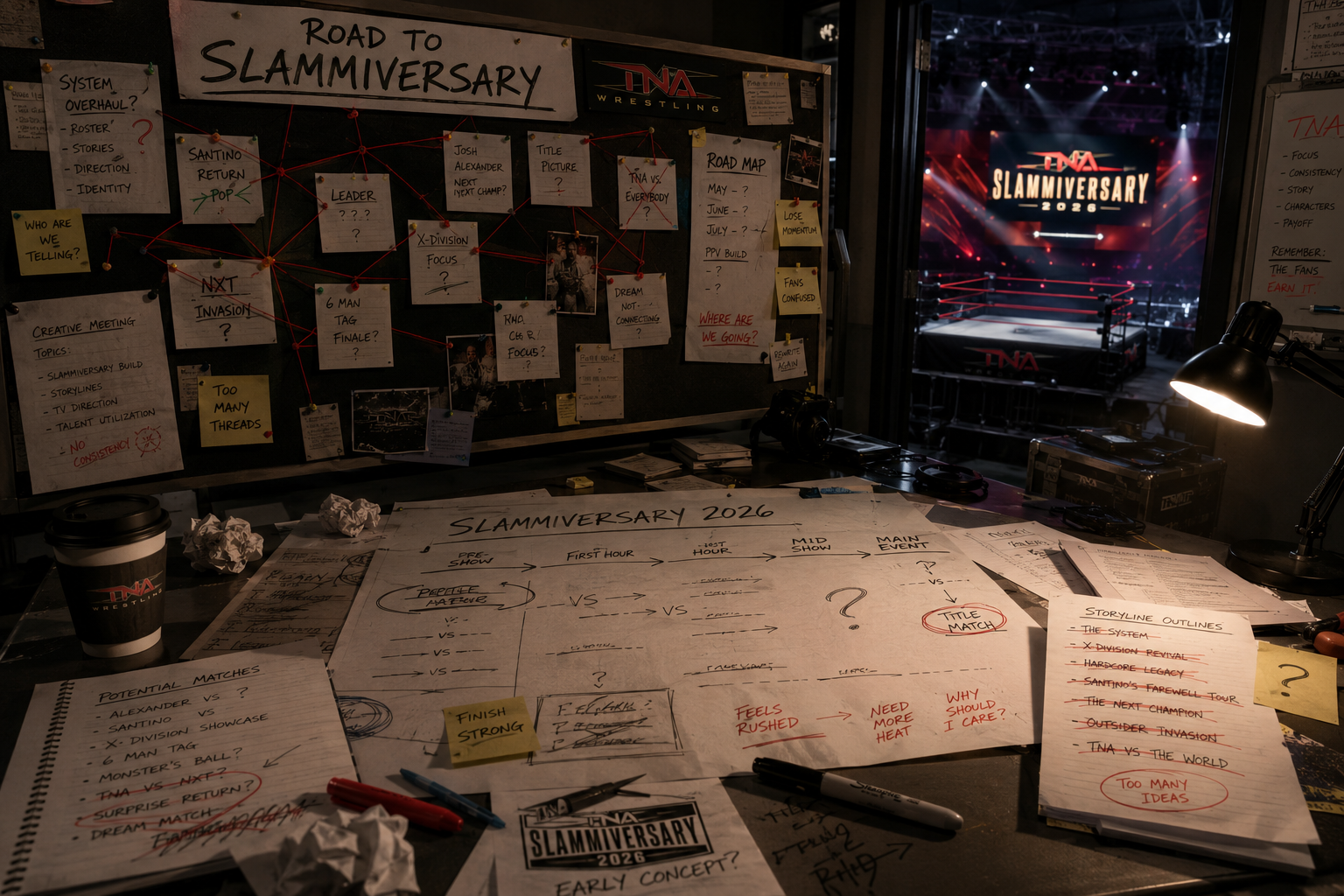
TNA Slammiversary should feel bigger than this.
That is the part I keep coming back to as a longtime TNA Faithful watching the company one month away from its biggest show of the summer. Slammiversary is not just another pay-per-view. It is TNA’s anniversary event. It is supposed to be the show where the company reminds people why this brand still matters, why its history matters, why its roster matters, and why fans should invest in where it is going next.
Instead, the road to Slammiversary feels flat, scattered, and way too surface-level.
Yes, TNA has announced that every championship will be defended. Yes, Ultimate X is coming back for the X-Division Championship. Yes, a ladder match has been announced. Yes, Slammiversary will take place Sunday, June 28, 2026, from the Agganis Arena in Boston with a special 3 p.m. ET start time to avoid going head-to-head with AEW x NJPW Forbidden Door later that same day. On paper, those are big announcements. But that is the problem. A major show cannot just feel big on paper. It has to feel big on television.
Right now, it does not.
A month away from Slammiversary, TNA should already have its top stories set in stone and playing out with urgency. The world title picture should feel undeniable. The Knockouts title picture should feel personal. The tag divisions should feel alive. The X-Division should feel like one of the company’s crown jewels. The younger talent should feel like they are being elevated into the next era of the company. Instead, it feels like TNA is announcing stipulations and hoping the brand name Slammiversary does the rest of the work.
That is not enough.
The biggest issue with TNA right now is that things are happening, but too many of them do not feel like they are building toward something bigger. That is what separates good television from busy television. You can have title matches, faction brawls, surprise appearances, NXT crossovers, open challenges, backstage segments, and gimmick matches, but if the audience cannot feel the emotional direction, then the show starts to feel hollow.
That is where TNA is right now.
Since the creative shift that saw Delirious take over as head of creative, with Tommy Dreamer remaining on the creative team and also moving into talent relations, TNA has felt less like a company building toward a new golden era and more like a company trying to plug holes week to week. I do not think this is a talent issue. TNA has talent. It has names. It has young wrestlers with upside. It has veterans who can still go. It has a WWE/NXT partnership that has brought more eyes to the product. It has a new television platform with AMC. It has history.
But tools do not matter if the blueprint is weak.
The Gail Kim decision still looks like one of the biggest warning signs of this entire era. Nobody outside the room can honestly say exactly what TNA officials were thinking when they let Gail go, but from the outside looking in, it came across like a company misunderstanding one of the biggest pieces of its own identity. Gail Kim was not just another backstage name. She was one of the faces, hearts, and architects of the Knockouts Division. She helped make that division matter when women’s wrestling on mainstream American television was not always being treated with that level of seriousness.
Gail poured her heart and soul into TNA. She helped build the Knockouts Division into something fans could brag about. She represented what made TNA different. So when TNA lets her go, and then the Knockouts Division starts feeling thin, directionless, and underdeveloped, that decision gets louder over time.
That is why I still think TNA should rehire Gail Kim.
Candice Michelle signing with the company and working with the Knockouts Division is a good move on paper. I am not against that at all. Candice brings experience, name value, and a different perspective. But the answer should not have been Candice or Gail. It should have been Candice and Gail. If TNA is serious about restoring the Knockouts Division to what it once was, Gail Kim and Candice Michelle working together would give that division credibility, structure, history, and fresh energy.
Right now, the Knockouts Division feels like it has names, not a fully formed world.
That is the problem with Mara Sadè. That is the problem with Indi Hartwell. That is the problem with Elayna Black. That is the problem with Jada Stone. That is the problem with Mila Moore. These are not talent problems. These are presentation problems. As someone who watches TNA consistently, I should not be sitting here asking who these women are supposed to be as characters. I know their names. I know they can wrestle. But what drives them? What do they want? What separates them from everyone else? What is their hook beyond being a new signing, a former WWE name, a young prospect, or a good wrestler?
Mara Sadè should feel like a major TNA project. Indi Hartwell should feel like a star acquisition being positioned with purpose. Elayna Black should feel like someone with a distinct aura and direction. Jada Stone and Mila Moore should be getting character-focused vignettes, sit-down interviews, protected wins, defining feuds, and clear motivations. Instead, too much of the division feels surface-level.
That is where TNA is failing its own roster.
The company keeps relying on gimmicks instead of stories. It keeps leaning on concepts instead of character development. It keeps putting people on television without giving fans enough reason to emotionally attach to them. A gimmick can get attention for a week. Character development keeps people invested for months. TNA needs more of the second and less of the first.
The same problem applies to the WWE/NXT partnership.
The partnership is valuable. I am not going to pretend it has not helped TNA’s visibility. It has put more eyes on the company, created bigger crossover moments, and clearly played a role in how the industry views TNA’s growth. But there is a difference between using a partnership as a boost and using it as a crutch. TNA cannot become a place where NXT talent shows up feeling more important, more defined, and more protected than TNA’s own roster.
That sends the wrong message.
TNA should be saying WWE works with us because we are valuable, not we are valuable because WWE works with us. That distinction matters. If TNA becomes too dependent on WWE/NXT involvement, then the company risks looking like a developmental extension instead of an alternative wrestling promotion with its own identity.
The System has become another crutch.
I do not hate The System. Eddie Edwards, Brian Myers, Alisha Edwards, Moose’s orbit, Cedric Alexander, Bear Bronson, and everyone tied into that world have all had moments that worked. But the show too often feels like it revolves around The System while everyone else fights for oxygen. TNA has several factions right now with The System, Order 4, The Diamond Collective, and The Undead Realm, but the focus does not feel balanced enough to create a living, breathing company.
Order 4 should feel dangerous and ideological. The Diamond Collective should feel like a serious act with a real mission. The Undead Realm should feel like the kind of weird, signature TNA universe only this company can pull off. Instead, those groups get television time, but television time and meaningful television time are not the same thing. A segment should get someone over. A match should advance a story. A promo should clarify a character. A faction should change the ecosystem.
Too often, TNA checks the box without making the moment matter.
That is also why the tag divisions feel so frustrating. Men’s tag team wrestling should matter more in TNA. Knockouts tag team wrestling is in an even tougher spot. I do not know if getting rid of the Knockouts Tag Team Titles is the right move forever, but I do think TNA has to be honest about where that division is right now. The Knockouts Division does not have enough depth, the tag titles have not had enough direction, and a once-promising and dominant faction like The Elegance Brand has not been used in a way that makes the division feel stronger.
For a moment, it looked like TNA was building something real. The Diamond Collective, The Elegance Brand, The IInspiration, Harley Hudson and Myla Grace, and now the reunion of Rosemary and Allie gave the division pieces to work with. But Harley and Myla have barely been on television, The IInspiration are gone, and The Elegance Brand spent too much time tied to Knockout legends instead of helping establish a deeper modern tag scene.
Yes, Rosemary and Allie going after the titles heading into Slammiversary gives TNA something with history and emotion. I like that. It feels like TNA. But what happens after Slammiversary? Are the titles just going to revolve around Rosemary and Allie and The Elegance Brand? Where are the next three teams? Where is the weekly structure? Where is the tournament? Where is the reason fans should believe this division has a future?
If TNA cannot answer that, then the company should seriously consider making the Knockouts Division a one-title division until it has enough depth to support tag belts again. That does not have to be permanent. It can be strategic. Pause or retire the titles with respect, rebuild the roster, sign real teams, run a Knockouts tag showcase, and bring the belts back when the division can actually breathe.
Championships should create prestige, not expose a lack of depth.
That is why I also want to see Knockouts Knockdown return. Not as nostalgia. Not as a one-night throwaway. Make it a real annual or semiannual spotlight for the division. Use it to debut new talent, crown contenders, run grudge matches, spotlight legends, and remind fans that the Knockouts Division was once one of the most important women’s divisions in North American wrestling.
The same goes for Gut Check.
TNA needs to bring back Gut Check as a quarterly event and modernize it. Make it a showcase for some of the best indie talent on the planet. Bring in wrestlers from the United States, Canada, the United Kingdom, Europe, Mexico, Japan, and Australia. Give winners contracts or short-term trial deals. Let the audience see the process. Let TNA become the company that finds the next Leon Slater, the next Ricky Sosa, the next Knockouts breakout, and the next great tag team before everyone else does.
TNA needs to become a destination for wrestlers, not a pit stop.
That is why the Ricky Sosa situation is so confusing. TNA made a big deal about signing one of the hottest young free agents on the independent scene. Chris Bey introduced him. The announcement was treated like a moment. Sosa has charisma, size, athleticism, and a ready-made connection with fans. So where is the follow-through? If Ricky Sosa is a future pillar, then treat him like one. Give him vignettes. Let fans learn his story. Protect his aura. Put him in the X-Division mix. Let him win. Let him lose with purpose. Let him become more than a signing announcement.
You cannot celebrate signing someone and then fail to make them feel important week to week.
That same concern applies to BDE, Jada Stone, and Sinner and Saint. All of them have had strong showings. All of them have shown enough to deserve more than stop-and-go booking. TNA needs to stop presenting promising talent like optional content. If these wrestlers are part of the future, then book them like the future. Give them stories. Give them rivalries. Give them wins that matter. Give them losses that teach us something. Give them promo time. Let fans attach to them before asking fans to care when they randomly show back up.
Leon Slater is another example of why TNA has to be careful.
Slater has been one of the most exciting young wrestlers in the company and one of the easiest talents to point to when talking about TNA’s future. His X-Division Championship reign gave the company energy, youth, and credibility. Cedric Alexander beating him for the title can work if the follow-up is strong. But if the follow-up is not centered on Slater’s heartbreak, frustration, growth, and next step, then TNA risks cooling off one of the best young stars it has.
That matters even more when there is already outside speculation about Slater’s future beyond TNA. The answer is not to treat him like just another guy. The answer is to make him feel indispensable.
The same goes for Mike Santana. He is the TNA World Champion, and there have been reports and rumors about his contract situation and WWE interest. If TNA has a world champion who could become a major target for another company, then that should be a wake-up call. Lock him down if you can. Build around him if you believe in him. Do not let the centerpiece of your company feel temporary.
That is the bigger issue with TNA right now. The company has momentum on paper, but it does not always feel like it is protecting that momentum creatively or contractually. Fans can sense when someone is being positioned like a true cornerstone and when someone feels like they are just passing through.
TNA cannot afford to feel like a waiting room.
This is where the history of Slammiversary makes the current road even more disappointing. Slammiversary used to feel like TNA planting its flag. It was the show where the company celebrated survival, chaos, risk, reinvention, and identity. It was where TNA could give fans matches and moments that felt different from anything else in mainstream wrestling. The X-Division had a stage. The Knockouts had a stage. Tag teams had a stage. TNA originals and major outside names collided in ways that made the company feel alive.
That is the standard.
Slammiversary should feel like a pay-per-view where stories peak, not where stories are still trying to find themselves. It should feel like a celebration of TNA’s past, present, and future. It should feel like the show where Mike Santana, Leon Slater, Mara Sadè, Indi Hartwell, Elayna Black, Cedric Alexander, Mustafa Ali, The Hardys, Rosemary, Allie, The System, Order 4, The Diamond Collective, The Undead Realm, Ricky Sosa, and the rest of the roster all have clear lanes.
Instead, TNA feels like it has the pieces without a strong enough picture.
The company needs deeper pockets, but money alone will not fix this. Bigger investment can help with production, contracts, marketing, live events, touring, talent retention, and presentation. TNA does need that. It needs resources. It needs someone willing to invest in the company like a true national wrestling brand. But creative direction still matters. A better TV deal does not automatically create better stories. A WWE partnership does not automatically create stars. Announcing that every title will be defended at Slammiversary does not automatically create heat.
TNA has to do the work.
Right now, the company feels too comfortable relying on shortcuts. The WWE/NXT partnership is a shortcut. The System dominating so much of the show is a shortcut. Gimmicks without enough story are a shortcut. Nostalgia without modern development is a shortcut. Signing exciting names without pushing them like stars is a shortcut. Announcing stipulations without fully built emotional stakes is a shortcut.
The frustrating part is that TNA is not hopeless.
This company has real talent. It has a fanbase that wants to believe. It has a history that still matters. It has a women’s division legacy most promotions would love to claim. It has one of the most exciting match concepts in wrestling with Ultimate X. It has the ability to present tag team wrestling, faction warfare, young stars, and character-driven wrestling in a way that feels different from WWE and AEW.
But it has to choose to be TNA.
Not WWE-adjacent. Not nostalgia-adjacent. Not faction-heavy for the sake of being faction-heavy. Not a place where young talent gets a flash and then disappears. Not a company where the Knockouts Division lives off its reputation instead of its current creative. Not a promotion where Slammiversary is one month away and fans are still waiting for the show to feel like the biggest event of the summer.
TNA can fix this, but it has to start acting with urgency.
Rehire Gail Kim. Let Gail and Candice Michelle rebuild the Knockouts Division with structure and purpose. Bring back Gut Check quarterly. Bring back Knockouts Knockdown. Create a tag team showcase show. Decide what the Knockouts Tag Team Titles are supposed to be. Lock down young talent. Stop treating Ricky Sosa like just a signing announcement. Make Leon Slater feel like the next franchise player. Make Mike Santana feel like the world champion the company cannot afford to lose. Give Mara Sadè, Indi Hartwell, Elayna Black, Jada Stone, and Mila Moore actual character development. Use Order 4, The Diamond Collective, and The Undead Realm with the same level of intent The System gets. Build Slammiversary like the anniversary show it is.
Most importantly, give fans reasons to emotionally invest again.
As a TNA fan, I am not asking for the company to be perfect. TNA has never been perfect. Some of its best eras were messy, chaotic, and frustrating. But they had life. They had identity. They had stars who felt like they were becoming something. They had divisions that felt important. They had pay-per-views that felt like destinations.
That is what is missing right now.
One month away from Slammiversary, TNA should feel hot. It should feel urgent. It should feel like the company is building toward a statement show. Instead, it feels like a promotion with all the ingredients and no fully realized recipe.
That is the concern.
TNA has the pieces. TNA has the history. TNA has the platform. TNA has the opportunity.
Now it needs the vision.
Make sure to subscribe to our Late Night Crew Wrestling YouTube Channel. Follow @yorkjavon, @kspowerwheels & @LateNightCrewYT on X.
I’m the quiet one until the bell rings then I’ve got takes. I live for WWE NXT and TNA, I want every promotion to succeed, and I will absolutely roast the bad decisions on sight (because someone has to). Anime taught me to respect long-term storytelling; wrestling taught me that sometimes the plan is “we panicked” and called it “unpredictable.” The Miz got me into all of this, so yeah I appreciate confidence, commitment, and the art of talking like you’re already the main event. Now I bring that same energy to the page as the main writer for Late Night Crew Wrestling because if you’re not here to be must-see and tell the truth, why are you here?!