Last night’s All Elite Wrestling didn’t present Dynamite like a checklist on the way to AEW Grand Slam Australia. It treated it like a breaking point.
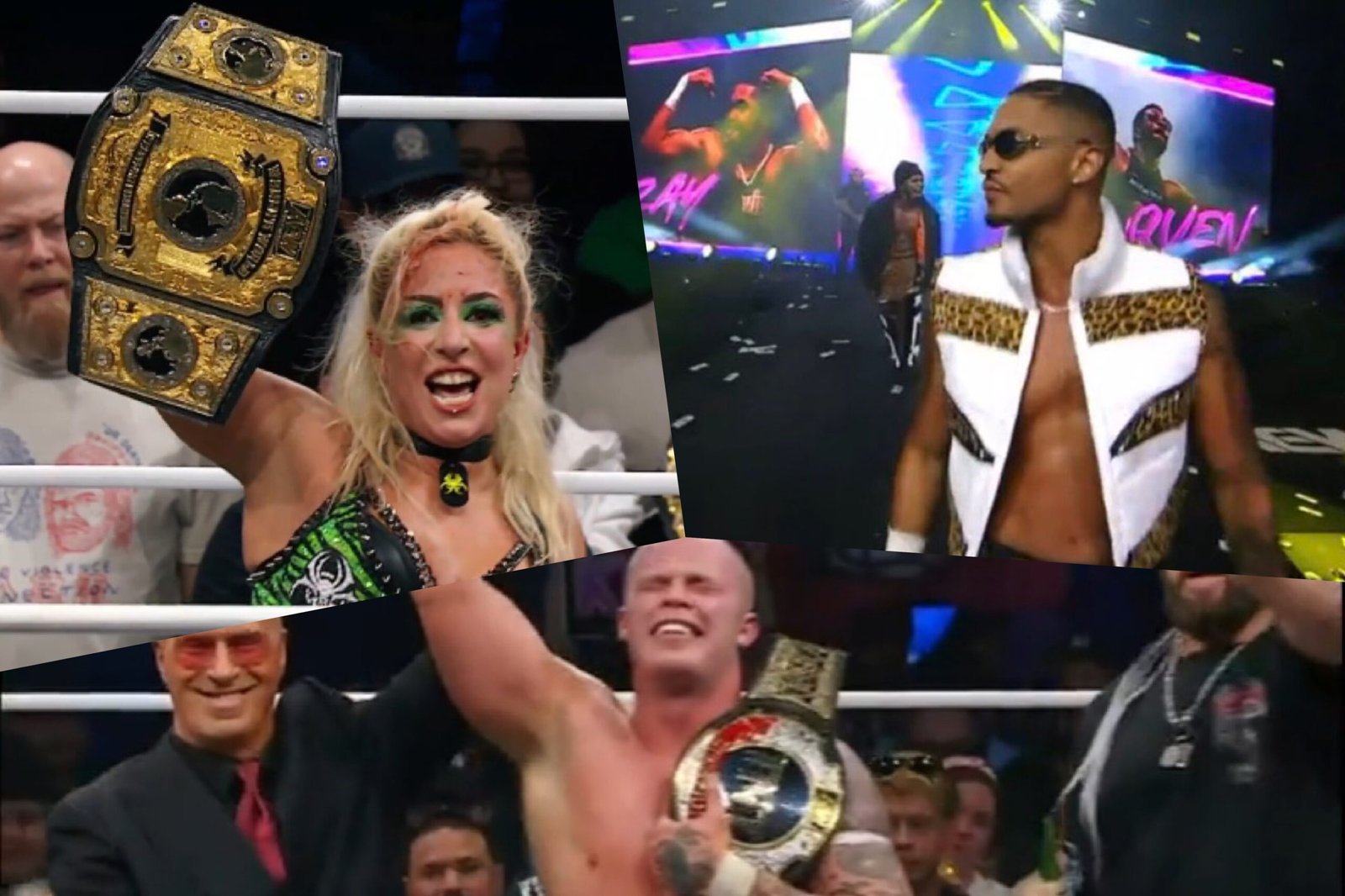
This wasn’t a “remind you what’s on Saturday” episode. It was AEW taking every major thread it’s been weaving since late January—the faction wars, the ego collisions, the humiliation angles, the title-chase paranoia—and tightening them until something had to snap. And two things did: the Kyle Fletcher–Tommaso Ciampa TNT title situation exploded into a sudden title change that instantly transformed into a ladder-match ultimatum for Australia, and the women’s division was outright rerouted when Thekla ripped the Kris Statlander era out by the roots in a violent strap-match main event.
But the most important part of the show wasn’t just “two new champions.” It was what the title changes meant. Fletcher’s win wasn’t framed like a fluke—he demanded the moment be recognized, then immediately weaponized it into a definitive, spectacle-driven finish in Sydney. Thekla’s win wasn’t framed like a fresh coat of paint—it felt like the entire division stepping into a darker ecosystem where numbers, cruelty, and control matter as much as wrestling skill.
And while Saturday is the immediate destination, Dynamite also planted the flag for what comes after. Kenny Omega and Swerve Strickland didn’t trade “tense words.” They detonated into the kind of building-wide fight that turns a rivalry into an obsession—and AEW locked in their collision for next week, making it clear the road to AEW Revolution isn’t waiting for Grand Slam to finish. Meanwhile, The Young Bucks earned the next shot at FTR and immediately made it personal, treating the contender win like a hostile takeover of the tag division’s top spot.
In other words: Dynamite wasn’t a go-home show built on reminders. It was a go-home show built on consequences.
Here Are The Full Results
- Death Riders (Jon Moxley, Claudio Castagnoli & PAC) def. Don Callis Family (Konosuke Takeshita, Josh Alexander & Mark Davis)
- Kyle Fletcher def. Tommaso Ciampa (c) (TNT Championship) — NEW CHAMPION
- Orange Cassidy & Roderick Strong def. Daniel Garcia & Clark Connors
- The Young Bucks def. The Rascalz & Private Party (AEW World Tag Team Championship #1 Contender’s Match)
- Thekla def. Kris Statlander (c) (AEW Women’s World Championship Strap Match) — NEW CHAMPION
The Breakdown, Storylines, Significance, and Narratives
1) Omega and Swerve finally tell the truth, then try to hurt each other for it
This didn’t begin with a single insult last night—it’s been building through the recent reshuffling at the top of the card where multiple “main event” identities are fighting for the same oxygen. Swerve’s whole posture in this stretch has been: I’m the present tense, stop treating me like I’m waiting my turn. Omega’s posture has been the inverse: I’m the standard, and I’m not apologizing for being the standard.
Those aren’t just viewpoints—they’re incompatible realities. AEW’s recent booking has forced them into the same space without giving either a clean lane to feel unquestionably “next,” which is exactly how you create resentment between two men who are used to being treated like the center of the universe.
What happened last night:
The segment was structured like a slow fuse: the words mattered, but the body language mattered more—posture tightening, distance closing, patience draining. When it erupted, it wasn’t a quick pull-apart; it became a building-wide fight that ended in a brutal crash through a table off the stage. Then AEW did the key thing a go-home show must do: it gave you a date. Omega vs. Swerve is official for next week.
Narrative and significance:
This is AEW making sure Grand Slam doesn’t consume the entire calendar. Saturday is the spectacle event; next Wednesday is the direction. Omega/Swerve now feels like a rivalry that can hijack March even without a championship attached because the prize is “who gets to be that guy” in the Revolution season pecking order.
2) Death Riders vs. Don Callis Family: a faction war that exists to sharpen Moxley vs. Takeshita, not replace it
The Continental picture has been framed as violence with purpose: the champion fights like he’s building a culture; the challenger operates like he’s building an empire. The Don Callis orbit is never content with “a match”—it wants leverage, optics, momentum, and bodies around the target. Death Riders, meanwhile, are built like a machine: smash the obstacle, move to the next one, repeat.
AEW has been careful not to overexpose the champion vs. challenger contact too early. That’s why trios matches like this matter—they let the factions bleed into each other while still saving the true singles war for a bigger stage.
What happened last night:
This match was paced like controlled chaos: bursts of speed, heavy strikes, and just enough champion/challenger orbiting to remind you what Saturday is about. Death Riders won, giving the champion’s side the go-home “momentum,” without flattening Takeshita’s credibility.
Narrative and significance:
For Grand Slam Australia, this is exactly the kind of go-home match you want for a title bout rooted in menace: it primes the audience to expect brutality while preserving the uncertainty. For Revolution season, it keeps the larger faction story alive regardless of who wins—because the belt is only part of the war.
3) Fletcher vs. Ciampa: the TNT title changes hands, then instantly becomes an Australia-sized finale
Ciampa’s TNT reign was never presented like a long, comfortable run—it was presented like an invasion. He took the title and dared the roster to try to take it back. Fletcher’s response wasn’t “I want my belt back.” It was “I want my identity back”—because he’s been fighting to be seen as more than a project or a rising name. He needed a win that reads as personal validation.
That’s also why the “how” mattered going in: Fletcher has been positioned as ruthless, but also proud—someone who wants the world to know he can do it without a thousand asterisks.
What happened last night:
They wrestled like two men trying to take years off each other’s careers—Ciampa targeting control and survival, Fletcher ramping the danger until the match felt like it had to end before somebody broke. Fletcher won and reclaimed the TNT Championship.
Then AEW immediately performed the go-home conversion: Fletcher didn’t celebrate. He pointed the title at Australia and turned the moment into a spotlight grab. Mark Briscoe answered, and the story clicked into place—this rivalry is dead even, and it needs a finish that can’t be argued. Fletcher demanded the ladder match.
Narrative and significance:
This is how you make a Saturday match feel bigger than “title defense.” The ladder match isn’t just spectacle—it’s a declaration that the rivalry ends in Sydney, not in a rematch loop. For Revolution month, it also defines what the TNT scene looks like afterward: either Fletcher walks out a validated champion with a signature defense, or Briscoe becomes the chaos agent who steals the weekend and forces the title picture into turbulence.
4) Cassidy & Strong vs. Garcia & Connors: the Conglomeration cracks, Darby’s revenge bleeds in, and the hair stip becomes real
The hair-vs-hair tornado tag at Grand Slam Australia has been built around humiliation—one of the most old-school, irreversible stakes in wrestling. But AEW has also layered it with faction energy: Toni Storm and Cassidy aren’t just fighting opponents; they’re fighting a philosophy that treats humiliation as dominance. Across recent weeks, the feud has escalated through threats, attacks, and the sense that the Death Riders orbit will cross any line to win.
At the same time, AEW has woven in another fuse: Darby Allin has been targeted and brutalized in this larger ecosystem, making Connors a walking grievance. And within the Conglomeration itself, Cassidy’s “I’ll figure it out” style has always tested the patience of partners who want structure and urgency.
What happened last night:
The match was built around tension, not just tags. Strong grew visibly irritated with Cassidy’s cadence and choices—and the key moment wasn’t a move, it was a decision: Strong left Cassidy hanging, then walked out, forcing Cassidy to survive alone. Darby’s presence and chaos neutralized Connors long enough for Cassidy to steal the win in a scramble.
Then came the real escalation: Marina Shafir targeted Mina Shirakawa and cut off a chunk of her hair in front of Storm. That single act redefined the entire stipulation from “a match with consequences” to “a feud where the consequences have already started.”
Narrative and significance:
The point of a hair match is belief. Once hair is actually cut on television, the audience stops seeing Saturday as a gimmick and starts seeing it as payback. And Strong walking out adds another layer: even if Cassidy and Storm win at Grand Slam, the Conglomeration’s internal stability is now a ticking issue that can explode on the road to Revolution.
5) The Bucks win the contender match, Private Party returns, and FTR gets dragged into a war instead of a defense
AEW has been rebuilding the tag division’s “top tier gravity” by centering it around teams with legacy weight. FTR as champions represent craft and control; the Bucks represent power and disruption. The contender match wasn’t just about earning a shot—it was about selecting which philosophy AEW wants pressing against the titles as Revolution season heats up.
The “wild card” tease mattered because it promised a jolt to the division’s depth. The return of Private Party wasn’t just nostalgia—it was AEW reminding the audience that the division has history and unfinished threads beneath the current spotlight.
What happened last night:
The match was chaos by design: the Rascalz making everything faster, Private Party feeding the unpredictability, the Bucks playing the veterans who know how to steal the decisive moment. The Bucks won and became #1 contenders.
Then AEW made sure it didn’t feel like a clean sports victory. The Bucks confronted FTR and turned the moment hostile—superkicks, disrespect, and the message that they’re not entering a respectful contender arc. They’re entering a takeover.
Narrative and significance:
This is a Revolution-lane feud: it doesn’t need extra stipulations because it’s about who “owns” the division’s identity. Even though the title match isn’t on Saturday’s Grand Slam card, Dynamite positioned it as the next major post-Grand Slam direction.
6) Thekla vs. Statlander: “Straplander” chooses violence… and still loses the division to Thekla’s ecosystem
This feud escalated because it stopped being about competition and became about contamination. Statlander has been presented as the kind of champion who wants to settle things directly—no ambiguity, no excuses. That’s why the strap match was the perfect narrative choice: it’s supposed to remove escape routes and force the challenger to survive the champion in the open.
But Thekla’s rise has been framed as something different. She doesn’t just fight—she imposes an environment. And her allies—Skye Blue and Julia Hart—turn every big match into a question of whether the champion can win while being surrounded by threats.
What happened last night:
The main event was nasty and strategic: the strap used as both weapon and control tool, brutality escalating, and Statlander fighting like a champion trying to drag the match back into “fair.” Thekla won the AEW Women’s World Championship with interference tipping the final moments, and the post-match chaos suggested the story won’t simply end with a handshake or a quiet rematch request.
Narrative and significance:
This is a deliberate destabilization before Grand Slam: AEW heads into Saturday with a brand-new women’s champion who feels like a narrative engine, not just a new name on the belt. For Revolution month, it opens multiple lanes at once: Statlander chasing justice, faction warfare expanding, and new challengers circling a champion who has already proven she’ll use any advantage to keep control.
Final AEW Grand Slam Australia Card
- MJF (c) vs Brody King (AEW World Championship)
- Jon Moxley (c) vs Konosuke Takeshita (AEW Continental Championship)
- Kyle Fletcher (c) vs Mark Briscoe (TNT Championship Ladder Match)
- Hangman Adam Page vs Andrade El Idolo (AEW World Title #1 Contender’s Match — shot at Revolution)
- Orange Cassidy & Toni Storm vs Wheeler Yuta & Marina Shafir (Loser gets their head shaved)
- Willow Nightingale & Harley Cameron (c) vs Megan Bayne & Penelope Ford (AEW Women’s Tag Team Championship)
Final Thoughts
AEW Dynamite on Feb. 11 wasn’t a show that simply reminded you what’s happening on Saturday—it changed what Saturday feels like.
Grand Slam Australia now has sharper edges because Dynamite made the stakes tangible. Kyle Fletcher didn’t just win the TNT Championship; he turned it into a headline attraction that demands a definitive ending, and a ladder match is the kind of stipulation that doesn’t allow “close but not quite” excuses. Death Riders walking out with trios momentum didn’t weaken the Continental Championship match—it amplified it, because the Callis Family didn’t get embarrassed; they got drawn into deeper water, which is exactly where Moxley lives. And the hair angle stopped being theoretical the moment Mina Shirakawa’s hair hit the scissors. AEW didn’t just raise the stakes—it showed you the cost.
The bigger story, though, is what Dynamite quietly promised about the post-Grand Slam landscape. Omega and Swerve didn’t brawl to fill time; they brawled because AEW is positioning their collision as a major roadblock on the way to Revolution. The Young Bucks didn’t just earn a title shot; they forced FTR into a fight they didn’t get to schedule on their own terms, which is how you turn a contender’s match into a division-wide power struggle. And Thekla winning the Women’s World Championship wasn’t just a surprise—it was a rerouting of the entire women’s division into something darker, more faction-driven, and more volatile heading into March.
So if Grand Slam Australia is the destination, Dynamite made one thing clear: it’s also a launching point. Saturday will settle scores, but it’s also going to create new ones—and this episode made sure AEW has multiple hot lanes ready the moment the Revolution road truly begins.
I’m the quiet one until the bell rings then I’ve got takes. I live for WWE NXT and TNA, I want every promotion to succeed, and I will absolutely roast the bad decisions on sight (because someone has to). Anime taught me to respect long-term storytelling; wrestling taught me that sometimes the plan is “we panicked” and called it “unpredictable.” The Miz got me into all of this, so yeah I appreciate confidence, commitment, and the art of talking like you’re already the main event. Now I bring that same energy to the page as the main writer for Late Night Crew Wrestling because if you’re not here to be must-see and tell the truth, why are you here?!