
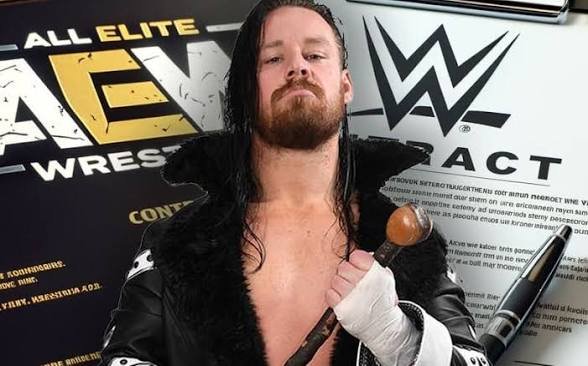
David Finlay didn’t just leave a company. He left a lane.
Over the past week, the wrestling world watched a former Bullet Club leader and proven international headliner choose AEW, then immediately saw the conversation swing toward WWE’s side of the negotiating table. The reason, as first reported by Cory Hays of Bodyslam.net, is simple and explosive: WWE’s interest was real, but the offer on the table reportedly wasn’t “main roster.” It was “start in NXT,” on a lower-level deal.
At the same time, fans are looking at Danhausen—of all people—debuting through the mystery crate angle at Elimination Chamber with the kind of rollout that reads like an immediate main roster investment.
That contrast is the story.
The Report That Lit the Match
According to Cory Hays of Bodyslam.net, Finlay was offered a WWE deal that would have required him to begin in NXT, described as a lower-level offer rather than main roster-level money and positioning. The report framed it as a key factor in Finlay’s decision to sign with AEW—one that came together quickly once WWE’s stance was clear.
WWE routes plenty of talent through NXT. That alone isn’t shocking. What’s sparked backlash is who we’re talking about.
Finlay is a fourth-generation wrestler with years of high-level experience, a physical edge that travels, and a résumé that includes leading one of the most influential factions of the modern era. “NXT first” doesn’t read like a normal step for a wrestler with that background. To fans, it reads like WWE put him in the “prove it” box anyway.
The Danhausen Factor
Then there’s the timing.
Danhausen debuted at Elimination Chamber as the man revealed from the mystery crate—an instant, unmistakable “WWE is doing something with this” moment. Reporting since has indicated he’s signed a multi-year deal and that the company views him as an immediate-value act, particularly as a character and merchandising play.
So the online argument isn’t really “Why did WWE sign Danhausen?” It’s this:
How does Danhausen get the main roster presentation and perceived main roster investment, while Finlay—lineage, credibility, leadership, and all—gets an NXT-start offer?
It’s not a knock on Danhausen’s appeal. It’s a question about WWE’s valuation.
Why WWE Might Have Taken That Route Anyway
The uncomfortable truth is that WWE often treats “main roster ready” less like a merit badge and more like a business category.
Danhausen is an instant-read character. He’s easy to package, easy to market, and easy for casual viewers to understand in seconds. WWE can drop him into TV immediately without needing a long explanation.
Finlay is the opposite kind of asset: context-rich, reputation-heavy, forged largely outside WWE’s system. Plugging him straight into Raw or SmackDown requires translation—defining him for WWE’s audience, explaining why he matters, and protecting him through weekly television’s churn. NXT can function as a controlled environment for that kind of presentation reset.
Even if WWE’s thinking was practical, the optics still land harsh: a proven, world-traveled leader reportedly being offered a developmental starting point.
Finlay Picks AEW, and the Message Gets Loud
Finlay’s AEW arrival didn’t feel like a man looking for opportunity. It felt like a man arriving with leverage.
He debuted alongside Gabe Kidd and Clark Connors, immediately tying himself to a violent, pack-minded identity and giving AEW fresh faction energy. The pitch was clear: Finlay isn’t here to “find himself.” He’s here to take something.
That’s why this report matters. Finlay didn’t choose AEW because it was available—he chose it because the role and money reportedly matched the level he believes he’s already earned.
What This Says About WWE Right Now
This situation is quickly becoming a shorthand for how fans view WWE’s priorities in 2026: the company appears more willing to invest instantly in an act that’s ready-made television than a name that’s ready-made credibility.
Finlay represents pedigree, leadership, and hard-earned aura. Danhausen represents immediate presentation and marketable identity. Put those two realities in the same week, and the discourse writes itself—fair or not.
And now every time WWE signs someone to a perceived main roster-level deal, the comparison will come back.
Because in the end, WWE reportedly offered a system. AEW offered a spotlight.
And Finlay followed the light.
Make sure to subscribe to our Late Night Crew Wrestling YouTube Channel. Follow @yorkjavon, @kspowerwheels & @LateNightCrewYT on X.
I’m the quiet one until the bell rings then I’ve got takes. I live for WWE NXT and TNA, I want every promotion to succeed, and I will absolutely roast the bad decisions on sight (because someone has to). Anime taught me to respect long-term storytelling; wrestling taught me that sometimes the plan is “we panicked” and called it “unpredictable.” The Miz got me into all of this, so yeah I appreciate confidence, commitment, and the art of talking like you’re already the main event. Now I bring that same energy to the page as the main writer for Late Night Crew Wrestling because if you’re not here to be must-see and tell the truth, why are you here?!