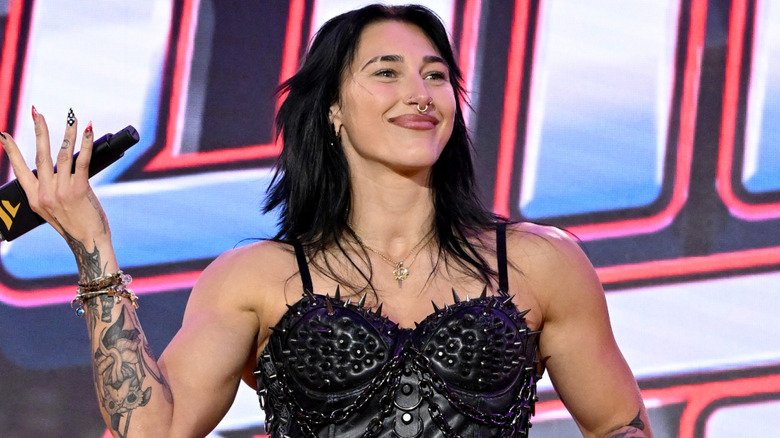
March is Women’s History Month, so I’m not doing the “Rhea Ripley is cool” version of this. Everybody already knows she’s cool. The real story is how Rhea became the kind of WWE star who doesn’t just win belts — she changes the temperature of the entire women’s scene. Some wrestlers feel important when the title is on them. Rhea feels important even when the title isn’t, because the company (and the audience) treats her like the division’s problem that never goes away.
And if we’re being honest, the reason she’s stayed in that lane isn’t just look, aura, or presentation. It’s that she’s repeatedly delivered on the nights where WWE asks you to prove you belong in the top tier.
Act I: Before “Mami,” there was proof
Rhea’s WWE rise didn’t start at the top. It started with her building credibility the old-fashioned way — by being thrown into environments where you either sink or you come out harder. The cleanest “origin point” is NXT UK, where she became the inaugural NXT UK Women’s Champion after winning the tournament finals against Toni Storm (as WWE and NXT UK title history have long documented).
That matters for Women’s History Month because it’s part of the larger shift: WWE’s women’s scene started expanding into multiple brands and multiple identities, and Rhea was one of the first wrestlers they trusted to be a foundation piece in that expansion. Not a cameo. Not a side act. A centerpiece.
Act II: The Royal Rumble win that didn’t feel like booking — it felt like inevitability
You can debate “when she became a megastar,” but you can’t debate what the 2023 Women’s Royal Rumble did for her. WWE didn’t give her the safe route. They gave her the hardest possible version of the win: No. 1 entry and surviving to the end, last eliminating Liv Morgan. WWE’s own match report frames it as record-setting, and it absolutely played like it.
That win turned into the WrestleMania match that basically became her calling card: Rhea vs. Charlotte Flair at WrestleMania 39, where she won the SmackDown Women’s Championship. WWE called it “a showdown for the ages,” and the wider coverage matched the tone — it wasn’t “good for the women,” it was just one of the best matches of the weekend.
If you want the layered part: it wasn’t only the win. It was the fact that after that match, Rhea stopped feeling like a “future top star” and started feeling like a wrestler WWE could build its women’s identity around.
Act III: Champion pressure, injury reality, and the “system shock” moment
The WrestleMania 40 defense against Becky Lynch is a different kind of test than winning the belt. That match is about carrying expectation — and Rhea retained. Both wrestling coverage and mainstream coverage framed it like a real title fight, and Rhea came out still feeling like the standard.
Then came the part that defines whether you’re truly “the one” in WWE: what happens when you’re forced out of the picture.
On April 15, 2024, WWE announced Rhea had to vacate the Women’s World Championship due to injury after the Liv Morgan angle.
And the way WWE framed it is important: it didn’t feel like a routine vacancy. It felt like the division lost its anchor. That’s how you know someone is an era-level piece — the title doesn’t just move, the whole show shifts.
The belt swap that people forget, but matters in the history
One detail that gets lost in the blur of weekly TV: after the 2023 title lineage shake-up, WWE formally presented Rhea with the Women’s World Championship on June 12, 2023, and she relinquished the SmackDown Women’s Championship as part of that changeover. WWE covered it directly, and Fightful did as well, because it was a clear “new era” branding moment with Rhea positioned as the face of it.
That’s not trivia — it’s Women’s History Month context. WWE literally chose her as the visual for what that new title identity was supposed to represent.
The praise and the critique (because the honest version matters)
The praise is easy to document: the Charlotte match was widely celebrated, and even Observer-side discussion around it leaned “all-time level” for a North American women’s match.
Rhea’s a rare mix of intimidation and structure — she can be the “monster” and still work a main-event pace without the match falling apart.
The critique is real too, and it mostly lives in two places: booking patterns and fan discourse. During her long run on top, there were stretches where people complained about defenses and the way Judgment Day gravity pulled focus away from the title scene — you can see that argument play out in fan communities constantly.
Rhea herself has also addressed fan criticism about booking publicly, which tells you she’s aware of the noise that comes with being positioned as a franchise player.
But here’s my takeaway: even the criticism proves the point. Nobody nitpicks you like that unless you’re treated as the center. The expectations are higher because her placement is higher.
The Rhea Ripley tape-study, without the fluff
This is why she keeps landing back at the top:
- She wrestles like contact is the point. Her matches don’t feel like a move list. They feel like a fight with intent.
- She can be “bigger than the match” without overpowering it. Some aura wrestlers forget to sell the opponent. Rhea usually makes the opponent feel like they’re surviving something.
- She never loses danger when she’s underneath. That’s the ace trait. You can hurt her, but she still feels like she can end you in one exchange.
Why she belongs in Women’s History Month conversations right now
Women’s History Month is about legacy, but it’s also about recognizing the women building the next version of history in real time. Rhea Ripley is era-defining because she helped normalize a kind of presentation WWE used to reserve for very specific stars: the “final boss” framing — not as a gimmick, but as a weekly reality you have to plan around.
And the best part? She didn’t get there off one moment. She got there off repeated proof: Rumble endurance, WrestleMania classics, championship pressure, injury adversity, and the ability to come back without feeling smaller.
That’s not hype. That’s résumé.
Make sure to subscribe to our Late Night Crew Wrestling YouTube Channel. Follow @yorkjavon, @kspowerwheels & @LateNightCrewYT on X.
I’m the quiet one until the bell rings then I’ve got takes. I live for WWE NXT and TNA, I want every promotion to succeed, and I will absolutely roast the bad decisions on sight (because someone has to). Anime taught me to respect long-term storytelling; wrestling taught me that sometimes the plan is “we panicked” and called it “unpredictable.” The Miz got me into all of this, so yeah I appreciate confidence, commitment, and the art of talking like you’re already the main event. Now I bring that same energy to the page as the main writer for Late Night Crew Wrestling because if you’re not here to be must-see and tell the truth, why are you here?!