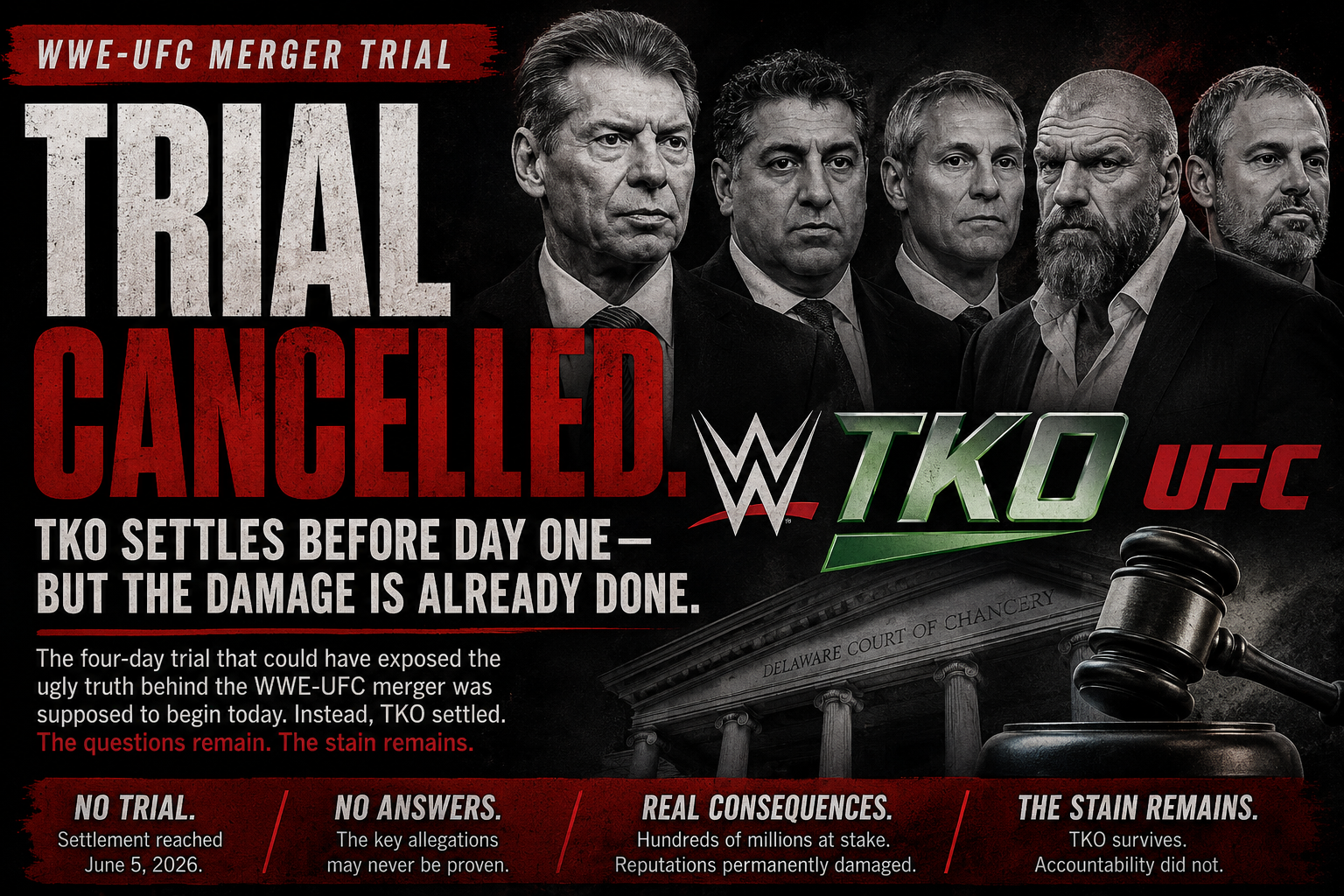
The four-day WWE merger trial was supposed to begin today, June 8, 2026, inside the Delaware Court of Chancery.
Vince McMahon, WWE President Nick Khan, TKO Chief Executive Officer Ari Emanuel, TKO President and Chief Operating Officer Mark Shapiro, WWE Chief Content Officer Paul “Triple H” Levesque and other major figures connected to the creation of TKO Group Holdings were expected to face questions about one of the most consequential transactions in modern professional wrestling history.
Instead, the courtroom will remain quiet.
The parties in the consolidated shareholder lawsuit have reached an agreement in principle to settle the case, cancelling a trial that threatened to expose even more about how WWE was sold to Endeavor, combined with UFC and folded into a publicly traded corporate machine worth billions of dollars.
The settlement still requires court approval. The financial terms have not been disclosed. Nobody outside the parties involved knows how much money will be paid, who will pay it, whether insurance will cover any portion of the cost or whether the final agreement will include governance reforms.
But the immediate outcome is clear.
TKO escaped the trial.
It did not earn a clean ending.
The company avoided four days of public testimony that could have become an embarrassment for some of the most powerful executives in sports and entertainment. It avoided having McMahon and Khan attempt to explain disappearing Signal messages in open court. It avoided deeper scrutiny of Emanuel’s voicemails offering McMahon legal support connected to pending federal investigations. It avoided the possibility of watching its carefully polished corporate image disintegrate under oath.
That is a practical victory.
It is not vindication.
The settlement does not erase the Delaware Court of Chancery’s sanctions opinion. It does not reverse the judge’s finding that spoliation of evidence occurred. It does not make the “Langis” exchange any less absurd. It does not resolve the central question hanging over the merger: did former WWE shareholders receive the best possible deal, or did McMahon’s personal interests shape the process from the beginning?
The trial is gone.
The stench remains.
How WWE and UFC Became TKO
On September 12, 2023, WWE and UFC officially came together under TKO Group Holdings.
Endeavor received a 51% controlling interest in the newly formed company. Existing WWE shareholders received the remaining 49% on a fully diluted basis. Emanuel became the top executive. Shapiro became president and chief operating officer. Khan remained WWE President. McMahon became executive chairman of TKO before resigning in January 2024 after Janel Grant filed a separate federal lawsuit against him and WWE.
The merger was promoted as a historic business achievement.
WWE, the largest professional wrestling company in the world, had been combined with UFC, the dominant mixed-martial-arts promotion, under one corporate umbrella. TKO would use Endeavor’s experience in media rights, ticket sales, licensing, sponsorships and premium hospitality to squeeze even more revenue out of two already powerful brands.
From a financial perspective, the machine has worked.
TKO reported $1.597 billion in revenue during the first quarter of 2026, along with $249.8 million in net income and $549.8 million in adjusted EBITDA. WWE generated $475.7 million in quarterly revenue, a 22% year-over-year increase. UFC generated $401.2 million, a 12% increase.
TKO is not a failing company.
That makes the underlying allegations more serious, not less.
Former WWE shareholders were entitled to a fair process when their company was sold. They were not required to accept a potentially compromised transaction simply because TKO later became more profitable.
A business can generate enormous revenue and still have a governance problem.
Those two realities can exist at the same time.
The Lawsuit Was Never Just About a Bad Deal
The shareholder lawsuit challenged the process that created TKO.
The plaintiffs alleged that McMahon steered WWE toward Endeavor and Emanuel because that transaction protected McMahon’s personal interests. A deal with Endeavor would give McMahon a continuing role inside the post-merger company while also offering legal support connected to federal investigations into his alleged misconduct.
The defendants denied the central allegations.
The court never issued a final judgment declaring that the merger was unlawful. The trial was supposed to determine whether the plaintiffs could prove their case and whether the defendants could successfully rebut it.
But the lawsuit became far more dangerous for the defense after Vice Chancellor J. Travis Laster issued a 41-page memorandum opinion imposing sanctions for spoliation of evidence.
The opinion did not say that every missing Signal message contained a smoking gun. Nobody can know exactly what disappeared.
That was the entire problem.
Senior WWE officials were subject to legal-hold notices instructing them to preserve relevant documents and electronically stored information. Those notices specifically addressed text messages, instant messages and automatic-deletion settings.
Yet disappearing-message settings remained in place. Some were manually changed. Certain Signal chats were configured to delete messages after short windows measured in hours or less.
Laster found that spoliation occurred and stated that the controlling stockholder and senior officers acted recklessly at a minimum in allowing it to happen.
This was not a minor recordkeeping mistake.
This was a self-inflicted legal disaster.
The Timeline That Refused To Stay Buried
The court opinion laid out a timeline that made the defense’s position increasingly difficult to explain.
On June 21, 2022, WWE’s assistant general counsel circulated a legal-hold notice addressing the allegations surrounding McMahon. The recipients included McMahon, Khan, Levesque, Stephanie McMahon and Brad Blum.
The notice instructed them to preserve relevant communications and suspend procedures that could delete, destroy or alter electronically stored information.
On August 5, 2022, the Department of Justice sent WWE a request for information regarding McMahon’s alleged misconduct. That same day, Khan manually changed the auto-delete setting for a Signal chat with McMahon so messages would disappear after one hour. Blum had made a similar change one day earlier.
On August 10, 2022, McMahon, Khan, Stephanie McMahon and Emanuel met for lunch and discussed a potential WWE–Endeavor transaction. That same day, Stephanie McMahon manually changed the auto-delete setting for a Signal chat with her father so messages would disappear after one hour.
The discussions continued.
The Raine Group’s Jeff Sine prepared a presentation titled “Project Stunner” describing a potential WWE deal. Sine, a longtime financial adviser to Emanuel, later proposed switching sides and representing McMahon in connection with a possible transaction.
By September 2022, Emanuel was leaving voicemails for McMahon discussing legal support.
In one voicemail, Emanuel stated that people at the Department of Justice had previously worked at Latham & Watkins, said that could be helpful, discussed indemnification and acknowledged that criminal matters could not simply be stopped.
In another voicemail, Emanuel said there were ways to work through issues involving the DOJ or other matters.
The court did not find that Emanuel obstructed an investigation. It did not find that he caused any federal inquiry to disappear.
The actual record is damaging enough without inventing anything.
The messages connected the potential Endeavor deal to McMahon’s legal exposure in a way that raised obvious questions about whether McMahon’s personal interests influenced his decision-making.
The “Langis” Exchange
Then there was “Langis.”
In February 2023, Khan sent McMahon a conventional text message containing a single word:
“Langis.”
McMahon asked what it meant.
Khan told him to read it backwards.
“Langis” reversed spells “Signal.”
The exchange would have been funny if it were not sitting in the middle of a high-stakes corporate lawsuit involving disappearing messages and allegations that WWE’s sale process had been steered toward a preferred buyer.
During depositions, Khan said he had no idea why he wrote Signal backwards. McMahon said he would need to take out a pencil to work out what the word meant.
Laster described their testimony about Signal use as “notably strained.”
That phrasing matters.
The court did not formally find that Khan or McMahon lied under oath. Laster is not a federal judge. The original version of this story went too far by describing the exchange as lying to a federal judge.
The corrected version is still brutal.
The vice chancellor presiding over a major Delaware corporate case openly described their testimony as notably strained. That is the kind of judicial language executives never want attached to their names.
The word “Langis” became the perfect symbol of the entire scandal.
A coded reference that was not particularly clever.
An explanation that was not particularly convincing.
A disappearing-message strategy that created a permanent reputational stain.
The Five Facts That Would Have Been Presumed True
The sanctions opinion placed the defense under a severe legal handicap.
Had the trial started today, the court would have presumed five facts to be true unless the defendants rebutted them with clear and convincing evidence:
- Emanuel’s promise to give McMahon a continuing role in a post-merger company influenced McMahon’s decision-making.
- Emanuel’s offer of indemnification and other legal support connected to pending federal investigations into McMahon’s alleged misconduct influenced McMahon’s decision-making.
- McMahon decided to pursue an Endeavor transaction in 2022 before WWE formally initiated its strategic-review process.
- Khan communicated with Emanuel between August and December 2022 to facilitate a WWE–Endeavor transaction.
- McMahon and Khan worked with The Raine Group to steer the process toward Endeavor and away from other potential bidders.
These were not final findings of liability.
The defendants still would have been allowed to introduce documents, call witnesses and attempt to persuade the court that the presumed facts were incorrect.
But the burden had shifted.
The people responsible for the missing messages would have been forced to deal with the uncertainty created by those missing messages.
That is the point of the sanctions.
The plaintiffs could not use evidence that no longer existed. The court decided the defense should not benefit from the absence it created.
Why The Trial Was Cancelled
The parties have not publicly explained why they settled.
Any definitive statement about private negotiations would be speculation.
The timing still speaks loudly.
The sanctions opinion was issued less than two weeks before the four-day trial was scheduled to begin. The defense was entering the courtroom with a heightened burden of proof on issues sitting at the center of the plaintiffs’ theory. McMahon, Khan, Emanuel, Shapiro, Levesque and other figures connected to the deal were expected to testify.
A public trial carried obvious risks.
Even if the defendants ultimately avoided the full damages sought by the plaintiffs, the testimony could have created damaging headlines, exposed additional internal communications and forced TKO executives to answer questions the company would rather leave unanswered.
Then, days before trial, an agreement in principle was reached.
Settlements happen for many reasons. Litigation is expensive. Trials are unpredictable. Public testimony creates reputational risk.
A settlement is not proof that the plaintiffs would have won.
But the sequence is impossible to ignore.
The sanctions ruling landed.
The legal burden became heavier.
The trial vanished.
How Much Money Was at Stake?
The plaintiffs’ expert estimated damages between approximately $466 million and $957 million, plus interest.
The argument focused partly on whether WWE shareholders should have received a larger percentage of TKO than the 49% they ultimately received. The plaintiffs contended that WWE’s relative value justified a greater ownership stake.
The defense disputed that position and argued that the merger was fair.
The eventual settlement amount will matter.
If the figure is relatively modest and largely covered by insurance, TKO will frame the resolution as the cost of eliminating legal uncertainty.
If the figure is substantial, it will reinforce the seriousness of the risk created by the sanctions opinion.
The source of the money will matter too.
Former WWE shareholders deserve to know whether the cost falls on insurance carriers, TKO, individual defendants or some combination of those sources. They deserve to know whether the agreement includes governance reforms. They deserve to know whether anyone will admit wrongdoing.
Until the settlement papers are filed, nobody should pretend those answers are known.
TKO Escaped the Courtroom, Not the Stench
TKO will survive.
WWE is not leaving the company. UFC is not being sold tomorrow. Raw, SmackDown, NXT and WWE premium live events will continue. UFC cards will continue. TKO executives will continue discussing revenue, adjusted EBITDA, media rights and shareholder returns.
The corporate machine will continue printing money.
That is not the same as accountability.
The company presents itself as the polished, modern, professionally managed evolution of WWE. It wants investors to believe the chaotic McMahon era has been replaced by a serious corporate structure with strong controls and credible leadership.
The merger litigation exposed how fragile that image can be.
This was not simply Vince McMahon leaving behind one more scandal after resigning from TKO.
Nick Khan remains WWE President and a TKO director. His role deserves serious scrutiny.
Khan is not a peripheral character in this story. The “Langis” exchange involved him directly. The court’s five presumptions would have included allegations that he communicated with Emanuel to facilitate the deal and worked with McMahon and Raine to steer the process toward Endeavor.
There is no confirmed indication that Khan will lose his position.
That does not mean the issue should disappear.
TKO shareholders deserve to know what the company has done to strengthen litigation-hold procedures, restrict the use of disappearing-message applications and create meaningful oversight for senior executives.
A publicly traded company cannot treat this as a public-relations inconvenience and quietly move on.
Triple H Is Not in the Same Position as Nick Khan
Levesque appeared in the sanctions opinion because he was among the Signal users who failed to ensure that relevant messages were properly preserved.
That is serious.
Senior executives do not get to ignore preservation obligations because their primary responsibilities involve creative direction rather than corporate transactions.
But Levesque should not be carelessly lumped into every allegation directed at McMahon and Khan.
The court made an important distinction. The five presumed facts related to the conduct and motivations of McMahon and Khan. Laster did not presume that other defendants knew about their actions or participated in them.
The public record does not justify claiming that Levesque helped pre-wire the Endeavor transaction or personally steered WWE away from competing bidders.
His creative control of WWE is unlikely to change because of this settlement alone.
The reputational issue remains.
Levesque has benefited from the perception that he represents a cleaner and more stable WWE. His presence in the opinion complicates that image, even if his role was not the same as Khan’s.
UFC Is Less Exposed, But It Is Not Separate
The deepest scar belongs to WWE.
The core allegations concern WWE’s sale process, McMahon’s return, Khan’s communications and decisions made before TKO formally launched.
UFC’s weekly operations are unlikely to change because of the settlement. Dana White was not the central figure in the alleged steering of WWE’s sale. UFC’s media-rights business, sponsorships and event schedule will continue moving forward.
But UFC cannot pretend this is somebody else’s problem.
UFC and WWE now sit inside the same parent company. Emanuel sits at the top of TKO. The court opinion examined whether an Endeavor transaction became attractive to McMahon partly because Emanuel offered him a continuing role and legal support.
That creates a credibility problem for the corporate structure housing both brands.
UFC fans may not care about Delaware fiduciary law.
Investors, business partners and regulators have fewer reasons to ignore it.
WWE Carries the Bigger Reputational Scar
WWE carries the greatest damage because the rot began inside WWE.
For decades, the company revolved around McMahon. He controlled the business, the product and the culture. His return in early 2023 was framed as a necessary step to explore strategic alternatives and maximize shareholder value.
The litigation created a more troubling picture.
The court opinion described discussions with Endeavor taking shape before WWE formally launched its strategic review. It described Emanuel’s legal-support offers. It described disappearing-message settings changing around critical moments. It described testimony about Signal use as notably strained.
The formation of TKO was supposed to represent WWE’s clean break from the old era.
Instead, the lawsuit suggested that the old culture may have shaped the transition into the new one.
That does not mean WWE is commercially weak.
It means financial success cannot be used as a disinfectant.
Fans Should Be Careful About What This Case Does and Does Not Prove
TKO deserves criticism for its aggressive monetization strategy.
WWE ticket prices have become increasingly difficult for ordinary fans to justify. Sponsorships have become harder to ignore. Premium live events have become corporate showcases. Talent releases remain frustrating. UFC has faced its own criticism over pricing and fighter compensation.
Those issues are real.
But the merger lawsuit does not prove that every unpopular business decision was caused by the Delaware case.
There is no public evidence that WWE released talent to prepare for an adverse judgment. There is no evidence that ticket-price increases were designed to create a settlement reserve. There is no evidence that every sponsorship push traces back to the lawsuit.
The stronger argument is broader and more credible.
TKO has built a business model that prioritizes monetization relentlessly. The merger litigation exposes the danger of trusting that model without demanding transparency and accountability from the executives running it.
Fans do not need to invent a conspiracy around every decision to recognize what is happening in front of them.
The product is becoming more commercialized because TKO believes it can extract more money without alienating enough fans to matter.
The lawsuit did not create that strategy.
It made the lack of accountability surrounding that strategy harder to ignore.
What Happens Next?
The proposed settlement must be finalized and presented to the Delaware Court of Chancery for approval.
The next filings should answer the most important remaining questions:
How much money will be paid?
Who will pay it?
Will insurance cover some or all of the settlement?
Will individual defendants contribute personally?
Will the agreement contain admissions of wrongdoing?
Will TKO be required to implement governance or compliance reforms?
How much more will the public learn about the merger process?
Until those details emerge, the case is not finished.
The trial has been avoided.
The accountability phase has not been completed.
Final Thoughts
The WWE–UFC merger lawsuit will not end with witnesses taking the stand today.
It will not end with McMahon trying to explain why he needed a pencil to work out what “Langis” meant. It will not end with Khan explaining why he sent Signal backwards. It will not end with Emanuel answering questions about voicemails connecting legal support to a potential deal.
That is exactly why the settlement matters.
TKO escaped the public trial that could have forced a fuller accounting of how the company was created.
The merger remains intact. WWE and UFC remain under the same corporate roof. The revenue will continue flowing. The stock market will continue rewarding growth. Executives will continue presenting TKO as a premium sports-and-entertainment powerhouse.
But the next time the company celebrates the merger as a flawless business triumph, the public should remember the details it could not erase.
A controlling shareholder determined to return.
A preferred buyer waiting in the wings.
A senior executive typing “Langis.”
Disappearing messages.
Testimony the court found notably strained.
A sanctions opinion that shifted the burden of proof.
A four-day trial cancelled before the first witness took the stand.
TKO may have purchased an ending.
It did not earn absolution.
I’m rebuilding the original featured image as a darker, cleaner editorial graphic: courthouse atmosphere, Vince McMahon and Nick Khan as the central figures, Ari Emanuel in the background, a glowing “LANGIS” visual element, shattered-message imagery and a headline centered on the trial being avoided without the questions disappearing.
Make sure to subscribe to our Late Night Crew Wrestling YouTube Channel. Follow @yorkjavon, @kspowerwheels & @LateNightCrewYT on X.
I’m the quiet one until the bell rings then I’ve got takes. I live for WWE NXT and TNA, I want every promotion to succeed, and I will absolutely roast the bad decisions on sight (because someone has to). Anime taught me to respect long-term storytelling; wrestling taught me that sometimes the plan is “we panicked” and called it “unpredictable.” The Miz got me into all of this, so yeah I appreciate confidence, commitment, and the art of talking like you’re already the main event. Now I bring that same energy to the page as the main writer for Late Night Crew Wrestling because if you’re not here to be must-see and tell the truth, why are you here?!