The working relationship between WWE and TNA Wrestling has already become one of the most significant and complicated partnerships in modern professional wrestling.
What began as a surprising crossover experiment has given TNA wrestlers opportunities to appear on a much larger platform, opened the door for WWE talent to work inside a different environment and placed a company that has spent years fighting to regain relevance back into the center of the wrestling conversation.
The partnership has created memorable moments. It has introduced TNA talent to a wider audience. It has also arrived during a period of genuine progress for the company, highlighted by the move of Thursday Night iMPACT! to AMC and AMC+ in January.
However, the relationship has raised an increasingly uncomfortable question.
Is WWE helping TNA become a stronger independent wrestling company, or is WWE placing itself in an advantageous position to benefit from TNA’s growth, evaluate its most valuable talent and potentially acquire the promotion if Anthem Sports & Entertainment eventually decides to sell?
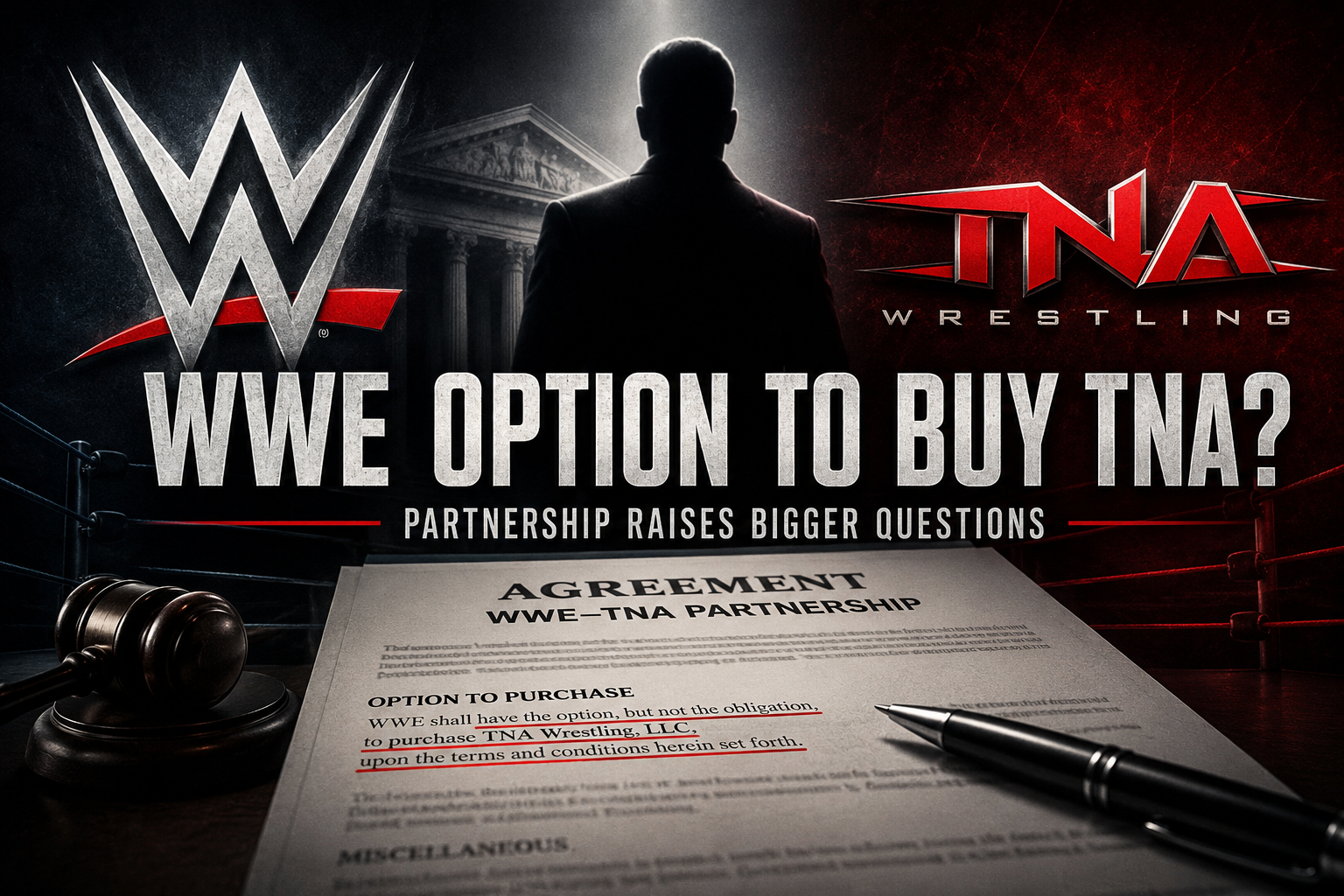
According to reporting from Dave Meltzer through the Wrestling Observer Newsletter in August 2025, WWE has an option to purchase TNA for a limited period and a right of first refusal if another potential buyer emerges.
Neither WWE, TNA nor Anthem has publicly released the agreement or officially confirmed its specific contractual terms. There is also no indication that WWE is preparing to exercise the reported option immediately.
This is not confirmation that TNA is about to be sold.
It is still a significant detail because the reported agreement potentially gives WWE a level of leverage that extends far beyond an ordinary talent-exchange partnership.
What WWE’s Reported Purchase Option Actually Means
A purchase option and a right of first refusal are two different concepts.
A purchase option could allow WWE to acquire TNA under conditions established in the agreement during a defined period. A right of first refusal would generally allow WWE to match an outside offer if Anthem decides to sell the promotion.
Neither provision means WWE currently owns TNA.
Neither provision means WWE can simply take control of the company whenever it wants.
Anthem remains the owner of TNA Wrestling. The promotion continues to operate as its own brand with weekly television, live events and pay-per-views.
The reported agreement is still important because it could complicate TNA’s long-term position.
Even if WWE never exercises its option, an outside investor may hesitate before seriously pursuing a purchase if WWE has the ability to match the final offer. WWE can maintain a productive relationship with TNA, benefit from the company’s increased visibility and preserve a potential pathway toward ownership without immediately taking on the expense, responsibility or scrutiny that would come with acquiring another American wrestling promotion.
That may be more valuable to WWE than purchasing the company right now.
The MLW Settlement Does Not Publicly Prohibit WWE From Buying TNA
The resurfaced discussion has also raised questions about whether WWE would legally be allowed to purchase TNA after settling Major League Wrestling’s antitrust lawsuit.
There is no publicly available evidence establishing that WWE is prohibited from doing so.
MLW accused WWE of monopolistic and anticompetitive conduct involving the professional-wrestling media-rights market. The lawsuit was settled in late 2023 and dismissed with prejudice. TKO Group Holdings later disclosed a $20 million charge connected to WWE’s antitrust settlement.
The complete settlement agreement has not been made public. Nobody outside the parties involved can definitively describe every obligation contained within it.
However, no publicly disclosed court filing, official statement or financial report establishes that WWE is automatically prohibited from acquiring another domestic wrestling company.
A potential WWE purchase of TNA could still attract attention.
WWE is the dominant wrestling company in the United States, and the MLW lawsuit would make the optics difficult to ignore. Any proposed acquisition could create questions about competition for talent, media rights, touring opportunities and other business relationships.
That is different from saying the deal would automatically be illegal.
The WWE Partnership Has Helped TNA
It would be inaccurate to frame the WWE relationship as entirely negative.
WWE and TNA officially announced their multi-year partnership in January 2025. The agreement created crossover opportunities for wrestlers from both companies across NXT, iMPACT!, selected WWE premium live events and TNA pay-per-views.
The relationship gave TNA access to a level of visibility that the company had struggled to generate consistently on its own. Jordynne Grace and Joe Hendry became two of the most prominent early examples, appearing on WWE programming while representing TNA and introducing the company to portions of WWE’s audience that may not have followed iMPACT! regularly.
TNA also took an important step forward when AMC Networks announced that Thursday Night iMPACT! would move to AMC and AMC+ as a two-hour weekly program.
The new era began in January with TNA presenting its flagship show on a stronger national television platform outside Anthem-owned AXS TV.
That matters.
TNA has spent years attempting to rebuild credibility after surviving financial instability, ownership changes, creative inconsistency and multiple periods when the company’s long-term future appeared uncertain.
The move to AMC represented tangible progress.
The WWE relationship helped make TNA feel relevant again.
The issue is not whether the partnership has helped TNA.
It has.
The issue is whether those benefits are enough to outweigh the long-term risks.
TNA Cannot Afford To Become A Temporary Showcase For WWE
The concern becomes clearer when looking at the relationship from WWE’s perspective.
WWE can feature TNA wrestlers on its programming, place them in front of a larger audience and evaluate how they perform inside the WWE system. The company can measure their crowd reactions, presentation, television presence and ability to work in a different environment before deciding whether to pursue them when their contracts become available.
TNA receives exposure.
WWE receives a low-risk scouting advantage.
That imbalance has become increasingly difficult to ignore after the departures of Jordynne Grace and Joe Hendry. Both wrestlers became major parts of the WWE–TNA crossover relationship before eventually joining WWE.
Neither wrestler was stolen.
Both had the right to pursue larger opportunities. WWE also did not create their value. TNA played a major role in helping Grace and Hendry become recognizable stars.
That is exactly why the pattern should concern TNA.
If the company develops a wrestler, places that wrestler at the center of its product and then watches WWE benefit from the finished product, TNA risks becoming a temporary proving ground rather than a legitimate destination.
Mike Santana Is The Most Important Test Yet
The uncertainty surrounding Mike Santana may become the most important test of TNA’s ability to protect its own foundation.
Santana is the reigning TNA World Champion and one of the most important wrestlers on the roster. His current TNA contract is reportedly expected to expire in July. WWE interest in Santana has also been reported.
Nothing has been officially finalized.
Santana has not been announced as a future WWE signing, and his departure should not be treated as a certainty.
However, the possibility carries major significance.
Santana is not simply another wrestler approaching free agency. TNA has positioned him as the face of the company. He represents the type of wrestler the promotion should be attempting to build around: an established talent with credibility, emotional connection and the ability to carry the world championship during a critical period.
Losing Santana shortly after investing heavily in him would create another difficult perception problem.
If TNA cannot retain its world champion after Grace and Hendry already transitioned to WWE, fans will naturally question whether the company is building long-term stars or preparing talent for someone else’s roster.
Leon Slater Represents The Long-Term Concern
Leon Slater presents a different challenge.
Fightful has reported that Slater’s current TNA agreement is scheduled to run into the fall of 2026. At only 21 years old, he has already established himself as one of the most exciting and valuable young wrestlers in the company.
Slater has the athletic ability, upside and growing profile that every major wrestling promotion would want to evaluate.
His future should not be treated as settled, and there is no confirmed departure.
The larger point is that TNA must decide what kind of company it wants to become.
A promotion at TNA’s level will never retain every wrestler forever. WWE and AEW have greater financial resources, larger platforms and more leverage. Talent will leave. That is part of the business.
TNA still needs to prove it can retain enough important wrestlers to establish a recognizable identity.
Santana represents the immediate concern.
Slater represents the long-term concern.
Steve Maclin’s Release Added To The Uneasiness
The timing of the resurfaced purchase-option discussion has made the situation feel even more significant.
TNA officially announced the releases of Steve Maclin and Myla Grace on June 7.
Maclin’s departure matters because he was not a disposable lower-card wrestler. He was a former TNA World Champion, an established television presence and someone capable of remaining an important part of the company’s upper card.
One release does not mean TNA is collapsing.
The concern comes from the accumulation of losses and uncertainty.
Jordynne Grace left for WWE.
Joe Hendry left for WWE.
Josh Alexander departed for AEW.
Steve Maclin was released.
Mike Santana is reportedly approaching the expiration of his contract while WWE interest grows.
Leon Slater will eventually become another important retention test.
Taken individually, each situation can be explained.
Viewed together, they reveal a deeper problem.
TNA cannot continue rebuilding its identity around wrestlers who may only be passing through.
Fans Are Beginning To Question The Direction Of The Partnership
The WWE–TNA relationship initially generated excitement because it created matchups and possibilities that once seemed unrealistic.
That excitement has not disappeared.
However, the tone of the online conversation has changed.
Fans are increasingly questioning whether the partnership is truly balanced or whether WWE receives the greater long-term benefit. Social-media discussions have compared the situation to WWE’s historical relationship with ECW and AEW’s working relationship with New Japan Pro-Wrestling.
Neither comparison is perfect.
Both are worth examining.
The ECW Comparison Is More Complicated Than It Appears
The comparison between TNA’s current relationship with WWE and the final years of the original ECW should not be treated as proof that history is repeating itself.
It should not be dismissed either.
WWF’s relationship with ECW was more cooperative behind the scenes than the on-screen presentation suggested.
Paul Heyman later revealed that WWF began paying ECW $1,000 per week in 1996 after Vince McMahon wanted to sign 2 Cold Scorpio. ECW stood to lose sponsorship revenue connected to Scorpio’s music, and McMahon agreed to cover the difference.
That arrangement had an understandable business explanation.
It also became part of a broader relationship that benefited both promotions.
In February 1997, McMahon invited ECW wrestlers to appear in sanctioned matches on Monday Night Raw. WWF gained unpredictable television during the Monday Night War. ECW gained national exposure shortly before presenting its first pay-per-view, Barely Legal.
The most remarkable example came in April 2000.
Mike Awesome appeared on WCW Monday Nitro while still holding the ECW World Heavyweight Championship. After a legal dispute, Awesome returned to ECW for one final title defense.
His opponent was Tazz, a former ECW champion who was already under contract with WWF.
The result created one of the strangest title changes in wrestling history.
A WWF-contracted wrestler defeated a WCW-contracted wrestler for the ECW World Heavyweight Championship inside an ECW ring.
Tazz later lost the title to Tommy Dreamer, returning the championship to ECW’s roster.
There was an obvious benefit for everyone involved except WCW.
ECW regained control of its championship.
WWF helped a smaller promotion with which it had maintained a complicated working relationship.
Vince McMahon also received the visual of one of his wrestlers defeating a talent who had just signed with his biggest competitor.
It would be speculation to claim that embarrassing WCW was the only reason McMahon approved the match.
The competitive symbolism was still impossible to miss.
Jim Ross later said he believed McMahon understood the strategic value of keeping ECW alive long enough for WWF to benefit from its tape library, talent and relationship with Heyman. WWE eventually acquired ECW’s assets through the bankruptcy process in 2003.
TNA is not ECW.
TNA has an established corporate owner in Anthem Sports & Entertainment, a weekly television platform on AMC and a business structure that differs significantly from ECW during its final years.
There is also no public evidence that WWE is privately funding TNA or preparing to absorb the company in the same manner.
The comparison still matters because wrestling history has already shown that WWE does not need to purchase a smaller promotion immediately to benefit from its existence.
That is why the reported option to buy TNA deserves attention.
The question is not whether WWE is secretly recreating the ECW playbook step by step.
The question is whether TNA can use the WWE relationship to strengthen its own future before the partnership begins serving WWE’s long-term interests more than its own.
The AEW And NJPW Comparison Requires Nuance
The AEW and NJPW comparison is also relevant, but it requires a more honest analysis than simply saying AEW took all of New Japan’s talent.
AEW has benefited significantly from wrestlers whose profiles were elevated through NJPW, including Kenny Omega, The Young Bucks, Jay White, Will Ospreay and Kazuchika Okada.
NJPW has received exposure, premium crossover events and opportunities through Forbidden Door.
AEW has received a disproportionate long-term roster benefit because it possesses the financial resources to sign several wrestlers NJPW helped establish.
However, Omega and The Young Bucks were central to AEW’s launch in 2019, before the formal Forbidden Door partnership existed. Tony Khan founded AEW, while The Elite provided a major part of the company’s early identity through their momentum from NJPW, Ring of Honor, Bullet Club and Being the Elite.
The stronger criticism is not that AEW literally stole everyone.
The stronger criticism is that partnerships between companies with unequal resources can become increasingly one-sided over time.
That is the concern TNA must confront.
What This Means For TNA Moving Forward
TNA is not dead.
It is not ECW.
It has not officially become WWE’s developmental territory.
The company still has a stronger television platform, a recognizable brand, talented wrestlers and an opportunity to build momentum heading into Slammiversary and the remainder of the year.
However, the reported purchase option changes the way the partnership should be viewed.
WWE may not need to buy TNA immediately to benefit from the relationship.
The company can maintain access, create crossover opportunities, evaluate talent and preserve a potential pathway toward ownership if Anthem eventually decides to sell.
TNA must make sure the partnership remains a tool rather than becoming its entire identity.
That means improving the creative direction, establishing stronger long-term stories, retaining enough foundational talent to reward fan investment and proving that the company can still create stars for its own future.
The biggest threat to TNA is not that WWE will purchase the company tomorrow.
The biggest threat is that fans stop viewing TNA as a destination because every major success story begins to feel like an audition for someone else.
The line between independent partner and feeder system has not disappeared.
It is becoming increasingly difficult to see.
Make sure to subscribe to our Late Night Crew Wrestling YouTube Channel. Follow @yorkjavon, @kspowerwheels & @LateNightCrewYT on X.

I’m the quiet one until the bell rings then I’ve got takes. I live for WWE NXT and TNA, I want every promotion to succeed, and I will absolutely roast the bad decisions on sight (because someone has to). Anime taught me to respect long-term storytelling; wrestling taught me that sometimes the plan is “we panicked” and called it “unpredictable.” The Miz got me into all of this, so yeah I appreciate confidence, commitment, and the art of talking like you’re already the main event. Now I bring that same energy to the page as the main writer for Late Night Crew Wrestling because if you’re not here to be must-see and tell the truth, why are you here?!