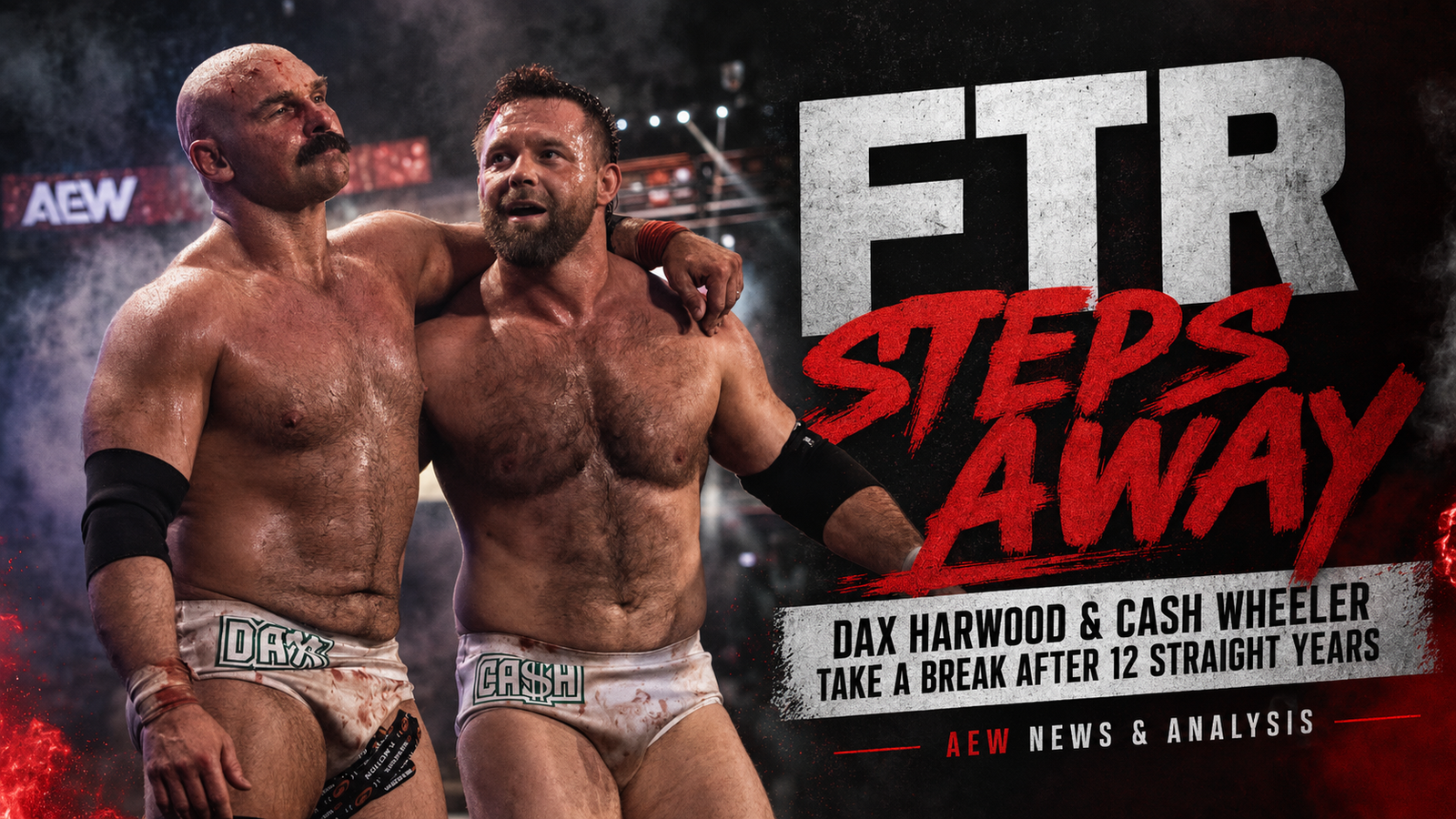
For the first time in more than a decade, FTR is finally taking a real breath.
Dax Harwood recently addressed why he and Cash Wheeler have been absent from AEW television since Double or Nothing, and while the headline could easily be twisted into retirement speculation, that is not really what this is. This is not FTR dramatically walking away from wrestling. This is not Dax and Cash closing the book on AEW. This is two wrestlers who have been grinding almost nonstop since 2014 finally admitting that their bodies, families and minds need time before the next chapter.
That alone makes this story bigger than a normal wrestling hiatus.
FTR has built its entire modern identity around work. Not just wrestling matches, not just chasing titles, but carrying the idea that tag team wrestling still matters when it is treated seriously. Dax and Cash have wrestled through WWE, NXT, AEW, ROH, AAA, NJPW and the independents while becoming one of the most decorated teams of their generation. They have been champions almost everywhere that matters, worked some of the best tag matches of the modern era, and spent years proving that a team does not have to be comedy, filler or two singles wrestlers thrown together to matter.
So when Dax says they are physically and mentally exhausted, that lands differently.
FTR has not appeared on AEW television since Double or Nothing, where they lost the AEW World Tag Team Championships to Adam Copeland and Christian Cage in a New York Street Fight “I Quit” Match. That match already felt like a hard stop. It was violent, emotional and final in the way AEW clearly wanted it to be. FTR did not just lose the belts. They lost them in a stipulation built around surrender, survival and damage. When a team drops the titles in that kind of match and then disappears, it usually means something.
Dax’s explanation confirmed that this absence is real, but not necessarily permanent. He spoke about years of wear and tear, injuries that have piled up, time away from family, and the reality of two men who have spent 12 straight years with the pedal down. That is the part fans sometimes forget. FTR’s style looks old-school, but old-school does not mean easy. Their matches are physical. Their bumping is violent. Their selling is committed. Their entire act depends on making every tag, every cutoff, every comeback and every finish feel like it matters.
That kind of wrestling ages you.
And that is why this break feels earned, not alarming.
Before FTR, There Was Dax Harwood Grinding Through The Independents
Before Dax Harwood became one of the loudest defenders of tag team wrestling, he was David Harwood, a North Carolina wrestler grinding through the independent scene under names like KC McKnight, KC Anderson and Dennis Laundry.
That background matters because Dax did not arrive in WWE as some empty developmental project waiting to be molded. He came in with years of regional wrestling experience, Southern wrestling influence and a very clear understanding of what he believed wrestling should look like. His work was never about being the flashiest athlete in the ring. It was about timing, structure, selling, struggle and making simple things feel important.
That is still the core of Dax Harwood today.
Dax wrestles like a man trying to prove a point. Every match feels like an argument for a specific kind of wrestling. He believes in tag team wrestling as a craft, not as a shortcut. He believes in a headlock meaning something. He believes in cutting the ring in half. He believes in making the hot tag feel like a release of pressure instead of just another spot. That is why he became such a natural fit in NXT’s golden era, because that version of NXT gave him room to be exactly what he already was: a throwback wrestler with modern sharpness.
Dax became the emotional engine of FTR because he talks and wrestles like someone who is personally offended when tag team wrestling is treated like filler. Sometimes that passion can rub people the wrong way, but it is also why FTR never feels fake. Dax believes this stuff. That is what makes it work.
Before FTR, Cash Wheeler Was The Underrated Piece That Made The Team Whole
Cash Wheeler’s road before WWE was just as important, even if it has never been talked about as loudly.
Before becoming Dash Wilder in WWE and Cash Wheeler in AEW, Daniel Wheeler wrestled as Steven Walters and built himself through the independent scene. He worked promotions like NWA Anarchy and other regional groups, winning titles and developing into the exact kind of wrestler who would eventually make FTR click.
Cash has always been the quieter half publicly, but that should never be confused with being the lesser half. In the ring, Cash is the glue. He is the speed change. He is the timing piece. He is the wrestler who can make Dax’s heavy, gritty, emotional style breathe without pulling the team away from its identity.
That is why Dax and Cash fit so naturally together. FTR only works if both wrestlers fully commit to the same philosophy. If one half wants to work like a traditional tag wrestler and the other half wants to chase highlights, the team falls apart. Cash never did that. He understood the assignment from day one.
He is the transition guy, the bump guy, the save guy, the one who can make chaos feel organized. He does not need to dominate the microphone because his value is in the rhythm of the match. Watch FTR closely and you see how often Cash is the one holding everything together. The timing on blind tags, the desperation on saves, the way he creates motion when the match needs it — that is not accidental. That is craft.
The Revival Was The Team WWE Had In Its Hands And Never Fully Understood
Dax and Cash started teaming in NXT as The Mechanics before becoming The Revival, and once the team found its identity, they became one of the best acts in the entire company.
Their NXT run was special because it happened in an environment that still allowed tag team wrestling to feel important. Against American Alpha, The Revival became the perfect villains: mean, smart, tactical and constantly one step ahead. Against Johnny Gargano and Tommaso Ciampa, they produced one of the greatest tag team matches in NXT history at TakeOver: Toronto. Those matches were not great because of chaos or overkill. They were great because every detail mattered.
The Revival made tags matter. They made isolation matter. They made the referee’s positioning matter. They made the hot tag feel like a finish before the finish. That was the brilliance of the act.
They were not trying to reinvent tag team wrestling. They were trying to remind people why it worked in the first place.
That is why their WWE main roster run is so frustrating to look back on. On paper, The Revival accomplished plenty. They won the Raw Tag Team Championships. They won the SmackDown Tag Team Championships. They became the first team to hold the NXT, Raw and SmackDown Tag Team Titles. That is not a small accomplishment.
But the problem was never the résumé. The problem was presentation.
The Revival had titles, but they rarely had the kind of consistent creative investment that made those titles feel as big as they should have. They came up from NXT with credibility, only to get trapped in the same stop-start main roster tag team system that has cooled off too many good teams over the years. Injuries did not help either, but even when they were healthy, WWE never fully made the tag division feel like a place where The Revival could become a true main event-level act.
That disconnect is what eventually broke the relationship.
For years, fans have pointed to the infamous comedy gimmick pitch as the symbol of why Dax and Cash wanted out of WWE. And yes, that was part of it. When a team that takes tag team wrestling as seriously as The Revival is presented with ideas that feel like a joke, it tells them exactly how the company sees them.
But Cash Wheeler has since made clear that another moment was the true final straw: WWE splitting The Revival away from Randy Orton.
That short-lived alliance had real potential. Orton gave them main-event danger. The Revival gave Orton a throwback, calculated, violent edge that fit him perfectly. It looked like something that could have worked, and according to Cash, Orton was fully behind the idea too. Then WWE separated them in the Draft, putting The Revival on SmackDown and Orton on Raw.
That was the sign.
It told Dax and Cash that even when something promising appeared, WWE did not have a real plan for them. They were not leaving because they were failures. They were leaving because they knew their ceiling inside WWE was not based on talent. It was based on how much WWE cared about tag team wrestling. And at that point, the answer felt clear.
AEW Gave FTR The Freedom To Become What WWE Would Not Let Them Be
When FTR arrived in AEW in 2020, it immediately felt like the right move. The debut worked because AEW did not need to overexplain them. Dax and Cash pulled up, stood across from The Young Bucks, and the entire story was already there.
FTR represented one vision of tag team wrestling. The Young Bucks represented another. That tension had been building for years, and AEW was the place where it could finally happen without being watered down.
Their first AEW Tag Team Title run gave them validation, but their bigger legacy came later. FTR became a team that did not just win in AEW. They traveled. They won the ROH World Tag Team Titles. They won the AAA World Tag Team Titles. They won the IWGP Tag Team Titles. At one point, they were carrying multiple major tag championships at the same time, turning themselves into a modern territory-style team in a wrestling world that rarely allows that anymore.
Then came the rivalry with The Briscoes.
That feud is the crown jewel of FTR’s post-WWE career. FTR vs. The Briscoes was everything Dax and Cash always said tag wrestling could be. It was violent. It was emotional. It was simple in the best way. Two great teams, two different kinds of pride, and a series of matches that felt like they were fighting over the soul of tag team wrestling itself.
The Briscoes trilogy did not just strengthen FTR’s legacy. It made their AEW/ROH chapter feel historically important. It proved that FTR did not leave WWE just to complain somewhere else. They left WWE and then backed up everything they had been saying for years.
The Accomplishments Speak For Themselves
At this point, FTR’s championship résumé is almost ridiculous.
They are three-time AEW World Tag Team Champions. They are former ROH World Tag Team Champions. They are former IWGP Tag Team Champions. They are former AAA World Tag Team Champions. In WWE, they were two-time NXT Tag Team Champions, two-time Raw Tag Team Champions and one-time SmackDown Tag Team Champions. They also became the first team to complete WWE’s NXT, Raw and SmackDown Tag Team Title sweep.
That is before even getting into the awards, the classic matches, the Briscoes rivalry, the Young Bucks rivalry, the American Alpha matches, the DIY match, the Copeland and Christian feud, and the way they have remained one of the most discussed tag teams in wrestling no matter where they work.
That is why this current break should not be viewed as FTR fading away.
It should be viewed as FTR finally getting the one thing they almost never allowed themselves to have: time.
Time to heal. Time to be with family. Time to let AEW’s tag division breathe without them. Time to make their eventual return feel important instead of routine.
If this really is just a pause, AEW should treat the comeback like a major deal. FTR does not need to be on television every week to matter. In fact, this break might help them. They are at their best when their matches feel like events, not obligations. The longer they are away, the easier it becomes to remember what they bring when they are fully locked in.
And if this is the beginning of the final stretch of their career, then they have already done enough.
Dax Harwood and Cash Wheeler bet on themselves, left a WWE system that never fully valued them the way they valued tag team wrestling, rebuilt their names in AEW and across the world, and became one of the greatest tag teams of the modern era.
That is the real story here.
FTR is not gone.
The Top Guys are just finally taking a breath.
Make sure to subscribe to our Late Night Crew Wrestling YouTube Channel. Follow @yorkjavon, @kspowerwheels & @LateNightCrewYT on X.
I’m the quiet one until the bell rings then I’ve got takes. I live for WWE NXT and TNA, I want every promotion to succeed, and I will absolutely roast the bad decisions on sight (because someone has to). Anime taught me to respect long-term storytelling; wrestling taught me that sometimes the plan is “we panicked” and called it “unpredictable.” The Miz got me into all of this, so yeah I appreciate confidence, commitment, and the art of talking like you’re already the main event. Now I bring that same energy to the page as the main writer for Late Night Crew Wrestling because if you’re not here to be must-see and tell the truth, why are you here?!