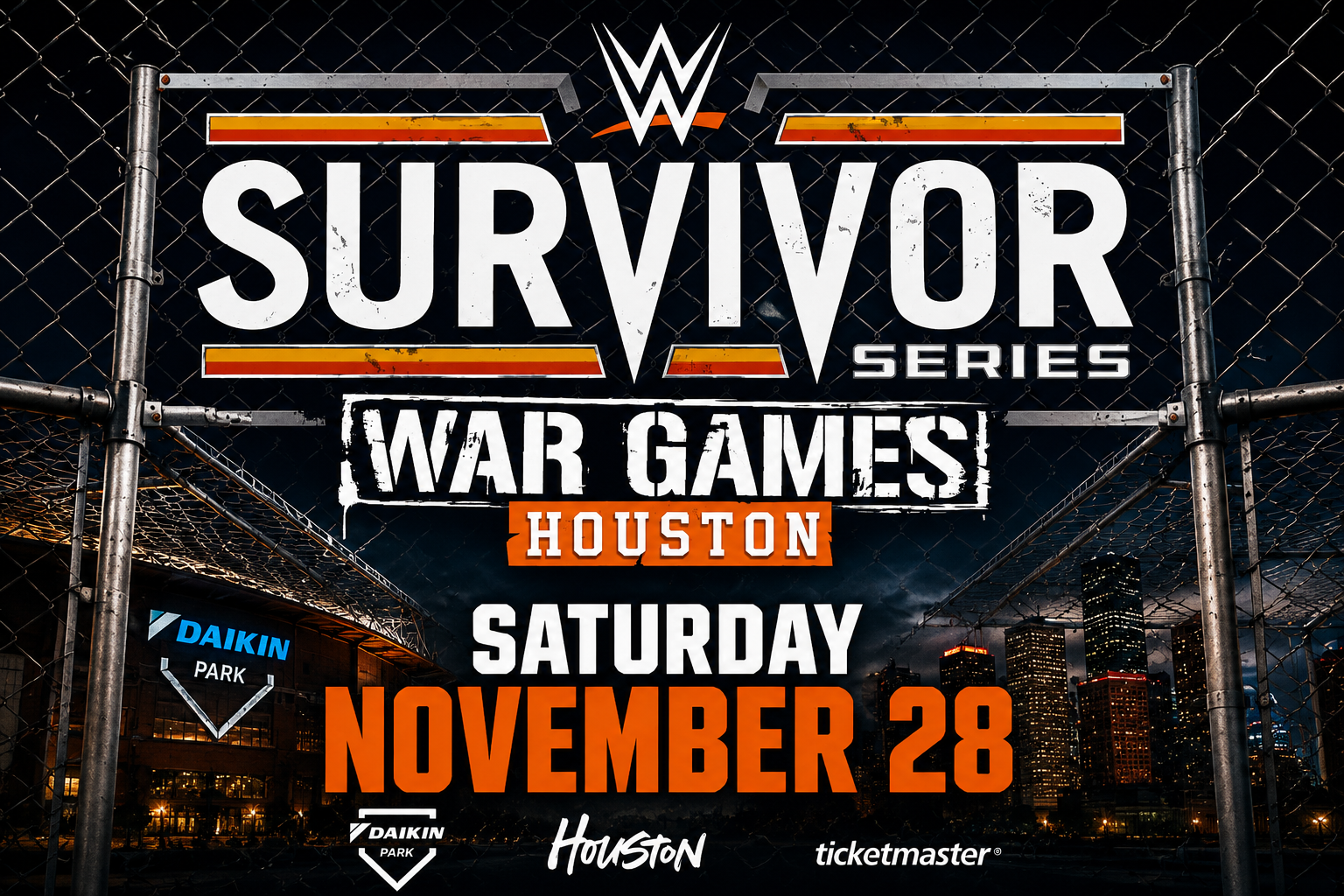
WWE made it official Monday, July 13: the 40th annual Survivor Series 2026 will take place Saturday, November 28, from Daikin Park in Houston, Texas.
The announcement answered the remaining questions surrounding the date and location, but the return of the Survivor Series: WarGames branding immediately reopened a much larger argument about what one of WWE’s original major events has become.
For the fifth consecutive year, WarGames will define Survivor Series. The traditional elimination matches that created the event, produced generations of memorable sole survivors and gave the show its actual identity remain nowhere in WWE’s presentation.
Houston is a strong destination. Daikin Park gives WWE another stadium, a proven wrestling market and a setting capable of making the 40th Survivor Series feel enormous. The issue is not the city or the venue. The issue is WWE continuing to build the entire event around a match that should be reserved for the right rivalry instead of automatically forced onto the calendar every November.
Credit: WWE
WWE Brings Survivor Series 2026 Back to Houston
Survivor Series 2026 will return to Houston for the first time since 2017, when Raw and SmackDown competed in one of the strongest modern versions of the traditional brand-warfare format.
Daikin Park, the home of the Houston Astros, last hosted a WWE premium live event when the 2020 Royal Rumble took place inside the stadium. Survivor Series will now become the second consecutive edition held at a Major League Baseball stadium following last year’s event at Petco Park in San Diego.
That decision is not difficult to understand from WWE’s perspective.
Last year’s Survivor Series established new event records for gate and attendance. WarGames offers WWE an easy stadium visual: two rings, one massive cage, ten major stars and a structure that looks dangerous before the company has announced a single participant.
Houston also carries decades of wrestling history. The city has hosted WrestleMania twice, multiple Royal Rumble events, Survivor Series and countless episodes of Raw and SmackDown. WWE is not gambling on an untested market. It is taking a proven attraction to a proven wrestling city during Thanksgiving weekend.
Tickets will go on sale for Survivor Series 2026 Friday, August 7, at 11 a.m. ET, with separate presales beginning earlier that week.
The location is not the problem. Houston deserves another major WWE event, and Daikin Park should give Survivor Series 2026 the scale expected from a 40th annual celebration.
The creative identity attached to that celebration is where the criticism begins.
How Houston Emerged After Other Survivor Series 2026 Plans Fell Apart
Before WWE confirmed Houston, the Survivor Series 2026 location remained unsettled considerably longer than expected.
International options had been discussed, but those plans failed to move forward. Boston also pushed to host the event, although financial negotiations stalled before an agreement could be reached. WWE was still expected to settle the matter before SummerSlam, and Houston was officially announced several weeks ahead of that deadline.
WWE has not publicly addressed the international discussions or Boston’s attempt to secure the show, so those details remain part of the behind-the-scenes location process rather than the official announcement.
Houston should not be dismissed as a weak consolation prize simply because other possibilities were considered.
Daikin Park provides WWE with a retractable-roof stadium that can be configured around the company’s production needs. It also keeps Survivor Series in the United States after last year’s successful stadium experiment while allowing WWE to market the event as another destination weekend.
The decision also reflects the larger direction of WWE’s premium live event business. Cities and local organizations increasingly compete to host major shows because of the tourism, hotel bookings, restaurant traffic and broader economic activity attached to WWE’s traveling audience.
Survivor Series is being presented less like an ordinary arena event and more like one of WWE’s annual destination spectacles.
That business strategy is understandable. The frustration is that WWE has modernized everything surrounding Survivor Series while allowing the event’s original concept to disappear.
The WarGames Backlash Is Not Going Away
The reaction to the announcement followed the same divided pattern that has surrounded Survivor Series since WarGames became its permanent identity in 2022.
Some fans remain excited. WarGames can produce spectacular visuals, dangerous stunts, major returns and the kind of chaotic main event that feels different from a standard tag-team match. The 2023 edition gave WWE the setting for CM Punk’s shocking return. The Bloodline story was a natural fit for the cage in 2022 and again produced a major attraction in 2024.
There is a reason the match remains popular.
However, the calls to restore the traditional Survivor Series format have become louder and more consistent as WWE continues guaranteeing WarGames before the story exists.
The reaction is not unanimous, and it would be dishonest to pretend every fan wants WarGames removed. The real reception is more complicated. There is still enthusiasm for the match itself, but there is also obvious fatigue with WWE treating it as a mandatory annual attraction.
Fans, wrestling journalists and major wrestling sites have repeatedly raised the same concerns.
The teams are often assembled too late. Separate rivalries are combined because WWE needs enough bodies to fill both sides. Wrestlers suddenly trust people they spent months fighting. Storylines are accelerated or stretched so they can conveniently reach the final Saturday in November.
That is not organic storytelling. That is booking backward from a gimmick.
WarGames should feel like the only possible ending to a violent faction war. Instead, WWE announces the match months in advance and then has to manufacture two groups large enough to enter the cage.
The difference matters.
When The Bloodline’s civil war demanded WarGames, the structure enhanced the story. The personal history, betrayals and family conflict justified putting everyone inside two rings surrounded by steel.
When several unrelated feuds are combined because Survivor Series is approaching, WarGames becomes an expensive container rather than the natural conclusion.
The match has not lost its potential. WWE has weakened its importance by making it inevitable.
WarGames Has Replaced the Event Instead of Improving It
The traditional Survivor Series match had flaws, especially during the years when WWE reduced it to Raw versus SmackDown and expected wrestlers to develop overnight loyalty to a brand color.
That format became lazy. Wrestlers who had spent the year chasing championships suddenly cared more about defending the honor of Monday or Friday night. Teams were announced without proper qualification, and the eventual victory often had no lasting consequences.
Moving away from that version was understandable.
Erasing traditional elimination matches was not.
The original format created drama that WarGames cannot duplicate. Every elimination changed the match. One team could gain control before losing several members in quick succession. A wrestler could be trapped alone against three or four opponents. Partners had to decide whether to protect themselves or sacrifice their bodies for the team.
A sole survivor could be created in one night.
Those matches gave WWE a structure capable of elevating wrestlers without immediately putting a championship around them. Randy Orton became synonymous with surviving. Dolph Ziggler received one of the biggest victories of his career by overcoming overwhelming odds. Roman Reigns once eliminated four opponents by himself. Kofi Kingston and Bianca Belair had performances built around endurance rather than one final pinfall.
WarGames operates differently.
There are no eliminations. The early portions are spent waiting for every participant to enter. The team with the advantage controls the temporary numbers game, but the actual match does not officially begin until the final competitor enters the cage.
That creates a strange contradiction. WWE calls the event Survivor Series, yet nobody has to survive anything in the traditional sense. Ten wrestlers enter, one fall ends everything and the other nine remain in the match.
The branding has become stronger than the identity of the event underneath it.
WWE Is Listening to Business More Than the Traditionalist Audience
The claim that WWE is not listening to its fans needs some context.
WWE is listening to the audience that buys tickets for the stadium spectacle, watches the countdown entrances, shares the cage dives online and reacts to the surprise appearances. Last year’s record business gives the company no financial reason to believe WarGames is failing.
What WWE is not listening to is the portion of its audience asking for the event’s original format to coexist with the modern attraction.
Those fans are not demanding that WarGames disappear forever. Most of the criticism is about oversaturation, weak team construction and WWE abandoning the traditional matches entirely.
That is a reasonable complaint.
Royal Rumble still revolves around the Royal Rumble match. Money in the Bank still uses ladder matches to crown briefcase holders. Elimination Chamber still places wrestlers inside the chamber. Those events maintain a clear connection between the name and the competition.
Survivor Series no longer does.
WWE could solve the problem without sacrificing the cage, the stadium presentation or the WarGames branding. The traditional format and WarGames can exist on the same card, provided each match has its own purpose.
That is where WWE Hall of Famer AJ Styles’ proposed Survivor Series concept becomes especially important.
AJ Styles’ WWE x AAA Idea Provides the Answer
My fantasy booking of AJ Styles’ WWE x AAA Survivor Series idea was built around one rule: the crossover could not become another lazy collection of wrestlers wearing different-colored shirts.
Raw, SmackDown, NXT and AAA would compete in a World Brand Classic, with men’s and women’s traditional elimination matches determining which brand could actually claim superiority.
Every roster position would be earned. Championships, television victories, premium live event performances and qualification matches would determine who represented each brand. Nobody would suddenly care about brand loyalty because November arrived.
The stakes would extend beyond empty bragging rights.
Winning brands could receive Royal Rumble advantages, future championship opportunities and premium live event positions. Any wrestler who pinned a champion would earn a legitimate future claim to that championship. AAA victories could guarantee the promotion greater representation on WWE events.
That gives every elimination meaning.
AJ Styles would serve as the bridge because his career extends far beyond one WWE brand. He understands international wrestling, company pride and what happens when wrestlers from different systems are placed together. His job would not be to become an authority figure or make the entire story about himself. He would challenge WWE to prove its claim of being the global leader.
AAA could not be treated like a visiting attraction brought in to make WWE stars look good. It would enter as a legitimate territory with its own champions, factions, traditions, grudges and internal politics.
That creates real brand warfare instead of manufactured television loyalty.
More importantly, the concept does not eliminate WarGames.
The World Brand Classic would handle the competitive side of Survivor Series. WarGames would be reserved for the most violent personal rivalry of the fall.
In my booking, that rivalry involved Roman Reigns, The Usos, Jacob Fatu, Solo Sikoa and Perros del Mal. Family betrayal, faction warfare and a conflict spreading across WWE and AAA programming would provide an actual reason for the cage.
The elimination matches would answer which brand was superior. WarGames would end the blood feud that could no longer be contained.
That is how the two concepts should coexist.
Houston Makes the World Brand Classic Even Bigger
The move to Daikin Park changes the location of the fantasy booking, but it strengthens the central idea.
Houston is a major international city with a strong Latino population, deep wrestling history and a market capable of embracing a WWE x AAA presentation. A four-brand World Brand Classic involving Raw, SmackDown, NXT and AAA would feel enormous inside a baseball stadium.
The visual presentation could distinguish every group without reducing the event to red shirts against blue shirts. Each brand would enter with its own production, champions, authority and wrestling identity.
The two-ring setup would remain available for WarGames later in the night.
That approach would allow WWE to celebrate the full history of Survivor Series instead of only celebrating the cage it attached to the event five years ago.
The 40th annual show should acknowledge what made Survivor Series different. The traditional format is not outdated. WWE’s lazy handling of it became outdated.
Qualification matches, meaningful rewards, cross-brand consequences and the presence of AAA would immediately make the concept feel current.
The 40th Survivor Series Must Be More Than Another Cage Show
WWE has the right city, the right venue and enough time to make Survivor Series feel important again.
Houston will provide the atmosphere. Daikin Park will provide the scale. WarGames will provide the spectacle.
Now WWE must provide the reason.
The company cannot continue assembling random teams in October and pretending every conflict belongs inside the cage. WarGames should be earned through months of escalating hatred, not guaranteed because WWE’s November schedule requires it.
Bring back the traditional men’s and women’s elimination matches. Make wrestlers qualify. Give the winners something valuable. Allow sole survivors to emerge. Let the results affect championships, the Royal Rumble and the larger WWE calendar.
Use AJ Styles’ WWE x AAA idea to make brand competition feel global instead of artificial.
Then take the one faction war violent enough to justify two rings and a steel cage and place it inside WarGames.
WWE does not have to choose between honoring Survivor Series and preserving its modern attraction. It can do both.
WarGames can remain part of Survivor Series.
It should not be allowed to replace Survivor Series.
Make sure to subscribe to our Late Night Crew Wrestling YouTube Channel. Follow @yorkjavon, @kspowerwheels & @LateNightCrewYT on X.
I’m the quiet one until the bell rings then I’ve got takes. I live for WWE NXT and TNA, I want every promotion to succeed, and I will absolutely roast the bad decisions on sight (because someone has to). Anime taught me to respect long-term storytelling; wrestling taught me that sometimes the plan is “we panicked” and called it “unpredictable.” The Miz got me into all of this, so yeah I appreciate confidence, commitment, and the art of talking like you’re already the main event. Now I bring that same energy to the page as the main writer for Late Night Crew Wrestling because if you’re not here to be must-see and tell the truth, why are you here?!