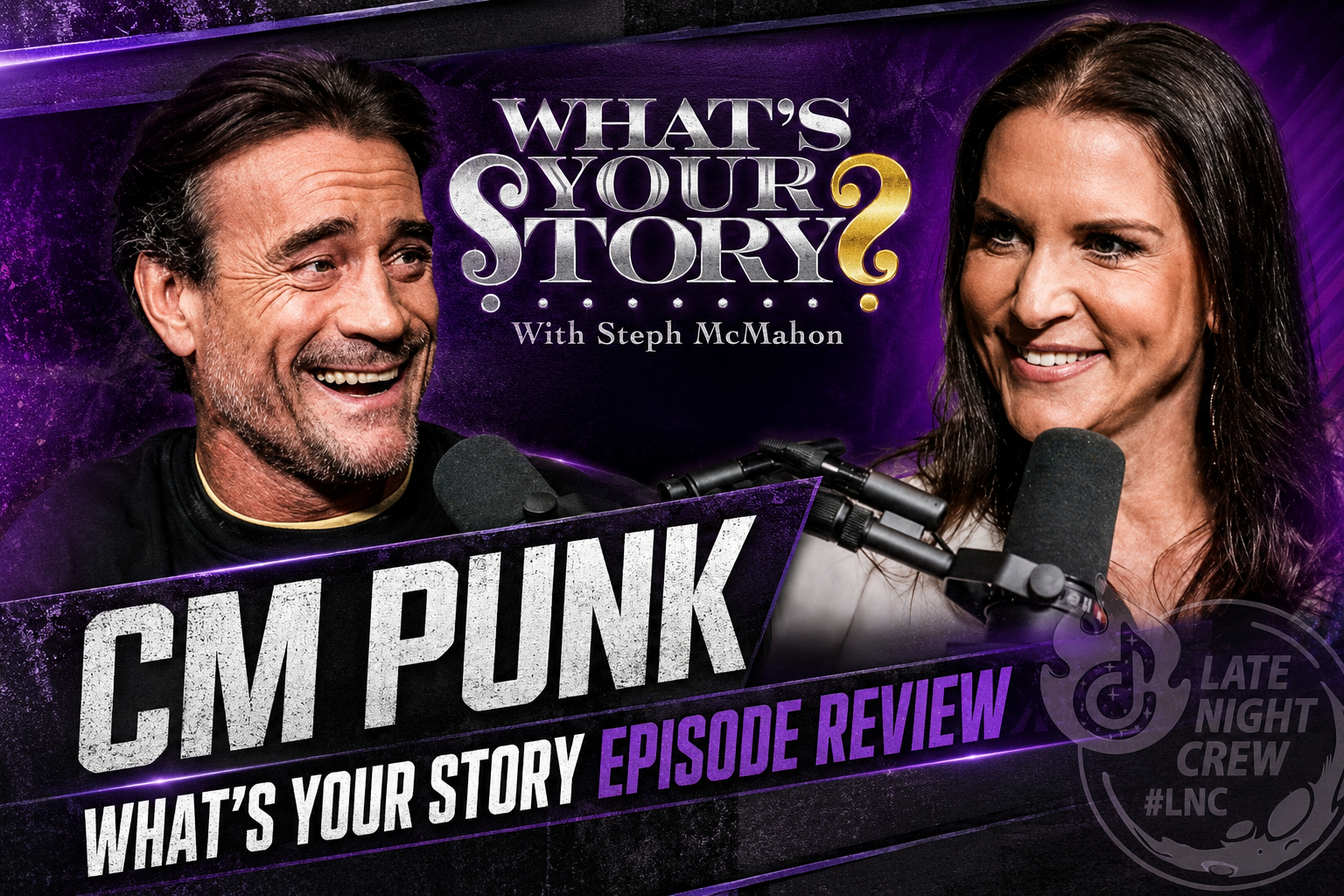
CM Punk sitting across from Stephanie McMahon would have been almost impossible to imagine a decade ago.
At one point, Punk represented everything WWE’s corporate structure struggled to control. Stephanie represented the family, leadership and system he openly challenged. Today, Punk is once again WWE Champion, Triple H oversees the company’s creative direction and Stephanie is interviewing him about the remarkable second act neither side once believed would happen.
That history gives Punk’s appearance on What’s Your Story? far more weight than the standard company-produced interview. The conversation covers his latest championship victory, the Summer of Punk, his relationship with WWE’s leadership, his dramatic physical transformation, the danger of fabricated social-media content and the death threats that have forced both Punk and Stephanie to deal with federal authorities.
The rebel is now carrying WWE’s biggest championship
Punk entered the interview less than a week removed from defeating Sami Zayn for the Undisputed WWE Championship on Monday Night Raw.
After more than two months away from television, Punk returned in the Chicago area, replaced Cody Rhodes in the main event and ended Zayn’s championship reign after only nine days. The result immediately divided fans. Punk is still one of WWE’s biggest and most compelling stars, but his victory also revived the exact criticism that defined his original conflict with the company: an established veteran returning and taking the spotlight from someone who had spent years fighting for his opportunity.
Punk does not avoid the irony. He mocks it.
“I beat that 41-year-old youngster fair and square.”
That line works because Punk knows precisely what people are saying. He is not pretending the argument does not exist. He is turning it into material, using the criticism to blur the line between the self-aware veteran, the confident champion and the unapologetic character who believes the entire industry is better when everyone is talking about him.
The timing adds another layer. Punk’s championship victory came almost 15 years after Money in the Bank 2011, when he defeated John Cena in the Chicago area and appeared to leave WWE with the title. The 2011 victory was built around escape. The 2026 victory represents acceptance.
Punk is no longer taking WWE’s championship away from the company. WWE has trusted him to carry it.
The Summer of Punk was born from exhaustion
Punk’s memories of 2011 are not as romantic as the mythology surrounding the Pipebomb.
By that point, he had spent years grinding through WWE’s schedule while fighting for greater recognition. He was physically tired, creatively dissatisfied and considering taking approximately six months away from the company. The Pipebomb did not come from someone patiently waiting for his planned coronation. It came from someone nearing the point where leaving felt more appealing than continuing under the same conditions.
Once the promo caught fire and WWE finally presented him as a genuine top star, Punk understood that reaching the level he had demanded would not make his life easier.
“The rent’s due every day.”
That remains the clearest explanation for how Punk approaches professional wrestling. Recognition is never permanent. One great promo, match or championship victory only creates the expectation that he must do it again.
It is also why Punk remains such a complicated figure. The mentality that drove him to prove everyone wrong also made it difficult for him to feel secure once he succeeded. Every opportunity became another test, and every disagreement could be interpreted as evidence that somebody still did not believe in him.
Pat Patterson’s approval meant more than Punk admitted at the time
Punk’s Survivor Series 2006 story cuts through the idea that he never cared what wrestling’s establishment thought of him.
Pat Patterson originally doubted whether Punk should receive an important moment during the traditional elimination match because he was unsure the audience knew Punk well enough. Adam Copeland advocated for him. Punk received the opportunity, the crowd responded and Patterson admitted that he had been wrong.
From that point forward, Patterson became one of Punk’s supporters. Punk now considers it one of the greatest days of his career.
Punk never rejected approval. He rejected the idea that approval should depend on politics rather than performance.
Patterson’s respect mattered because Punk earned it in real time. The crowd gave its verdict, Patterson listened and Punk gained an influential advocate. For someone whose career has been built around forcing doubters to acknowledge him, that moment was almost the perfect CM Punk story.
Punk sees Triple H’s job differently now
The discussion about wrestling bookers provides one of the clearest examples of Punk’s evolution.
Punk believes only a handful of genuine bookers remain. The old territorial model allowed one promoter to follow personal instincts, for better or worse. Modern WWE creative is shaped by writers, producers, executives, boardroom considerations, television requirements and countless other variables.
Punk has told Triple H that he does not envy the responsibility. When the show works, the wrestlers often receive the credit. When something fails, the person overseeing creative absorbs the blame.
That is a long way from the Punk who once viewed WWE management almost exclusively as an obstacle.
He has not stopped being opinionated, but he now appears more willing to understand why people in leadership make decisions he may not personally choose. That does not erase his history with Triple H. It demonstrates why repairing that relationship became possible.
Both men stopped treating the other as a frozen version of the person they disliked a decade earlier.
Fake outrage has created a real safety problem
The most disturbing portion of the interview begins when Punk is shown supposed reactions from Seth Rollins, Becky Lynch and Logan Paul.
Punk quickly recognizes that the posts are fabricated. The graphics and statements were made to look authentic, creating the possibility that thousands of people could become angry over comments none of the wrestlers actually made.
That problem becomes more dangerous in professional wrestling, where performers intentionally blend legitimate feelings with scripted conflict. Punk makes a living convincing audiences that what they are watching might be real. AI-generated content takes that emotional investment and removes the performer’s control over it.
Punk acknowledges that strong emotional reactions can benefit him professionally. The problem comes when viewers carry fabricated outrage beyond television and social media.
Both Punk and Stephanie reveal that the FBI has contacted them regarding death threats. Punk describes remaining aware of his surroundings while walking publicly with AJ Lee because the people consuming false or inflammatory information are not always harmless.
“All it takes is that one time.”
That is the moment the conversation stops being about annoying fan behavior and becomes about personal safety. Wrestling thrives on making people care, but no performer can control how every person processes that emotion or what a dangerously obsessed individual may decide to do with it.
Punk’s physical transformation is about controlling the final chapter
At 47, Punk has also committed to one of the most disciplined physical routines of his career.
Approximately six weeks before WrestleMania 42, Punk became inspired by Chad Gable’s workouts and contacted trainer Jay Ferruggia. He did not begin with a specific target weight or a demand for a six-pack. He wanted his appearance to make it obvious that he had done everything possible to prepare.
Punk began weighing his food, counting calories and simplifying his meals. Each morning, he sends Ferruggia his weight, temperature and a mirror photograph so his daily nutrition can be adjusted. He now treats training as the first major responsibility of his day and describes the gym as a form of therapy.
Even his story about gaining 20 pounds during a seven-day Hawaiian vacation with AJ Lee reinforces that structure. Punk allowed himself to enjoy the trip, returned home and immediately resumed the routine that had transformed him. Within five days, he says, he was back to his previous weight.
Punk understands that every performance at this stage will be evaluated against his age. Fans will analyze his conditioning, movement, appearance and durability before discussing anything else.
He cannot stop that conversation. He can make sure nobody questions whether he prepared.
Punk’s return is not an erasure of what happened
The easiest interpretation of Punk’s current WWE run is that the rebel eventually became part of the establishment.
There is truth in that. Punk is WWE Champion. He speaks sympathetically about Triple H’s creative responsibilities. He is comfortable discussing personal growth with Stephanie McMahon on an official WWE production.
But reconciliation does not mean his original grievances were imaginary. It means Punk and WWE eventually decided that preserving their hostility was less valuable than discovering what they could still create together.
The current version of Punk is not harmless or completely sanitized. He remains argumentative, self-assured and unusually comfortable turning criticism into part of his presentation. The difference is that he is more willing to recognize complexity.
The younger Punk often treated compromise as surrender. The current Punk appears to understand that changing your mind is not always the same as abandoning your principles.
That is the real story behind the interview.
CM Punk did not return to WWE because the previous decade suddenly stopped mattering. He returned because it mattered enough for both sides to finally confront it, survive it and build something neither could have created while remaining trapped inside the anger.
You can watch the full podcast episode below:
Make sure to subscribe to our Late Night Crew Wrestling YouTube Channel. Follow @yorkjavon, @kspowerwheels & @LateNightCrewYT on X.
I’m the quiet one until the bell rings then I’ve got takes. I live for WWE NXT and TNA, I want every promotion to succeed, and I will absolutely roast the bad decisions on sight (because someone has to). Anime taught me to respect long-term storytelling; wrestling taught me that sometimes the plan is “we panicked” and called it “unpredictable.” The Miz got me into all of this, so yeah I appreciate confidence, commitment, and the art of talking like you’re already the main event. Now I bring that same energy to the page as the main writer for Late Night Crew Wrestling because if you’re not here to be must-see and tell the truth, why are you here?!