
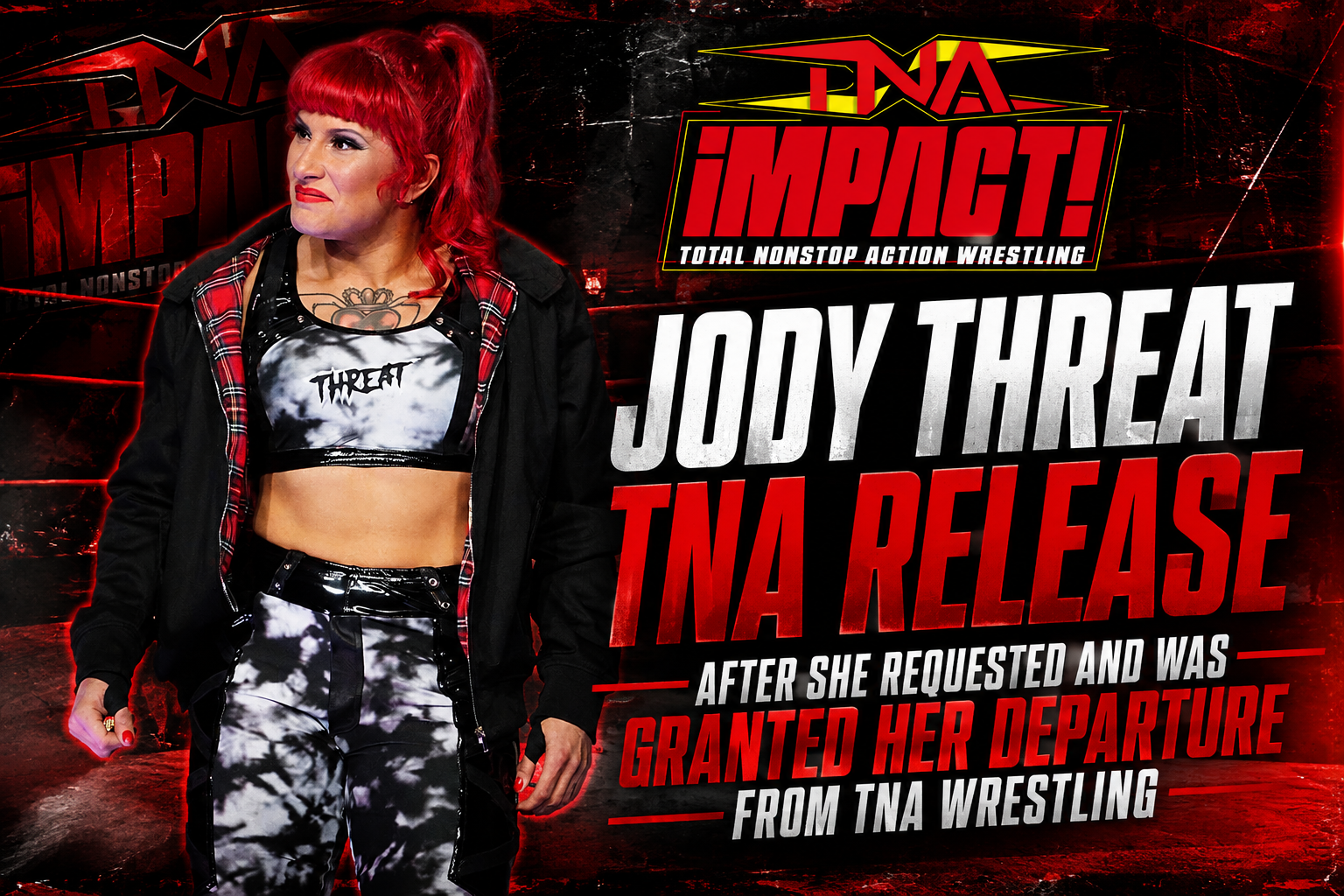
Jody Threat TNA release is official after the former two-time Knockouts World Tag Team Champion reportedly requested to leave the company and TNA granted that request.
According to Fightful Select, Threat asked for her release and is now finished with TNA. As of Monday, August 3, 2026, neither Threat nor TNA has publicly provided a detailed explanation for the decision. There is no confirmed report of disciplinary trouble, backstage heat, a contract dispute, creative frustration, a financial disagreement or an offer from another promotion.
That distinction matters. The responsible version of this story is not to invent a dramatic reason before one has been reported. The real story is already significant enough: TNA publicly re-signed Threat in January, called her a cornerstone of the Knockouts division, promoted her as a key part of the company’s new AMC era and then lost her less than seven months later.
This is not a routine contract expiration. Jody Threat TNA release happened because she asked to leave while still under contract, and TNA agreed.
Jody Threat TNA release comes only months after TNA promised a singles breakthrough
TNA announced Threat’s new agreement on January 14 with language that now feels impossible to ignore. The company described her as a cornerstone of the Knockouts division and said she would be a key part of Thursday Night iMPACT! on AMC.
Threat sounded equally optimistic.
After spending much of her run beside Dani Luna in Spitfire, she said 2026 would be her opportunity to prove what the “Wild Child” could do as a solo competitor. The message was direct: the tag-team chapter had established her, but the new contract was supposed to unlock the next level.
Threat had previously acknowledged that her original contract was approaching its expiration date and told Fightful that her goal, should she remain with TNA, was to pursue the Knockouts World Championship.
She remained.
She re-signed.
That next level never fully arrived. The Jody Threat TNA release makes that unfinished promise the central issue surrounding her departure.
TNA did not completely bury Threat or remove her from television. She won a Knockouts battle royal at No Surrender, earned a world-title opportunity against Arianna Grace, worked a featured rivalry with Tessa Blanchard and advanced into the quarterfinals of the tournament to crown the first Knockouts Television Champion.
Those are meaningful opportunities on paper.
The problem is that they never developed into sustained elevation. Threat moved from one short-term assignment to another without TNA committing to one defining singles story, one championship chase or one character direction long enough to transform her from a dependable Knockout into an essential one.
Being used is not the same as being pushed.
TNA trusted Threat to have physical matches, represent the division and make opponents look credible. The company did not consistently build its weekly television around her momentum. The Jody Threat TNA release exposes the distance between how TNA described her importance in January and how little permanent progress followed.
1. TNA found a reliable wrestler but never established her as a singles star
The Jody Threat TNA release ends a run that began when Threat arrived in IMPACT Wrestling in 2023 with a presentation that did not need excessive explanation.
She was intense, physical, reckless in the right way and believable against almost anyone in the division.
Threat did not wrestle like a polished television creation trying to reproduce the same safe sequence every week. Her offense had force. Her pace felt urgent. Her entire “Wild Child” identity worked because it appeared connected to the way she actually performed.
That gave TNA a wrestler who could stand out without an elaborate character overhaul.
The company’s best idea for Threat became Spitfire.
Pairing her with Dani Luna made sense. Their styles complemented each other, their personalities created an easy team identity and they gave the Knockouts tag division a credible full-time act. Together, Threat and Luna became two-time TNA Knockouts World Tag Team Champions and helped stabilize championships that frequently struggled to feel supported by a deep division.
Spitfire was successful.
It also became the clearest thing TNA ever created for Threat.
Once the team ended, TNA kept presenting her as someone on the verge of becoming more important. She received chances, but not the sustained creative investment needed to convert potential into position.
The Jody Threat TNA release closes a run in which the company understood her usefulness more clearly than it understood her ceiling.
2. The end of Spitfire should have launched Threat, not left her drifting
The Jody Threat TNA release also forces a harder look at Spitfire’s split, which was supposed to create two singles wrestlers.
Instead, Dani Luna eventually requested and received her release in March, and Threat has now followed her out of the company. Both members of one of TNA’s most established women’s teams were gone within months of each other.
That is not automatically proof that both women left for the same reason. Their situations should not be carelessly merged into one backstage theory.
It is still a damaging outcome.
TNA took a proven team, ended it and failed to retain either wrestler long enough to make the breakup feel worthwhile. If the purpose of separating Spitfire was to create singles momentum, the final result is difficult to defend.
Luna left.
Threat received scattered opportunities.
The tag division lost an anchor.
Now the singles division has lost both performers as well.
A breakup is only valuable when the promotion knows what comes next.
TNA appeared to know what it wanted to end. It never showed the same certainty about what it wanted to build.
3. Threat’s 2026 push produced moments without producing momentum
The Jody Threat TNA release makes Threat’s battle-royal victory at No Surrender look like the beginning of a singles push that never reached its destination.
She earned a Knockouts World Championship match against Arianna Grace and entered the title opportunity already carrying storyline injuries after being attacked by Tessa Blanchard. The setup protected her toughness and gave the audience a reason to see her as someone fighting through adversity.
Threat challenged Grace during the March 5 episode of Thursday Night iMPACT!, but interference from Stacks contributed to the champion retaining. The official TNA results showed Threat receiving a legitimate opportunity without being allowed to complete the breakthrough.
That defeat could have worked if it had launched a longer climb.
Instead, Threat moved into the Blanchard program, including the first Knockouts Bunkhouse Match in TNA history. The match gave Threat a featured television attraction and allowed her to work the rugged, violent style that fit her naturally.
However, the story ended without permanently changing her position.
The same pattern followed her into the Knockouts Television Championship tournament.
Threat defeated Gabby Forza in the opening round and advanced to face Jada Stone in the quarterfinals. The tournament appeared capable of giving Threat the focused singles direction that had been missing throughout much of her run.
Our previous breakdown of the TNA Knockouts Television Championship tournament identified Threat’s physical matchup with Forza as one of the bracket’s potential highlights and questioned whether TNA had enough depth and creative discipline to support the new championship.
That concern looks more serious now.
On July 30, only four days before the release report, Stone defeated Threat by roll-up and advanced to the semifinals.
There is nothing wrong with using an established wrestler to elevate a younger talent. Stone beating Threat can be defended as a meaningful upset designed to strengthen a rising Knockout.
The timing now changes how the match looks.
It became Threat’s final televised TNA appearance, turning what seemed like a tournament setback into an abrupt endpoint. TNA had promoted Threat as part of the field for a new championship designed to create more opportunities for the women’s roster.
Days later, the Jody Threat TNA release removed one of the division’s most reliable workers entirely.
4. TNA’s January announcement now reads like another promise without a plan
The Jody Threat TNA release makes TNA’s January announcement impossible to dismiss as ordinary promotional exaggeration.
Calling every re-signing historic, essential or game-changing has become a normal part of wrestling marketing. Companies want every contract announcement to feel important, even when the actual creative plans are limited.
TNA went beyond simply announcing that Threat had signed.
It identified her as a cornerstone and framed her singles run as an important piece of the AMC era. That created a standard the company’s booking needed to meet.
It did not.
Threat was visible, but visibility alone does not fulfill the promise of a breakthrough.
She challenged for the title, but she was not established as a long-term title threat.
She had a major feud, but the feud did not reposition her.
She entered the television-title tournament, but her run ended in the quarterfinals.
The language said cornerstone.
The booking said dependable supporting player.
That contradiction does not prove Threat requested her release because of creative dissatisfaction. No credible report has established her motivation, and it would be dishonest to present speculation as fact.
It does show why the departure will immediately create questions about TNA’s ability to convert positive announcements into meaningful long-term plans.
The Jody Threat TNA release is especially awkward because the company made such a public point of saying this contract would be different.
5. The Knockouts division loses an identity that outside names cannot automatically replace
For the Knockouts division, the Jody Threat TNA release matters because TNA’s relationship with WWE and NXT has given the company access to fresh opponents, recognizable television talent and crossover stories without replacing the need for its own core roster.
That partnership can be valuable.
It cannot become a substitute for retaining TNA’s own wrestlers.
Threat was not valuable because she had worked somewhere bigger before arriving. She was valuable because she had become identifiable with TNA.
She represented the kind of wrestler the company should be able to develop, feature and keep: experienced enough to deliver on television, established enough to help younger opponents and distinct enough to avoid feeling interchangeable.
The Knockouts Television Championship tournament already leaned on NXT wrestlers and independent names to expand its field. Losing Threat makes the internal depth problem more obvious.
A guest can create a fresh match.
A partner promotion can create a temporary attraction.
Neither replaces the continuity of someone who has spent years becoming part of the division’s weekly identity.
TNA has always sold the Knockouts division as more than a collection of women’s matches. At its best, the division has been one of the company’s defining institutions.
That reputation requires more than bringing in recognizable names. It requires building and retaining wrestlers who become associated with the promotion itself.
Threat became one of those wrestlers.
Now she is gone.
6. Jody Threat TNA release joins a pattern TNA can no longer dismiss as isolated
Placed beside TNA’s other roster changes, the Jody Threat TNA release must still be analyzed carefully because every exit has its own circumstances.
Steve Maclin requesting his release is not automatically connected to Dani Luna leaving.
A contract expiration is different from a release request.
Tessa Blanchard’s departure cannot be treated as identical to Myla Grace’s situation.
Eric Young leaving does not prove the same thing as Threat asking out.
Responsible analysis has to preserve those distinctions.
TNA still has a larger problem.
Too many wrestlers have left, requested releases or reached uncertain contractual situations during a period when the company is supposed to be taking a major step forward on AMC.
One departure can be explained as normal turnover. A repeated series of departures becomes an organizational question, even when the specific reasons are different.
The departure of Steve Maclin raised similar questions because TNA lost another dependable wrestler shortly after presenting him as an important part of its television product.
The recent expiration of Mara Sadè’s TNA contract created additional uncertainty while she was still involved in the Knockouts Television Championship tournament.
The situations are not identical.
The cumulative effect still matters.
Why are wrestlers deciding their futures are better served outside TNA?
Why is the company publicly presenting people as important pieces before losing them months later?
Why does TNA repeatedly appear to begin creative directions without securing the talent long enough to complete them?
The Jody Threat TNA release does not answer those questions.
It makes them harder to ignore.
TNA does not need to panic every time someone leaves. It does need to examine whether its contracts, communication, compensation, creative planning and talent relations are strong enough for the larger platform the company says it wants to occupy.
7. Jody Threat leaves TNA more valuable than when she arrived
The Jody Threat TNA release sends her into the next phase of her career with more value than she possessed when she arrived, and her TNA run should not be dismissed because it ended without a singles championship.
She became a two-time Knockouts World Tag Team Champion.
She developed television experience.
She worked different match structures, characters and opponents.
She proved she could function as a babyface, a tag wrestler, a singles challenger and a physical gatekeeper for emerging talent.
Most importantly, she leaves with a clear identity.
Threat does not need another promotion to invent her from nothing. She needs a promotion to decide what level it believes she can reach and book her consistently toward that level.
AEW and Ring of Honor are obvious possibilities because Threat previously appeared on AEW Dark: Elevation against Athena and her physical style would fit either roster.
A WWE or NXT opportunity will naturally be discussed because of the working relationship between WWE and TNA, although no interest has been reported.
Threat could also remain highly active across the Canadian, American and international independent scenes, where her name and résumé carry more value than they did before she signed with IMPACT.
None of those destinations is confirmed.
The most important part of her next decision should not simply be the size of the company. It should be whether that company has a real role for her.
Threat has already experienced what happens when a promotion likes what she provides but never completely commits to what she could become.
Jody Threat TNA release: TNA granted the request but still owns the failure
The Jody Threat TNA release may have been the correct decision once she asked to leave, because granting a wrestler’s release can be better than forcing an unwanted relationship to continue.
If Threat no longer wanted to remain under contract, forcing her to stay would not have repaired the relationship or improved the television product.
TNA deserves basic credit for allowing the two sides to separate instead of turning the contract into a public fight.
That does not erase the failure.
TNA re-signed Threat, announced that she would be central to its future, began a singles chapter and reached the end of that relationship before the company delivered the breakthrough it promoted.
The final judgment should not be that Threat failed because she never became Knockouts World Champion.
The more accurate judgment is that TNA never consistently created the conditions needed to discover how far she could go.
Threat gave the company three years of reliability, physicality and credibility. She helped hold together the Knockouts tag division, accepted the transition into singles competition and remained useful across multiple stories.
When TNA finally claimed it was ready to show everyone who Jody Threat could be, the promotion gave her fragments of a push instead of a complete one.
Now another established wrestler has decided that leaving is the better option.
That is the brutally simple reality behind the Jody Threat TNA release, and it is a reality TNA cannot explain away as ordinary roster turnover.
Make sure to subscribe to our Late Night Crew Wrestling YouTube Channel. Follow @yorkjavon, @kspowerwheels & @LateNightCrewYT on X for continued coverage of the Jody Threat TNA release.

I’m the quiet one until the bell rings then I’ve got takes. I live for WWE NXT and TNA, I want every promotion to succeed, and I will absolutely roast the bad decisions on sight (because someone has to). Anime taught me to respect long-term storytelling; wrestling taught me that sometimes the plan is “we panicked” and called it “unpredictable.” The Miz got me into all of this, so yeah I appreciate confidence, commitment, and the art of talking like you’re already the main event. Now I bring that same energy to the page as the main writer for Late Night Crew Wrestling because if you’re not here to be must-see and tell the truth, why are you here?!