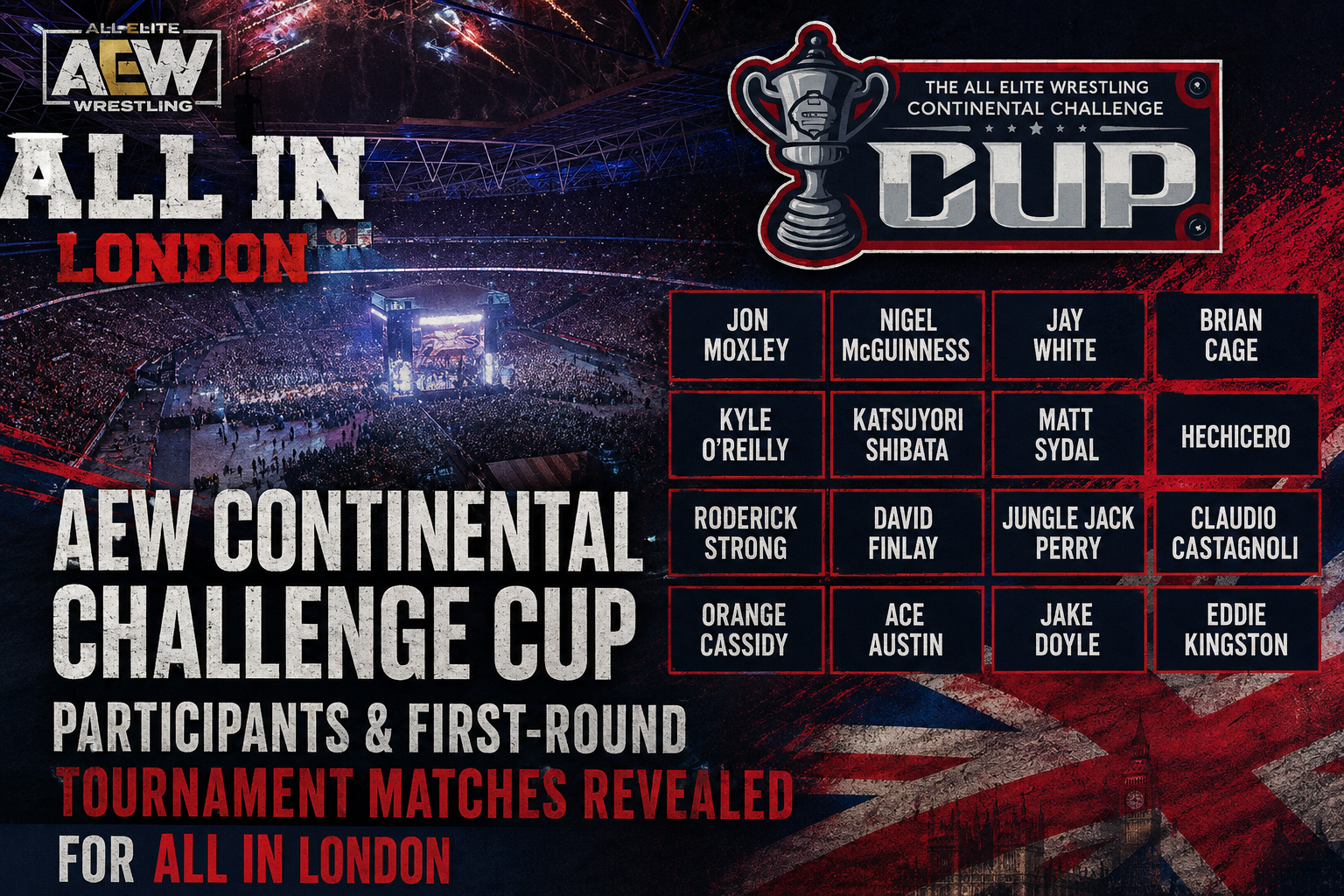
The AEW Continental Challenge Cup bracket is officially set, and AEW has assembled a legitimately deep 16-man field featuring Jon Moxley, Eddie Kingston, Jay White, Nigel McGuinness, Claudio Castagnoli, Orange Cassidy, Kyle O’Reilly, Katsuyori Shibata and several wrestlers from outside the company.
Tony Khan and Tony Schiavone revealed the complete lineup, tournament rules and all eight opening-round matches during the AEW Continental Challenge Cup Selection Special. The tournament begins Saturday, August 8, on Collision and concludes August 30 at AEW All In: London inside Wembley Stadium. The winner will receive the Continental Cup and leave Wembley as the AEW Continental Champion.
On paper, AEW has created one of its most interesting tournaments in years.
The field has star power, technical wrestlers, international representation, returning names and several built-in rivalries. More importantly, the tournament is not simply another predictable bracket where every possible matchup is visible weeks in advance. AEW is using a blind-draw format after each round, meaning the eight first-round winners will be placed back into the selection pool before the quarterfinal matchups are determined.
That structure gives the tournament unpredictability, but it also places more pressure on AEW to make every round feel connected. Random matches alone are not storytelling. The wrestlers, promos and television presentation still have to give people a reason to care beyond seeing who gets pulled from a draw.
AEW Continental Challenge Cup participants
The complete 16-man field includes:
- Jon Moxley
- Nigel McGuinness
- Jay White
- Brian Cage
- Kyle O’Reilly
- Katsuyori Shibata
- Matt Sydal
- Hechicero
- Roderick Strong
- David Finlay
- Jungle Jack Perry
- Claudio Castagnoli
- Orange Cassidy
- Ace Austin
- Jake Doyle
- Eddie Kingston
It is a strong field because there is no single style controlling the tournament.
Moxley, Kingston, Finlay and Perry can turn their matches into fights. O’Reilly, Strong, Shibata and McGuinness bring the technical side. Cassidy, Sydal, Austin and White add speed, timing and creativity. Cage, Doyle and Claudio provide size and power, while Hechicero is capable of making almost any matchup feel completely different from the rest of the tournament.
AEW also deserves credit for including names who are not normally positioned in its main-event picture. Ace Austin, Jake Doyle, Hechicero and David Finlay prevent the tournament from feeling like AEW simply rearranged the same group of television regulars.
The biggest omission is the lack of a truly shocking entrant.
The lineup is deep, but AEW had an opportunity to use the blind-draw concept to introduce one surprise competitor whose inclusion would have immediately changed the tournament’s perceived ceiling. The field does not need another major star to be good, but one completely unexpected name would have made the selection special feel more important.
How the AEW Continental Challenge Cup works
All tournament matches will be contested under Continental rules, meaning outside interference is prohibited and there will be no time limits. Sixteen wrestlers will compete in eight first-round matches. Those eight winners will be placed into another blind draw to determine four quarterfinal matches.
The four remaining wrestlers will advance to the semifinals on August 26 during Dynamite in Glasgow, Scotland. The two semifinal winners will then meet in the final at All In: London on August 30. The tournament winner receives the Continental Cup and becomes the new AEW Continental Champion.
Removing time limits is the correct decision.
AEW does not need draws creating unnecessary confusion in a single-elimination tournament. Every match must produce a winner, and the no-interference rule should theoretically prevent the tournament from becoming another excuse for factions to crowd ringside and decide matches that are supposed to be about individual competition.
The concern is enforcement.
AEW frequently announces rules that sound important before becoming flexible whenever the storyline requires it. Continental rules only matter when violations have actual consequences. If managers, teammates or faction members interfere without anyone being removed, suspended or disqualified, the tournament’s central rule becomes meaningless.
The blind draw is the most interesting element because there is no traditional bracket. Wrestlers cannot prepare for a predetermined path to Wembley, and AEW can adjust the tournament based on injuries, audience reactions or developing storylines.
That flexibility can be valuable, but it also opens AEW to criticism if every draw conveniently produces the exact match the company needs. The draws must feel transparent. AEW should conduct them on television rather than announcing the next round through graphics or social media.
Claudio Castagnoli vs. Ace Austin
Claudio Castagnoli against Ace Austin is an excellent opening-round matchup because the contrast is obvious.
Claudio possesses a major advantage in strength, experience and physicality. Austin must use speed, movement and intelligence to avoid getting trapped in a match where Claudio can control him with uppercuts, throws and relentless pressure.
Austin is one of the tournament’s most intriguing additions. He has the talent to become more than a guest who loses a competitive first-round match, but AEW must decide whether his inclusion is designed to create a genuine upset or simply give Claudio a different opponent.
The easy result is Claudio advancing.
The more interesting result would be Austin surviving long enough to expose Claudio’s arrogance and stealing the victory. An upset would immediately prove that participation from outside AEW is not decorative.
This match takes place Saturday, August 8, on Collision.
Jake Doyle vs. Eddie Kingston
Jake Doyle against Eddie Kingston has the potential to become the tournament’s most violent first-round match.
Doyle has the size and presence to make Kingston fight from underneath, while Kingston is at his best when a match feels personal, ugly and uncomfortable. Kingston does not need complicated choreography. He needs an opponent willing to stand in front of him and fight.
The obvious story is Kingston attempting to win the same championship that has remained connected to his AEW identity. Kingston became the inaugural Continental Champion after winning the first Continental Classic, and placing him in this tournament gives AEW a natural emotional thread.
Doyle defeating him would be a major statement.
However, eliminating Kingston immediately would remove one of the tournament’s strongest potential stories unless the loss begins a separate feud. Kingston should not advance only because of history, but AEW would be wasting something valuable by treating him like another name in the draw.
This match is scheduled for Collision on August 8.
Orange Cassidy vs. Matt Sydal
Orange Cassidy and Matt Sydal may deliver the cleanest wrestling match of the first round.
They are familiar enough with each other’s styles to avoid wasting time establishing basic chemistry. Sydal can still work at a pace that forces Cassidy to become more aggressive, while Cassidy’s ability to shift from comedy into serious competition makes him dangerous in tournament settings.
The problem is predictability.
Sydal is credible enough to produce a good match, but very few people will realistically expect him to eliminate Cassidy. AEW must give viewers a reason to believe an upset is possible. A competitive 12-minute match where Cassidy eventually hits the Orange Punch will accomplish very little beyond filling television time.
Sydal needs to control stretches of the match, counter Cassidy’s familiar offense and force him to win differently.
Cassidy advancing would give the tournament another established fan favorite, but Sydal pulling off the upset would be the exact kind of result that makes blind-draw tournaments feel dangerous.
The match will happen on Collision on August 8.
Jungle Jack Perry vs. Jon Moxley
Jon Moxley defending his position against Jungle Jack Perry is the biggest first-round match.
Moxley enters the tournament as the reigning AEW Continental Champion, but he does not receive a bye or any protection. He must survive the same structure as everyone else, and the eventual tournament winner will leave Wembley with his championship.
That creates immediate stakes.
Perry defeating Moxley in the first round would guarantee a new champion at All In and completely reshape the tournament. Moxley winning keeps the possibility alive that he could survive four rounds and retain the title at Wembley.
The matchup also carries factional tension because Perry and Moxley are both capable of operating as ruthless heels without wrestling the same way. Perry is more calculated. Moxley wants to drag opponents into chaos and prove they cannot survive his pace.
The no-interference rule is especially important here. AEW cannot advertise a tournament built around individual competition and then allow associates of either man to influence the result.
Moxley probably advances, but Perry is credible enough to make the outcome uncertain. That uncertainty is exactly what the opening round needs.
The match takes place Wednesday, August 12, on Dynamite.
Jay White vs. David Finlay
Jay White against David Finlay has the deepest history of any first-round match.
Their shared connections to Bullet Club and New Japan Pro Wrestling give AEW a ready-made story that does not require weeks of manufactured tension. Both men understand how the other thinks, and neither should approach the match like a normal tournament assignment.
White is one of the most complete wrestlers in the field. He can win cleanly, manipulate situations and make every detail feel intentional. Finlay brings a more direct and violent approach.
AEW must explain their history for viewers who do not regularly watch New Japan. The company has a bad habit of presenting international history as though everyone already knows it. A short video package would do more for this match than commentators quickly mentioning Bullet Club after the bell rings.
This is also one of the few opening-round matches where either result feels believable.
White advancing would add another potential tournament winner. Finlay winning would immediately establish him as a serious threat instead of an outside wrestler passing through AEW.
White and Finlay meet on Dynamite on August 12.
Brian Cage vs. Hechicero
Brian Cage against Hechicero is the strangest matchup in the best possible way.
Cage is a powerhouse who can move faster than someone his size should. Hechicero is an unpredictable technical wrestler who attacks limbs, creates unusual submission positions and forces opponents into matches they cannot fully prepare for.
This match should not become Cage performing impressive power moves while Hechicero waits for his turn. The appeal is watching Hechicero attempt to dismantle Cage’s strength piece by piece.
Cage is physically capable of overpowering almost anyone in the tournament, but Hechicero may be the worst stylistic matchup for him. One mistake could place Cage in a hold he cannot escape.
Hechicero advancing would create several fresh quarterfinal possibilities. Cage advancing would preserve a major powerhouse who could eventually collide with Moxley, Claudio, Kingston or Doyle.
The matchup takes place Saturday, August 15, on Collision.
Kyle O’Reilly vs. Roderick Strong
Kyle O’Reilly against Roderick Strong may be the best pure wrestling match in the opening round, but it is also a frustrating draw.
AEW placed two wrestlers with years of history and obvious chemistry against each other immediately. The match should be excellent, but one of the tournament’s best workers will be eliminated before the quarterfinals.
That is the advantage and disadvantage of a blind draw.
O’Reilly and Strong know each other too well for this to feel like a basic technical exhibition. They should counter familiar offense, target previous injuries and gradually allow mutual respect to turn into frustration.
The match also needs emotional context. AEW cannot rely solely on viewers knowing their history from Ring of Honor, NXT and other promotions. Their relationship should be addressed directly.
O’Reilly may have the stronger chance of advancing based on his recent positioning, but Strong is exactly the type of wrestler who can quietly reach the final if AEW commits to him.
They meet on Collision on August 15.
Katsuyori Shibata vs. Nigel McGuinness
Katsuyori Shibata against Nigel McGuinness is the most fascinating and potentially uncomfortable match in the opening round.
McGuinness entered the tournament because of the opportunity to compete for a championship at Wembley Stadium. Shibata represents one of the most physically demanding opponents AEW could have drawn for him.
The match has enormous historical appeal. Both men built reputations around physicality, toughness and technical precision. They also endured career-threatening medical issues that dramatically changed their wrestling careers.
AEW must handle that history responsibly.
The match does not need reckless headbutts, unnecessary neck trauma or attempts to recreate the most dangerous moments from either man’s past. Its value is seeing two experienced wrestlers use timing, positioning and psychology to create intensity without trying to prove something through avoidable risk.
McGuinness advancing would strengthen his Wembley story. Shibata advancing would give the tournament one of its most credible wrestlers and eliminate any suggestion that Nigel was included solely for nostalgia.
This match is scheduled for Collision on August 15.
The AEW Continental Challenge Cup can elevate the championship
The Continental Championship has needed a stronger identity.
AEW has too many championships, and several of them become background accessories whenever the company’s creative attention shifts elsewhere. Creating another tournament connected to the Continental title could make that problem worse, especially with the Continental Classic returning later in the year.
However, the Continental Challenge Cup has a different format and presentation.
The Continental Classic is a round-robin competition built around points, blocks and endurance over several weeks. The Continental Challenge Cup is single elimination. One loss ends a wrestler’s tournament immediately.
That difference matters.
The Cup should feel sudden and unforgiving, while the Classic rewards consistency across multiple matches. AEW must repeatedly explain that distinction instead of assuming viewers will naturally separate two tournaments built around the same championship.
The bigger issue is what happens after Wembley.
Winning a trophy means very little when the trophy disappears from television a month later. AEW must establish whether the Continental Cup will be defended, displayed alongside the championship or used to qualify its winner for another competition.
The tournament can help the title, but only when the result creates momentum beyond All In.
Final thoughts
The AEW Continental Challenge Cup has an outstanding field and several opening-round matches capable of delivering completely different styles.
Moxley against Perry has the biggest immediate stakes. White against Finlay carries the strongest existing history. O’Reilly against Strong may produce the best wrestling. Shibata against McGuinness has the most emotional intrigue. Cage against Hechicero is the most unpredictable stylistic clash.
AEW has done the easy part by assembling talented wrestlers.
The difficult part is making the tournament feel like more than several good matches placed between regular television storylines. Every participant needs motivation. Every upset needs consequences. Every blind draw needs to feel legitimate. The Continental Championship must feel more valuable at the end than it did at the beginning.
This tournament does not need interference, overbooking or five different faction stories running through it. The wrestlers, the championship and the opportunity to win at Wembley should be enough.
When AEW keeps its presentation focused, few promotions can match the depth of its roster. The AEW Continental Challenge Cup is an opportunity to prove that depth can produce a meaningful tournament rather than another temporary bracket everyone forgets once the pay-per-view ends.
Make sure to subscribe to our Late Night Crew Wrestling YouTube Channel. Follow @yorkjavon, @kspowerwheels & @LateNightCrewYT on X.
I’m the quiet one until the bell rings then I’ve got takes. I live for WWE NXT and TNA, I want every promotion to succeed, and I will absolutely roast the bad decisions on sight (because someone has to). Anime taught me to respect long-term storytelling; wrestling taught me that sometimes the plan is “we panicked” and called it “unpredictable.” The Miz got me into all of this, so yeah I appreciate confidence, commitment, and the art of talking like you’re already the main event. Now I bring that same energy to the page as the main writer for Late Night Crew Wrestling because if you’re not here to be must-see and tell the truth, why are you here?!