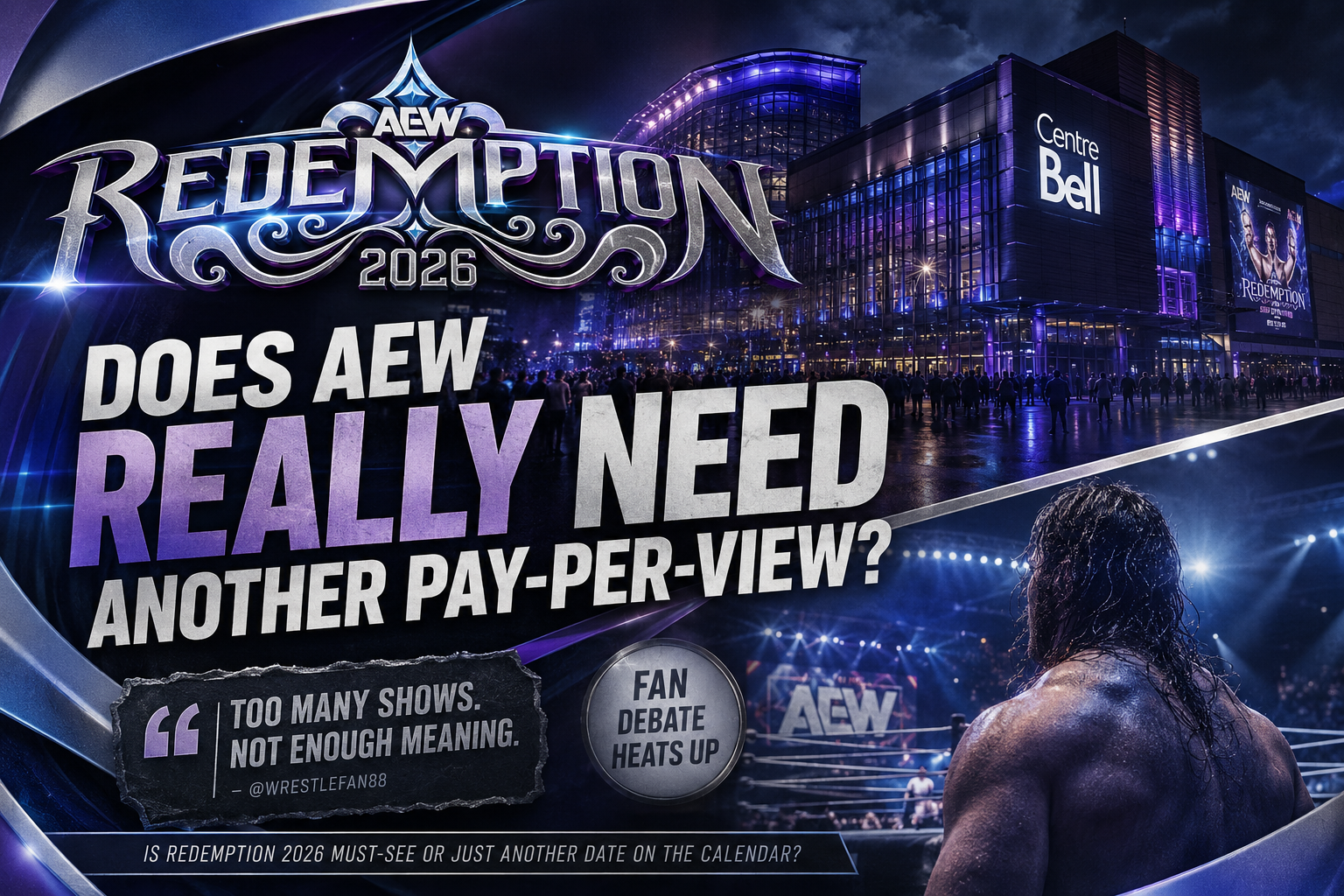
AEW Redemption takes place Sunday, July 26, from the Bell Centre in Montreal, and the company is promoting the show as a historic occasion: the launch of a brand-new pay-per-view event in one of Canada’s strongest wrestling markets.
The card looks good. That is almost never the problem with AEW.
Kenny Omega will defend the AEW World Championship against Kevin Knight. Thekla will put the AEW Women’s World Championship on the line against Willow Nightingale. Adam Copeland and Christian Cage will defend the AEW World Tag Team Championship against Claudio Castagnoli and PAC. Kyle Fletcher will defend the AEW International Championship against Bandido. Mark Davis will defend the AEW National Championship against Andrade El Ídolo. Hikaru Shida will defend the TBS Championship against Maya World. The Young Bucks will face Jon Moxley and Will Ospreay, while Chris Jericho will revive The Painmaker against Tommaso Ciampa in a No Holds Barred Match.
There is more than enough talent on that card to deliver another excellent night of professional wrestling.
There are six championship matches, several former world champions, some of the best wrestlers in the world, established stars, developing names and enough different styles to prevent the event from becoming repetitive once the bell rings. AEW’s pay-per-views have earned a reputation for delivering strong in-ring quality even when the television build has been uneven.
That reputation is exactly why Redemption presents such an important question.
Does AEW actually need another pay-per-view, or has the company reached the point where its ability to produce good matches is being used to justify an increasingly crowded event calendar?
Redemption is not arriving after a long period of anticipation. It is taking place four weeks after Forbidden Door and five weeks before All In at Wembley Stadium. It sits directly between an established crossover event and AEW’s largest annual show. Several of its biggest matches are openly being used to advance stories that are expected to peak at All In.
That makes Redemption feel less like a destination and more like a premium-priced bridge.
AEW can still put on a great show. Kenny Omega and Kevin Knight can deliver. Thekla and Willow can have a strong women’s championship match. Copeland, Christian, Claudio and PAC can produce an excellent tag-team title fight. Moxley, Ospreay and The Young Bucks can tear the building apart.
But great wrestling cannot be the only answer every time someone asks why another pay-per-view exists.
At some point, the event itself needs a reason.
AEW’s Original Pay-Per-View Model Was Part of Its Identity
When AEW first established its yearly schedule, the limited pay-per-view model helped separate the company from WWE.
Revolution, Double or Nothing, All Out and Full Gear became the core annual events. There were long periods between them, giving Dynamite time to build stories, create contenders and allow rivalries to breathe before reaching a major conclusion.
That structure was not perfect.
Some feuds ran too long. AEW occasionally struggled to maintain momentum across several months. Wrestlers could spend weeks in holding patterns. Television sometimes relied on special episodes because the next traditional pay-per-view remained too far away.
However, the limited schedule gave the events weight.
A pay-per-view felt like a major destination because there were only a few opportunities each year for AEW to present one. The company needed to select its most important rivalries, strongest championship programs and largest attractions. Fans had time to anticipate the show and recover financially before purchasing another one.
AEW’s early pay-per-view model also helped establish trust.
Fans could spend money expecting a long show filled with important matches because the company was not asking them to do it every few weeks. Even when the television build was inconsistent, the relative scarcity gave the event a natural level of importance.
The pay-per-views felt like chapters.
They were not simply additional content.
That changed gradually.
Forbidden Door was introduced in 2022 as the crossover event with New Japan Pro-Wrestling. All In became an AEW pay-per-view in 2023. WrestleDream and Worlds End were added later that year. Dynasty followed in 2024.
By 2025, AEW’s recognized pay-per-view lineup included Revolution, Dynasty, Double or Nothing, All In, Forbidden Door, All Out, WrestleDream, Full Gear and Worlds End.
The company had moved from four major annual events to nine.
Redemption now becomes another addition.
That does not automatically make the expansion wrong. AEW is a much larger company than it was during its first several years. It has more television, more championships, a larger roster, international ambitions, broader streaming distribution and several markets it wants to reach with major events.
The question is no longer whether AEW should remain permanently limited to four pay-per-views.
The question is whether every new event is adding something the existing calendar did not already provide.
Expanding the Schedule Solved One Problem and Created Another
The move beyond four pay-per-views addressed several legitimate creative issues.
AEW no longer has to stretch every major feud across three or four months. A rivalry can begin, develop and reach a pay-per-view conclusion within a more manageable period. Champions receive more premium defenses. Wrestlers can move through programs without spending several weeks in repetitive tag matches designed only to delay the inevitable singles encounter.
A larger schedule also creates financial opportunities.
More pay-per-views mean more ticket revenue, more event purchases, more sponsorship inventory and more major shows for media partners. AEW can take pay-per-view events to international and Canadian markets instead of concentrating most of its largest cards in the United States.
The expanded distribution through HBO Max, Prime Video, traditional cable, MyAEW and other platforms makes those events easier to purchase across different markets. A company with a large media-rights agreement and a growing streaming relationship has an obvious incentive to produce more premium content.
There is nothing inherently irresponsible about AEW creating another event.
Redemption becomes a problem if the event exists because the business model wants more pay-per-views before the creative product has produced another pay-per-view-level destination.
That distinction is important.
An event calendar should serve the stories.
The stories should not be rushed, rearranged or stretched to serve an event calendar.
The more pay-per-views AEW adds, the greater the risk that weekly television becomes a production line moving wrestlers from one event to the next. A pay-per-view ends, the next card immediately begins forming and the company has little time to explore the aftermath before promoting another destination.
That is already visible around Redemption.
Forbidden Door took place on June 28. The event crowned Will Ospreay and Mercedes Moné as Owen Hart Cup winners, establishing them as the men’s and women’s world championship challengers for All In. Andrade left the Don Callis Family. Jay White returned. Several faction stories moved forward.
Ten days later, Beach Break changed both the AEW World Championship and International Championship and determined the women’s world-title challenger for Redemption.
Eighteen days after Beach Break, Redemption will take place.
Five weeks later, AEW will return to Wembley Stadium for All In.
There is almost no room for anything to breathe.
Redemption Is Trapped Between Forbidden Door and All In
The placement of Redemption is the event’s largest structural weakness.
Forbidden Door was not an ordinary pay-per-view. It was a major crossover show featuring AEW and international talent, a large steel-cage match and the finals of both Owen Hart Foundation tournaments. The tournament winners were rewarded with world championship matches at All In.
That immediately made All In the company’s long-term destination.
Will Ospreay is waiting for the AEW World Champion.
Mercedes Moné is waiting for the AEW Women’s World Champion.
The winners at Redemption will not simply celebrate. They will move forward toward challenges that have already been established.
This gives AEW’s two world-title matches an unusual problem.
The audience knows Redemption is not the end of either championship story.
It is an obstacle placed in front of the champions before the matches AEW has already identified as more important.
Kenny Omega vs. Kevin Knight is taking place beneath the shadow of Omega vs. Will Ospreay.
Thekla vs. Willow Nightingale is taking place beneath the shadow of the women’s champion vs. Mercedes Moné.
That does not make the challengers irrelevant. Kevin Knight and Willow Nightingale are talented enough to create doubt and deliver strong performances.
It does mean AEW has already told the audience that the larger destination exists somewhere else.
Redemption is being asked to feel essential while All In remains visible directly behind it.
Beach Break May Have Been More Consequential Than Redemption
AEW’s July 8 Beach Break episode of Dynamite presented several developments that would normally define a pay-per-view.
Kenny Omega defeated MJF to become AEW World Champion for the second time.
Kyle Fletcher defeated Konosuke Takeshita to become AEW International Champion.
Willow Nightingale won the Casino Gauntlet to earn an AEW Women’s World Championship match.
Chris Jericho faced Tommaso Ciampa in the match that produced their Redemption rematch.
Those were not minor television developments.
The AEW World Championship changed hands.
A second championship changed hands.
A major pay-per-view challenger was determined.
A personal rivalry escalated.
Beach Break created Redemption while also delivering developments larger than several matches currently advertised for Redemption.
That creates a difficult value comparison.
The free television special gave fans Omega vs. MJF with Omega’s championship future at stake. Redemption gives them Omega defending against Kevin Knight in a match where Omega is already expected to reach All In as champion.
Beach Break gave fans Fletcher defeating Takeshita for the International Championship. Redemption gives them Fletcher defending against Bandido shortly after winning it.
Beach Break gave fans Willow winning the Casino Gauntlet. Redemption gives them the championship match created by that result.
Beach Break gave fans the first Jericho–Ciampa match. Redemption gives them the rematch less than three weeks later with a No Holds Barred stipulation and another Jericho persona attached.
AEW has made its special television episodes so eventful that some pay-per-views now feel like extensions of television rather than a level above it.
That is a major problem when AEW is asking fans to purchase the event separately.
The purpose of strong television should be making the audience desperate to see the pay-per-view conclusion. Television should not deliver the larger development and leave the pay-per-view to manage the consequences.
Kenny Omega vs. Kevin Knight Feels Like a Premium Live Placeholder
Kenny Omega becoming AEW World Champion again should have been the beginning of a major new era.
He defeated MJF after entering Beach Break with his future championship eligibility at stake. The match carried history, danger and long-term consequences. Omega had already lost to MJF more than once. Another defeat would have permanently removed him from the world-title picture.
Omega overcame that pressure and became champion for the second time.
The moment should have created enormous possibilities.
Omega could confront his declining physical condition, the expectations attached to his legacy, his relationship with The Young Bucks, his connection to Hangman Page and the approaching All In challenge from Will Ospreay.
Instead, his first pay-per-view defense is against Kevin Knight.
Kevin Knight is an exciting wrestler with legitimate upward potential. His TNT Championship run has helped establish him beyond his previous tag-team identity, and placing him opposite Omega gives him a chance to prove that he belongs in AEW’s world-title environment.
The issue is not Knight’s talent.
The issue is why this match is happening.
Knight had been promised a title opportunity by MJF. After Omega defeated MJF, Knight asked whether that promise would be honored. Omega initially noted that he was not obligated to honor an agreement made by the former champion, then gave Knight the match anyway.
That is not a compelling central conflict.
Knight did not win a major contender match.
He did not defeat Omega.
He did not force Omega’s hand.
He did not spend months climbing toward the opportunity.
He asked, and Omega agreed.
AEW can frame the decision as Omega being a fighting champion, but that does not make the matchup feel like the main attraction of a new pay-per-view.
It feels like a championship defense scheduled because Redemption needed one.
The problem becomes more obvious when Will Ospreay is already waiting at All In. Ospreay won the Owen Hart Cup and earned the championship match at Wembley. AEW has made that future confrontation one of its largest ongoing stories.
Omega vs. Knight is therefore difficult to believe as a genuine title-change possibility.
AEW could have Knight win and completely alter the All In direction. That would be shocking, but it would also risk throwing away Omega vs. Ospreay shortly after Omega regained the title.
The more likely outcome is Omega retaining after Knight delivers a strong performance.
That may help Knight.
It may produce an excellent match.
It does not give Redemption the uncertain, urgent world-title main event that a new pay-per-view should have.
The final Dynamite before Redemption makes the situation even more awkward. Knight is scheduled to defend the TNT Championship against Darby Allin four days before challenging Omega.
If Knight loses the TNT Championship, he enters Redemption after a defeat.
If Knight retains cleanly, Darby suffers another setback.
If interference determines the result, AEW is using television overbooking to protect a pay-per-view challenger whose world-title match already feels predictable.
AEW has placed Knight in two major title matches within four days without developing enough emotional space for either one.
That is not necessarily ambitious booking.
It may simply be overbooking.
Omega’s First Reign Deserves a More Important First Pay-Per-View Chapter
Omega is not an ordinary transitional champion.
His return to the title should be treated as a major development in AEW’s history.
His first reign was associated with The Elite, Don Callis, championship collecting and the company’s attempt to connect several promotions through one central figure. His second reign should not merely repeat that formula.
The new Omega is older, physically more vulnerable and surrounded by relationships that have changed dramatically.
The Young Bucks are no longer uncomplicated allies.
Hangman has returned while claiming he will never challenge for the world championship again.
Ospreay is approaching as both a challenger and a man whose current alliances create mistrust.
Moxley and the Death Riders remain connected to several major stories.
MJF has lost the title and may disappear temporarily.
Omega’s second reign should immediately feel psychologically different from the first.
Redemption should be the first major opportunity to define that difference.
Instead, the world-title match is structured around Omega generously granting a challenger an opportunity that another champion promised.
The story asks almost nothing difficult of Omega.
It does not force him to confront his past.
It does not challenge his leadership.
It does not threaten one of his relationships.
It does not create moral tension.
It asks him to wrestle a talented younger opponent before moving toward Will Ospreay.
That is a Dynamite championship story presented as the center of a pay-per-view.
Thekla vs. Willow Nightingale Is Stronger Than the Men’s World-Title Story but Carries the Same All In Problem
Willow Nightingale won the Casino Gauntlet and earned her opportunity against Thekla.
Unlike Knight, Willow secured the championship match through a defined competitive mechanism. Her return and victory created a genuine emotional moment, and her natural connection with the audience gives the match an immediate babyface–heel structure.
Thekla has developed into one of AEW’s most distinctive women’s champions. Her physical style, presentation and willingness to become increasingly cruel give Willow a clear obstacle. Willow’s optimism and emotional openness make her a natural contrast.
This is a legitimate championship program.
It still exists beneath the shadow of All In.
Mercedes Moné won the women’s Owen Hart Cup and is guaranteed a world-title opportunity at Wembley. The winner of Thekla vs. Willow is already moving toward Mercedes.
That creates several possibilities.
Thekla can retain, continuing her reign into the larger Mercedes match.
Willow can win, creating a fresh babyface champion opposite Mercedes.
Mercedes can interfere or influence the result, immediately entering the story.
The outcome is less predictable than Omega vs. Knight, which helps the match.
However, the story has not received enough time to feel like the main women’s rivalry of the summer. Willow won the opportunity at Beach Break, and Redemption follows less than three weeks later. The challenge has been established quickly because the calendar demanded a contender.
The match may be excellent. Willow and Thekla are capable of creating the emotional stakes once they are in the ring.
AEW should not depend upon the wrestlers to manufacture all the emotional depth during the match itself.
Adam Copeland and Christian Cage vs. Claudio Castagnoli and PAC Has Talent but Feels Like Another Death Riders Rotation
Copeland and Christian defending the AEW World Tag Team Championship against Claudio and PAC should be a major match.
Four experienced, accomplished wrestlers are involved. Christian and Copeland’s reunion contains decades of history. Claudio and PAC provide a physically and stylistically dangerous challenge. The champions are attempting to prove that their reunion is more than nostalgia.
The issue is that the current Death Riders structure has become so broad that individual combinations can feel interchangeable.
One week, Wheeler Yuta and Daniel Garcia challenge the champions.
The next week, Claudio and PAC attack.
Moxley is involved elsewhere.
Ospreay is temporarily connected to the group.
Different members move between singles, tag and multi-man stories.
That creates a large faction universe, but it can reduce the uniqueness of the individual match.
Why are Claudio and PAC specifically the team that should challenge Copeland and Christian?
What do they believe about the champions?
Do they see them as legends overstaying their place?
Do they want to prove that violence and discipline can defeat experience?
Are they pursuing the titles for themselves or carrying out a wider Death Riders objective?
The physical attack provides a reason for the match. It does not provide a complete story.
Copeland and Christian’s title reign should also be about more than former friends reuniting and defending against whichever heel team attacks them. Their history contains betrayal, resentment, competition and complicated affection. Every defense should test whether the relationship is truly repaired.
Claudio and PAC are talented enough to test them athletically.
The story needs to test them emotionally.
The Young Bucks vs. Jon Moxley and Will Ospreay Reveals Redemption’s True Purpose
The Young Bucks vs. Moxley and Ospreay may be one of Redemption’s most compelling matches.
It also makes the event’s transitional role impossible to ignore.
The Bucks want to prove that they remain AEW’s greatest tag team. They are also attempting to expose Ospreay as someone Kenny Omega should not trust heading into All In.
Ospreay and Moxley are an uneasy combination. Ospreay’s relationship with the Death Riders complicates his position as Omega’s future challenger. Moxley remains one of the most dangerous figures in the company. The Bucks have their own history with Omega and their own interest in the tag-team titles.
There are several layers.
Can Ospreay and Moxley function together?
Are The Young Bucks attempting to protect Omega or manipulate him?
Does Ospreay genuinely respect Omega?
Is Moxley using Ospreay?
Are The Bucks trying to move toward Copeland and Christian’s championships?
The match can advance several stories at once.
That is also the problem.
Its primary importance is what it tells Kenny Omega before All In.
The Bucks’ stated purpose is to expose Ospreay.
Redemption is therefore being used to create the next chapter of a match happening five weeks later.
That makes this an All In angle taking place on a separate pay-per-view.
There is nothing wrong with one pay-per-view leading toward another. Wrestling stories should continue.
The issue is how much of Redemption exists to prepare Wembley rather than define Montreal.
Kyle Fletcher vs. Bandido Could Be Outstanding but Was Created Too Quickly
Kyle Fletcher won the AEW International Championship at Beach Break and is now defending it against Bandido.
That matchup could be incredible.
Fletcher has grown into one of AEW’s most complete young wrestlers. Bandido can work at an elite pace, connect with the audience and create spectacular moments without abandoning physical credibility.
The match does not need excessive melodrama to succeed.
It does need more than annoyance.
Fletcher being irritated by Bandido is enough to create a television defense. It is not automatically enough to make the match feel pay-per-view essential.
The International Championship should have a defined identity.
It should represent AEW’s relationship with wrestling beyond one country, a high-level open competitive standard or a champion willing to defend against contrasting international styles.
Instead, the belt has often depended on the person holding it to create meaning. Fletcher has only recently won it, and Redemption is arriving before his reign has developed an identity.
Bandido is therefore entering as an exciting opponent rather than a deeply developed challenger.
AEW’s roster is so talented that the company can produce matches like this whenever it needs to strengthen a card.
That strength can become a weakness.
A great matchup becomes an easy substitute for a great story.
Mark Davis vs. Andrade El Ídolo Has One of the Card’s Clearest Personal Foundations
Andrade leaving the Don Callis Family at Forbidden Door gives his National Championship match with Mark Davis a logical story.
Andrade wants to damage the group he abandoned.
Davis holds a championship that gives Andrade a direct target.
Andrade earned the match by defeating Jake Doyle, forcing his way through another Callis Family obstacle.
This is one of Redemption’s more coherent programs because the title and personal conflict are connected.
Andrade does not merely want the National Championship.
Taking it would weaken the family he rejected.
Davis is not merely defending a belt.
He is protecting the group’s status and punishing a former member.
The problem is the championship itself.
AEW already has the World Championship, TNT Championship, International Championship, Continental Championship and National Championship in its men’s singles structure, alongside championships from partner promotions and Ring of Honor that regularly appear on AEW television.
The National Championship needs a reason to exist beyond being another belt attached to the Don Callis Family.
What makes it national?
What competitive identity separates it from the TNT or International Championship?
What does winning it specifically mean to Andrade?
If the strongest answer is that it belongs to someone in the Callis Family, then the personal story is carrying a championship that still lacks its own clear purpose.
Hikaru Shida vs. Maya World Demonstrates AEW’s Compressed Challenger Problem
Hikaru Shida retained the TBS Championship against Queen Aminata by cheating, then attacked her after the match. Maya World made the save.
That was enough to create Maya’s championship opportunity at Redemption.
The story is easy to follow.
Shida cheated.
Maya opposed her.
Shida now has to defend against Maya.
The question is whether one save should create a pay-per-view title match.
Maya has momentum and has been positioned as one of AEW’s rising women. She reached the Owen tournament final and has continued gaining visibility. A TBS Championship match can help establish her at a higher level.
However, the accelerated process again reveals AEW’s calendar pressure.
A television angle immediately becomes a pay-per-view match because Redemption needs a card.
There is little time for Shida to target Maya personally, Maya to explain why the championship matters or Queen Aminata to react to being the person Shida actually cheated and attacked.
Aminata risks becoming the plot device used to move Maya into the title match.
AEW could use all three women to create a deeper program.
Aminata may resent Maya benefiting from her suffering.
Maya may believe she did what was right.
Shida may manipulate that tension.
The current schedule has compressed the story before those layers can develop.
Chris Jericho vs. Tommaso Ciampa Is a Rematch Using Nostalgia to Create Immediate Importance
Ciampa defeated Jericho at Beach Break through questionable means. The rivalry continued through violence, leading Jericho to revive The Painmaker and Ciampa to accept a No Holds Barred rematch.
The feud has a direct reason for continuing.
The first match did not provide clean satisfaction.
Jericho wants revenge.
Ciampa refuses to fear another Jericho persona.
The No Holds Barred stipulation follows the escalation.
This may be one of the easiest Redemption matches to understand.
It also highlights a larger Jericho problem.
Jericho has spent years cycling through names, personas, catchphrases and previous versions of himself. The Painmaker carries history from New Japan, but its return risks feeling like another attempt to create instant importance through branding.
The character cannot simply be regular Chris Jericho with face paint, a hat and a more violent stipulation.
Ciampa should expose that.
He should treat The Painmaker as an older wrestler reaching into the past because his present identity is no longer frightening enough.
Jericho should not merely claim the persona makes him dangerous. He should demonstrate why the loss at Beach Break forced him into a darker version of himself.
The match can work because both wrestlers understand violence and character.
The rematch is still occurring only 18 days after their first encounter.
That pace leaves little room for the transformation to feel earned.
Six Championship Matches Do Not Automatically Make Redemption Essential
AEW can promote Redemption as a championship-heavy event.
The AEW World Championship.
AEW Women’s World Championship.
AEW World Tag Team Championship.
AEW International Championship.
AEW National Championship.
TBS Championship.
That looks impressive.
AEW’s number of championships makes the statistic less meaningful.
Title matches happen regularly on Dynamite and Collision. Beach Break featured two championship changes. The final Dynamite before Redemption includes a TNT Championship match and a Women’s World Tag Team Championship No Disqualification Match.
Championship wrestling is no longer exclusive to pay-per-view.
That is not inherently bad. Television titles should be defended on television. World champions should occasionally wrestle on weekly programming.
The problem arises when AEW uses the volume of championships to make every pay-per-view card look loaded.
A title match only becomes important when the title possesses a defined identity, the challenger has a credible claim and the result changes something.
Six belts do not equal six developed stories.
AEW’s Championship Inflation and Pay-Per-View Inflation Feed Each Other
A large roster encourages more championships.
More championships encourage more title matches.
More title matches make it easier to populate additional pay-per-views.
More pay-per-views require more challengers and more television mechanisms to create them.
That cycle can keep everyone active while making everything feel less exclusive.
Kevin Knight can defend one championship on Wednesday and challenge for another on Sunday.
Fletcher can win a title and defend it on pay-per-view less than three weeks later.
Maya can make one save and receive a championship match.
Andrade can leave a faction, win one match and challenge for another belt.
The matches are logical in isolation.
Together, they reveal a company moving at a speed that leaves little time for hierarchy.
Who is the most important champion beneath Omega?
Which secondary title is the most prestigious?
Which challengers have spent months earning their positions?
Which championship match is actually capable of changing the company?
When every belt receives pay-per-view presentation, the audience is told that all of them matter. When they all matter in similar ways, none of them feels uniquely important.
Redemption Has No Clear Event Identity
Revolution has an established annual position.
Double or Nothing is connected to AEW’s origin.
All In is the company’s largest global stage.
Forbidden Door represents crossover wrestling.
All Out has deep historical ties to AEW and Chicago.
WrestleDream is associated with wrestling history and Antonio Inoki’s influence.
Worlds End closes the year.
Full Gear carries one of AEW’s original internal references.
What is Redemption?
The name suggests second chances, recovery and wrestlers attempting to correct past failures.
The card contains some of those ideas, but they are not presented as one unifying theme.
Jericho is attempting to avenge a loss.
Andrade is attempting to damage the Callis Family.
Willow is attempting to become champion.
Omega is beginning another reign.
Copeland and Christian are attempting to prove their reunion.
Those ideas could be framed around redemption, but AEW has not built the event’s identity around them.
The name currently feels generic enough to attach to any collection of matches.
A new pay-per-view needs more than a logo.
It needs a reason fans will understand when the event returns next year.
A signature location.
A recurring tournament final.
A defining match concept.
A specific place on the calendar.
A narrative theme.
Redemption currently has none of those beyond being the show between Forbidden Door and All In.
Montreal Deserves a Major Event, but the Market Cannot Be the Entire Justification
Holding Redemption at the Bell Centre is a strong decision.
Montreal is one of professional wrestling’s most important cities. The audience understands wrestling history, responds passionately and can give the event an atmosphere different from a routine American arena show.
AEW has also made international expansion a major part of its identity. Running pay-per-views in Canada helps the company demonstrate that its global ambitions extend beyond occasional television tapings.
The business and market justification is clear.
Montreal deserves a meaningful AEW pay-per-view.
That does not mean the city should receive a card designed primarily to bridge AEW toward London.
The Bell Centre crowd will almost certainly elevate the show. A passionate audience can make predictable matches feel larger and turn strong wrestling into something memorable.
AEW should not rely on the crowd to create the importance that the build did not.
The city should enhance the story.
It should not be asked to provide one.
The Strongest Argument for Redemption
AEW’s supporters can make a completely reasonable defense of the event.
The company has an enormous roster and needs more major opportunities.
The eight-match card offers variety without becoming unmanageably large.
Most of the matches have logical stories.
The Montreal market deserves a pay-per-view.
The HBO Max and broader streaming relationships create demand for premium events.
AEW’s expanded schedule has prevented some rivalries from becoming excessively long.
The company’s pay-per-views consistently deliver.
Kevin Knight, Maya World, Mark Davis, Willow Nightingale and Kyle Fletcher benefit from receiving major-event positions alongside established stars.
All In does not need to prevent AEW from holding another important event five weeks earlier.
Every point is valid.
The existence of more pay-per-views is not automatically a creative failure.
The strongest companies should be capable of producing several major events each year.
The problem is not the calendar number alone.
The problem is hierarchy.
Redemption does not currently feel equal to Revolution, Double or Nothing, All Out, Full Gear or All In.
It does not possess the unique crossover identity of Forbidden Door.
It does not close the year like Worlds End.
It does not carry an established purpose.
It feels like a high-level intermediary show elevated to pay-per-view because AEW now has the distribution, roster and business incentives to produce one.
That can still be successful financially.
It remains creatively risky.
What Redemption Must Accomplish
Redemption cannot simply deliver good matches.
AEW already delivers good matches on television.
The event needs to create developments that could not have occurred on Dynamite.
Kenny Omega’s second championship reign needs a defining character direction. A routine successful defense against Knight will not be enough. Something involving Ospreay, The Young Bucks, Hangman or another major relationship needs to alter Omega’s road to All In without making Knight feel like an afterthought.
Kevin Knight needs to leave the event at a higher level than he entered. A long match and a respectful handshake would be too familiar. His performance, decision or post-match direction needs to reveal a new character dimension.
Thekla vs. Willow needs to create more than the identity of Mercedes Moné’s opponent. The winner should enter All In with a personal position toward Mercedes, while the loser should retain a meaningful story.
Copeland and Christian’s relationship needs to be tested. The championship defense should reveal whether their reunion is stable or whether old weaknesses remain.
The Young Bucks vs. Moxley and Ospreay needs to produce a major consequence for Omega’s trust in Ospreay, the Bucks’ tag-team ambitions or Ospreay’s Death Riders connection.
Andrade’s attempt to damage the Callis Family needs to change the faction rather than end with a routine title result.
Maya World’s championship opportunity needs to establish whether she is ready for AEW’s upper level, not simply whether she can have a good match with Shida.
Jericho’s Painmaker return needs to carry an actual cost. If the persona disappears after another violent match, it will have functioned as temporary marketing.
The event needs to justify its name by creating genuine redemptions, failures and transformations.
AEW Cannot Keep Using Match Quality as Its Universal Defense
AEW’s greatest strength has become its easiest shield against criticism.
The card looks good.
The matches will probably deliver.
The crowd will be hot.
The pay-per-view will likely receive strong reviews.
All of that may happen.
None of it answers whether Redemption needed to exist as a separate pay-per-view.
A television special can deliver excellent wrestling.
A special episode of Dynamite can include championship matches.
Collision can feature a violent faction battle.
A pay-per-view needs to provide a level of consequence, exclusivity and narrative importance that weekly programming cannot.
Redemption currently feels like a collection of matches that would make an incredible three-hour Dynamite special.
That is not an insult to the card.
It is a criticism of the event’s necessity.
AEW Does Not Need Fewer Great Matches—It Needs Stronger Event Hierarchy
Returning permanently to four pay-per-views is probably unrealistic and unnecessary.
AEW has grown beyond that schedule.
The company has more platforms, markets and commercial opportunities. A larger calendar can work.
AEW needs to decide which events are true tentpoles and which are supporting premium shows.
If Redemption is intended to be a smaller bridge event, the company should price, structure and promote it accordingly.
The show does not need six championships and eight matches attempting to look equal to All In.
It could be built around one defining tournament, one central theme or a shorter card where every match possesses a clear purpose.
If Redemption is intended to become a major annual tentpole, AEW must give it an identity and enough space on the calendar to breathe.
Placing it between Forbidden Door and All In makes that almost impossible.
The company cannot ask fans to treat every pay-per-view like the biggest night of the year.
Events need hierarchy.
Championships need hierarchy.
Stories need hierarchy.
Without that, AEW becomes a company with constant major matches and fewer truly major moments.
Redemption Exposes AEW’s Larger Creative Risk
AEW is producing more content, more championships, more special episodes and more pay-per-views than it did during its early years.
The company is larger, but larger does not automatically mean more important.
Redemption exposes the danger of AEW confusing abundance with depth.
More title matches do not automatically create stronger divisions.
More pay-per-views do not automatically create more compelling stories.
More wrestlers on major cards do not automatically create more stars.
More excellent matches do not automatically create more memorable events.
AEW’s original appeal came partly from making wrestling feel special again. The company presented itself as an alternative where matches had consequences, records mattered, championships possessed clear importance and pay-per-views were major destinations rather than monthly obligations.
AEW should not become trapped by nostalgia for its own early model. It should evolve.
Evolution requires understanding which qualities were worth protecting.
Scarcity was one of them.
Not absolute scarcity. AEW does not need to return to four events.
It needs enough scarcity that a pay-per-view still feels different from a special Dynamite.
Redemption may be an excellent show. It may contain several of the best matches of July. The Montreal crowd may create an unforgettable atmosphere. Kevin Knight and Maya World may take major steps forward. Omega, Ospreay, Moxley and The Young Bucks may produce an angle that transforms All In.
The event can succeed.
Its success would not automatically prove that AEW needed another pay-per-view.
It may only prove, once again, that AEW has enough talented wrestlers to overcome an overcrowded calendar.
That is not a sustainable answer forever.
Redemption needs to become more than the event between Forbidden Door and All In. It needs to create a reason to exist that cannot be replaced by Beach Break, Grand Slam, a three-hour Dynamite or another branded television special.
Until AEW establishes that reason, Redemption represents the clearest evidence yet that the company’s pay-per-view expansion has moved beyond solving creative problems and started creating new ones.
Make sure to subscribe to our Late Night Crew Wrestling YouTube Channel. Follow @yorkjavon, @kspowerwheels & @LateNightCrewYT on X.
I’m the quiet one until the bell rings then I’ve got takes. I live for WWE NXT and TNA, I want every promotion to succeed, and I will absolutely roast the bad decisions on sight (because someone has to). Anime taught me to respect long-term storytelling; wrestling taught me that sometimes the plan is “we panicked” and called it “unpredictable.” The Miz got me into all of this, so yeah I appreciate confidence, commitment, and the art of talking like you’re already the main event. Now I bring that same energy to the page as the main writer for Late Night Crew Wrestling because if you’re not here to be must-see and tell the truth, why are you here?!