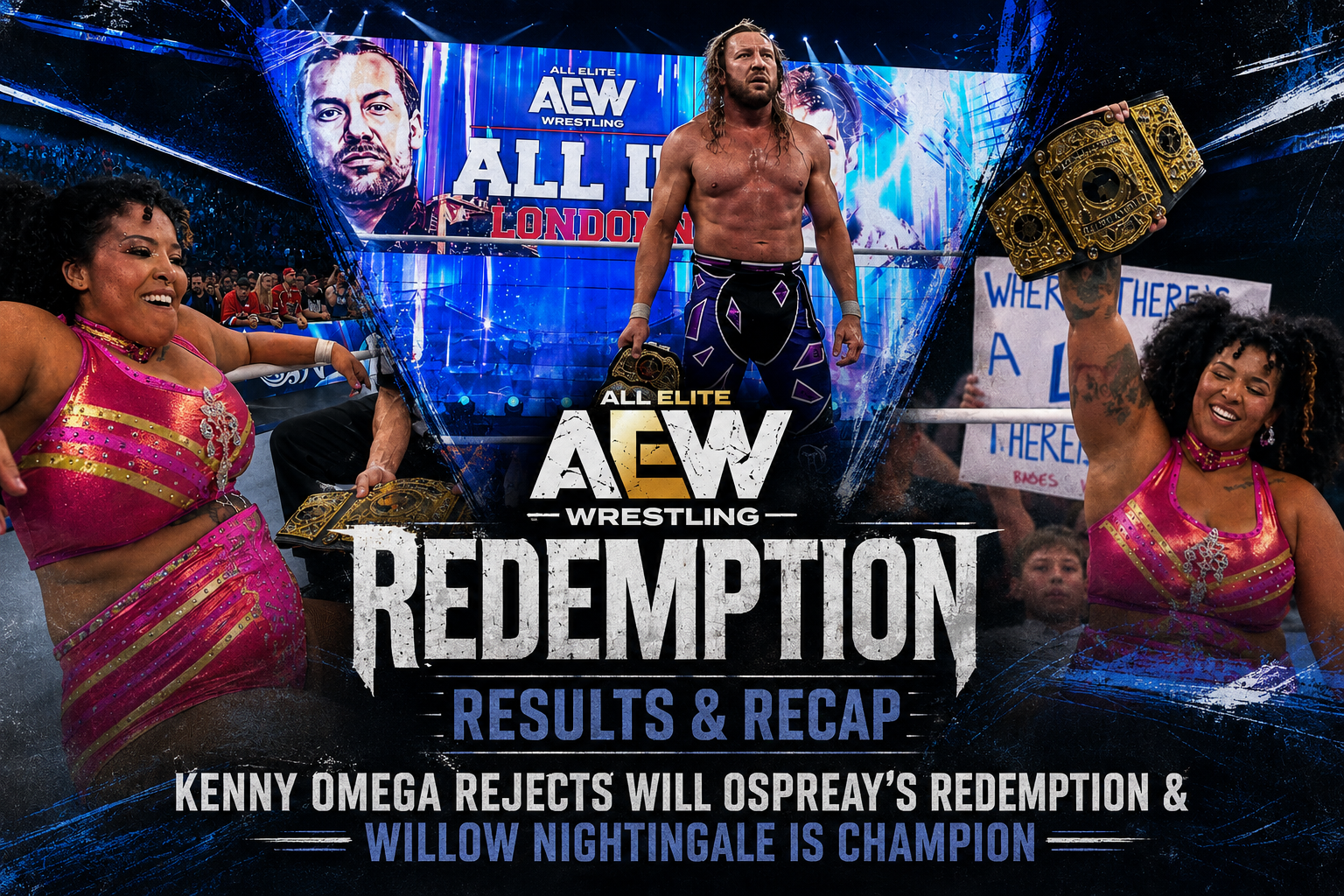
AEW Redemption arrived at Montreal’s Bell Centre last night with ten main-card matches, seven championships at stake and 35 days remaining before All In: London, but the inaugural pay-per-view will be remembered less for its overloaded lineup than for the consequences left behind. Kenny Omega successfully defended the AEW World Championship against Kevin Knight, Willow Nightingale finally climbed to the top of AEW’s women’s division, Andrade El Ídolo captured his first AEW title and Maya World stunned Hikaru Shida. None of those developments, however, created a louder conversation than Will Ospreay abandoning the Death Riders to save Omega—only for the champion to remind him that one moral decision could not erase weeks of betrayal. Redemption delivered several excellent performances and meaningful championship changes, but another marathon card, too many belts and some wildly uneven storytelling prevented it from becoming the defining stop on the road to Wembley that AEW needed.
Here Are the Full Results
- The Conglomeration (c) defeated The Lethal Twist (AEW World Trios Championship on the Buy-In)
- “Speedball” Mike Bailey defeated Jack Perry, Komander, The Beast Mortos, Nick Wayne and El Clon in a six-way ladder match to earn an AEW International Championship opportunity.
- The Young Bucks defeated AEW Continental Champion Jon Moxley and Will Ospreay.
- Kyle Fletcher (c) defeated Bandido (AEW International Championship)
- The Dogs defeated Bang Bang Gang (Double Chain Match)
- Maya World defeated Hikaru Shida (c) to become the NEW TBS Champion
- Adam Copeland and Christian Cage (c) defeated PAC and Claudio Castagnoli (AEW World Tag Team Championship)
- “The Painmaker” Chris Jericho defeated Tommaso Ciampa (No Holds Barred match)
- Andrade El Ídolo defeated Mark Davis (c) to become the NEW AEW National Champion
- Willow Nightingale defeated Thekla (c) to become the NEW AEW Women’s World Champion
- Kenny Omega (c) defeated TNT Champion Kevin Knight (AEW World Championship)
Breakdowns & Reactions
The Rougeau Family Celebration Gives Montreal Its Hometown Moment
AEW opened the Buy-In by honoring 80 years of the Rougeau family, with Matt Menard introducing Jacques and Raymond Rougeau before Rocky Romero interrupted to declare the Don Callis Family Canada’s only important wrestling family.
Jacques slapped Romero, Raymond added a kick and the Montreal crowd received exactly the uncomplicated hometown celebration it wanted. The segment did not attempt to manufacture a major storyline out of the ceremony. Romero generated easy heat, the Rougeaus received their flowers and AEW acknowledged the wrestling history of the city hosting its newest pay-per-view.
It was simple nostalgia done correctly. Romero can absorb this type of humiliation without damaging the Don Callis Family’s more protected members, while Jacques and Raymond were allowed to create one more memorable Montreal reaction.
Grade: B
What Worked
- AEW gave Montreal-specific history a meaningful place on the show.
- Jacques Rougeau’s slap produced an immediate hometown reaction.
- Rocky Romero was the right expendable villain for the segment.
What Didn’t Work
- The interruption followed a predictable legends-segment formula.
- It had no real significance beyond the Buy-In celebration.
The Conglomeration vs. The Lethal Twist
The Conglomeration’s World Trios Championship defense against Jay Lethal, Blake Christian and Lee Johnson was energetic enough to justify its Buy-In placement, even though the challengers never felt like a genuine threat to win the titles.
Christian and Johnson supplied the speed and spectacular offense, while Lethal gave the team credibility and structure. The champions’ contrasting styles remained the match’s strongest feature. Kyle O’Reilly and Roderick Strong provided the physicality, while Orange Cassidy brought the timing and crowd connection.
The finish brought the champions together rather than making the match another solo Cassidy showcase. O’Reilly and Strong hit Total Elimination, Strong delivered End of Heartache and Cassidy was dropped onto Lethal for the pin.
The Demand watching from ringside gave the defense a needed consequence. Without that challenge, this would have felt like another championship match AEW added simply because it had three more titleholders available.
Grade: B-
What Worked
- The champions wrestled like a cohesive three-man unit.
- Blake Christian produced several of the match’s best athletic moments.
- The Demand’s involvement established the next title program.
What Didn’t Work
- The Lethal Twist received almost no meaningful build.
- The result never felt uncertain.
- AEW’s Trios Championship still lacks a central identity.
Mike Bailey Wins the Six-Way Ladder Match
Opening the main card with Montreal’s own Mike Bailey was an obvious and correct decision. Bailey received one of the night’s loudest reactions and rewarded the crowd by surviving a deliberately chaotic ladder match to earn a shot at Kyle Fletcher’s International Championship.
Komander, Nick Wayne, El Clon, Jack Perry and The Beast Mortos each received a dangerous showcase moment. Wayne’s Phoenix Splash from a ladder through El Clon and a table created one of the show’s wildest images. Komander launched himself across the ringside area, Perry delivered a Canadian Destroyer from a ladder and Mortos provided the power that kept the match from becoming six interchangeable aerial performances.
Bailey returned during the final stretch, crushed Mortos with Ultima Weapon on a ladder and retrieved the contract.
The crowd made the result feel bigger than the match’s actual story. Bailey was always the likely winner, but predictability was not a problem when the hometown favorite was clearly the best choice.
The larger problem was AEW’s familiar ladder-match logic. Wrestlers repeatedly abandoned clear opportunities to climb so they could arrange another table, ladder or dive. The athleticism was exceptional; the competitive urgency was not.
Grade: A-
What Worked
- Bailey winning in Montreal created the first major emotional release.
- Every participant received at least one memorable moment.
- The victory immediately established Fletcher’s next challenger.
What Didn’t Work
- Too many sequences required wrestlers to ignore the actual objective.
- The match occasionally felt like a stunt exhibition rather than a competition.
- Several risks were more spectacular than necessary.
The Young Bucks vs. Jon Moxley and Will Ospreay
This was the most important match on the card because it finally forced Will Ospreay to confront what joining the Death Riders actually required.
Ospreay entered through the crowd beside Moxley and Marina Shafir while wearing Death Riders branding, but the performance underneath the costume told a different story. When Ospreay and Nick Jackson collided heads, Nick began selling a possible concussion. Ospreay showed concern. Moxley immediately identified an injury to exploit.
That contrast became the entire match.
Moxley piledrove Nick on the floor, targeted his head and demanded that Ospreay do the same. Ospreay continued participating in the match, so he was hardly innocent, but he hesitated whenever Moxley asked him to cross the final line.
The Bucks fought from underneath more seriously than usual. Matt was forced to survive long stretches alone while Nick repeatedly tried to continue despite his condition. Their offense remained elaborate, but the urgency removed much of their normal comedy.
Ospreay eventually stood over a defenseless Nick and prepared to drive repeated elbows into the back of his head. He stopped. Moxley forcibly tagged himself in, stomped Nick, applied the bulldog choke and delivered multiple Paradigm Shifts followed by the Death Rider.
Moxley still wanted more. He retrieved a chair, but Ospreay took it away. The hesitation allowed the Bucks to recover, overwhelm Moxley with superkicks and pin the Continental Champion.
The storytelling was strong, but the concussion framing was uncomfortable. Wrestling has spent years asking audiences to take head injuries seriously, yet this match portrayed Nick as barely functional while he continued performing complicated offense. The angle made Moxley look monstrous, but the execution risked turning legitimate concussion symptoms into dramatic decoration.
Online reaction reflected that split. Many viewers praised Ospreay’s internal conflict and the Bucks’ serious presentation, while others found the concussion story manipulative and unnecessarily reckless.
Grade: A-
What Worked
- Ospreay’s hesitation directly advanced the show’s central storyline.
- Moxley’s complete lack of compassion made him more dangerous.
- The Bucks earned their All In title opportunity through a meaningful victory.
- The match connected directly to the post-main-event angle.
What Didn’t Work
- The concussion presentation was difficult to watch for the wrong reasons.
- Ospreay’s moral awakening came after he had already participated in the attack.
- Marina Shafir’s interference added little to a story already working without it.
Jon Moxley Warns Will Ospreay
After the loss, Moxley made the message clear: when Ospreay refused to pull the trigger, Moxley would do it himself.
The segment did not need to be long. Moxley had already seen enough. Ospreay wanted the perceived strength of the Death Riders without completely surrendering his conscience, and that compromise was no longer acceptable.
This gave the later main-event angle a logical foundation. Moxley did not suddenly turn against Ospreay after Omega’s match. He had already concluded that Ospreay was incapable of becoming the weapon he wanted.
Grade: B+
What Worked
- The segment clearly established Moxley’s disappointment.
- It connected the tag loss to the final angle.
- Ospreay’s position within the group became impossible to maintain.
What Didn’t Work
- The story was already obvious from the match.
- Moxley’s point did not need additional explanation.
Kyle Fletcher vs. Bandido
Kyle Fletcher and Bandido delivered the best complete wrestling match of the night.
Fletcher sent Don Callis backstage because he wanted to prove he could defeat the ROH World Champion without help. That detail mattered. Fletcher’s confidence has evolved beyond being another wrestler who survives through Don Callis Family interference. He now believes he is good enough to dominate on his own.
Bandido forced him to prove it.
The match combined Fletcher’s power and control with Bandido’s rare mixture of strength, speed and aerial ability. Bandido delivered a one-handed gorilla press slam, frog splash, 21 Plex and Revolutionary Fly. Fletcher survived, grew increasingly desperate and targeted Bandido’s head and neck with progressively more dangerous offense.
Bandido finally hit the 21 Plex for the match’s best near fall, but Fletcher escaped. The champion answered with an avalanche Michinoku Driver, drove Bandido into the turnbuckle and finished him with a brutal turnbuckle brainbuster.
Fletcher won cleanly and looked better because of it. Bandido lost without being reduced to another disposable challenger.
The match also exposed AEW’s crowded championship system. Bandido entered as ROH World Champion, while Fletcher defended one of AEW’s several secondary singles titles. The performance elevated the International Championship more than the belt elevated either wrestler.
Bailey later selecting Fletcher for Grand Slam Mexico gave the champion’s night a proper next chapter.
Grade: A
What Worked
- Fletcher defeated an established champion without interference.
- Bandido’s offense created credible near falls.
- The match escalated naturally instead of immediately becoming a finishing-move exchange.
- Bailey’s challenge gave the result immediate direction.
What Didn’t Work
- The outcome became fairly obvious once Callis left ringside.
- AEW’s abundance of championships complicated the importance of the match.
- Some late head-and-neck offense bordered on excess.
The Dogs vs. Bang Bang Gang
David Finlay and Clark Connors defeated Jay White and Juice Robinson in a Double Chain Match that succeeded whenever it felt disorganized, physical and hateful.
The chains functioned as restraints and weapons rather than decorative props. Finlay and Connors isolated their opponents, choked them around the ring post and used the steel to turn the match into an ugly fight.
That awkwardness helped. The wrestlers could not always move smoothly because they were legitimately restricted, giving the brawl a less rehearsed texture than many AEW stipulation matches.
The violence eventually became repetitive. Once both teams had used the chains for whipping, choking and pulling opponents into the steel, the match needed a stronger final escalation.
The Dogs winning was the correct decision for their momentum. They needed more from the match than the established Bang Bang Gang did. Jay White, however, remains trapped in a frustrating booking cycle. AEW presents him like a major star, but his losses continue to keep him outside the company’s serious singles-title conversations.
Grade: B
What Worked
- The chain stipulation changed how the wrestlers moved and fought.
- Finlay and Connors gained credibility from the victory.
- The match maintained a rougher tone than the ladder spectacle before it.
What Didn’t Work
- The chain offense became repetitive.
- The feud was not important enough to fully support the violence.
- Jay White absorbed another major loss without a clear future direction.
Maya World vs. Hikaru Shida
Maya World produced the night’s biggest upset by defeating Hikaru Shida for the TBS Championship, but the championship change was stronger than the match supporting it.
Shida controlled most of the contest and repeatedly appeared capable of ending it. Maya survived the Kitana, multiple knee strikes, the TBS Lock and a Falcon Arrow. When Maya reached the bottom rope after the Falcon Arrow, Shida mistakenly believed she had won and argued with the referee.
Maya caught her with a bridging fallaway slam and scored the three-count.
The story was clear: Shida’s arrogance cost her. The execution left Maya looking fortunate rather than fully prepared. She absorbed most of the champion’s offense and won when Shida made an avoidable mistake.
An upset can launch a young wrestler, but the follow-up will decide whether this was a genuine elevation or a championship change built almost entirely around shock value. Maya now has to carry television segments, defend against credible challengers and establish a personality beyond being the young underdog who survived.
Fan reaction was similarly divided. The result generated excitement, especially with Maya winning her first AEW championship on her birthday, but the match itself did not convince everyone that she was ready to lead the TBS division.
Grade: C+
What Worked
- The upset produced a genuine surprise.
- Maya’s emotional reaction made the championship feel important.
- Shida’s arrogance provided a clear reason for the loss.
What Didn’t Work
- Maya spent too much of the match absorbing offense.
- The finish made Shida look careless more than Maya looked superior.
- The in-ring execution was noticeably uneven.
The Demand Challenges The Conglomeration
After watching The Lethal Twist fail on the Buy-In, Ricochet, Bishop Kaun and Toa Liona challenged The Conglomeration for the World Trios Championship on Dynamite.
It was direct, logical and more important than the Buy-In defense itself. The Demand has enough personality and physical credibility to give the champions a real program, while Ricochet’s presence immediately raises the profile of the belts.
The challenge also revealed how transitional the Lethal Twist defense had been. The real rivalry was sitting at ringside throughout the match.
Grade: B
What Worked
- The next title defense was announced immediately.
- The Demand feels like a more credible threat than the previous challengers.
- Ricochet and Orange Cassidy provide a natural focal point.
What Didn’t Work
- The quick turnaround makes the Buy-In challengers feel even less important.
- AEW still needs to explain why the Trios Championship matters.
Adam Copeland and Christian Cage vs. PAC and Claudio Castagnoli
PAC and Claudio Castagnoli attacked Adam Copeland before Christian Cage reached the ring, forcing the champions to fight from underneath from the opening bell.
The ambush gave the match structure. Copeland spent the early portion isolated, while Christian had to recover before the champions could function as a team.
The match was professionally worked but never felt like a major pay-per-view championship attraction. Four experienced wrestlers produced a logical contest, yet the audience already understood that Copeland and Christian needed to retain so they could face the Young Bucks at All In.
The champions eventually overcame the Death Riders, with Christian sending PAC into Copeland’s spear to secure the victory.
The post-match confrontation carried more importance than the match. The Young Bucks came to the ring and the first-time All In meeting became official. Copeland accepted the handshake. Christian walked away, keeping enough tension alive to prevent the champions from becoming a completely sentimental reunion act.
Grade: B-
What Worked
- The pre-match assault established immediate stakes.
- Copeland and Christian retained without unnecessary overbooking.
- The Young Bucks confrontation confirmed a major All In match.
- Christian refusing the handshake preserved his character.
What Didn’t Work
- The result was never seriously in doubt.
- The action felt like a bridge to All In rather than a major title defense.
- The Death Riders were becoming overexposed across the card.
Chris Jericho vs. Tommaso Ciampa
Chris Jericho revived the Painmaker for a No Holds Barred match that threw glass, barbed wire, thumbtacks, hockey-themed weapons, green mist and a power drill into one exhausting package.
Tommaso Ciampa was naturally comfortable in the environment. His intensity made the fight feel personal, while Jericho committed fully to the violence required by the Painmaker presentation.
The match still crossed from disturbing into ridiculous. Ciampa drove Jericho through a mirror with an avalanche Psycho Driller. Jericho used green mist, a tack-covered Judas Effect and a barbed-wire mirror. The final submission came when Jericho pressed a drill against Ciampa’s head.
The weapon was so extreme that it became impossible to take literally. Instead of making the finish more frightening, it exposed the theatrical mechanics behind it.
Jericho winning was also the wrong long-term decision. Ciampa is the newer AEW performer and would have benefited from winning a violent match tailored to his character. Jericho’s special costume does not need greater protection than someone the company could still build into a consistent upper-midcard threat.
Some fans enjoyed the unapologetic chaos. Others viewed it as the clearest example of AEW confusing excess with intensity. Both reactions were understandable, but the match lasted well beyond the point when its violence stopped carrying additional meaning.
Grade: C
What Worked
- Both wrestlers committed physically.
- Ciampa looked completely comfortable in the stipulation.
- The Montreal-specific weapons gave the match local flavor.
What Didn’t Work
- The power-drill finish became cartoonish.
- Too many weapons weakened the impact of each individual spot.
- Jericho winning did little for AEW’s future.
- The match added unnecessary length to an already overloaded show.
Divine Dominion Confronts Mick Foley
Women’s World Tag Team Champions Megan Bayne and Lena Kross questioned Mick Foley about whether any team could match their dominance or violence.
Foley eventually identified the Brawling Birds as a team Divine Dominion had not defeated, planting the seed for a future championship match.
The segment accomplished its basic purpose, but it felt inserted to give Foley another appearance and move the champions toward their next opponents. Bayne and Kross came across as physically imposing, although forcing Foley to bow added more awkwardness than heat.
Grade: C+
What Worked
- The next Women’s World Tag Team Championship program was introduced.
- Foley’s history gave his endorsement some weight.
- Divine Dominion maintained its arrogant presentation.
What Didn’t Work
- The dialogue felt overly staged.
- Foley bowing did not make the champions more intimidating.
- The segment interrupted the flow of an already long card.
Andrade El Ídolo vs. Mark Davis
Andrade El Ídolo defeated Mark Davis to become the new AEW National Champion and completed one of the night’s most sensible title changes.
Andrade nearly ended the match immediately with Día de los Muertos, but his growing showmanship allowed Davis to recover. Andrade took pictures, interacted with admirers and embraced the “Real Latino Man” presentation that AEW initially seemed determined to treat as heel behavior despite increasingly positive reactions.
Davis punished those distractions with power offense and briefly controlled the match, but Andrade’s athleticism and charisma ultimately carried the closing stretch. He hit Día de los Muertos and The DM to claim his first AEW championship.
Davis never established a memorable identity for the National Championship. Andrade at least feels capable of giving the belt personality, particularly as his independence creates more tension with Don Callis.
AEW should follow the audience rather than fighting it. Andrade is being cheered, and forcing him back into a generic villain role would waste the momentum that made this victory feel important.
Grade: B+
What Worked
- Andrade’s victory matched the audience’s investment.
- He won cleanly without Don Callis Family involvement.
- The championship gives Andrade’s current momentum something tangible.
- His relationship with Callis provides an obvious next story.
What Didn’t Work
- Davis’ reign ended without ever becoming memorable.
- Andrade’s repeated distractions occasionally made him look careless.
- The purpose of the National Championship remains vague.
Mike Bailey Calls His Shot
After winning the ladder match, Mike Bailey officially selected August 5 at Grand Slam Mexico for his International Championship match against Kyle Fletcher.
The announcement was efficient and gave both the ladder match and Fletcher’s victory immediate significance. Bailey did not carry the contract around for weeks while AEW delayed the obvious matchup.
Fletcher against Bailey is an easy match to promote. Fletcher is the increasingly arrogant champion who believes he can defeat anyone without assistance. Bailey is the hometown hero who survived a ladder war to earn his opportunity.
Grade: B+
What Worked
- The ladder-match victory received an immediate payoff.
- Grand Slam Mexico gained an important championship match.
- Bailey and Fletcher are natural stylistic opponents.
What Didn’t Work
- The match belongs to Grand Slam Mexico rather than the All In card.
- AEW has limited time to build a personal issue beyond athletic competition.
Willow Nightingale vs. Thekla
Willow Nightingale finally became AEW Women’s World Champion by surviving Thekla’s attack on her injured ear and overcoming Skye Blue’s interference.
Willow entered with her ear bandaged after requiring stitches following her Dynamite brawl with Thekla. The champion immediately identified the injury as her path to victory, biting, pulling and attacking the wound with increasing cruelty.
Willow’s comebacks were driven by power and urgency. She threw Thekla around ringside, pounced her from the ring and later planted Skye Blue with Babe with the Powerbomb on the floor.
Thekla appeared to have Willow beaten after a spear, but she became more interested in inflicting additional punishment than securing the pin. Willow caught her with a backslide and won the championship.
The finish protected Thekla, but it also mirrored the Shida match too closely. Two champions lost on the same card because they became distracted and failed to finish opponents they had already controlled.
Willow’s celebration made the moment work. The Conglomeration joined her, Orange Cassidy presented the backpack and Willow placed the World Championship inside it. It was joyful, authentic and completely consistent with the character fans have supported for years.
The concern is Mercedes Moné. Willow’s victory should represent the beginning of a meaningful reign, not a transitional stop before Mercedes wins at Wembley. Their history gives AEW a strong foundation: Willow has beaten Mercedes before, and Mercedes now has the opportunity to take the company’s biggest women’s prize from her on its largest stage.
The story only works if Willow is presented as an equal rather than a temporary obstacle.
Grade: A-
What Worked
- Willow received the championship moment she had earned.
- Thekla’s attack on the injured ear gave the match a clear story.
- Willow overcoming Skye Blue reinforced her resilience.
- The post-match celebration felt genuine rather than manufactured.
- Mercedes watching immediately established the All In direction.
What Didn’t Work
- The finish repeated the same champion-makes-a-mistake formula as Shida’s loss.
- Thekla’s failure to cover Willow made her look unnecessarily foolish.
- Mercedes’ presence prevented Willow’s celebration from completely standing alone.
Kenny Omega vs. Kevin Knight
Kevin Knight entered the biggest match of his AEW career attempting to become “Jet Two Belts,” but the All In main event hanging over Redemption made the result almost impossible to disguise.
Knight nevertheless looked like he belonged. He attacked Omega’s legs, used his speed to force the champion into defensive positions and attempted to steal the match with the TNT Championship.
His strongest near fall came after hitting Crash Landing onto the title belt. Knight later attempted the UFO Splash, but Omega raised his knees and regained control.
Knight escaped an early One-Winged Angel attempt and continued countering, but Omega eventually landed the decisive knee and completed the One-Winged Angel to retain.
The match elevated Knight’s performance without truly elevating him as a threat. The audience never believed AEW would cancel Omega versus Ospreay five weeks before Wembley. Knight was wrestling for credibility rather than the championship, no matter how insistently commentary suggested otherwise.
Omega winning was the only sensible result. Knight now needs a meaningful TNT Championship rivalry rather than remaining a supporting character in the Don Callis Family’s larger battles.
Grade: B+
What Worked
- Knight looked comfortable in a pay-per-view main event.
- The championship-belt near fall briefly created believable danger.
- Omega gave Knight enough offense to protect his future.
- The clean finish preserved the All In main event.
What Didn’t Work
- The outcome was overwhelmingly predictable.
- Knight’s challenge always felt secondary to Omega versus Ospreay.
- The TNT Champion remains trapped inside other wrestlers’ stories.
Will Ospreay Leaves the Death Riders—But Kenny Omega Refuses to Forgive Him
The most important segment of Redemption began after Omega’s victory.
Wheeler Yuta, Daniel Garcia, Claudio Castagnoli and PAC attacked the World Champion. The Young Bucks attempted to help Omega but were overwhelmed. Claudio placed a chair around Omega’s neck while Moxley watched.
Ospreay ran to the ring and pleaded with the Death Riders to stop. Yuta embraced him while secretly signaling Claudio to continue. Ospreay recognized the setup and removed the chair.
Moxley then handed Ospreay a plastic bag and ordered him to place it over Omega’s head. Ospreay’s hands shook before he ripped the bag apart, punched Moxley and cleared the Death Riders from the ring.
Ospreay removed the group’s knee pad and threw it away. He handed Omega the World Championship, shook his hand and declared that the issue was now between them.
Omega responded with the One-Winged Angel.
That final decision saved the segment from becoming a shallow redemption shortcut. Ospreay rejected Moxley and prevented a serious attack, but that did not erase the fact that he voluntarily joined the Death Riders, fought beside them and participated in their violence.
Omega had no reason to trust him.
The attack did not automatically make Omega a villain. It made him a champion unwilling to pretend that one heroic decision repaired weeks of betrayal. Ospreay had taken the first step toward redemption; Omega reminded him that redemption requires more than ripping off a logo and saving someone once.
The segment still had flaws. The plastic-bag imagery remains excessive, and the Death Riders appearing throughout the show made the group feel less dangerous through overexposure. Some viewers also found Ospreay’s moral struggle melodramatic and questioned why he needed so long to realize what Moxley’s group represented.
Those criticisms are fair. The journey has been inconsistent. The destination, however, was compelling.
Omega and Ospreay now enter All In with more than athletic competition between them. Ospreay believes he escaped the Death Riders. Omega believes he still has to answer for joining them.
Grade: A
What Worked
- Ospreay’s break from the Death Riders completed the night’s central narrative.
- Omega refused to hand him instant forgiveness.
- The One-Winged Angel added personal distrust to the All In main event.
- The Bucks’ involvement connected the evening’s biggest stories.
- Ospreay now has to earn redemption rather than simply announce it.
What Didn’t Work
- The plastic-bag imagery was unnecessary.
- The Death Riders were used too frequently across the card.
- Ospreay’s realization came later than his character should have required.
- The segment bordered on melodrama before Omega restored its complexity.
Best Match and Segment of the Night
Best Match: Kyle Fletcher vs. Bandido
Fletcher and Bandido delivered the most complete match on the show. It had athletic spectacle, clean escalation, protected near falls and a decisive finish that strengthened the champion without damaging the challenger. Unlike the ladder match, it did not sacrifice competitive logic for stunts. Unlike the main event, it was not overshadowed by the angle waiting afterward.
Best Segment: Kenny Omega Attacks Will Ospreay
Ospreay leaving the Death Riders was expected. Omega refusing to forgive him was not. The One-Winged Angel transformed the All In main event from another elite-level wrestling exhibition into a story about betrayal, accountability and whether Ospreay’s change of heart came too late.
Current AEW All In: London Card
- Kenny Omega (c) vs. Will Ospreay (AEW World Championship)
- Willow Nightingale (c) vs. Mercedes Moné (AEW Women’s World Championship)
- Adam Copeland and Christian Cage (c) vs. The Young Bucks (AEW World Tag Team Championship)
AEW has established three major matches, but the card still needs considerably more definition with only five weeks remaining. Omega versus Ospreay now has the strongest personal story. Willow versus Mercedes has history and a clear championship hook. Copeland and Christian versus the Bucks has enormous name value, but its build needs more than respect, handshakes and Christian refusing to participate.
What Was Announced for This Week’s AEW Dynamite
- The Conglomeration (c) vs The Demand (AEW World Trios Championship)
- The fallout from Kenny Omega attacking Will Ospreay is expected to continue.
- Dynamite will take place from the Masonic Temple Theater in Detroit.
One championship match is not enough for the first Dynamite after a pay-per-view, especially when AEW has five weeks to build Wembley Stadium. Wednesday’s show needs clear developments for Omega and Ospreay, Willow and Mercedes, the Young Bucks and the tag champions, Andrade’s future with Don Callis and Maya World’s first direction as TBS Champion.
Final Thoughts
AEW Redemption was a good wrestling show buried inside an unnecessarily long pay-per-view.
Fletcher and Bandido delivered an excellent championship match. The Bucks, Moxley and Ospreay produced the strongest in-ring storytelling. Willow Nightingale’s championship victory gave the night its most satisfying emotional moment, while Andrade’s win rewarded momentum AEW should have embraced sooner.
The problems were equally visible. Seven championship matches made championship wrestling feel routine rather than special. Jericho and Ciampa confused escalation with substance. Maya World’s title victory created a memorable result without delivering a performance equally convincing. Several matches existed primarily to establish something happening later.
The five-hour structure also worked against the wrestlers. AEW continues to treat volume as value, even when cutting two matches would make every remaining story feel more important.
Redemption ultimately succeeded because of its closing idea. Will Ospreay discovered that refusing to become worse is not the same as making amends for what he had already done. He abandoned the Death Riders, saved Kenny Omega and expected the champion to accept that his conscience had returned.
Omega answered with the One-Winged Angel.
Ospreay may have left the Death Riders last night, but he did not escape the consequences. That is the story capable of carrying AEW to Wembley—provided the company trusts it enough to stop burying it underneath unnecessary factions, excessive violence and another overloaded card.
Overall Grade: B
Make sure to subscribe to our Late Night Crew Wrestling YouTube Channel. Follow @yorkjavon, @kspowerwheels & @LateNightCrewYT on X.
I’m the quiet one until the bell rings then I’ve got takes. I live for WWE NXT and TNA, I want every promotion to succeed, and I will absolutely roast the bad decisions on sight (because someone has to). Anime taught me to respect long-term storytelling; wrestling taught me that sometimes the plan is “we panicked” and called it “unpredictable.” The Miz got me into all of this, so yeah I appreciate confidence, commitment, and the art of talking like you’re already the main event. Now I bring that same energy to the page as the main writer for Late Night Crew Wrestling because if you’re not here to be must-see and tell the truth, why are you here?!