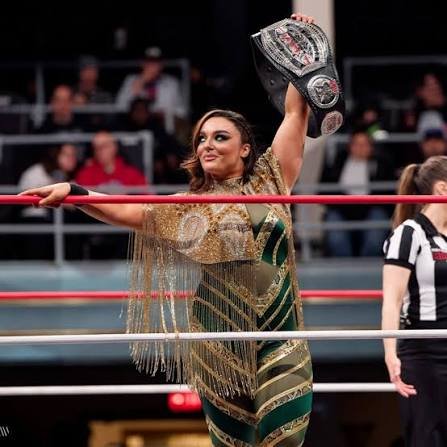
March is Women’s History Month, and Deonna Purrazzo is one of the cleanest “you either respect this or you don’t like wrestling” careers going today. Because her whole brand isn’t volume. It’s precision. The Virtuosa gimmick works because it isn’t a costume — it’s a mission statement. She’s built a decade-plus career on the idea that if you’re going to call yourself elite, you better be able to prove it with fundamentals, pacing, and finishes that feel final.
And right now she’s exactly where she belongs: ROH Women’s Pure Champion — a belt that’s basically designed to reward discipline, strategy, and the kind of technical arrogance Deonna has turned into an art form.
The origin: Jersey grit, mat IQ, and a style that never chased trends
Deonna came up through the Northeast pipeline where nobody hands you credibility — you earn it by being reliable, sharp, and safe. Her wrestling has always had that “trained properly” look: clean transitions, strong base, and holds that feel like traps instead of filler. She didn’t become technical because it was fashionable. She was built that way from the start, which is why her work ages well in any era.
The passport years: indies, Japan seasoning, and learning how to keep her identity anywhere
Before she became a TV anchor, she did the modern wrestler thing the right way: she traveled. She wrestled across the U.S. independent circuit and worked in Japan with STARDOM, which matters because it rounded her out. Deonna isn’t a “one-style” technician — she can work fast, she can work physical, and she can work story-heavy. But no matter the setting, she still wrestles like a Virtuosa: controlled, deliberate, slightly condescending, and always building toward the same point — you’re going to tap.
WWE/NXT: the system chapter that wasn’t the final sentence
Her WWE/NXT run is part of the story even if it wasn’t the defining peak. It gave her reps in the biggest machine and helped sharpen her TV instincts. But the important part of Deonna’s legacy is what happened after: she didn’t leave that system and fade. She left, recalibrated, and came back as a franchise-level champion elsewhere. That’s Women’s History Month energy: women controlling their direction and raising their value on their own terms.
IMPACT/TNA: the Virtuosa era that turned her into a division’s anchor
This is where the career becomes undeniable.
Deonna returned to IMPACT in 2020 and immediately felt like the division’s new spine — not because she talked louder than everyone, but because her matches carried authority. She won the Knockouts World Championship early in her run, and what made her reigns stand out wasn’t just the belt count — it was the identity:
- She made the Knockouts title feel like a technician’s prize.
- She defended like the champion was the one grading the challenger.
- She turned submission finishes into a signature, not a coincidence.
She’s a three-time Knockouts World Champion for a reason: when IMPACT needed the belt to feel stable and important, Deonna was one of the names they trusted to hold it.
And her title-collector stretch wasn’t just local either. She stacked major outside hardware during that era, including AAA gold and a cross-promotional “I’m taking your belt too” moment when she won the ROH Women’s World Championship in a winner-takes-all match on IMPACT TV. That wasn’t a gimmick. That was Deonna’s brand becoming real: prestige, leverage, and receipts.
Mickie James: the feud that forced the Virtuosa to bleed
If you want the rivalry that proved Deonna could headline something with real emotional stakes, it’s Mickie James.
The genius of that feud is that it wasn’t just veteran vs newcomer. It was legacy vs control. Mickie represented history and heart. Deonna represented structure and superiority — the kind of champion who doesn’t just want to win, she wants to prove you don’t belong in her ring.
At Bound For Glory 2021, Mickie beat Deonna for the Knockouts title in a match that mattered because it felt like the Virtuosa finally met someone who wouldn’t be bullied by technique or ego.
Then Hard To Kill 2022 took it to the extreme: Texas Death Match, Mickie retaining, and Deonna being dragged into a kind of fight she couldn’t win just by being “better.” That’s why it’s a legendary feud — it expanded Deonna. It proved she had grit underneath the polish, and it proved she could be a top villain without being a cartoon.
Matthew Rehwoldt and Steve Maclin: one is part of the act, one is real life
Deonna has always understood presentation, and her on-screen pairing with Matthew Rehwoldt was a perfect extension of the Virtuosa persona — pageantry, arrogance, and that “we’re above you” energy. Their Homecoming King & Queen win wasn’t just a cute tournament result; it became another way to frame Deonna as wrestling royalty.
In real life, Deonna’s partner is Steve Maclin, and together they’ve carried themselves like a modern wrestling power couple without turning it into a crutch. It’s another layer of why Deonna’s brand works: she keeps her personal life real, and her on-screen world theatrical — and she doesn’t blur the lines unless it serves the story.
ROH Women’s Pure Champion: the belt that fits her like it was custom-built
Now we’re at the current chapter, and it’s the cleanest fit of her entire career. Pure Rules aren’t just rules — they’re a philosophy. Limited rope breaks. Emphasis on discipline. Matches that punish impatience.
Deonna winning the tournament at Final Battle 2025 to become the inaugural ROH Women’s Pure Champion felt less like a surprise and more like ROH admitting the obvious: if you want a new belt to mean something, you put it on the wrestler whose entire identity is “I make wrestling look correct.”
And since then, she’s defended it the way you’d expect: not like she’s trying to survive, but like she’s trying to prove the division has to meet her standard.
What she means to women’s wrestling — and wrestling, period
Deonna Purrazzo’s significance isn’t just “great women’s wrestler.” It’s that she’s helped normalize craft as currency in modern mainstream wrestling.
She’s the wrestler coaches point to when they talk about fundamentals.
She’s the wrestler veterans trust when they want a match to feel solid.
She’s the wrestler opponents fight because they know it’ll make them better.
March is Women’s History Month, so the point isn’t only to celebrate the loudest stars. It’s to celebrate the women who raised the bar in ways you can measure. Deonna raised it with technique, with discipline, and with a career that’s basically one long argument that wrestling—real wrestling—still matters.
The Virtuosa didn’t build her legacy on noise.
She built it on proof.
Make sure to subscribe to our Late Night Crew Wrestling YouTube Channel. Follow @yorkjavon, @kspowerwheels & @LateNightCrewYT on X.
I’m the quiet one until the bell rings then I’ve got takes. I live for WWE NXT and TNA, I want every promotion to succeed, and I will absolutely roast the bad decisions on sight (because someone has to). Anime taught me to respect long-term storytelling; wrestling taught me that sometimes the plan is “we panicked” and called it “unpredictable.” The Miz got me into all of this, so yeah I appreciate confidence, commitment, and the art of talking like you’re already the main event. Now I bring that same energy to the page as the main writer for Late Night Crew Wrestling because if you’re not here to be must-see and tell the truth, why are you here?!