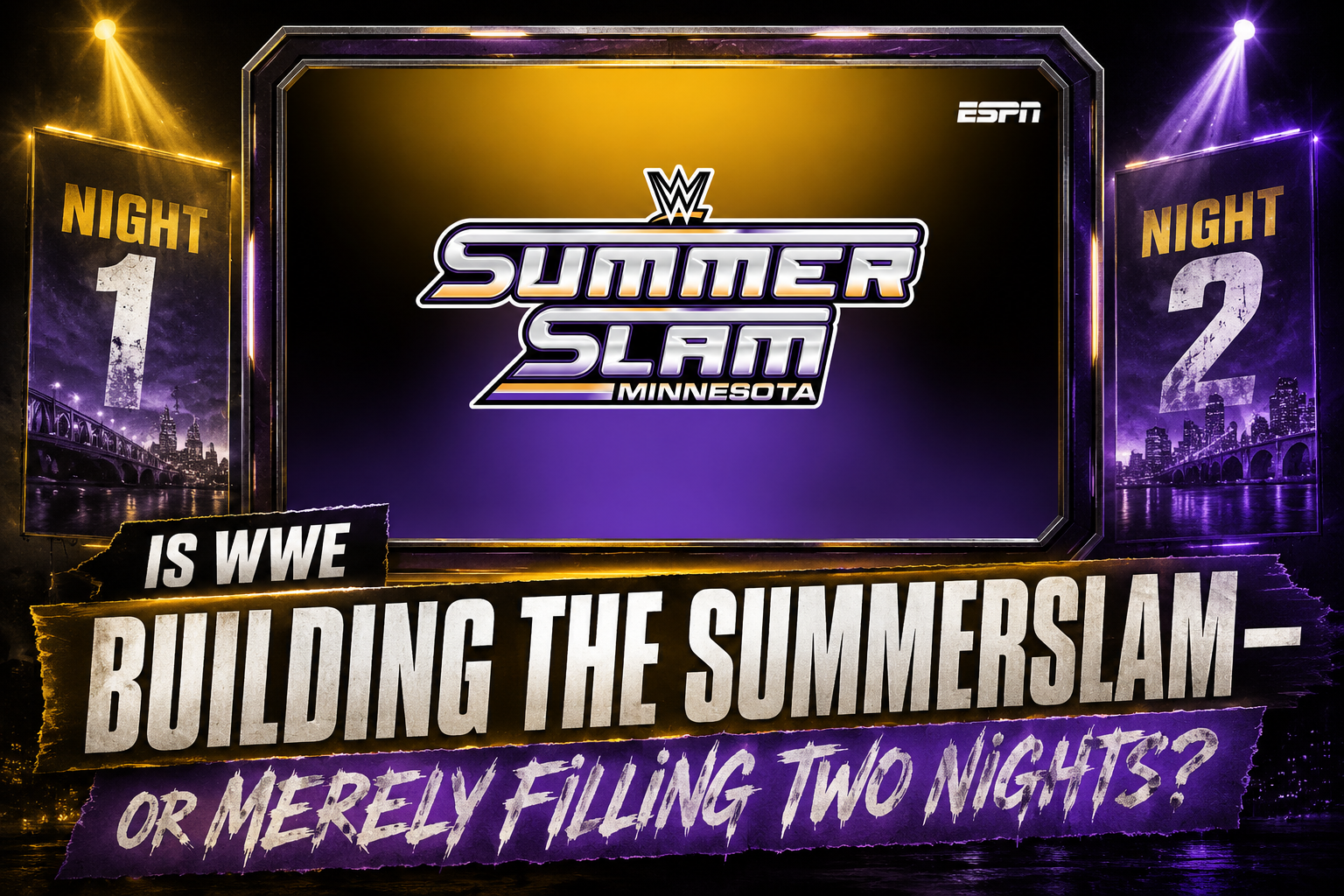
WWE SummerSlam 2026 has almost every surface-level ingredient required to look like one of the biggest professional wrestling events of the year. It will take place across Saturday, August 1, and Sunday, August 2, at U.S. Bank Stadium in Minneapolis. The current nine-match lineup includes two men’s world-championship matches, a Hell in a Cell rubber match between Brock Lesnar and Oba Femi, GUNTHER facing Nick Aldis in Aldis’ WWE in-ring debut, an interim WWE Women’s Championship Ladder Match, another major Bloodline match and several established champions defending their positions.
WWE has the names.
WWE has the venue.
WWE has the stipulations.
WWE has the championships.
WWE has enough history to produce several outstanding video packages.
What WWE has not consistently created is the emotional urgency that should make a two-night SummerSlam feel like the unavoidable conclusion to months of escalating stories.
There is a difference between constructing a loaded card and building an essential event.
A loaded card is impressive when someone reads it.
An essential event feels impossible to miss because the audience has become emotionally invested in what will happen when the wrestlers finally meet.
SummerSlam currently has far more of the first quality than the second.
That does not mean SummerSlam will be a poor event. The opposite may happen. The wrestlers could produce several excellent matches. WWE’s stadium presentation, entrances, production, commentary, crowd size and video packages can generate a sense of importance that was not always present on weekly television.
That possibility is part of the problem.
WWE has become so effective at manufacturing the final-event atmosphere that it can survive without creating an equally compelling journey. The company knows that once the lights come on, the music plays and the crowd fills the stadium, SummerSlam will look important. That has reduced the apparent pressure to make every Raw and SmackDown on the road to Minneapolis feel equally necessary.
The two-night format is no longer an experiment
SummerSlam becoming a two-night event was not an accidental scheduling decision. WWE announced in May 2024 that Minneapolis would host SummerSlam 2026 across two nights. Four months later, WWE announced that the 2025 event at MetLife Stadium would become the first SummerSlam actually held across two nights. The sequence shows that WWE was already planning the expanded SummerSlam model before the first edition of that model had occurred.
This is not merely WWE adding one extra evening because a specific card became unusually large.
It is the WrestleMania model being extended to WWE’s second-largest traditional annual event.
The business logic is obvious.
Two nights create two stadium gates.
Two nights create additional premium seating, hospitality packages, sponsorship opportunities and merchandise sales.
Two nights create more programming inventory for WWE’s media partners.
Two nights allow the host market to promote SummerSlam as an entire destination weekend rather than one evening.
Two nights allow WWE to feature more contracted wrestlers and provide more sponsors with individual match integrations.
WWE has promoted two-day ticket packages for Minneapolis and will stream both nights through ESPN’s platform in the United States and Netflix internationally.
From a commercial standpoint, expanding SummerSlam is entirely rational.
The creative consequences are more complicated.
When SummerSlam was one night, limited space forced WWE to make decisions. Not every champion could receive a match. Not every recognizable wrestler could appear. Not every active rivalry deserved a premium-event position.
The two-night model reverses that pressure.
Instead of asking, “Which stories are important enough for SummerSlam?”, WWE can begin asking, “What additional stories can help fill SummerSlam?”
That change is subtle but significant.
More available positions do not necessarily produce more great stories. They can lower the narrative standard required to reach the card.
A championship may be enough.
A returning name may be enough.
A stipulation may be enough.
A first-time match may be enough.
A comedy attraction may be enough.
A multi-person faction match that gathers several unfinished issues into one place may be enough.
The event becomes larger while the individual rivalries become less developed.
SummerSlam’s identity is being transformed
Historically, SummerSlam was valuable because it was WWE’s major summer destination without being another WrestleMania.
Its greatest events often possessed one or two defining narratives rather than an obligation to feature nearly everyone.
SummerSlam 1997 was shaped by Bret Hart’s conflict with The Undertaker, Shawn Michaels’ role as special guest referee and the stipulations surrounding the main event. If Bret lost, he could no longer wrestle in the United States; if Michaels displayed bias toward The Undertaker, the same restriction applied to him. The match was not large because the card had been expanded. It was large because the story had created consequences that extended beyond the championship.
SummerSlam 2002 was built around Brock Lesnar’s rapid transformation from rookie destroyer into a legitimate threat to The Rock and the Undisputed WWE Championship. Brock had been on the main roster for only several months, yet the company had created a clear generational confrontation: WWE’s established mainstream megastar against the new physical phenomenon being positioned to replace him.
SummerSlam 2013 centered on Daniel Bryan attempting to prove that he belonged at the highest level against John Cena, followed by Triple H and Randy Orton destroying the moment Bryan finally achieved that validation. Bryan’s journey, Cena’s respect, Vince McMahon’s resistance, Triple H’s referee position and Orton’s Money in the Bank contract all converged on one emotional question: would WWE allow Daniel Bryan to become its champion?
SummerSlam 2022 promoted Roman Reigns vs. Brock Lesnar as one final match, used the Last Man Standing stipulation to give the rivalry a definitive ending and presented the main event as a conclusion rather than another chapter designed to protect a future rematch.
Those events did not require every match to have equal depth. No wrestling event does.
They did, however, possess clear emotional centers.
SummerSlam 2026 currently feels less like one event with a central identity and more like two nights of WWE inventory assembled beneath one brand.
The card contains dream-match branding, family warfare, comedy, championship competition, authority-figure conflict, a generational monster rivalry, a hometown challenger, an injury-created ladder match and several overlapping stories. Variety can be healthy, but variety without hierarchy creates an event where every match is promoted as significant and few stories feel truly defining.
What a properly built SummerSlam match requires
Not every SummerSlam rivalry needs to involve hatred.
Not every match needs blood.
Not every feud needs to begin six months earlier.
A great major-event card should include different emotional tones.
One match can be based on sporting competition.
Another can be deeply personal.
Another can be a spectacle.
Another can provide comedy.
Another can elevate a younger wrestler.
The problem begins when WWE mistakes the existence of a match category for a developed story.
A championship match is not automatically a story.
A first-time match is not automatically a story.
A ladder match is not automatically a story.
A Hell in a Cell match is not automatically a story.
Two former Shield members sharing history is not automatically a current story.
The Bloodline existing is not automatically a story.
A properly built SummerSlam program should answer several questions.
Why must these wrestlers face each other now?
Why must the match occur at SummerSlam rather than on an ordinary episode of Raw or SmackDown?
What does each person want beyond the obvious desire to win?
What emotional weakness has the opponent exposed?
What will become permanently different after the result?
Which character will be forced to change?
Which larger division or championship direction depends upon the outcome?
Some current SummerSlam matches answer several of those questions.
Others answer almost none.
How the 2026 card came together
The road to SummerSlam did not begin with one unified creative direction. It emerged from several separate event cycles and sudden changes.
At Night of Champions, Sami Zayn defeated then-champion Cody Rhodes and GUNTHER in a Triple Threat Match to win the Undisputed WWE Championship. IYO SKY defeated Liv Morgan in the Queen of the Ring final and chose Liv’s Women’s World Championship as her SummerSlam target.
On the June 29 Raw, Seth Rollins challenged World Heavyweight Champion Roman Reigns for SummerSlam, while Brock Lesnar demanded that his deciding match against King of the Ring winner Oba Femi take place inside Hell in a Cell.
On July 3, Cody defeated Jey Uso to earn a rematch against Sami.
On the July 6 Raw in Chicago, GUNTHER attacked Cody before the championship match. CM Punk replaced Cody and defeated Sami to become the Undisputed WWE Champion. Cody therefore retained a championship opportunity, but the champion waiting for him had changed from Sami to Punk.
On July 10, Punk and Cody confronted one another and agreed to the SummerSlam championship match. On the same show, GUNTHER attacked Nick Aldis after the general manager placed GUNTHER and Sami in a Saturday Night’s Main Event tag match against Punk and Cody.
On July 13, Roman and Seth participated in a chaotic contract signing, Oba confronted Brock, Chad Gable won a Gauntlet Match to become Penta’s Intercontinental Championship challenger, and LA Knight helped establish the six-man SummerSlam match involving Solo Sikoa, Royce Keys, Jacob Fatu and The Usos.
On July 17, Tiffany Stratton and Jade Cargill became the first women to qualify for the interim championship ladder match. Cody’s match against GUNTHER ended without a result after Punk and Sami became involved.
Saturday Night’s Main Event then combined Punk, Cody, GUNTHER and Sami in a tag-team match, continued the Nick Aldis–GUNTHER conflict and devoted significant time to Danhausen’s program with Judgment Day.
On July 20, Seth rejected Solo Sikoa’s offer of help against Roman, Oba defeated JD McDonagh in a brief showcase, Penta and Chad Gable teamed together despite being SummerSlam opponents, IYO and Liv appeared inside the Danhausen–Dominik–Joe Hendry story, and The Bloodline ended the show standing over LA Knight, Solo and Royce Keys.
The timeline reveals WWE’s recurring creative method.
A tournament creates one match.
A contender match creates another.
An injury creates another.
A sudden championship substitution creates another.
A faction brawl creates another.
A returning authority figure’s physical conflict creates another.
These mechanisms successfully populate the card.
The question is how many of them have produced stories deeper than the mechanism that created them.
CM Punk vs. Cody Rhodes: A Dream Match Created Through Chaos Rather Than Purpose
CM Punk vs. Cody Rhodes is unquestionably a major match.
They possess five combined WWE Championship reigns and will meet one-on-one for the first time in nearly 18 years. Cody entered July expecting to receive a rematch against Sami Zayn. GUNTHER removed him from the match, Punk replaced him and became champion, leaving Cody’s title opportunity intact but changing the identity of the champion.
That chain of events is exciting.
It is also reactive.
Punk did not spend months pursuing Cody.
Cody did not spend months questioning Punk’s championship claim.
Neither man intentionally engineered the match.
Circumstances placed them together.
That is not automatically a weakness. Wrestling sometimes creates powerful stories from sudden changes. The issue is whether WWE recognizes how much deeper the matchup can become.
The unused ideological conflict
Punk and Cody are two of the most self-mythologizing wrestlers in modern WWE.
Both speak about their careers as movements rather than employment.
Both attach moral meaning to professional decisions.
Both position themselves as representatives of wrestling history.
Both left WWE after feeling restricted by the company’s perception of them.
Their departures produced opposite identities.
Punk became the symbol of the disillusioned star who publicly rejected WWE. His most powerful mythology came from saying the institution was dishonest, politically driven and incapable of recognizing genuine value until that value became impossible to ignore.
Cody’s journey was less about publicly rejecting WWE and more about proving that WWE had been wrong about his ceiling. He reinvented himself, became central to the creation of AEW and then returned to WWE with the explicit purpose of accomplishing what his father never did.
Punk returned as the famous institutional critic.
Cody returned as the institutional success story.
That is the rivalry.
Punk can believe Cody is the perfect example of WWE’s ability to absorb rebellion. Cody left, created an alternative, returned and became the polished corporate face of the company he once needed to escape.
Cody can believe Punk turned legitimate grievances into a permanent identity. Punk condemns systems, leaves when relationships collapse and later returns while continuing to present himself as the principled outsider.
Punk can question whether Cody’s “finish the story” language is sincere or carefully manufactured.
Cody can question whether Punk is capable of happiness without someone or something to oppose.
Punk can argue that Cody needs approval from executives, fans and his family’s history.
Cody can argue that Punk needs resentment because resentment is the fuel around which he built his legend.
None of that requires a heel turn.
Two babyfaces can remain sympathetic while recognizing that their beliefs are incompatible.
The excessive use of respect
WWE frequently books babyface dream matches through respect.
The champion says the challenger earned the opportunity.
The challenger says the champion deserves recognition.
They shake hands.
Tension gradually increases.
One accidental or intentional strike creates doubt.
The formula protects both wrestlers from becoming less likable.
It also reduces emotional specificity.
Punk and Cody should not merely want to determine who is better.
They should want to prove that the other man’s interpretation of his own career is false.
The championship then becomes more than the prize. It becomes evidence.
A Punk victory tells Cody that becoming WWE’s chosen standard-bearer did not make him untouchable.
A Cody victory tells Punk that the institution did not weaken Cody’s authenticity.
The problem created by Sami Zayn
Sami’s championship reign lasted nine days before Punk defeated him. Cody had earned the right to challenge Sami, but GUNTHER’s attack removed Cody and unintentionally handed Punk the opportunity.
That creates unresolved issues surrounding both Sami and GUNTHER.
Sami was not defeated by the man who earned the rematch.
Punk became champion through an opportunity created by someone else’s attack.
Cody did not lose his position.
GUNTHER’s anger redirected the championship.
Those complications can make the story richer, but WWE’s quick shift to Punk vs. Cody risks treating Sami’s championship reign as transitional machinery.
Sami should remain emotionally connected to the title picture.
He has a legitimate grievance against Punk for accepting the sudden opportunity.
He has a grievance against GUNTHER for causing the entire situation.
He may also resent Cody for moving directly to SummerSlam without addressing the rematch Sami never expected to lose under those circumstances.
The July tag match grouped the four men together, but a tag-team combination is not a substitute for exploring the emotional consequences of the championship change.
What the build still needs
Punk and Cody need at least one confrontation without GUNTHER, Sami or another external element.
The promo cannot remain respectful.
Punk should directly challenge Cody’s self-image.
Cody should force Punk to explain why accepting a sudden title match in Chicago was principled when Punk has spent his career criticizing opportunists and corporate favorites.
Punk should tell Cody that he would have done exactly the same thing.
Cody should admit he would have—but argue that he would not pretend the opportunity was anything more than fortune.
That type of exchange would expose hypocrisy on both sides.
The match does not need a physical attack before SummerSlam.
It needs emotional damage.
Roman Reigns vs. Seth Rollins: The Greatest History on the Card, but Not Yet the Best Current Story
Roman and Seth possess more shared history than any other SummerSlam pairing.
Seth betrayed The Shield in 2014.
He inserted himself into Roman’s WrestleMania 31 championship match and pinned Roman.
He defeated Roman cleanly at Money in the Bank 2016.
He caused Roman to lose emotional control at Royal Rumble 2022.
He helped Cody oppose Roman at WrestleMania XL.
Seth later defeated Roman and Punk in a WrestleMania Triple Threat Match and took Paul Heyman from Roman. WWE’s current records give Seth a 5-4-1 advantage in singles matches against Roman.
This is not a feud that needs manufactured history.
It needs a present-tense purpose.
History can become creative camouflage
WWE can produce an hour-long Roman–Seth playlist because the footage already exists. The company has promoted exactly that type of retrospective content during the current build.
That history makes the match important.
It also allows WWE to avoid answering what the rivalry means in 2026.
Seth wants the World Heavyweight Championship he says he never lost because injury forced him to relinquish it.
Roman wants to defeat a rival who repeatedly undermined his career.
Those are legitimate motivations.
They are not the deepest available motivations.
The real conflict should concern ownership of their generation.
Roman became the larger star.
Seth can claim he became the more complete wrestler.
Roman received the longer reigns, protected presentation, family empire and attraction schedule.
Seth carried more weekly television, adapted through more character changes and repeatedly proved that he could defeat Roman directly.
Roman can accuse Seth of confusing workload with greatness.
Seth can accuse Roman of confusing protection with superiority.
That argument would make the match feel current.
Solo’s offer illustrates WWE’s tendency to connect everything to The Bloodline
On July 20, Solo offered Seth help against Roman and The Bloodline. Seth rejected the offer.
The rejection was the correct immediate choice. Seth’s central argument loses value if he requires Roman’s family enemy to help him.
However, the segment also shows how difficult WWE finds it to allow a Roman story to exist outside Bloodline mechanics.
Roman vs. Seth should be capable of standing independently.
The more the feud becomes connected to Solo, The Usos, Jacob Fatu or Paul Heyman’s faction history, the less it is about the two wrestlers whose unresolved rivalry is supposed to sell the match.
The strongest build would isolate them.
Roman should remove his family from the equation.
Seth should remove his available allies.
The match should become the rare occasion where Roman must prove his greatness without an empire and Seth must prove his intelligence without a scheme.
What the result needs to resolve
Another disqualification would repeat Royal Rumble 2022.
Bloodline interference would protect Roman while avoiding the rivalry’s central question.
Solo helping Seth would weaken Seth’s claim.
Paul Heyman deciding the result would redirect the story toward betrayal rather than competitive resolution.
The match needs to answer whether Seth’s psychological control remains real.
Roman’s character development should be measured through his ability to resist Seth’s attempts to provoke him.
Seth’s character should then be measured by whether he can defeat Roman when the psychological strategy stops working.
A clean result would permanently alter their relationship.
That is what SummerSlam should do.
Oba Femi vs. Brock Lesnar: The Best-Built Match but the Most Dangerous Booking Decision
Oba and Brock have the card’s cleanest structure.
Oba defeated Brock at WrestleMania 42.
Brock appeared to retire.
Brock returned and defeated Oba at Clash in Italy.
Oba won King of the Ring.
Brock demanded Hell in a Cell in Minnesota.
Their series is tied.
The third match must decide who stands above the other.
This is what organic escalation looks like.
The stipulation follows the rivalry.
The result matters beyond the championship because no championship is required.
The match concerns physical hierarchy.
Why the Cell works
Brock requested the structure and has previous Cell experience, including victories over The Undertaker. Oba has never competed inside it.
That creates a real strategic difference.
Brock is not merely entering another violent environment. He chose an environment where experience appears to favor him.
Oba’s challenge is therefore not only beating Brock. It is conquering Brock inside the veteran’s selected form of warfare.
That makes the Cell part of the story rather than decoration.
The build has still leaned too heavily on destruction without enough verbal depth
Oba has attacked security and destroyed lesser opponents while Paul Heyman has warned him about Brock. On July 20, Oba quickly defeated JD McDonagh in another physical showcase.
Those visuals protect Oba’s dominance.
The program needs a clearer philosophical confrontation.
Brock should explain why he returned after leaving his gloves behind.
Was he humiliated?
Did he believe WrestleMania exposed weakness?
Did he recognize Oba as a threat to his legacy?
Did he return because walking away after losing would have meant accepting succession?
Oba should explain why defeating Brock a second time matters more than the first.
The first victory made him famous.
The second must make Brock obsolete.
That language would clarify what the trilogy is deciding.
WWE cannot avoid choosing the future
If Brock wins, Oba’s WrestleMania victory becomes a historic upset within a rivalry Brock ultimately controlled.
If Oba wins through interference, the succession remains incomplete.
If the finish is disputed, the Cell loses purpose.
If WWE schedules a fourth match, the trilogy ceases to be a trilogy and the SummerSlam stipulation becomes promotional inflation.
Oba must win decisively, and WWE must book him differently afterward.
A victory over Brock cannot be followed by ordinary 50-50 television.
The match is well-built because its result will change the hierarchy.
It becomes a failure if WWE refuses to allow that change.
Liv Morgan vs. IYO SKY: Legitimate Competition Undermined by Unequal Attention
IYO earned the right to select a women’s champion by defeating Liv in the Queen of the Ring final. She immediately chose Liv and the Women’s World Championship.
The foundation is straightforward and effective.
IYO defeated the champion.
IYO now wants the title.
Liv wants to prove the tournament loss does not establish superiority.
The problem is not the reason for the match.
The problem is the amount and quality of storytelling surrounding it.
The July 13 segment briefly gave the program structure
On July 13, IYO defeated Roxanne Perez despite attempted interference. Liv Morgan, Raquel Rodriguez and Roxanne then overwhelmed IYO until Sol Ruca attempted to make the save. Liv ended the segment by striking IYO with the championship.
That segment established several useful ideas.
Liv depends upon numbers.
IYO can defeat members of Liv’s circle.
Sol has a reason to oppose Liv and Raquel.
Roxanne and Raquel can function as strategic extensions of the champion.
The attack gave IYO a grievance beyond the tournament result.
The following week did not deepen those ideas.
The July 20 booking made the title feud supporting material
Liv interfered during Joe Hendry vs. Dominik. Danhausen brought IYO to ringside, and IYO’s presence helped neutralize Liv before Danhausen assisted Hendry in winning.
The segment connected stories.
It also placed the Women’s World Championship rivalry beneath the comedy conflict.
Liv and IYO did not receive their own match, extended promo or independent confrontation.
They appeared to help advance Danhausen vs. Dominik.
This is a larger problem than one week of television. It communicates priority.
WWE found space for Roman–Seth history, Oba’s showcase, Bloodline violence, Penta and Gable’s temporary team and Danhausen’s comedy.
The women’s world-title program entered through interference.
The rivalry’s strongest unused idea
Liv claims to be the greatest women’s champion of all time. IYO is regularly presented as one of WWE’s best active wrestlers. WWE’s official match promotion explicitly frames the contest around which woman is superior.
The feud should become a debate over what defines greatness.
IYO believes ability should determine authority.
Liv believes championships are preserved through strategy, influence and survival.
IYO sees Liv’s entourage as evidence that Liv cannot stand alone.
Liv sees IYO’s commitment to pure competition as naïveté.
That is a compelling title feud.
WWE should stop treating it like an accessory to another match.
The Interim WWE Women’s Championship Ladder Match: Opportunity Created Through Emergency
Rhea Ripley’s injury forced WWE to find a temporary champion. Tiffany Stratton and Jade Cargill became the first qualifiers on July 17. Tiffany defeated Jacy Jayne cleanly, while Jade advanced through disqualification after Charlotte Flair interfered against Nia Jax.
The ladder match is an efficient response.
It creates several television qualifiers.
It places five women on SummerSlam.
It produces a visually marketable attraction.
It protects four wrestlers from direct pinfall defeats.
It crowns a champion without forcing WWE to select one obvious singles match.
Efficiency is not the same thing as depth.
The injury is the story WWE should embrace
The new champion will exist beneath Rhea’s shadow.
That should define the entire program.
The participants should not merely say they want the championship.
They should explain what becoming interim champion means.
One woman may reject the word “interim.”
Another may view herself as protecting Rhea’s championship until Rhea returns.
Another may argue that Rhea’s injury created an opportunity the division desperately needed.
Another may believe winning will prove she should have been champion before Rhea was injured.
The winner’s future character depends upon this distinction.
A confident champion may demand that WWE stop calling her temporary.
An insecure champion may defend constantly to build legitimacy.
A heel may attempt to delay Rhea’s recovery or attack her when she returns.
The injury should create psychological stakes, not just a new match.
The qualifiers need to create relationships
Tiffany earned her position cleanly.
Jade benefited from Charlotte’s interference.
Nia was denied.
Charlotte chose to involve herself.
Those facts should collide.
Tiffany can question Jade’s legitimacy.
Jade can resent Charlotte.
Nia can demand inclusion or revenge.
The field should become unstable before the match.
If WWE merely adds three more names through qualifiers and presents a graphic, it will have populated the ladder match without building it.
GUNTHER vs. Nick Aldis: A Fascinating Match Built Through an Abrupt Detour
GUNTHER entered the summer as one of WWE’s most protected career killers. WWE’s official promotion emphasizes that he retired Goldberg, AJ Styles and John Cena within the previous year. He also remained involved around the Undisputed WWE Championship before his conflict with Nick Aldis redirected him.
Aldis was functioning as SmackDown general manager.
GUNTHER attacked him after Aldis created the Saturday Night’s Main Event tag match.
Aldis later struck GUNTHER with the WWE Championship and cost him another opportunity.
The SummerSlam match followed.
The matchup is intriguing.
The transition into it has been extremely fast.
The authority-figure problem
An authority figure stepping into the ring can be effective when the story demonstrates that normal authority has failed.
Aldis should exhaust fines, suspensions and administrative consequences.
GUNTHER should continue violating them.
Aldis should initially refuse to wrestle because he understands that becoming physically involved compromises his position.
The audience should watch GUNTHER remove every safer alternative.
Instead, the feud moved quickly from confrontation to attack to match.
The speed makes the program feel like WWE needed a SummerSlam opponent for GUNTHER and recognized Aldis as a fresh attraction.
That may be the practical reason. The story needs to make it feel like the character’s reason.
The unused insecurity
GUNTHER should accuse Aldis of becoming a general manager because WWE did not respect his wrestling career.
Aldis spent years as a world champion outside WWE. Inside WWE, he entered through management rather than as a wrestler.
That fact should be the wound.
GUNTHER can argue that Aldis chose the suit because he knew stepping into WWE’s ring would expose the difference between his reputation and WWE’s standard.
Aldis can argue that leadership required him to suppress the part of himself GUNTHER is provoking.
The match then becomes about whether Aldis’ authority came from maturity or fear.
The danger to GUNTHER
GUNTHER has already been moved away from the WWE Championship into a program with an authority figure.
If he loses, his Career Killer momentum is weakened.
If he wins easily, Aldis’ return becomes ceremonial.
The match needs Aldis to prove he remains credible while GUNTHER ultimately demonstrates why returning against him was a terrible decision.
The buildup should emphasize that this is not a nostalgic exhibition.
It is Nick Aldis gambling his institutional authority against the most dangerous wrestler available.
Penta vs. Chad Gable: The Card’s Most Traditional Wrestling Story
Chad Gable won a seven-man Gauntlet Match on July 13 to become Penta’s challenger. He will compete in his home region of Minneapolis and is attempting to win his first WWE singles championship. Penta has defended the Intercontinental Championship against multiple opponents since retaining it in a WrestleMania ladder match.
This is a perfectly logical championship match.
It is also one of the least emotionally developed matches on the card.
Redemption without full accountability
WWE’s official promotion says Gable returned to Raw attempting to make amends for his actions over the previous years. That has drawn the attention of Rey Mysterio, Dragon Lee and Penta.
The redemption premise has potential.
What exactly is Gable repairing?
Who has he apologized to?
What has changed in his behavior?
Why should Penta trust him?
What does winning the Intercontinental Championship prove about the success or failure of that redemption?
The story cannot rely solely upon commentary saying Gable is making amends.
Redemption requires choices.
Gable should receive an opportunity to cheat and refuse.
Penta should question whether the refusal is sincere.
Someone harmed by Gable’s previous actions should confront him.
The title match then becomes a moral test rather than a hometown athletic showcase.
The forced partnership problem
On July 20, Penta and Gable teamed together against Rusev and Ethan Page. They won after Gable escaped the Accolade and Penta hit the Mexican Destroyer.
The “opponents must coexist” tag match is one of WWE’s most heavily used creative devices.
It provides television wrestling.
It allows both SummerSlam opponents to remain protected.
It can create accidental tension.
It rarely deepens the core conflict unless one partner makes a revealing choice.
Penta and Gable need an actual disagreement.
Penta may believe Gable is using redemption to manipulate public sympathy.
Gable may believe Penta has never taken him seriously as a singles contender.
The wrestling quality is not in question.
The story needs a reason to be more than a very good Intercontinental Championship match.
The Bloodline Six-Man Match: A Familiar Formula with New Positions
LA Knight, Solo Sikoa and Royce Keys will face Jacob Fatu and The Usos. The official story explains that Knight previously teamed with The Usos at WrestleMania 42, but Jimmy and Jey later realigned with Roman. Jacob was forced into Roman’s Bloodline after losing Tribal Combat. Solo repeatedly refused to rejoin. Keys, who grew up around the family, was rejected as someone who was not truly blood.
There is a great deal of information.
There is not one clear protagonist.
Solo’s story
Solo says he hates his family and will never return.
That is strong language.
The story needs to explain what he wants instead.
Rejecting Roman is not an independent identity.
Solo should have his own vision of leadership, loyalty and success.
Otherwise, he remains defined by the family even while opposing it.
Jacob’s story
Jacob is forced to serve Roman because of Tribal Combat.
Why does he accept the condition?
Does he consider the stipulation sacred?
Is he waiting to rebel?
Does he fear what resistance would mean for other relatives?
Does part of him believe Roman’s order is necessary?
If WWE does not explore his reasoning, Jacob becomes a weapon transferred between leaders.
The Usos’ story
Jimmy and Jey escaped Roman before returning.
The reunion should require accountability.
Did Roman change?
Did they forgive him?
Are they allies with boundaries or once again obedient soldiers?
The build has emphasized their alignment more than the emotional work required to justify it.
Royce Keys’ story
Keys is rejected because he is not blood.
That can create a powerful outsider narrative.
He can argue that family is defined through loyalty and shared history rather than genetics.
He can expose the hypocrisy of a group that repeatedly betrays blood relatives while dismissing someone who remained loyal.
The build needs to allow Keys to articulate that wound rather than functioning primarily as another body in the six-man match.
LA Knight’s story
Knight is the established star most vulnerable to being lost inside the faction structure.
He has no biological place in the family argument.
That should become his frustration.
Knight should openly resent being forced to deal with Roman’s family politics again.
He should want the match because The Bloodline keeps interfering with his own ambition, not because WWE needed a third member for Solo’s team.
The familiar weekly structure
On July 13, a match involving Keys and Jimmy ended through outside involvement, Solo pretended he was ready to return before attacking the family, Knight arrived with a chair and the SummerSlam match was announced. On July 20, Jacob defeated Knight before The Bloodline attacked Solo, Keys and Knight and stood tall.
The sequence is functional.
It is also extremely familiar.
Match.
Interference.
Brawl.
Save.
Challenge.
Later match.
More interference.
Faction stands tall.
WWE is using new people to repeat Bloodline mechanics the audience already understands.
The match will probably receive strong reactions because the performers remain popular.
Popularity does not make the structure fresh.
Danhausen vs. Dominik Mysterio: Necessary Variety or Two-Night Padding?
Danhausen’s conflict with Judgment Day began through money. Danhausen and other wrestlers became involved in attempts to keep the “human monies” from Dominik and his allies. The program expanded through comedy segments, a No Disqualification Match involving JD McDonagh and celebrity involvement at Saturday Night’s Main Event.
Danhausen vs. Dominik is now a SummerSlam match.
The issue is not whether comedy belongs.
The issue is how much of WWE’s limited creative energy has been devoted to this comedy compared with more important championships.
What works
Danhausen is immediately recognizable.
Dominik is an excellent comedic heel.
Judgment Day provides multiple characters for Danhausen to manipulate.
The stolen money gives the conflict an understandable object.
The curse gives WWE a recurring comedic mechanism.
The match can provide pacing relief on a long card.
A two-night SummerSlam should not consist entirely of serious 20-minute matches.
What does not work
Dominik is AAA Mega Champion, yet the championship is secondary to the money.
Liv Morgan is Women’s World Champion, yet her fear of Danhausen’s curse has entered her SummerSlam build.
IYO SKY has been brought into the same comedy environment.
Joe Hendry defeated Dominik in a non-title match after Danhausen and IYO became involved.
The comedy is no longer self-contained.
It is consuming surrounding stories.
That is where variety becomes imbalance.
Danhausen vs. Dominik can belong at SummerSlam.
It should not receive more narrative attention than Liv vs. IYO.
The match needs consequences
The money must go somewhere.
The curse must either be broken, intensified or revealed as psychological.
Dominik must remain a credible wrestler once the bell rings.
Danhausen must survive without suddenly becoming a conventional elite competitor.
The match should be concise and positioned between more emotionally demanding contests.
If it becomes a long celebrity-filled production, it will look less like necessary variety and more like material created because WWE has two nights to fill.
The Card’s Larger Structural Problems
Too many stories are being produced through mechanisms
Punk vs. Cody emerged through a replacement championship match.
Liv vs. IYO emerged through Queen of the Ring.
The ladder match emerged through injury and qualifiers.
Penta vs. Gable emerged through a Gauntlet Match.
The Bloodline six-man emerged through a faction brawl.
GUNTHER vs. Aldis emerged through authority-figure involvement.
Mechanisms are useful. They provide order.
The issue is that WWE often treats the mechanism as sufficient storytelling.
Winning a tournament explains how someone received the match.
It does not explain who the winner becomes because of the opportunity.
Winning a Gauntlet Match explains why Gable is the challenger.
It does not explain why Penta personally distrusts or respects him.
An injury explains why an interim championship is required.
It does not explain what the interim label means emotionally.
The “can they coexist?” formula is overused
Punk and Cody teamed before facing each other.
Penta and Gable teamed before facing each other.
WWE regularly combines event opponents into temporary partnerships because the format protects both wrestlers and provides an easy television main event.
The device becomes lazy when the partnership does not reveal character.
Will Punk abandon Cody to protect himself?
Will Cody prioritize winning the tag match over proving a point?
Will Gable refuse to cheat?
Will Penta trust him?
Without a meaningful decision, coexisting is simply scheduling.
Stipulations are creating importance WWE should create through stories
Hell in a Cell makes Oba vs. Brock look enormous.
The ladder match makes the interim title feel spectacular.
Tribal Combat created Jacob’s forced allegiance.
A No Disqualification Match expanded Danhausen’s comedy program.
Stipulations work best when the story becomes too intense for ordinary rules.
They work poorly when they are introduced to make an ordinary build appear intense.
Oba vs. Brock has largely earned the Cell because the series is tied and the generational hierarchy must be settled.
The interim ladder match has not earned its danger through rivalry; the danger is being used to create a champion quickly.
That distinction matters.
The championships are not equally protected by attention
Roman’s championship receives historic framing.
Punk and Cody receive dream-match framing.
Oba and Brock receive major physical presentation despite having no championship involved.
Liv and IYO were used inside a comedy angle.
The interim women’s title is being constructed through qualifiers.
Penta and Gable briefly teamed.
The imbalance shows which stories WWE assumes require serious sustained attention and which can survive through match mechanics.
The Counterargument: SummerSlam Has More Depth Than the Criticism Suggests
A fair analysis must acknowledge that several matches do possess substantial foundations.
Roman and Seth have more than a decade of history.
Oba and Brock have a clear trilogy.
Punk and Cody’s careers contain enormous ideological material.
Liv and IYO have a direct tournament result.
Gable’s hometown and championship pursuit create natural sympathy.
Aldis’ wrestling background gives the GUNTHER match intrigue.
The Bloodline participants possess complicated relationships.
The ladder match is a logical response to an injury.
Danhausen and Dominik provide variety.
WWE also still has television remaining before August 1. The company can sharpen several programs in the final stretch.
Not every match needs months of hatred. SummerSlam can include a competitive championship defense beside a family grudge and comedy attraction.
All of that is true.
The criticism is not that the card lacks reasons.
It is that WWE has not consistently transformed those reasons into emotional necessity.
Roman and Seth possess history, but the modern argument remains underdeveloped.
Punk and Cody possess ideology, but WWE has leaned on friendship and circumstance.
Liv and IYO possess competitive legitimacy, but unequal attention has weakened their presentation.
Gable earned the match, but earning the match is most of the story.
The ladder match has stakes, but the participants’ distinct motivations remain incomplete.
The Bloodline has history, but the structure feels repetitive.
Danhausen and Dominik have comedy, but the comedy has begun swallowing surrounding championship programs.
The Real Risk Is That SummerSlam Will Be Good Enough to Excuse the Build
This is the central issue.
SummerSlam may be excellent.
Roman and Seth may deliver a psychologically intelligent match.
Punk and Cody may produce a championship classic.
Oba and Brock may create a brutal, decisive conclusion.
GUNTHER and Aldis may exceed expectations.
Penta and Gable may produce outstanding technical wrestling.
The ladder match may deliver spectacular moments.
The six-man tag may generate loud reactions.
Danhausen and Dominik may entertain the crowd.
If that happens, WWE will receive praise for a strong SummerSlam.
The criticism of the road may disappear because the destination succeeded.
But the wrestlers producing good matches does not prove the creative build was effective.
It proves WWE’s roster can overcome it.
The greatest version of SummerSlam should not begin feeling important when the opening video plays.
It should feel important weeks earlier.
The audience should spend Raw and SmackDown fearing what the characters will do before they finally reach Minneapolis.
The current card often feels like an impressive collection of matches waiting for WWE’s production team to provide the missing urgency.
WWE has built several excellent individual components.
It has not yet built one cohesive two-night event.
At present, SummerSlam 2026 feels less like the unavoidable destination of WWE’s summer stories and more like WWE recognized that it had two stadium nights to fill, selected the largest available names and concepts, and trusted the event itself to make everything feel bigger than the weekly storytelling did.
That approach can produce a successful show.
It cannot produce a truly unforgettable road to SummerSlam.
Make sure to subscribe to our Late Night Crew Wrestling YouTube Channel. Follow @yorkjavon, @kspowerwheels & @LateNightCrewYT on X.
I’m the quiet one until the bell rings then I’ve got takes. I live for WWE NXT and TNA, I want every promotion to succeed, and I will absolutely roast the bad decisions on sight (because someone has to). Anime taught me to respect long-term storytelling; wrestling taught me that sometimes the plan is “we panicked” and called it “unpredictable.” The Miz got me into all of this, so yeah I appreciate confidence, commitment, and the art of talking like you’re already the main event. Now I bring that same energy to the page as the main writer for Late Night Crew Wrestling because if you’re not here to be must-see and tell the truth, why are you here?!