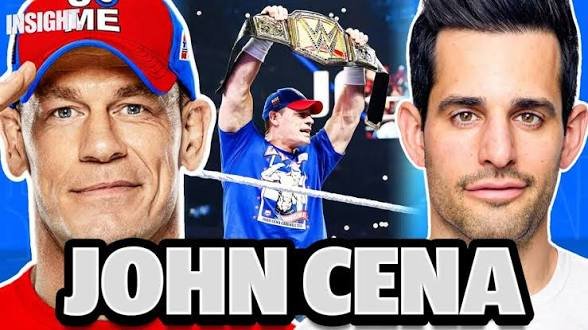
In one of the last long-form sit-downs of his in-ring career, John Cena joined Chris Van Vliet on Insight with Chris Van Vliet for an hour-plus conversation that feels less like a hype piece and more like a living résumé, confession and thank-you letter rolled into one. Taped in Hollywood just days before Saturday Night’s Main Event on December 13, Cena walks through his 2025 farewell tour, the polarizing heel turn, CM Punk’s redemption, his 17th world title, and how marriage forced him to rewire his life.
Throughout the interview, Cena is thoughtful, brutally honest and clearly on the other side of the “never give up” grind he once lived by. And at every turn, he makes sure the spotlight is bigger than just himself.
All quotes and stories in this article are drawn from John Cena’s appearance on Insight with Chris Van Vliet; fans can watch or listen to the full conversation on Chris Van Vliet’s YouTube channel and podcast.
“Don’t Make It a Tribute Show” – Designing a Farewell That’s About the Future
A huge portion of the conversation centers on Cena’s final night: Saturday Night’s Main Event, where he will wrestle GUNTHER in the last match of his 20+ year WWE career.
Cena reveals that when he sat down with Triple H and WWE to map out the show, his one non-negotiable was that it not be a two-hour John Cena tribute festival. He didn’t want endless video packages and nostalgia segments built around him. Instead, he pitched the event as a showcase of what comes next: big-time, “non-canon” exhibition matches pitting main roster stars against the “best and brightest” of NXT, designed to exist outside current storylines so they could create special one-night-only pairings.
His logic is simple: traditional tribute shows almost never feel “just right” to anyone—too much for some, not enough for others. Rather than chasing an impossible perfect goodbye, he’d rather use his last night to pass the torch, give younger talent a taste of that big-match roar, and make SNME a night where NXT names walk away having literally shared the stage with the Greatest of All Time.
When he says this will truly be his last match, he leaves no wiggle room. Multiple outlets have already picked up his insistence that there is “no chance” he wrestles again after December 13, and he reiterates on Insight that this will be his final in-ring performance and he’s “not doing anything after that.”
The 2025 Farewell Tour and a Heel Turn Meant to “Ruin the Fun”
Van Vliet digs into what made 2025 so demanding physically and creatively. Cena wrestled 18 matches this year—his busiest schedule since 2018—on top of movie and media obligations.
The most controversial piece was the heel turn that shocked fans at Elimination Chamber. According to Cena, the turn wasn’t some long-term master plan—it was pitched to him as a way to create a truly jarring moment on the road to WrestleMania. The character goal? To “ruin the fun” of wrestling: work more methodically, make things uncomfortable, be deliberately unsatisfying, and force the audience to miss the traditional John Cena they’d taken for granted.
Crucially, that heel run was always designed to be temporary. He explains that the story was structured so he would eventually turn back for the final stretch of the farewell tour, with Cody Rhodes positioned as the hero who restores “the fun” to WWE.
Cena also credits Paul Heyman for nudging him to open up his move-set again after WrestleMania 41—advice that led to more expansive performances in big matches against Randy Orton at Backlash and CM Punk at Night of Champions.
The Rock, Travis Scott and Why “What Could Have Been” Doesn’t Matter
One of the more headline-grabbing parts of the interview is Cena’s response when Van Vliet asks about the original creative plans that involved The Rock and Travis Scott in his heel run. Those plans were widely discussed online when both were suddenly absent from the story, leaving fans to speculate about what WWE “should have” done.
Cena brushes the entire topic aside. He tells Van Vliet that he’s always the last to know when it comes to long-term creative, and he refuses to dwell on scenarios that never actually happened. To him, “what could have been” is a rabbit hole that stretches all the way back to Brock Lesnar leaving for the NFL—because if Brock never leaves, maybe we never get John Cena as we know him.
It’s a very Cena answer: he acknowledges fan curiosity, but his focus is always on executing what’s in front of him, not rewriting the past. If WWE loses access to a big star, his instinct is, “Cool, what do you want to do instead?” and then figure out how to make that version work.
CM Punk, Saudi Arabia and Calling Punk His “Wrestling Soulmate”
The emotional peak of the conversation comes when Cena talks about CM Punk. On Insight, he calls Punk his “wrestling soulmate” and spends significant time unpacking what their 2025 program—and Punk’s decision to finally work Saudi Arabia—meant to him.
Cena admits that watching Punk travel to Saudi Arabia and openly apologize for his infamous 2019 tweet about the country moved him to tears. For Cena, Punk’s willingness to show vulnerability and accountability on that stage went far beyond a wrestling storyline; it was a moment of cultures meeting in the middle and fans choosing forgiveness.
He also lights up when describing Punk’s decision to parody the “Doctor of Thuganomics” persona as part of their build, calling it the kind of creative idea that only works because Punk threw himself into it completely. Post Wrestling and other outlets have already highlighted how strongly Cena views Punk’s arc this year as a story of redemption and acceptance.
17 World Titles, the Intercontinental Championship and the Art of Passing the Torch
Van Vliet then steers Cena toward legacy: the 17th world title, the long-awaited Intercontinental Championship run and how he sees those accomplishments now that he’s at the finish line.
Cena admits he wrestled with the idea of surpassing Ric Flair’s long-mythologized world title record. He’s open about how much he loves Flair personally and how careful he wanted to be about the optics of “breaking” that benchmark. Ultimately, he frames his 17th championship as less about topping Ric and more about opening a door—proving that 18 is possible and setting up a future star to be the one who goes past him. In his mind, that moment only truly pays off when he’s able to stand there and shake the hand of whoever finally hits 18.
On the Intercontinental Championship, he reveals how much pride he took in turning what WWE internally views as a “secondary” title into a primary objective at this stage of his career. He loved that this late run allowed him to work with Dominik Mysterio in three of his last four matches and that Dominik ultimately beat him clean to reclaim the belt, further elevating both the title and Dom himself.
It’s classic Cena booking logic: use your remaining star power to make the mountain taller for the next climber.
Brock Lesnar, AJ Styles and Owning His Mistakes
The Insight article and Cena’s own words also give rich detail on two of the most-talked-about matches of this farewell run: Wrestlepalooza against Brock Lesnar and his “love letter to wrestling” match with AJ Styles in Perth.
On Brock, Cena explains that the relatively short main event was completely intentional. Lesnar was returning as a once-in-a-generation attraction, and Cena’s job—especially on his way out—was to help rebuild Brock as a monster for someone else to conquer down the line. If that meant taking a barrage of F-5s after a hopeful mid-match comeback, so be it. The “low” of that night, he believes, set up the “high” of the AJ Styles match that followed.
The AJ bout is where you see another layer of his mindset. Cena reveals that he wrote and secretly handed ring announcer Alicia Taylor that now-famous, highly personal introduction for Styles without clearing it with production. He did it because he wanted to do something special for “his guy”—but in doing so, he broke his own rule about communication and went into business for himself. Afterward, he immediately sought out AJ to thank him, then apologized to several key creative figures and promised it would never happen again.
That blend of sentimentality and accountability runs through the entire interview: even his best ideas, he says, have to serve the team.
Quiet Heat, Second Chances and the Weight of a First Impression
Not everything in the conversation is about big arenas and championships. Cena also shares a smaller, more personal story about an unnamed WWE colleague who approached him years after a bad first encounter.
As recounted in coverage of the interview, the wrestler pulled him aside and explained that their initial meeting had gone poorly; they’d offered an “olive branch” and Cena had essentially blown them off. For years, that single moment colored their entire perception of him—until they got to work together regularly and realized the person they now knew didn’t match that memory.
For Cena, that conversation is equal parts humbling and motivating. It reinforces how much a single interaction can linger and how important it is to remain approachable, even when you’re overworked, exhausted or pulled in a dozen directions. It dovetails with the broader theme he hits later in the interview: success, in his view, comes from being invested, professional, reliable and coachable, not from being the most naturally gifted.
Marriage, Balance and Letting Wrestling Stop Being “Everything”
Some of the most striking honesty in the interview doesn’t involve another wrestler at all—it’s about John Cena the person. He openly admits that for years he was a self-described workaholic, obsessed with being the hardest worker in the room. That mindset drove him to the top of WWE and into Hollywood, but it also left him isolated. At one point, he looked around and realized he had “no connection” in his life.
Recent coverage of the Insight appearance and his other retirement-week interviews has highlighted how profoundly marriage to Shay Shariatzadeh changed that. Cena explains that their relationship taught him to prioritize connection and balance over constant grind, and that now, her opinion is the only approval he truly needs.
That shift mirrors his approach to retirement itself. On Insight, he says his body feels awful after 18 matches this year, that it takes longer to warm up and longer to recover, and yet he’s at peace. There is, in his words, “no chance” he wrestles again. He’s excited for life after wrestling, grateful that this chapter doesn’t have to define his entire existence, and acutely aware of how many legends have struggled to walk away.
A Farewell Built on Gratitude, Not Regret
By the time the conversation wraps, you’re left with a portrait of a man who has thought deeply about how he wants to exit.
He planned this farewell tour years in advance. He was willing to turn heel in a way that intentionally “ruined” the product for a while to tell a bigger story. He asked that his final show be about the future, not a parade of his own highlights. He cried watching CM Punk find redemption. He used his last runs with major titles to elevate Dominik Mysterio and whoever eventually surpasses him at 18 world championships. And he’s finally learned to let wrestling be something he did, not the only thing he is.
For all of that—and for giving him the space to say it out loud—both John Cena and this moment in wrestling history owe a big nod to Chris Van Vliet and Insight with Chris Van Vliet, which continues to be one of the industry’s most essential long-form platforms for conversations like this.
If you’re a fan trying to make sense of what this final week means, this interview is required viewing.
You can watch the full interview below:
Make sure to subscribe to our Late Night Crew Wrestling YouTube Channel. Follow @yorkjavon, @kspowerwheels & @LateNightCrewYT on X.
I’m the quiet one until the bell rings then I’ve got takes. I live for WWE NXT and TNA, I want every promotion to succeed, and I will absolutely roast the bad decisions on sight (because someone has to). Anime taught me to respect long-term storytelling; wrestling taught me that sometimes the plan is “we panicked” and called it “unpredictable.” The Miz got me into all of this, so yeah I appreciate confidence, commitment, and the art of talking like you’re already the main event. Now I bring that same energy to the page as the main writer for Late Night Crew Wrestling because if you’re not here to be must-see and tell the truth, why are you here?!