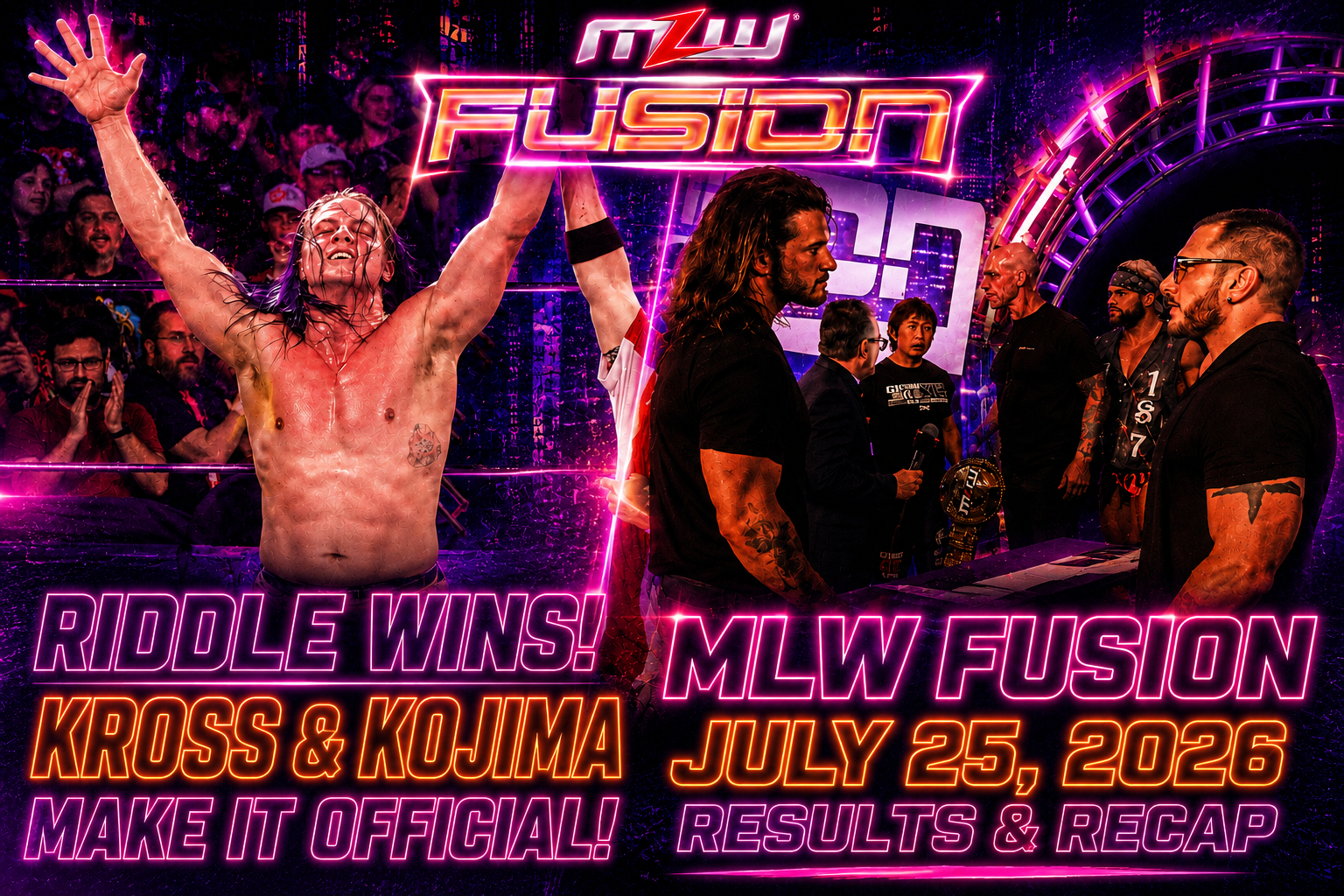
Tonight’s MLW Fusion continued FantasticaMania USA from Charleston, South Carolina, but the international branding largely served as a backdrop for an episode focused on advancing MLW’s regular television stories.
Matt Riddle survived another collision with the Skyscrapers by defeating Josh Bishop, LaBron Kozone continued his heavily promoted rise against Andrew Everett, and ZAMAYA finally earned a decisive victory over Priscilla Kelly in their increasingly personal rivalry.
The most important development came outside the ring. MLW World Heavyweight Champion Killer Kross and two-time champion Satoshi Kojima signed the contract for their upcoming championship match, turning a straightforward title announcement into a confrontation over legacy, fear and whether Kojima still possesses enough to overthrow MLW’s self-proclaimed Blood King.
MLW also addressed the uncertain future of the World Middleweight Championship, the Glasgow Boys warned the rest of the roster that they were coming for control, and the internal war surrounding CONTRA Unit became even more dangerous ahead of next week.
Tonight was not built around one spectacular match. It was a progression episode that used three predictable results to strengthen rising wrestlers and move several stories closer to their next major collision.
Here Are the Full Results
- LaBron Kozone defeated Andrew Everett.
- ZAMAYA defeated Priscilla Kelly.
- Matt Riddle defeated Josh Bishop.
- Killer Kross and Satoshi Kojima signed the contract for their upcoming MLW World Heavyweight Championship match.
LaBron Kozone vs. Andrew Everett
MLW opened the in-ring portion of tonight by continuing the rapid construction of LaBron Kozone.
Since Teddy Long introduced Kozone as one of the central pieces of MLW’s next generation, every appearance has been designed to reinforce the same idea. Kozone is powerful, athletic, composed and already viewed internally as someone who can eventually become one of the promotion’s most important wrestlers.
Andrew Everett presented the most stylistically interesting opponent Kozone has faced during this initial run.
Everett could not match Kozone’s strength, but his speed, creativity and aerial offense prevented the match from becoming another immediate demolition. He forced Kozone to move, adjust and chase rather than simply planting his feet and overpowering an opponent standing directly in front of him.
That gave the match a purpose beyond producing another Kozone victory.
Everett’s entire “Giant” presentation remains intentionally ridiculous, but he is much more effective when the comedy supports his wrestling rather than replaces it. Tonight, he used his experience to create openings and briefly made Kozone look less comfortable than he had during his previous victories.
Kozone remained patient.
Instead of attempting to follow Everett into an unnecessarily complicated aerial match, he repeatedly slowed the pace and dragged the contest back toward his own strengths. Whenever Everett began developing sustained momentum, Kozone answered with one heavy strike or powerful counter that immediately changed the direction of the match.
Kozone eventually defeated Everett and preserved his undefeated momentum.
The result was obvious, but the match succeeded because Everett made Kozone work differently. MLW did not present Kozone as invincible. It presented him as adaptable.
That distinction matters.
A wrestler who destroys every opponent without resistance can quickly become repetitive. A wrestler who encounters different problems and keeps finding solutions feels like someone developing into a legitimate contender.
The problem is that MLW has nearly reached the limit of what these developmental victories can accomplish.
Kozone has already received Teddy Long’s endorsement. He has defeated several established wrestlers. Commentary continually presents him as a future centerpiece. The promotion now needs to identify what he is climbing toward.
The Southern Crown Championship is the most natural destination.
Kozone’s physical style fits the identity MLW wants attached to that championship, and a program with Trevor Lee would allow him to move beyond showcase victories into a rivalry with actual stakes. Continuing to place different midcard wrestlers in front of him without establishing a larger objective will eventually turn momentum into repetition.
What Worked
- Everett’s speed forced Kozone to adjust his usual approach.
- Kozone remained powerful without being presented as completely untouchable.
- The match showed that Kozone can work effectively against a smaller aerial opponent.
- MLW maintained the consistency of one of its clearest pushes.
What Didn’t Work
- The result never felt uncertain.
- Everett remains valuable as an opponent but rarely receives a meaningful direction of his own.
- Kozone’s undefeated run still lacks a clearly defined championship destination.
- MLW continues telling viewers that Kozone is important instead of placing him in a story that proves it.
Grade: B-
The Glasgow Boys Put the MLW Locker Room on Notice
Joe Coffey, Mark Coffey and Wolfgang delivered a direct warning to the rest of MLW.
The Glasgow Boys are not entering the promotion to quietly fill television time or become another temporary alliance. They believe their experience, physicality and existing chemistry make them capable of controlling MLW’s faction-heavy landscape.
That message was simple, but simplicity was the correct choice.
MLW does not need to spend weeks explaining why Coffey, Coffey and Wolfgang trust one another. Their shared history already gives the group more credibility than a collection of wrestlers suddenly placed together for storyline convenience.
The larger challenge is separating them from MLW’s other groups.
The promotion currently has the Skyscrapers, the CONTRA Mercenaries, the original CONTRA Unit, the Good Brothers’ alliance with Shotzi Blackheart and Mads Krule Krügger, and now the Glasgow Boys entering the same crowded environment.
There are plenty of large wrestlers, violent promises and faction confrontations. What MLW needs are clearer objectives.
The Glasgow Boys should immediately target the World Tag Team Championship and the Skyscrapers. That rivalry would give the trio a purpose while placing two physically imposing groups against one another without requiring extensive explanation.
Joe Coffey, Mark Coffey and Wolfgang look credible together. Now MLW must ensure they become more than another group standing backstage and promising violence.
What Worked
- The Glasgow Boys immediately established a united identity.
- Their existing chemistry makes the group feel natural.
- Their physical style fits MLW’s presentation.
- A rivalry with the Skyscrapers is already easy to imagine.
What Didn’t Work
- MLW’s faction landscape is becoming overcrowded.
- The group did not identify one specific target.
- Another warning promo will mean little without immediate action.
- Their presentation risks blending into the promotion’s other collections of heavy hitters.
Grade: B-
ZAMAYA vs. Priscilla Kelly
ZAMAYA and Priscilla Kelly entered tonight with unfinished business rather than participating in another disconnected women’s division match.
That history gave the contest an aggression often missing from MLW’s secondary women’s matches.
Kelly did not treat ZAMAYA like another prospect she could politely test. She attempted to disrupt her rhythm, slow the match down and turn it into an uncomfortable fight. Kelly’s greatest strength has always been her ability to make hostility feel natural through body language, facial expressions and small acts of disrespect.
ZAMAYA responded with the explosiveness that has defined her MLW presentation.
She is not being built as an underdog who must survive every match through heart alone. MLW wants her to feel unpredictable and physically dangerous. Her offense is most effective when it arrives suddenly, immediately changing the match after an opponent appears to have established control.
Kelly’s experience allowed her to prevent ZAMAYA from dominating without resistance. She dragged the match into a slower pace, attacked whenever ZAMAYA attempted to build momentum and treated every exchange as an opportunity to make the rivalry more personal.
ZAMAYA eventually defeated Kelly, earning the most meaningful singles victory of her MLW run.
The result was necessary.
Kelly had already defeated ZAMAYA earlier in their rivalry, and another loss would have stalled the newcomer before her push could fully begin. By winning tonight, ZAMAYA did more than even the score. She established herself as one of the clearest possible challengers to MLW Women’s World Champion Shotzi Blackheart.
That championship direction must now become explicit.
Shotzi has received significant television time, but much of it has been connected to Mads Krule Krügger, the Good Brothers, the Skyscrapers and the increasingly complicated CONTRA war. Those stories have kept Shotzi visible while quietly pushing her championship into the background.
ZAMAYA gives MLW an opportunity to correct that.
She has the presentation, momentum and physical credibility required to challenge Shotzi. The promotion does not need to book the title match immediately, but it should stop treating the women’s championship as a prop attached to a larger faction story.
ZAMAYA has defeated Kelly. The next development should be Shotzi acknowledging that a legitimate challenger is approaching.
What Worked
- The match felt connected to an existing rivalry.
- Kelly’s aggression gave ZAMAYA a more difficult test.
- ZAMAYA earned a meaningful victory over an established opponent.
- The result created a logical next challenger for Shotzi.
- Both wrestlers approached the match with visible hostility.
What Didn’t Work
- The rivalry needed more promo time before the match.
- Kelly has become increasingly predictable as the established wrestler who loses to a rising name.
- MLW has not yet formally connected ZAMAYA’s momentum to the women’s championship.
- Shotzi’s faction involvement continues overshadowing her actual title reign.
Grade: B
MLW Addresses the World Middleweight Championship
MLW delivered breaking news surrounding the World Middleweight Championship following last week’s international four-way match involving KUSHIDA, Templario, Alan Angels and Taiji Ishimori.
The championship picture has become one of the more complicated elements of the current Fusion season because MLW has attempted to combine its existing roster with talent and title developments connected to CMLL, New Japan Pro-Wrestling and CONTRA Unit.
That international scope can make the championship feel important, but it can also create confusion when the television presentation does not clearly establish who the recognized champion is, who has the strongest claim and which results control the championship’s direction.
Last week’s four-way match delivered the type of global showcase FantasticaMania USA promised. However, the post-match chaos involving KUSHIDA and Templario made the championship feel secondary to CONTRA’s expanding war.
Tonight’s update attempted to place the title back at the center of the conversation.
MLW must keep the next step simple.
The division already contains enough strong wrestlers to produce compelling matches. What it needs is a clear champion, a clear challenger and a direct reason they are fighting. Additional layers of faction interference, disputed recognition or cross-promotional confusion will only make the championship harder to follow.
What Worked
- MLW acknowledged the uncertainty instead of ignoring it.
- The announcement kept last week’s four-way relevant.
- The international involvement gives the championship a larger identity.
- The division has several credible challengers available.
What Didn’t Work
- The championship picture has become unnecessarily difficult to follow.
- CONTRA’s storyline continues consuming attention from the title itself.
- MLW needs to establish one unmistakable direction.
- Another complicated explanation would hurt a division that should be built around fast, high-level wrestling.
Grade: C+
Matt Riddle vs. Josh Bishop
Matt Riddle entered tonight in an unusual position.
He remains one of the most recognizable wrestlers in MLW and still has a legitimate argument that Alex Hammerstone prevented him from becoming World Heavyweight Champion. However, Killer Kross has moved toward Satoshi Kojima, while Riddle has been left fighting through the promotion’s collection of massive heavyweights.
Josh Bishop was another physical obstacle, but he was not a meaningless one.
The Skyscrapers have been presented as one of MLW’s most dangerous groups. Bishop may not possess Donovan Dijak’s complete in-ring range or Bishop Dyer’s established reputation, but his size and straightforward power make him believable whenever he is placed against a smaller opponent.
Riddle could not afford to treat Bishop like a conventional wrestler.
Whenever Bishop established control, he used his size to prevent Riddle from creating the space required for his kicks and rapid offensive combinations. Riddle’s challenge was not simply hurting Bishop. It was avoiding prolonged exchanges where Bishop could impose his strength.
Riddle attacked in bursts.
He used speed, strikes and movement rather than attempting to prove that he could overpower a larger wrestler. That approach protected the size difference and allowed Bishop to remain dangerous even while Riddle gradually gained control.
Riddle eventually defeated Bishop and continued rebuilding his momentum.
The victory was necessary, but the larger direction remains unclear.
Riddle has not received a decisive conclusion to his rivalry with Kross. His issues with Hammerstone remain unresolved. The Skyscrapers now represent another threat. MLW is keeping Riddle active and protected, but activity is not the same as direction.
He needs one objective.
Another World Heavyweight Championship opportunity would be justified because his previous match did not produce a clean resolution. A full rivalry with Hammerstone would also make sense because Hammerstone repeatedly prevented Riddle from completing his championship pursuit.
Continuing to place Riddle against different large wrestlers without choosing one story risks making him feel busy rather than important.
The match did what it needed to do. Riddle overcame Bishop, the Skyscrapers suffered a meaningful singles defeat, and MLW preserved the possibility of returning Riddle to the championship picture.
Now the promotion needs to decide which possibility actually matters.
What Worked
- Bishop’s size created a believable physical problem.
- Riddle adjusted his offense instead of unrealistically overpowering him.
- Bishop remained imposing despite losing.
- Riddle received another needed victory.
- The match reinforced the danger surrounding the Skyscrapers.
What Didn’t Work
- The outcome was predictable.
- Bishop still feels more like a physical obstacle than a fully developed character.
- Riddle’s rivalry with Hammerstone remains unresolved.
- MLW has not explained whether Riddle is still pursuing Kross.
- The victory did not create an obvious next step.
Grade: B-
CONTRA Unit’s Civil War Becomes More Dangerous
The internal conflict surrounding CONTRA Unit continued hanging over tonight’s episode.
Big Damo’s arrival last week changed the balance of power when he attacked Mads Krule Krügger and revealed himself as the Serpent’s newest weapon. The attack made it clear that the conflict is no longer limited to propaganda, mysterious videos or threats appearing across the screen.
CONTRA’s competing sides now have monsters capable of physically destroying one another.
Krügger was once presented as the Black Hand of CONTRA. His connection with Shotzi Blackheart and the Good Brothers has placed him against the faction’s latest incarnation, while Big Damo has entered as a destructive force specifically assigned to eliminate him.
That gives next week’s match a strong physical foundation.
The problem remains the amount of explanation required to understand every allegiance.
CONTRA Unit has splintered. The CONTRA Mercenaries have their own relationships. Shotzi revived Krügger and aligned with the Good Brothers. The Skyscrapers are involved because of their championship rivalry with Gallows and Anderson. Big Damo now serves the Serpent.
There is enough material for a major faction war, but MLW has introduced developments faster than it has clarified them.
Krügger versus Damo should help simplify the story by placing the conflict directly in the ring. Two enormous wrestlers attempting to destroy one another is easier to understand than another collection of mysterious interruptions and shifting alliances.
What Worked
- Big Damo immediately feels like a serious threat.
- His history and size make him a believable opponent for Krügger.
- The rivalry finally has a direct singles match.
- CONTRA’s internal war has genuine physical consequences.
What Didn’t Work
- The faction relationships remain overly complicated.
- Viewers should not need to track several versions of CONTRA.
- Shotzi’s role in the story continues overshadowing her championship.
- MLW needs the match to provide an actual development rather than another inconclusive brawl.
Grade: B
Killer Kross and Satoshi Kojima Sign the MLW World Heavyweight Championship Contract
Killer Kross and Satoshi Kojima closed tonight by making their MLW World Heavyweight Championship match official.
Kojima entered the confrontation carrying something most of Kross’ challengers cannot claim: a legitimate history with the championship.
He is a two-time MLW World Heavyweight Champion whose relationship with the promotion stretches across different eras. He does not need a manufactured personal issue to justify challenging Kross. His accomplishments provide the foundation.
Kross approached the signing differently.
The reigning champion did not treat Kojima’s history as something deserving automatic reverence. To Kross, Kojima’s legacy is valuable because defeating him would add another respected name to the Blood King’s reign.
That contrast gave the segment its purpose.
Kojima views the championship as proof that his career still possesses another meaningful chapter. Kross views Kojima as part of the history he intends to consume.
Scarlett Bordeaux’s presence strengthened Kross’ presentation without taking control of the confrontation. Kross works best when he appears calm enough to make everyone else uncomfortable. He does not need to scream throughout an entire segment or destroy furniture immediately. His confidence creates the threat.
Kojima refused to be intimidated.
That was essential.
A veteran challenger cannot enter a championship program simply grateful to be included. Kojima needed to behave like someone who genuinely believes he can defeat Kross, reclaim the championship and embarrass a champion who has built his identity around inevitability.
Both men signed the contract, but the confrontation quickly moved beyond paperwork.
Kross attempted to establish psychological control. Kojima resisted. The tension eventually erupted, ensuring the segment did not end as another respectful exchange between champion and challenger.
The physicality worked because it followed a clear ideological conflict.
Kross believes Kojima’s greatest accomplishments exist behind him.
Kojima believes Kross has mistaken age for weakness.
The championship match is now official, but MLW still must address the largest weakness surrounding the program: the result feels predictable.
Kross only recently began establishing this reign. He remains one of the central faces of the promotion’s latest television era. Kojima is credible enough to challenge him, but most viewers will expect Kross to retain.
The build therefore cannot rely entirely on asking who will win.
MLW must establish how Kojima can win.
The lariat should be treated as a legitimate threat capable of ending Kross’ reign. Kross should spend the match attempting to neutralize Kojima’s arm, disrupt his timing and prevent the veteran from building toward his most dangerous weapon.
That would create a championship match with an actual strategic story.
Without that, Kojima risks becoming another decorated veteran placed in front of Kross to strengthen the champion’s résumé.
Tonight’s segment avoided that problem for now. Kojima looked proud, confrontational and completely unwilling to accept the role of ceremonial challenger.
What Worked
- Kojima’s actual MLW history gave the match legitimacy.
- Kross treated Kojima’s legacy as something he wanted to conquer.
- Kojima refused to behave like an appreciative veteran.
- Scarlett enhanced Kross without dominating the segment.
- The championship felt connected to history, identity and reputation.
- The confrontation gave the match more tension than a respectful challenge would have created.
What Didn’t Work
- Kross remains the overwhelming favorite.
- MLW has not fully established Kojima’s path to victory.
- Contract signings remain an overused wrestling device.
- The rivalry still needs one more major development before the match.
- Kojima cannot become another respected name used only to validate Kross.
Grade: A-
FantasticaMania USA’s Second Week
Tonight’s episode carried the FantasticaMania USA branding, but it did not feel as internationally distinct as last week’s show.
The previous episode delivered a four-way Middleweight Championship match involving representatives from MLW, CMLL and New Japan Pro-Wrestling. That match naturally reflected the cross-promotional identity promised by the event’s name.
Tonight was primarily an MLW Fusion episode.
Kozone continued his domestic rise. ZAMAYA advanced toward Shotzi. Riddle battled a member of the Skyscrapers. The Glasgow Boys issued a warning. CONTRA’s internal conflict moved forward. Kross and Kojima signed their championship contract.
Kojima’s involvement gave the closing segment international importance, but the rest of the episode could have occurred under the standard Fusion banner without changing significantly.
That does not make the episode unsuccessful. It makes the branding feel broader than the actual content.
FantasticaMania USA should represent more than placing one or two international names on an MLW episode. It should alter the pace, style and atmosphere of the show. Last week accomplished that more effectively.
Tonight was stronger as weekly storyline television than as a special cross-promotional event.
Best Match and Segment of the Night
Best Match: ZAMAYA vs. Priscilla Kelly
ZAMAYA and Kelly delivered the match with the clearest personal issue and the most meaningful consequence. ZAMAYA’s victory moved her closer to the women’s championship while preventing their rivalry from ending as another one-sided setback for a rising wrestler.
Best Segment: Killer Kross and Satoshi Kojima’s Contract Signing
Kross and Kojima gave the World Heavyweight Championship a clear generational conflict. Kojima’s history made him credible, while Kross’ confidence prevented the segment from becoming a celebration of the challenger’s past.
What Was Announced for Next Week’s MLW Fusion
- Mads Krule Krügger vs Big Damo.
- The war surrounding CONTRA Unit will continue.
- The fallout from Killer Kross and Satoshi Kojima’s contract signing will continue.
- MLW will further address the World Middleweight Championship picture.
Final Thoughts
Tonight’s MLW Fusion was effective without being exceptional.
Every major result served an identifiable purpose. Kozone remained undefeated. ZAMAYA moved closer to Shotzi. Riddle survived another Skyscraper. Kross and Kojima made their World Heavyweight Championship match official.
The show’s greatest strength was its clarity.
MLW knew which wrestlers needed to win and why those victories mattered. It avoided sacrificing Kozone’s momentum, protected Riddle’s position near the top and gave ZAMAYA the victory required to keep her push alive.
The weakness was predictability.
None of the three matches produced serious uncertainty. Kozone was always expected to defeat Everett. ZAMAYA needed to beat Kelly. Riddle was unlikely to lose while his championship and Hammerstone stories remain unresolved.
Predictable wrestling can still be effective when the journey creates enough tension, but tonight often felt more focused on reaching the expected result than making viewers question it.
MLW also needs to simplify its faction landscape.
The Glasgow Boys, Skyscrapers, Good Brothers, CONTRA Unit, CONTRA Mercenaries, Shotzi, Krügger and Big Damo all occupy overlapping territory. The wrestlers are individually credible, but the allegiances and conflicts are becoming harder to follow than necessary.
Kross and Kojima provided the strongest material because their conflict required no complicated explanation. One is the current champion attempting to define his reign. The other is a former champion refusing to accept that his greatest victories are behind him.
That simplicity gave the closing segment weight.
Tonight successfully moved MLW forward. Next week must begin turning that movement into clearer destinations.
Kozone needs a championship target.
ZAMAYA needs Shotzi.
Riddle needs either Hammerstone or another championship opportunity.
The Glasgow Boys need a specific enemy.
CONTRA needs clearer battle lines.
Kross and Kojima already know exactly what they want. That is why their confrontation stood above everything else on the show.
Overall Grade: B
Make sure to subscribe to our Late Night Crew Wrestling YouTube Channel. Follow @yorkjavon, @kspowerwheels & @LateNightCrewYT on X.
I’m the quiet one until the bell rings then I’ve got takes. I live for WWE NXT and TNA, I want every promotion to succeed, and I will absolutely roast the bad decisions on sight (because someone has to). Anime taught me to respect long-term storytelling; wrestling taught me that sometimes the plan is “we panicked” and called it “unpredictable.” The Miz got me into all of this, so yeah I appreciate confidence, commitment, and the art of talking like you’re already the main event. Now I bring that same energy to the page as the main writer for Late Night Crew Wrestling because if you’re not here to be must-see and tell the truth, why are you here?!