For nearly thirteen years, Bullet Club was more than a faction — it was an institution. Its influence permeated NJPW’s creative decisions, global exposure, and even wrestling culture itself, transforming the way heel stables were built, marketed, and interpreted worldwide. From its audacious beginnings under Prince Devitt to its global dominance under Kenny Omega and The Elite, Bullet Club became the defining standard for faction-based storytelling in modern wrestling. Its presence was omnipresent, omnipotent, and, by its final years, almost unassailable.
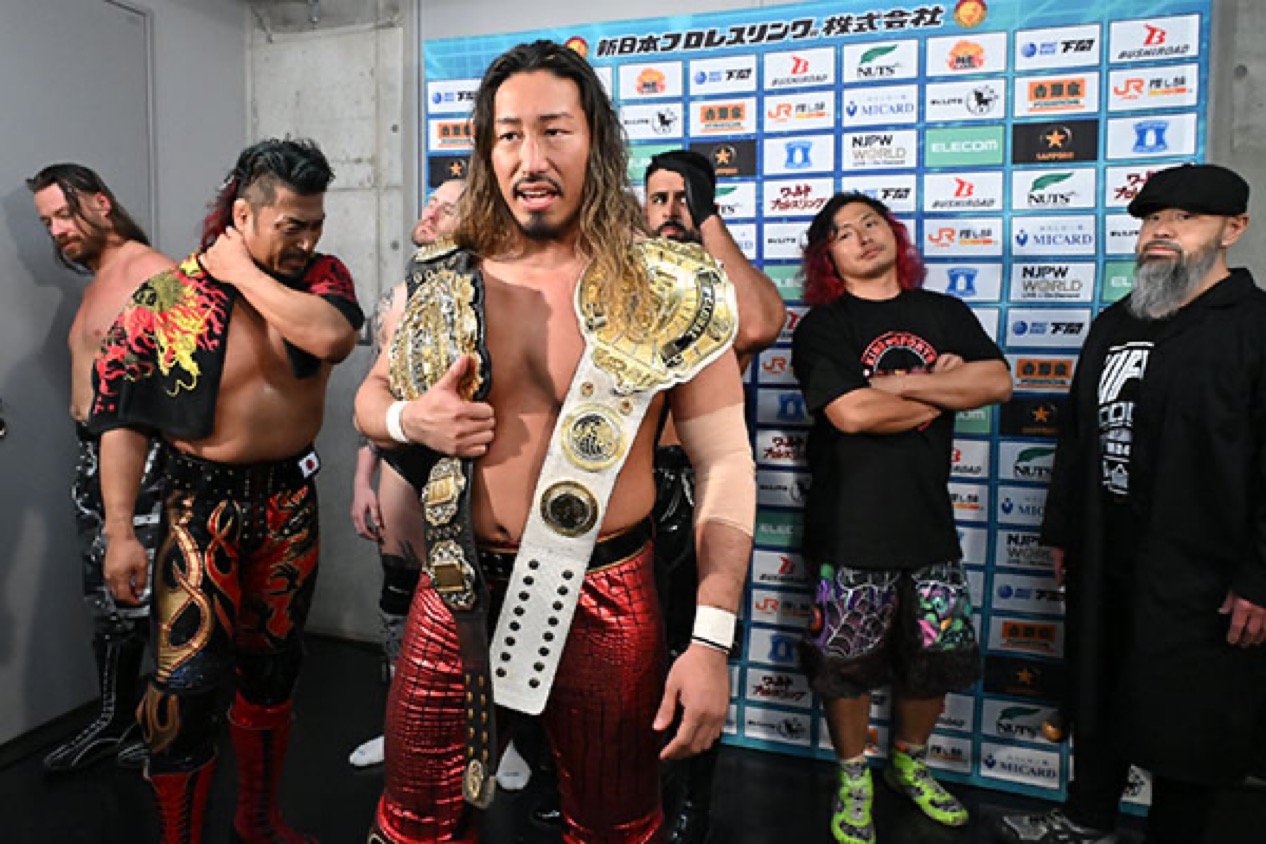
Yet, as NJPW entered 2026, it quietly ended the faction. There was no over-the-top sendoff, no lingering nostalgia angle — just a clean, strategic transition. At New Year Dash!!, the final iteration of Bullet Club, the War Dogs, was absorbed into a new power structure: Unbound Co., a faction designed not just to fill a void but to reshape NJPW’s factional hierarchy and creative direction for the next era.
This was not a collapse. It was a calculated conclusion to a 13-year run that had long outlived its narrative utility.
Bullet Club: A 13-Year Stranglehold on NJPW Storytelling
To understand why Bullet Club ended, it is essential to examine its historical evolution and creative impact. Founded in May 2013, Prince Devitt’s original vision was audacious: a gaijin-led heel faction designed to disrupt NJPW’s established hierarchy. Devitt, later known internationally as Finn Bálor, leveraged charisma and rebellious energy to challenge the traditional faction model in Japan. The early Bullet Club thrived on disruption, introducing a foreign heel ethos into a system that had historically emphasized dojo loyalty and hierarchical respect.
- AJ Styles Era: When Devitt departed and AJ Styles assumed leadership, Bullet Club shifted from a disruptive entity to a championship-driven powerhouse. Styles elevated the faction to main event prominence, demonstrating its ability to anchor NJPW’s narrative while remaining a dominant heel faction.
- Kenny Omega / The Elite Era: Omega and The Elite transformed Bullet Club into a global brand, transcending NJPW entirely. Merchandise sales, international attention, and crossover appearances in ROH and later AEW amplified Bullet Club’s influence beyond Japanese borders. During this era, the faction’s identity became intertwined with its members’ star power, creating both a cultural phenomenon and a storytelling shortcut for NJPW.
- Jay White Era: Returning the faction to NJPW-centric dominance, Jay White emphasized strategic control over chaos, using Bullet Club as a tool for championship focus and long-term heel dominance. Narrative complexity increased, but global brand influence waned slightly as White’s leadership emphasized precision and authority over spectacle.
- David Finlay / War Dogs: The final iteration of Bullet Club, the War Dogs, stripped away excess. Without the glamour of Omega’s Elite or Styles’ charisma, the faction returned to raw aggression and tactical dominance. This final form highlighted both the faction’s enduring utility and its eventual limitations. By 2025, Bullet Club was no longer a creative engine — it was a factional crutch, a name carrying more weight than narrative innovation.
Across these eras, Bullet Club fundamentally dominated NJPW storylines, anchored tournament narratives, and shaped title scenes. Its longevity was unmatched, but with that dominance came creative stagnation. The faction had become an automatic focal point, leaving limited room for other narratives to flourish organically. NJPW faced the rare problem of too much structural gravity: the faction was indispensable, yet increasingly restrictive.
War Dogs: The Culmination of Bullet Club
David Finlay’s War Dogs were not a revival; they were an extraction of Bullet Club’s essence. By removing legacy members, nostalgic callbacks, and merchandising-driven aesthetics, War Dogs distilled the faction into a pure instrument of competition and aggression.
This stripped-down identity served two purposes: it reasserted Bullet Club’s in-ring credibility and highlighted its narrative exhaustion. War Dogs could dominate matches and control storylines, but its simplified identity revealed a critical truth: the Bullet Club brand itself was no longer necessary to maintain audience engagement or storyline interest. NJPW’s decision to absorb War Dogs into a broader factional framework was thus not a closure of legacy but a strategic pivot: the faction had completed its arc and made space for a new creative order.
Unbound Co.: The Faction Built for the Post-Bullet Club Era
Unlike Bullet Club, which relied heavily on identity, nostalgia, and star power, Unbound Co. is a structured, functional faction designed to control NJPW’s narrative hierarchy. By absorbing War Dogs and select unaffiliated top talent, NJPW has created a faction that can operate across divisions, influence title scenes, and anchor storylines without relying on past reputation.
Unbound Co. is not built for spectacle; it is built for efficiency, dominance, and long-term storytelling flexibility. This is a deliberate move by NJPW: factions no longer exist primarily as branding tools — they are narrative instruments. Every member’s placement has creative purpose, and every interaction signals story potential rather than relying solely on name recognition.
The Hierarchy of Unbound Co.
Unbound Co.’s internal structure reflects strategic planning and narrative clarity. Unlike Bullet Club’s often ambiguous chain of command, NJPW has defined the faction’s roles to serve both creative and competitive storytelling purposes.
Before analyzing individuals, the faction should be understood as a multi-tiered system: leadership anchors, veteran pillars, junior division influencers, and supporting enforcers. Each level serves a distinct function within both match narratives and long-term storytelling arcs.
- Yota Tsuji — Leader
Tsuji occupies the top position as both IWGP Heavyweight and Global Heavyweight Champion. His dual-title reign underscores NJPW’s confidence in him as the faction’s focal point. He is not merely the most visible member; he is the axis around which Unbound Co. rotates. This strategic placement ensures that the faction moves in tandem with the promotion’s central storylines, allowing NJPW to tell heavyweight-focused narratives while maintaining internal cohesion. - David Finlay — Enforcer and Legacy Bridge
As the last Bullet Club leader, Finlay carries historical credibility without being tethered to the brand. His role is to enforce faction dominance, guide mid-tier members, and bridge the past with the present. In storyline terms, he ensures Unbound Co. retains aggression and tactical discipline, while narratively linking the faction to NJPW’s factional history, giving the group depth beyond current titleholders. - Shingo Takagi — Veteran Anchor
Takagi provides main-event-level credibility to the faction, especially in the heavyweight division. His inclusion allows Unbound Co. to maintain dominance in marquee tournaments and championship storylines while mentoring younger talent within the group. Shingo’s presence ensures that Unbound Co. is taken seriously in matches and storylines, bridging fan perception and creative intention. - Hiromu Takahashi — Junior Division Strategist
Hiromu’s role ensures the faction’s influence spans beyond the heavyweight division. By controlling junior-level narratives, Hiromu allows Unbound Co. to impact NJPW’s card across multiple tiers, creating storytelling flexibility that Bullet Club could no longer achieve. His unpredictability and technical prowess also offer storyline intrigue, giving NJPW creative room for nuanced faction interactions. - Supporting Core — Operational Backbone
Members such as Gabe Kidd, Clark Connors, Drilla Moloney, Taiji Ishimori, and other unaffiliated talent serve as the faction’s structural foundation. Their function is not spotlight dominance but narrative versatility: handling tag teams, tournament arcs, and division-specific conflicts while maintaining the faction’s cohesion. Each supporting member has a defined niche, allowing Unbound Co. to operate simultaneously in multiple storylines without losing focus. This depth makes the faction both formidable and flexible, capable of narrative dominance across the card.
Creative and Competitive Implications for NJPW
Unbound Co. reshapes NJPW’s factional dynamics and opens opportunities for story evolution:
- Heels and rivals can now be positioned independently without defaulting to Bullet Club associations.
- Title scenes can evolve organically, with multi-layered competition across divisions.
- Cross-division matchups, tag tournaments, and international talent integration become narrative tools rather than structural necessities.
- The faction functions as a creative pivot, allowing NJPW to manage storylines with precision while retaining the ability to escalate rivalries organically.
The faction’s design reduces reliance on legacy branding, emphasizing performance, competition, and story-centric hierarchy.
Legacy Without Dependency
Bullet Club’s impact is undeniable. Its influence reshaped NJPW, launched global stars, and redefined how wrestling stables operate worldwide. Yet NJPW has demonstrated a rare creative discipline: retiring a beloved faction at the precise moment it has completed its narrative function.
Unbound Co. is not a tribute to history — it is a strategic and functional evolution, designed to dominate, structure, and drive storylines across divisions. NJPW’s post-Bullet Club era is no longer defined by nostalgia or name recognition but by purposeful storytelling and competitive hierarchy.
Bullet Club’s era is complete. Its legacy is secure. And Unbound Co. now stands as the central axis around which NJPW’s next decade will revolve.
Make sure to subscribe to our Late Night Crew Wrestling YouTube Channel. Follow @yorkjavon, @kspowerwheels & @LateNightCrewYT on X.
I’m the quiet one until the bell rings then I’ve got takes. I live for WWE NXT and TNA, I want every promotion to succeed, and I will absolutely roast the bad decisions on sight (because someone has to). Anime taught me to respect long-term storytelling; wrestling taught me that sometimes the plan is “we panicked” and called it “unpredictable.” The Miz got me into all of this, so yeah I appreciate confidence, commitment, and the art of talking like you’re already the main event. Now I bring that same energy to the page as the main writer for Late Night Crew Wrestling because if you’re not here to be must-see and tell the truth, why are you here?!