The TNA Genesis pay-per-view tonight is less a mere wrestling event and more a potential reboot button for the promotion as it embarks on a crucial new chapter. After the much-hyped Thursday Night iMPACT! debut on AMC — a broadcast industry milestone intended to expand TNA’s reach and legitimacy — the company finds itself in a position that mixes real-world obstacles with narrative opportunity. Critics and fans responded to the AMC premiere with a polarized reception, praising the ambition and marquee title change while criticizing production inconsistencies, pacing issues, and moments that felt underwhelming for a national cable relaunch. While some longtime fans appreciated the gritty, throwback feel of the show, others questioned whether TNA’s presentation matched the expectations of a modern primetime audience.
Behind the scenes, however, the outlook was notably more optimistic. PWInsider Elite reported that AMC executives who were in attendance for the debut were very happy with the show, believing it delivered a strong first impression without major technical problems and accomplished what it needed to do as a launch event. That internal approval gives Genesis added importance — not just as a wrestling card, but as the first real opportunity for TNA to build consistency, trust, and momentum with both fans and its new television partner as 2026 officially gets underway.
Complicating matters has been a series of unavoidable real-world disruptions. Visa issues and unexpected roster departures forced TNA to cancel and reshuffle multiple advertised matches, including the scheduled X-Division Championship bouts for both the AMC debut and tonight’s Genesis PPV, as well as the originally planned Knockouts World Championship match. Add in the departure of The Rascalz, who were expected to be foundational players in TNA’s reset, and the company has had to pivot creatively on short notice — turning Genesis into a test of adaptability as much as execution.
Here is everything advertised for tonight’s show
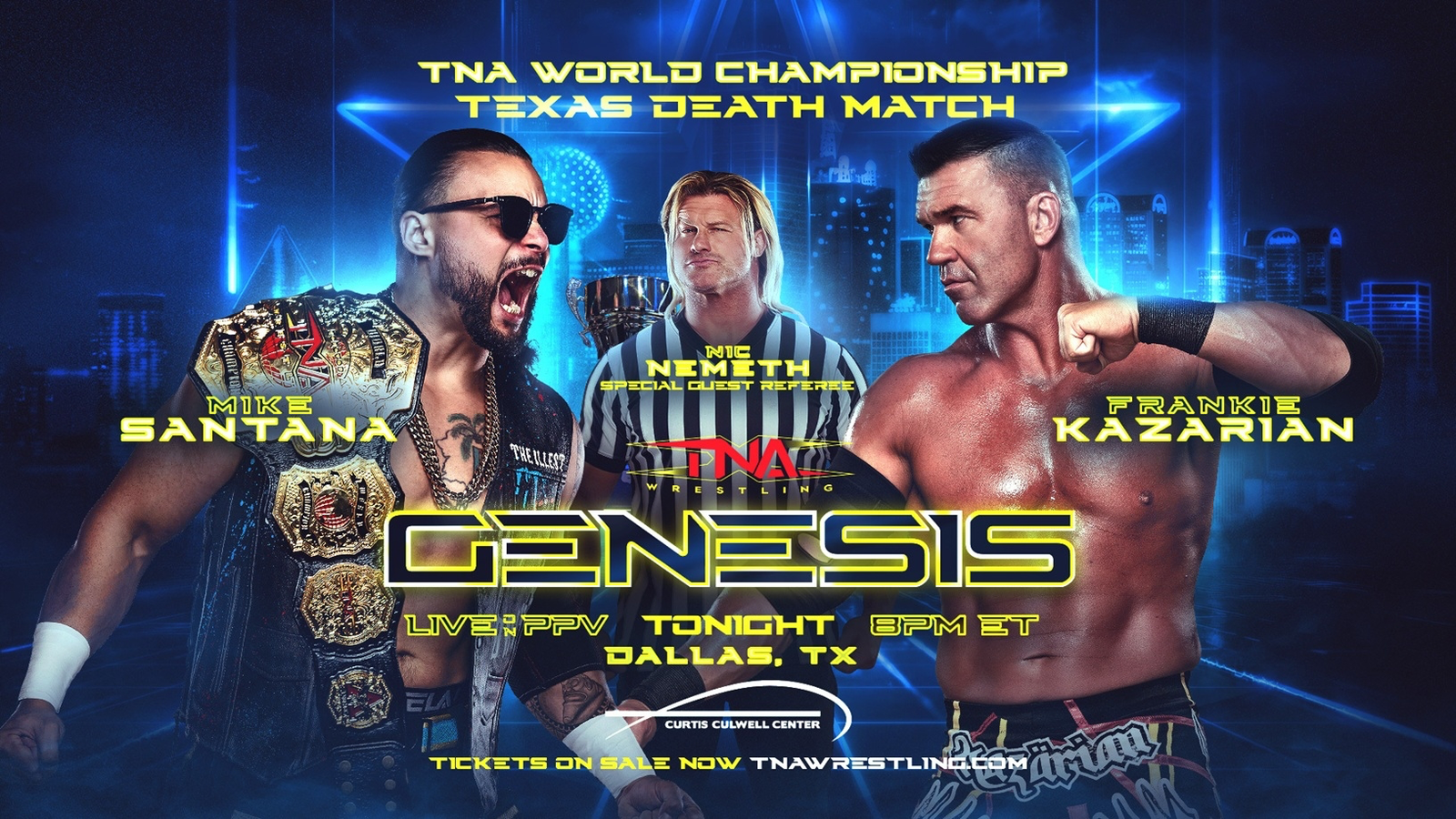
- Mike Santana (c) vs Frankie Kazarian (Texas Death Match for the TNA World Championship) (Nic Nemeth special guest referee)
- The Hardys (c) vs The Righteous (TNA World Tag Team Championship)
- Léi Yǐng Lee (c) vs Zaria w/Sol Ruca (TNA Knockouts World Championship)
- Cedric Alexander vs Moose vs Joe Hendry
- Elijah vs Mustafa Ali
- A.J. Francis vs Rich Swann
- Ryan Nemeth vs Mara Sadè
- Channing “Stacks” Lorenzo w/Arianna Grace (c) vs Eric Young vs B.D.E. vs TBD (TNA International Championship)
- Eddie Edwards vs Johnny Dango Curtis (JDC’s Retirement Match)
Genesis streams live from the Curtis Culwell Center in Garland, Texas, with Countdown to Genesis airing approximately one hour before bell time on TNA+ and digital platforms.
Match Breakdown & Analysis
Mike Santana (c) vs. Frankie Kazarian
—
Texas Death Match for the TNA World Championship
Analysis: This is the centerpiece of Genesis — not just a title match, but the culmination of the company’s first big rivalry of the AMC era. Santana lost the title back to Kazarian heading into the debut episode of TNA Impact! on AMC, only to reclaim it that night in a hard‑fought battle that emphasized Santana’s rising status and Kazarian’s veteran resilience.
Santana’s initial reign had already been significant in re‑establishing him as a top star as TNA repositioned itself — and his victory on AMC set an emotional tone for the new era. Kazarian, meanwhile, is a storytelling anchor: a seasoned former champion and Call Your Shot Gauntlet winner whose history with TNA runs deep.
The Texas Death Match stipulation adds thematic weight — portrayed as the final settling of a bitter feud between a determined new‑era champion and a storied veteran clinging to relevance. The added twist — Nic Nemeth as special guest referee — injects strategic unpredictability, since Nemeth holds the Call Your Shot trophy and could theoretically leverage his position even further. Santino Marella and authority figure Daria Rae sold this as a curveball rather than a simple referee assignment.
This match is designed to test both men — Santana’s championship legitimacy and Kazarian’s legacy — and clearly positions TNA’s world title scene as one where physicality and narrative grit matter as much as athletic display.
The Hardys (c) vs. The Righteous
—
TNA World Tag Team Championship
Analysis: The Hardys — Matt and Jeff — are painted as the emotional center of the tag division and one of the most recognizable teams in TNA history. Their presence simultaneously delivers nostalgia and credibility — perfect for boxing in a team like The Righteous, whose signing was announced as a major roster addition just for this bout.
On the AMC debut, the Hardys teamed with Elijah to defeat Order 4, but afterward they were ambushed in a brutal attack by The Righteous, signaling ongoing animosity and reinforcing The Righteous as genuinely dangerous challengers.
The Righteous — Vincent and Dutch — bring a nihilistic menace and psychological unpredictability that contrasts with the Hardys’ determination and veteran showmanship. TNA is clearly positioning this feud as old school grit vs. new era aggression, conveying that tag team wrestling is still central to its identity even amidst broader roster turbulence.
Léi Yǐng Lee (c) vs. Zaria
—
TNA Knockouts World Championship
Analysis: Originally, Dani Luna was slated to challenge for the Knockouts World Championship, reflecting her momentum and positioning within the women’s division — especially after strong performances and storyline development leading to Genesis. Those plans were scrapped due to real‑world visa problems that prevented her entry.
TNA pivoted on live television by having Lee issue an open challenge on the AMC debut of Impact!, which was answered by Zaria, a notable external signing from WWE/NXT returning on surprising terms. Director of Operations Daria Rae was involved in formalizing Zaria’s inclusion, underscoring the importance TNA places on her as a credible threat and a boost to the Knockouts scene.
Lee herself has been portrayed as a fiercely competitive champion — hard‑hitting, technically savvy, and ready to defend her title against any challenger. Zaria’s outsider status adds unpredictable intensity, making this match less about continuity and more about reinvention within the division in a year when TNA is reshaping its women’s roster and storylines.
Johnny Dango Curtis vs. Eddie Edwards
—
Retirement Match
Analysis: Johnny Dango Curtis (JDC) has been on a narrative trajectory that combines swaggering bravado with underdog pathos. TNA’s Genesis Preview confirmed this bout as his final match, emphasizing that Curtis wanted a meaningful send‑off rather than a gimmick‑driven exit.
Eddie Edwards, a longtime TNA mainstay and respected veteran, was selected as the opponent — a choice that elevates the match’s emotional stakes. Their shared history and contrasting styles (Curtis’ theatrical, boisterous persona vs. Edwards’ grounded, hard‑knocking ethos) gives this match structure beyond finish and loss, serving as a narrative rite of passage and a denouement for JDC’s arc.
This match carries the unique weight of legacy and closure, which makes it a compelling centerpiece for fans invested in TNA’s past and present — especially as the company looks to integrate new faces alongside established names.
Cedric Alexander vs. Moose vs. Joe Hendry
—
Triple Threat
Analysis: This three‑way is one of the clearest examples on the card of storylines reshaped by real‑world events. Originally, TNA X‑Division Champion Leon Slater was scheduled to defend in a three‑way against Alexander and Moose — a match built over weeks on Impact! television and in official previews. Visa complications prevented Slater’s travel, so the bout became a non‑title triple threat instead, with Joe Hendry stepping in.
Each competitor brings a distinct character dynamic:
- Cedric Alexander — the technically gifted, determined contender who has navigated both singles and tag team competition;
- Moose — the powerhouse whose prior championship claims and gritty persona make him a formidable wild card;
- Joe Hendry — the charismatic wildcard with a blend of confidence, unpredictability, and narrative inconsistency that often turns matches into character showcases.
This match doesn’t just offset Slater’s absence — it underscores TNA’s ability to make a creative virtue of necessity by giving all three men a storyline moment and ensuring the audience sees dynamic in‑ring contrasts. There’s drama, physical contrast, and ongoing implications for each competitor’s path following Genesis.
Elijah vs. Mustafa Ali
Analysis: A matchup rooted in faction conflict and personal animosity, this bout continues threads from weeks of Impact! television. Elijah — at times wrestling in tag contexts and six‑man scenarios — has used theatrical presentation, crowd engagement and improvisational pacing to cultivate a hybrid entertainer/athlete identity.
Mustafa Ali, conversely, blends strategic in‑ring psychology with the enforcement presence of his faction (Order 4) and allies like Tasha Steelz, John Skyler, Jason Hotch and Special Agent Zero. The feud between Elijah and Ali has included segments where symbolism and persona played heavy roles, and Genesis gives both men a moment to settle it one‑on‑one.
This match highlights TNA’s midcard storytelling: compelling character contrast rather than overbooking, and a chance for an established performer in Ali to assert his dominance against an unpredictable opponent.
A.J. Francis vs. Rich Swann
Analysis: This is a personal clash rooted in faction conflict and betrayal. On television, Swann refused to hit a crucial move on Impact!, demonstrating integrity and earning heat from Francis. That refusal turned into a moment of conflict that set this match’s emotional footing — nearly a classic grudge bout.
Francis, positioned as the brutish, force‑forward competitor, embodies a mindset of resentment and aggression, while Swann’s agile resilience and crowd‑friendly style juxtapose power with finesse. This match works as a midcard subplot with real emotional stakes, giving both men an opportunity to forge identity and momentum heading deeper into 2026.
Ryan Nemeth vs. Mara Sadè — Intergender Match
Analysis: Unlike traditional booking — where intergender matches can sometimes be novelty spots — TNA has crafted a Nemeth vs. Sadè pairing that aligns with ongoing character work for both performers. Ryan Nemeth’s pestering, provoking persona has been a narrative thorn in Sadè’s side, and their interactions on Impact! television built enough heat to make this matchup feel like a natural escalation rather than a stunt.
This bout reinforces TNA’s willingness to push unique storytelling beats and give performers outside the typical championship scenes meaningful spotlight moments. It also allows Sadè to showcase her athleticism against a contrasting competitor, strengthening her presence on the roster, while giving Nemeth further chances to carve a memorable underdog/heel identity.
TNA International Championship — Four‑Way Match
Analysis: This international title bout continues a layered subplot involving Santino Marella’s personal stakes and broader faction implications on Impact! television. Champion Stacks — challenged not just by three opponents but by narrative conflict stemming from external interference (including betrayal involving his fiancé Arianna Grace) — enters this multi‑man melee with both personal and professional stakes.
Eric Young — a seasoned veteran — and B.D.E. — a physically imposing threat — both add stylistic contrast and unpredictable pacing dynamics to the bout, while a Texas surprise opponent (announced officially for Genesis) adds that final splash of local unpredictability that often elevates multi‑person matches.
Four‑way formats in TNA historically serve as story accelerators — opportunities to test characters in chaotic environments and elevate emerging stars. This match fits that blueprint, giving visibility to the international title and shifting momentum while retaining storytelling complexity.
AMC Debut: Expectations vs. Reality
TNA’s first broadcast on AMC was designed to be a statement — new network, larger audience, historical branding, and a world title match positioned to anchor the night. Mike Santana defeating Frankie Kazarian for the TNA World Championship provided a feel-good, momentum-driven moment that many praised as the right call to headline the debut. However, fan and critic reactions quickly highlighted lingering concerns. While the crowd energy and in-ring effort were largely applauded, criticism focused on production polish, timing issues, and whether the overall presentation felt “big enough” for a relaunch of this magnitude.
Still, the internal response mattered just as much. According to PWInsider Elite, AMC executives were pleased with the debut and saw it as a successful foundation rather than a finished product. That distinction matters — because Genesis now becomes the measuring stick for whether TNA can refine, tighten, and elevate its weekly product moving forward instead of simply repeating old habits under a new banner.
Visa Issues, The Rascalz Departure, and Creative Course Correction
The visa issues affecting multiple talents were not minor inconveniences — they directly removed championship matches that had been advertised weeks in advance. The X-Division Championship picture was hit the hardest, with the planned title defenses scrapped for both the AMC debut and Genesis, forcing the company to reshuffle contenders and postpone clarity around one of its historically most important divisions.
Similarly, the Knockouts World Championship match scheduled for Genesis had to be reworked entirely due to visa complications, turning what was supposed to be a straightforward title defense into a last-minute pivot. While TNA deserves credit for addressing these changes on screen rather than ignoring them, the disruptions exposed how fragile long-term planning can be for a company navigating international talent logistics.
The departure of The Rascalz only added to that instability. Once viewed as central figures in both the tag team and X-Division rebuilds, their exit erased multiple planned matchups and left noticeable gaps in the card. For fans, it reinforced skepticism about TNA’s direction; for TNA, it underscored the urgency of establishing a deeper, more reliable core moving forward.
Roster Stability, Signings, and New Faces
On the roster front, there are also major re-signings and new arrivals injecting stability amid the chaos. Nic Nemeth has officially re-signed with TNA, reaffirming his commitment to the company and stepping into a crucial role tonight as the special guest referee in the World Championship main event. The Righteous were also announced as officially signed to TNA, immediately slotting into the tag title picture and providing a fresh, credible threat to The Hardys.
In addition, Thursday Night iMPACT! on AMC introduced two notable new figures. Daria Rae officially debuted as the assistant to Director of Authority Santino Marella, positioning her as an on-screen power player moving forward. Rae’s first major act was announcing the signing of Elayna Black, a highly touted Knockouts division addition whose arrival signals TNA’s intent to reinforce and modernize the women’s roster despite recent setbacks.
Why Genesis Matters
Genesis 2026 is not about perfection — it’s about direction. After a divisive AMC debut, roster instability, and unavoidable logistical issues, this PPV represents TNA’s chance to stabilize the narrative, re-earn fan confidence, and prove that the new television era is capable of growth rather than repetition.
A violent Texas Death Match main event, reshaped championship scenes, new signings, and renewed authority structure all converge tonight. Whether Genesis feels like a true reset or another missed opportunity will define how TNA enters the rest of 2026 — not just in storyline terms, but in credibility with fans, critics, and its new network alike.
Make sure to subscribe to our Late Night Crew Wrestling YouTube Channel. Follow @yorkjavon, @kspowerwheels & @LateNightCrewYT on X.
I’m the quiet one until the bell rings then I’ve got takes. I live for WWE NXT and TNA, I want every promotion to succeed, and I will absolutely roast the bad decisions on sight (because someone has to). Anime taught me to respect long-term storytelling; wrestling taught me that sometimes the plan is “we panicked” and called it “unpredictable.” The Miz got me into all of this, so yeah I appreciate confidence, commitment, and the art of talking like you’re already the main event. Now I bring that same energy to the page as the main writer for Late Night Crew Wrestling because if you’re not here to be must-see and tell the truth, why are you here?!