
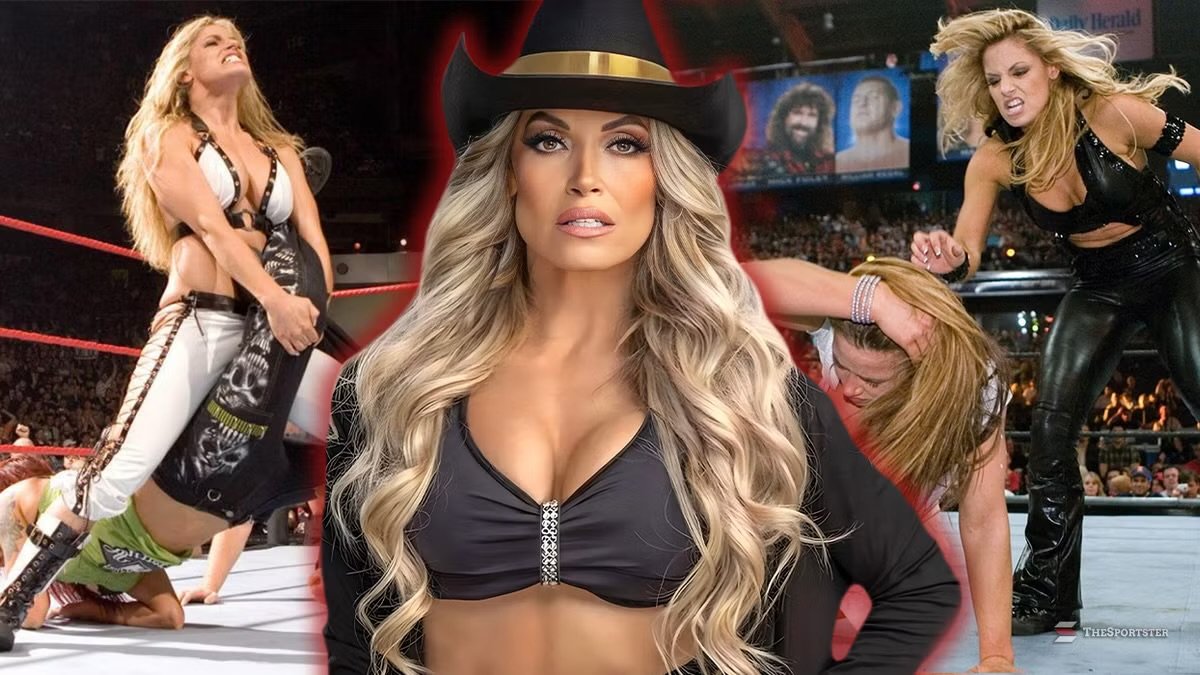
March is Women’s History Month, and Trish Stratus is one of those careers that looks completely different depending on where you start the clock.
If you start in 2000, you see the truth WWE rarely admits out loud: Trish was brought in as a presentation play, not a finished wrestler. If you start in 2006, you see a seven-time champion who retired on top in her hometown. And if you zoom out and take the whole run in one breath, you see the real legacy — Trish didn’t just succeed in her era, she helped change what a “WWE women’s star” was allowed to be.
The uncomfortable but important beginning
Trish debuted on WWE TV in March 2000, introduced as the manager for Test & Albert — “T&A” in the most Attitude Era way possible. That context matters because it shows the starting point: women’s wrestling wasn’t the priority, and women’s characters were often written as accessories first.
The reason Trish’s story becomes Women’s History Month material is that she didn’t stay an accessory. She learned in public. She took the bumps, ate the criticism, and kept improving until “model who wrestles” flipped into “wrestler who happens to look like a model.” That’s a huge difference, and it didn’t happen by accident.
The first title win that changed her lane
Her first Women’s Championship win at Survivor Series 2001 — in a six-pack challenge for the vacant title — is the first real checkpoint where WWE quietly tells you, “Okay, we’re doing this.” It wasn’t just a belt; it was Trish moving from featured personality to featured performer.
From there, her early title years are basically the division trying to figure itself out in real time. Jazz, Victoria, Molly Holly — that era was messy, but Trish becoming the constant in it is what made it matter. WWE might not have always booked the division like a priority, but they kept coming back to Trish when they needed stability.
Trish vs. Lita: the rivalry that gave the division credibility
If you want the stretch that aged the best, it’s Trish and Lita — because it felt like two women fighting for the top spot in a company that didn’t always act like that top spot existed.
And the historic moment is simple: December 6, 2004 — Trish vs. Lita main-evented Raw for the Women’s Championship, and Lita won. That match is remembered because it wasn’t framed like a novelty. It was framed like the biggest thing on the show, and it proved the women could carry that responsibility when WWE actually committed to it.
That’s Women’s History Month significance right there: not just “they did it,” but “they did it and it worked.”
The Mickie James feud: when women’s storytelling got real TV investment
The other defining chapter is Mickie James. WWE built an obsession story that’s still talked about because it had weekly momentum and actual emotional stakes — not just “we’ll throw them in a match.”
WrestleMania 22 is the peak: Mickie beat Trish for the Women’s Championship, ending Trish’s 448-day reign — still one of the longest women’s world title reigns of the 21st century. That reign matters because it’s the clearest sign WWE trusted Trish to be the anchor for an extended period, not just a transitional champion.
And the deeper point? Trish’s best feuds weren’t just “good matches.” They were programs that made the division feel like it belonged in the same storytelling universe as the men.
Unforgiven 2006: the retirement that felt like a reward
Trish’s full-time ending is still one of the cleanest WWE has ever done for a woman from that era: Unforgiven 2006 in Toronto, Trish beat Lita to win her seventh Women’s Championship, then retired.
No “we’ll see you next week.” No awkward reset. A real sendoff, a real moment, and a real sense that the company understood what she meant. In an era where women’s careers often ended quietly, Trish went out like a headliner.
The second act: proving she wasn’t just nostalgia
Trish going into the Hall of Fame in 2013 felt inevitable, but her post-retirement legacy is what’s impressed me most. She’s shown up over the years without cheapening her aura — and when she’s returned for real matches, she’s taken real risks. The 2023 feud with Becky Lynch is the best example: it wasn’t a cameo, it was a proper program, and it ended with Becky beating Trish inside a steel cage at Payback.
That matters because it reinforces the point: Trish didn’t only help push the division forward back then — she’s still credible in the modern pace when the company asks her to be.
Final Thoughts
Trish Stratus is a Women’s History Month headliner because her career is the rare WWE arc where you can see the evolution happen on-screen:
- She entered the company in an era that didn’t fully respect women’s wrestling.
- She improved enough to become the division’s centerpiece anyway.
- She helped normalize women in bigger angles and bigger match slots.
- She retired on top, then returned years later and still looked like she belonged.
That’s not just “legend status.” That’s impact. Trish didn’t simply benefit from WWE’s women’s evolution — she’s one of the reasons it had to evolve in the first place.
Make sure to subscribe to our Late Night Crew Wrestling YouTube Channel. Follow @yorkjavon, @kspowerwheels & @LateNightCrewYT on X.

I’m the quiet one until the bell rings then I’ve got takes. I live for WWE NXT and TNA, I want every promotion to succeed, and I will absolutely roast the bad decisions on sight (because someone has to). Anime taught me to respect long-term storytelling; wrestling taught me that sometimes the plan is “we panicked” and called it “unpredictable.” The Miz got me into all of this, so yeah I appreciate confidence, commitment, and the art of talking like you’re already the main event. Now I bring that same energy to the page as the main writer for Late Night Crew Wrestling because if you’re not here to be must-see and tell the truth, why are you here?!