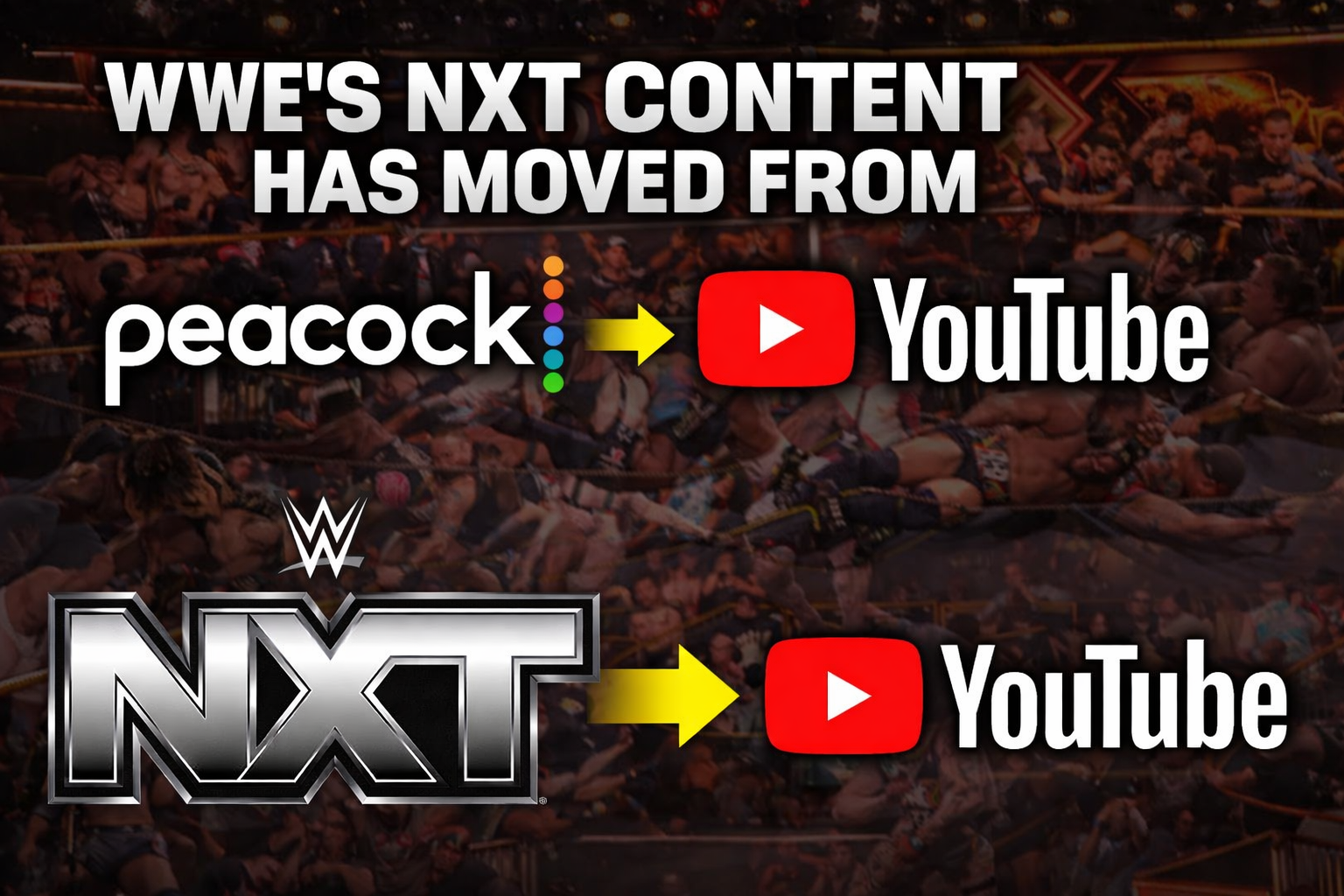
WWE’s NXT library quietly finding a new home on YouTube is the kind of media shift that looks minor on the surface but reveals something much bigger underneath. What began as fans noticing NXT content disappearing from Peacock has turned into a much clearer story: WWE has been repositioning the brand’s archival footprint away from the old subscription-based model and toward a more accessible, public-facing platform. On paper, that is a change in where the content lives. In practice, it feels like an early sign of how WWE and TKO want to handle pieces of the company’s archive going forward.
That is what makes this more significant than a routine streaming update. NXT is not just another section of the WWE library. It is one of the most critically acclaimed brands the company has produced in the modern era, the home of the TakeOver legacy, and the launching point for many of the names who now define WWE television. Moving that history out of Peacock’s ecosystem and into YouTube does not just make it easier to watch. It changes how that history is presented, discovered and used.
Bryan Alvarez was the first to put the story on the radar when he reported that NXT content would be coming off Peacock on March 15. From there, the development took on a clearer shape as follow-up reporting from F4WOnline and POST Wrestling helped connect the dots. What initially sounded like a rights-related removal turned out to be part of a broader transition, with the official NXT YouTube channel becoming an increasingly visible home for full episodes, complete TakeOver events and historic matches.
That distinction is important, because the story is not simply that content left Peacock. The more meaningful point is that WWE clearly had a destination in mind. The company’s official NXT YouTube channel now presents itself as a place for full episodes, complete TakeOver events and archival material, making it clear that this is not just a case of random uploads filling a content gap. WWE has effectively turned YouTube into a real access point for the brand’s history.
There is a major strategic difference between those two homes. Peacock operated as a vault. It was where committed WWE viewers went when they already knew what they wanted to watch and were willing to pay for access. YouTube works differently. YouTube is discovery-driven. It puts NXT’s past in front of casual viewers, lapsed fans and newer audiences who may never have gone looking for old episodes on a premium service but will absolutely click on a full TakeOver or a complete TV episode when it is placed in front of them. For a brand whose identity has always been tied to building future stars, that kind of visibility matters.
That is why NXT makes so much sense as the first major piece of WWE archive content to be handled this way. Its history is rich enough to have real standalone value, but it also remains directly relevant to the present. The black-and-gold era still carries enormous prestige. The TakeOver brand still means something to fans. And the current version of NXT continues to serve as WWE’s pipeline for the next generation. By putting that lineage on YouTube, WWE is not simply preserving the past. It is using the past to strengthen the brand’s present identity and future reach.
The move also fits neatly into comments TKO President and COO Mark Shapiro made months ago when he said the company was pursuing a non-exclusive deal for WWE library content. At the time, that sounded like a broad corporate talking point. Now it reads more like a roadmap. If NXT’s library can live outside the old one-platform model, then WWE is showing that its archive no longer has to function as a single bundled asset tied to one home. Different pieces of the content portfolio can be distributed in different ways depending on what best serves the audience and the business.
That matters because it represents a real philosophical change. For years, WWE fans were conditioned to think of archive access in all-or-nothing terms. First it was WWE Network, then Peacock in the United States. The expectation was that WWE history belonged in one place. NXT’s migration away from Peacock challenges that idea. WWE is no longer treating the library as one giant vault that only has value behind a paywall. It is starting to look at parts of that archive as flexible media assets that can be deployed strategically across multiple platforms.
For Peacock, that is a notable loss in perception even if the broader WWE relationship remains intact. The service was once presented as the definitive domestic home for WWE’s archive. NXT’s removal weakens that image, especially for a fan base that viewed the platform as the natural successor to WWE Network. Once a recognizable and highly valued portion of the company’s history moves elsewhere, the idea of Peacock as the one-stop archive home becomes harder to sustain.
For WWE, though, the upside is obvious. NXT’s archive is no longer locked behind a subscription barrier where only the most deliberate fans will seek it out. It is now positioned on the largest video platform in the world, where full episodes and premium events can become part of a larger audience funnel. A casual viewer can watch one old TakeOver, recognize a current main-roster star in their NXT prime, and suddenly be drawn deeper into WWE’s broader ecosystem. That is not just archive management. That is brand-building.
It also says something about how WWE sees NXT itself. This is not content being dumped into obscurity. It is being placed somewhere highly visible, highly searchable and easy to access. That suggests WWE understands the value of NXT’s legacy and sees it as an active part of the brand rather than a closed chapter. The company is not hiding that history. It is foregrounding it.
That is ultimately why this story matters. The headline version is that NXT content is off Peacock and now widely available on YouTube. The more important version is that WWE has chosen to make one of its strongest archival properties easier to find, easier to revisit and easier to use as a gateway to the current product. Alvarez deserves credit for first bringing attention to the Peacock exit, but the larger takeaway is what the move represents now. This is not just a library update. It is a glimpse into WWE’s evolving media strategy, and NXT appears to be the first major brand to show what that strategy actually looks like.
Make sure to subscribe to our Late Night Crew Wrestling YouTube Channel. Follow @yorkjavon, @kspowerwheels & @LateNightCrewYT on X.

I’m the quiet one until the bell rings then I’ve got takes. I live for WWE NXT and TNA, I want every promotion to succeed, and I will absolutely roast the bad decisions on sight (because someone has to). Anime taught me to respect long-term storytelling; wrestling taught me that sometimes the plan is “we panicked” and called it “unpredictable.” The Miz got me into all of this, so yeah I appreciate confidence, commitment, and the art of talking like you’re already the main event. Now I bring that same energy to the page as the main writer for Late Night Crew Wrestling because if you’re not here to be must-see and tell the truth, why are you here?!