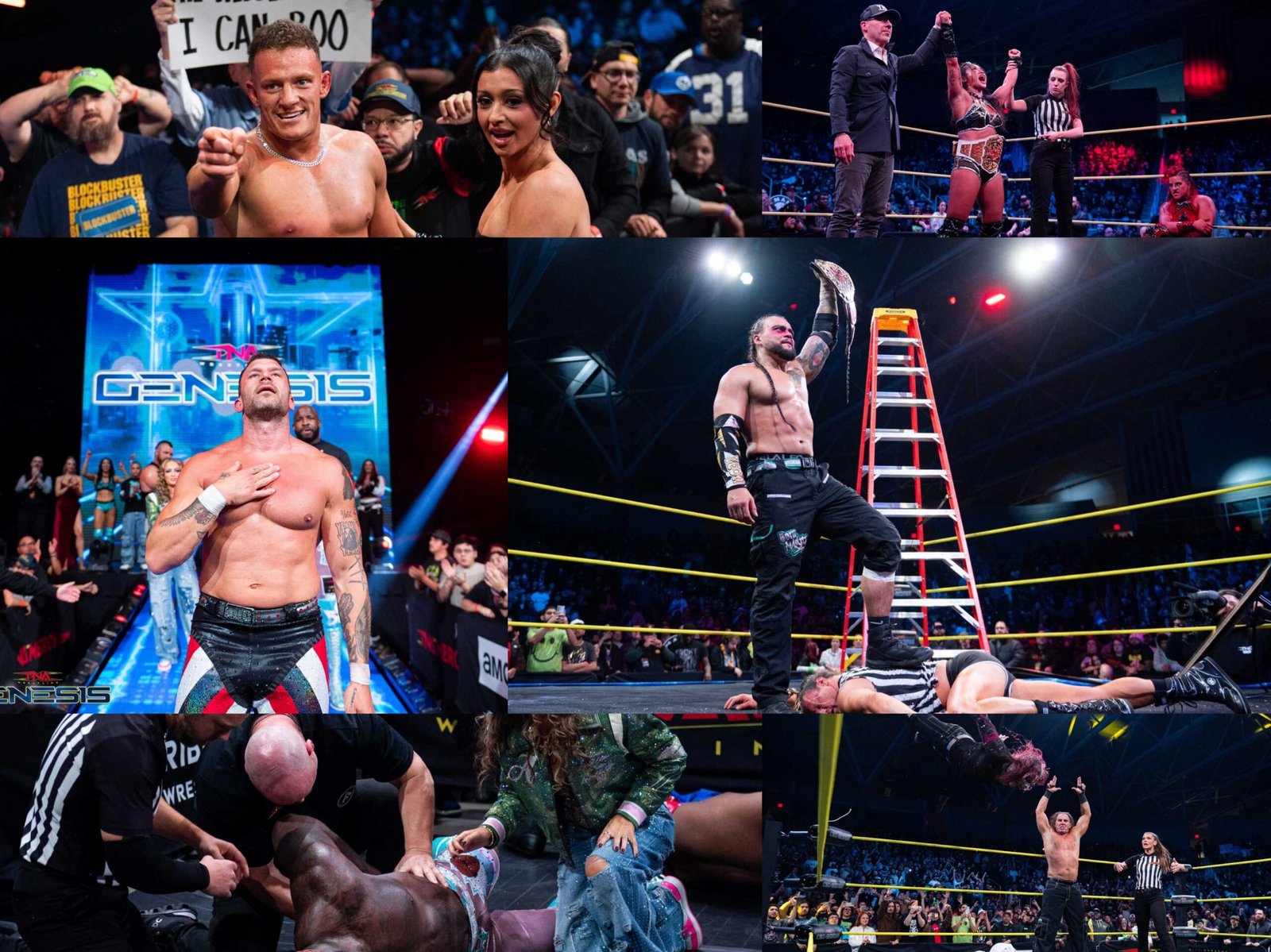
TNA Genesis 2026 arrived carrying a burden few pay-per-views are asked to shoulder. Just days removed from a widely criticized TNA iMPACT! debut on AMC that left fans disengaged and critics questioning the company’s creative direction, Genesis was framed — both internally and externally — as a litmus test. Could TNA reassert its identity? Could it stabilize perception? And could it prove that the AMC stumble was not the defining moment of this new era?
By the end of the night in Garland, Texas, Genesis did not erase every concern — but it did something far more important: it re-centered the company around clarity, wrestling, and forward-moving storytelling. Through decisive championship matches, layered faction involvement, meaningful debuts, and emotionally grounded moments, TNA presented a show that felt intentional rather than reactionary.
Here are the full results
Countdown To Genesis
- Channing “Stacks” Lorenzo (c) defeated KJ Orso, BDE, and Eric Young (TNA International Championship)
- Tessa Blanchard and Mila Moore defeated Indi Hartwell and Vicious Viki
TNA Genesis Main Card
- AJ Francis defeated Rich Swann
- Mustafa Ali defeated Elijah
- Eddie Edwards defeated Johnny Dango Curtis (JDC’s Retirement Match)
- Ryan Nemeth defeated Mara Sadé
- Léi Yǐng Lee (c) defeated Zaria (TNA Knockouts World Championship)
- The Hardys (c) defeated The Righteous (TNA World Tag Team Championship)
- Joe Hendry defeated Cedric Alexander and Moose
- Mike Santana (c) defeated Frankie Kazarian (TNA World Championship – Texas Death Match)
Genesis as a Reset: Match Breakdown, Story Threads, and What Comes Next
If TNA Genesis was designed to answer whether the company could regain control of its narrative after a rocky AMC debut, the most striking takeaway was not any single match — it was discipline. Genesis showed a promotion consciously stripping away excess and re-centering itself around fundamentals: hierarchy, cause-and-effect booking, and letting wrestlers tell stories through action rather than exposition.
Where the AMC debut often felt like it was trying to explain TNA to a new audience, Genesis trusted the audience to feel TNA again.
That philosophical shift informed nearly every creative decision on the card.
World Championship as Tone-Setter, Not Just a Main Event
Mike Santana vs. Frankie Kazarian was booked less like a spectacle and more like a thesis statement.
The Texas Death Match stipulation justified the violence rather than using it as shock value, and Santana’s win was structured around attrition instead of cleverness. That matters. In a post-Genesis landscape, Santana doesn’t feel like a placeholder champion or transitional figure — he feels like the embodiment of the promotion’s renewed ethos: gritty, resilient, and earned.
Just as important was what didn’t happen. Nic Nemeth did not overshadow the match. There was no overbooked swerve. The Call Your Shot contract remained a narrative pressure point rather than a shortcut. After the AMC debut was criticized for clutter and over-explanation, this restraint was not accidental — it was corrective.
Tag Team Booking as a Lesson in Stability
The Hardys retaining the TNA World Tag Team Championship served a structural purpose beyond the match itself.
In moments of creative transition, promotions often overcorrect by tearing everything down. TNA didn’t do that here. By keeping the titles on the Hardys while still presenting The Righteous as credible threats, Genesis emphasized continuity over chaos.
This wasn’t nostalgia booking — it was stabilizing booking. Fans watching in the aftermath of the AMC debut needed familiar anchors, and the tag division provided one. The Hardys didn’t feel like relics; they felt like infrastructure.
Knockouts Division: Layered Storytelling and Clear Direction
No division benefited more from Genesis’ recalibration than the Knockouts.
Léi Yǐng Lee vs. Zaria was a study in controlled escalation. Lee wasn’t portrayed as unbeatable; she was portrayed as adaptable. Zaria wasn’t treated as an invading force; she was treated as a legitimate equal. That balance is critical in cross-promotional matches, especially when perception around outside partnerships is fragile.
The Elegance Brand’s involvement elevated the match without hijacking it — and that choice paid dividends later.
Elayna Black’s post-match confrontation worked precisely because it was understated. In contrast to the AMC debut’s tendency to over-announce and over-explain, this segment trusted visual storytelling. Champion. Challenger. Eye contact. Intent.
When you add The Elegance Brand’s earlier interference in the Knockouts tag match, a clear pattern emerges: the division now has multiple power centers, not a single linear feud. That’s sustainable booking — and something TNA sorely lacked during less stable periods of its history.
International Championship: Reintroducing Opportunity as a Selling Point
The TNA International Championship match did more heavy lifting than it initially appeared.
KJ Orso’s surprise inclusion wasn’t framed as nostalgia or stunt casting. It was framed as access. Genesis quietly reintroduced the idea that TNA is a place where opportunity can still materialize without months of preamble.
Crucially, Orso was allowed to belong immediately. He wasn’t framed as an outsider. He wasn’t protected through comedy. He simply wrestled — and that choice triggered organic fan speculation about his future.
This is how you rebuild goodwill after a misstep: not by announcing change, but by demonstrating openness.
Midcard Matches as Role Definition, Not Filler
One of the AMC debut’s biggest criticisms was that talent felt undefined. Genesis corrected that through clarity.
- Joe Hendry’s win reinforced him as a crowd-driven force without sacrificing competitive credibility.
- Mustafa Ali’s performance continued to sharpen his role as a manipulative tactician rather than a generic workrate villain.
- AJ Francis’ victory further distanced him from novelty and moved him toward legitimacy.
- Ryan Nemeth’s concise win advanced character without overstaying its welcome.
None of these matches tried to do too much — and that restraint was the point.
The Emotional Core as Structural Closure
Johnny Dango Curtis’ retirement match wasn’t placed to spike emotion — it was placed to close a chapter. Eddie Edwards’ role as both opponent and heir apparent reinforced a generational handoff rather than a sentimental goodbye.
After a debut episode criticized for lacking emotional grounding, this moment reminded fans that TNA still understands how to let wrestling breathe.
Did Genesis Deliver the Reset It Needed To?
The answer from fans and critics alike was clear: Genesis was a bounce-back.
The show was widely contrasted with the AMC debut — favorably. Where the debut felt scattered, Genesis felt cohesive. Where television felt overproduced, the PPV trusted wrestling, pacing, and narrative clarity.
One strong event doesn’t solve weekly consistency, but Genesis restored confidence — and in this moment, that mattered most.
TNA iMPACT! – Post-Genesis Direction
Coming out of Genesis, TNA has momentum — and responsibility.
Key threads moving forward include:
- Fallout from Santana’s war and Nic Nemeth’s looming threat
- Elayna Black emerging as a top Knockouts contender
- The Elegance Brand asserting division-wide influence
- International Championship depth expanding with new faces
Final Verdict
TNA Genesis 2026 didn’t promise a new era — it demonstrated what one could look like.
By prioritizing clarity, restraint, and meaningful progression, TNA reminded fans why the brand still matters. Whether that momentum carries into weekly television will determine the future — but for one night, Genesis put the company back on solid ground.
Make sure to subscribe to our Late Night Crew Wrestling YouTube Channel. Follow @yorkjavon, @kspowerwheels & @LateNightCrewYT on X.
I’m the quiet one until the bell rings then I’ve got takes. I live for WWE NXT and TNA, I want every promotion to succeed, and I will absolutely roast the bad decisions on sight (because someone has to). Anime taught me to respect long-term storytelling; wrestling taught me that sometimes the plan is “we panicked” and called it “unpredictable.” The Miz got me into all of this, so yeah I appreciate confidence, commitment, and the art of talking like you’re already the main event. Now I bring that same energy to the page as the main writer for Late Night Crew Wrestling because if you’re not here to be must-see and tell the truth, why are you here?!