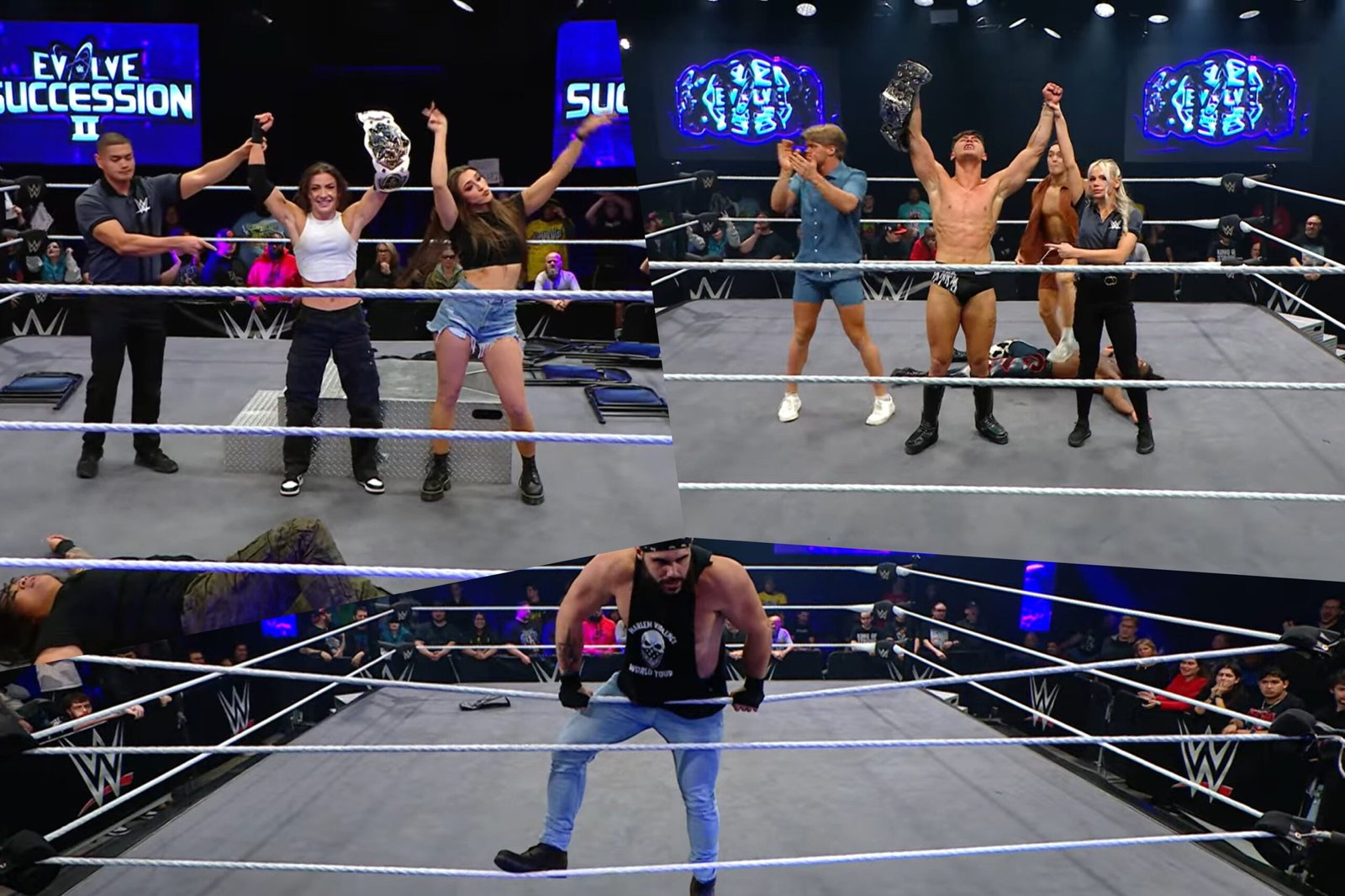
EVOLVE needed a statement episode, not a souvenir. Succession II delivered that kind of “big night” energy by stripping the card down to what matters most: decisive wins, title matches treated like title matches, and one closing image designed to reframe the next chapter. No overbooking. No cheap swerves. Just EVOLVE’s current pillars holding the line—while a new problem kicked the door in and made sure everyone understood the future doesn’t get handed out. It gets taken.
Here are the full results
- Harlem Lewis def. Brooks Jensen
- Kendal Grey (c) def. PJ Vasa (EVOLVE Women’s Championship Street Fight)
- Jackson Drake (c) def. Cappuccino Jones (EVOLVE Championship)
Notable show beats: The Vanity Project spoke backstage; a Laynie Luck vignette aired; security footage showed Kam Hendrix and Harley Riggins attacking Tate Wilder earlier in the day; and Harlem Lewis ended the night attacking The Vanity Project after the main event.
Breakdown, analysis, narratives, and why Succession II mattered
Harlem Lewis vs. Brooks Jensen: the night’s first thesis statement
This opener wasn’t framed as a competitive coin flip. It was framed as a declaration. Lewis didn’t just win—he used the win to articulate intent and position himself as the brand’s next unavoidable force, explicitly setting his sights on the EVOLVE Championship. That’s smart EVOLVE booking: the title picture is never “after the main event,” it’s “through the whole episode,” so your big match already has pressure on it before the bell rings.
What it signals: EVOLVE is quietly making Lewis its most important non-champion. When a show called “Succession” ends with him as the final visual, the brand is telling you exactly who it wants you thinking about the next morning.
Kendal Grey (c) vs. PJ Vasa: a Street Fight built to validate the champion
Street Fights can be lazy shorthand—noise, props, and a finish. This one worked because it was a character test: Vasa as the threat who can drag you into chaos, Grey as the champion who can survive it without losing her identity. The match was designed to make you believe Grey could be knocked off, then designed to make you believe she could endure anything long enough to find one decisive opening.
The important part wasn’t “we used chairs.” It was the feeling EVOLVE chased: Grey didn’t out-muscle the monster—she outlasted her. That’s a champion’s story, and it’s exactly why reviewers came away praising Grey’s upside and the decision not to rush a switch just because the stage was bigger.
The next challenger energy is already in the room. Tyra Mae Steele watching and reacting (and the way the post-match vibe was framed) read like EVOLVE laying the groundwork for the next title conversation—one where Grey’s legitimacy is the target, not just her belt.
Jackson Drake (c) vs. Cappuccino Jones: EVOLVE’s best argument for itself
This is the match that justifies EVOLVE existing in 2026: an earnest, high-stakes title match between two wrestlers the brand is actively trying to elevate, presented with the intensity of a “real” main event rather than a developmental exhibition.
Pro Wrestling Dot Net’s takeaway said it loudest: across the show’s run, this main event belongs in the top tier, and Drake winning clean mattered—no buddies, no shortcuts, no “he escaped.” Drake beat a hungry challenger and looked like a champion doing it.
And that’s where Cappuccino Jones’ night becomes sneakily important. In EVOLVE, the challengers have to matter—because EVOLVE doesn’t have decades of legacy to lean on. This match did the heavy lifting: Jones didn’t feel like a placeholder; he felt like a credible “almost.” That’s how you build a bench.
Then came the real Succession II ending. Harlem Lewis didn’t just confront the moment—he hijacked it, attacking The Vanity Project in the closing stretch and turning the post-main-event airspace into his personal campaign ad. The show didn’t end with Drake celebrating. It ended with EVOLVE’s next storm standing tall.
Praise, criticism, and what the loudest reactions actually mean
What the credible reviews praised
- A “big episode” that felt purposeful. The card was tight, the pacing was direct, and the show treated the title matches like they carried real weight.
- Grey’s continued rise. The Street Fight was framed as the kind of defense that makes a champion feel more complete, not just protected.
- The main event’s quality and Drake’s presentation. That “clean win” detail shows EVOLVE understands perception: if you want fans to buy a new top guy, you can’t constantly give him an asterisk.
Where fans and viewers pushed back
- “Succession” with no title change can feel like a tease. That was the undercurrent in live reactions—if the branding promises turnover, some viewers expect at least one belt to move.
- Street Fight prop fatigue. The live thread’s “big pile of chairs” diminishing-returns critique is a fair warning. EVOLVE can’t let its violence beats become copy-paste visuals.
Here’s the nuance: those criticisms aren’t “the show failed.” They’re evidence EVOLVE is hitting the stage of its growth where audiences start demanding escalation and consequences. That’s a good problem—because it means people are watching with expectations, not just curiosity.
What next week’s Town Hall announcement could be
EVOLVE is advertising a Town Hall with a “major announcement,” and that phrasing isn’t accidental—it’s an admission that the brand wants to define its direction out loud, in front of its own roster and its own audience.
A few realistic lanes EVOLVE could take (and why each makes sense after Succession II):
- A formal EVOLVE Championship pathway (Lewis as the catalyst).
Succession II ended with Lewis forcing himself into the spotlight. A Town Hall is the perfect “authority” wrapper to make his next step feel official: contender series, a #1 contender match, or a mini-tournament that gives EVOLVE multiple weeks of stakes without hot-shotting the belt. - A women’s title direction announcement (Tyra Mae Steele positioned as the next headline).
If Grey is going to keep straddling EVOLVE and bigger platforms, EVOLVE needs clarity: who is her next defense, and what does the division chase look like? A Town Hall can set that structure—especially if the brand wants a “Road to…” arc that culminates in another special. - A brand identity move: expansion, roster drafts, or an “EVOLVE standard.”
EVOLVE’s biggest long-term challenge isn’t match quality—it’s distinctiveness. A Town Hall is where you announce rules, ranking systems, talent showcases, crossovers, or a seasonal format that makes EVOLVE feel like its own ecosystem instead of just “more WWE content.” - A storyline accountability angle (the parking lot attack fallout).
The Tate Wilder attack footage is the kind of incident EVOLVE can use to justify crackdowns, suspensions, or a match type announcement. If Kam Hendrix and Harley Riggins are going to be positioned as chaos agents, the Town Hall is where EVOLVE can “address” it and turn it into bookings with heat.
Final thoughts
Succession II succeeded because it didn’t confuse “special” with “random.” The champions stayed champions, but the show still moved forward—Grey proved she can carry big-match pressure, Drake got the kind of clean main-event win that builds credibility, and Harlem Lewis walked out of the night feeling like the next center of gravity.
The critiques are real, too: EVOLVE can’t brand nights as “Succession” forever without occasionally delivering the dopamine of a true turnover, and the brand has to watch its prop-heavy instincts before they become parody. But if next week’s Town Hall uses Succession II’s closing image as fuel—structure the title chase, define the women’s division direction, and give EVOLVE a clearer identity—then March 4 wasn’t a night of “no changes.” It was the night EVOLVE drew the map for how change is going to happen.
Make sure to subscribe to our Late Night Crew Wrestling YouTube Channel. Follow @yorkjavon, @kspowerwheels & @LateNightCrewYT on X.
I’m the quiet one until the bell rings then I’ve got takes. I live for WWE NXT and TNA, I want every promotion to succeed, and I will absolutely roast the bad decisions on sight (because someone has to). Anime taught me to respect long-term storytelling; wrestling taught me that sometimes the plan is “we panicked” and called it “unpredictable.” The Miz got me into all of this, so yeah I appreciate confidence, commitment, and the art of talking like you’re already the main event. Now I bring that same energy to the page as the main writer for Late Night Crew Wrestling because if you’re not here to be must-see and tell the truth, why are you here?!