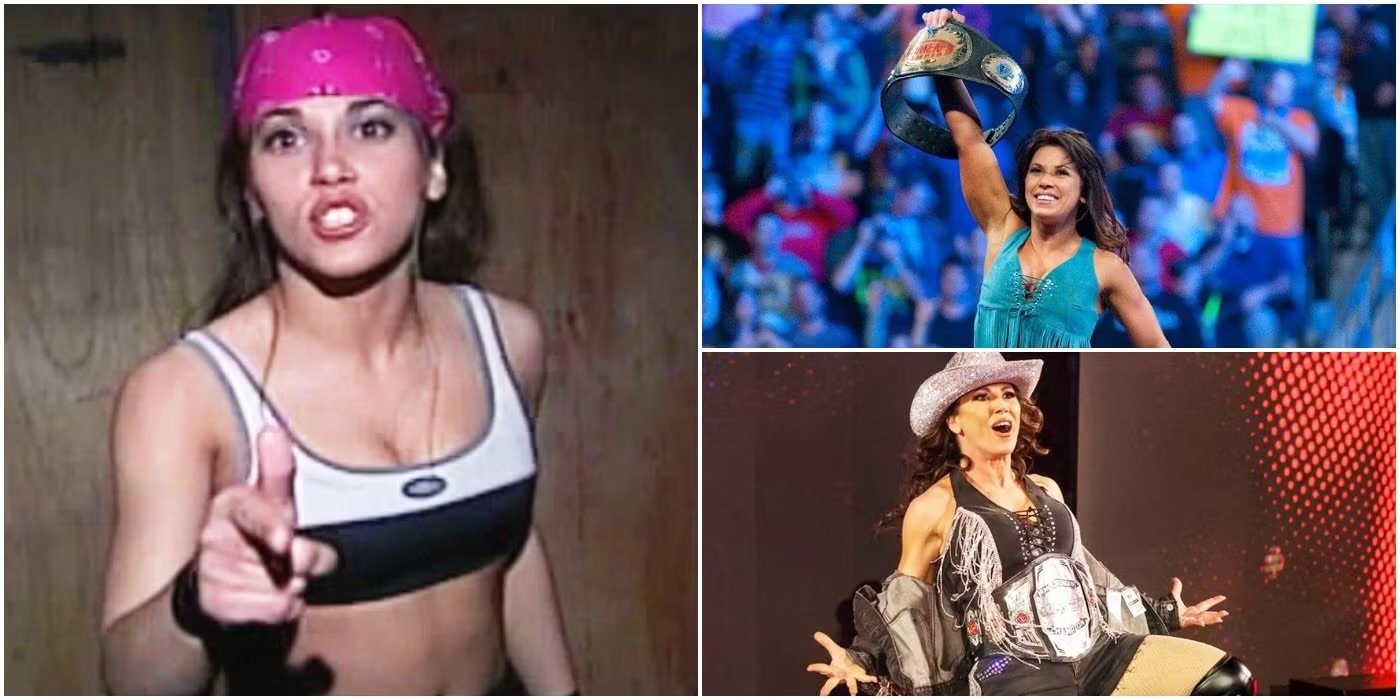
March is Women’s History Month, and Mickie James is the kind of career you spotlight when you want the full picture of women’s wrestling growth—because her legacy isn’t confined to one company, one title, or one “prime.” Mickie’s value has always been that she can take any role—underdog, villain, mentor, champion, threat—and make it feel personal, like the match is about more than the match.
And when she needs to remind you who she is, she doesn’t overthink it. She hits the chorus:
Hardcore Country.
The foundation: Alexis Laree, early TNA, and the wrestler who was always more than the presentation
Before WWE fame, she was grinding as Alexis Laree and getting early national looks—including appearances in NWA: TNA in the early 2000s—before the WWE system polished her into a TV-ready weapon. That background matters because Mickie has never wrestled like someone who needed to be protected by production. She’s always been a performer who could carry.
WWE: Trish Stratus and the obsession angle that made Mickie a star in one storyline
Mickie’s breakout is still one of WWE’s best women’s arcs because it wasn’t a one-week push—it was a slow burn.
The Trish Stratus story worked because Mickie played it in layers: the sweet superfan, the clingy friend, the jealous shadow, then the full flip into obsession. It wasn’t just “crazy girl” storytelling—Mickie made it feel like escalation. Like every boundary Trish set became another trigger.
WrestleMania 22 is the payoff that cemented her: Mickie beats Trish for the Women’s Championship, and it doesn’t feel like a lucky win. It feels like the final scene of a story she controlled from the moment she walked in the door.
From there, her WWE résumé is real history: five-time WWE Women’s Champion and one-time Divas Champion—meaning she stayed relevant through multiple versions of WWE women’s booking, not just one hot period.
TNA/IMPACT: Madison Rayne, Tara/Victoria, and the feud web that made Mickie a Knockouts pillar
If WWE made Mickie famous, TNA made Mickie foundational—because the Knockouts division was built to reward people who could wrestle and anchor long-form storytelling.
Madison Rayne: control, manipulation, and the Title vs. Hair gut-punch
The Mickie–Madison rivalry wasn’t just “face vs heel.” Madison was the champion who needed control; Mickie was the threat who wouldn’t be managed. The tension was always bigger than the belt—Madison was trying to keep the division in her image, and Mickie kept showing up like a wrecking ball.
That’s why Lockdown 2011 still gets talked about: Title vs. Hair, steel cage, and Mickie wins the Knockouts Championship in a blink—so fast it felt like a mugging. That finish wasn’t a mistake. It fit the story: Madison played games, Mickie kicked the door in.
Tara/Victoria: the emotional fuse in the middle of the war
The Tara layer is what gave that era weight. Tara wasn’t just “another body.” She was the wildcard—caught in Madison’s orbit, then breaking free. Mickie’s role in that dynamic made her feel like the division’s truth serum: she exposed who was real and who was performing power.
That’s why Mickie’s TNA work holds up. It wasn’t just matches. It was relationships and consequences—exactly what the best Knockouts storytelling has always been.
The Deonna Purrazzo feud: when modern women’s wrestling in IMPACT got violent on purpose
If you want late-career Mickie at her most serious, it’s Deonna Purrazzo.
Deonna didn’t treat Mickie like a legend who deserved respect—she treated her like a problem that had to be erased. The feud escalated into genuinely personal territory, and it climaxed at Hard To Kill 2022 with a Texas Death Match that went on last. That match mattered because it was IMPACT flat-out saying, “This is the main event, and the women are carrying it.” Mickie retaining wasn’t just a win; it was a statement that she could still headline the heaviest kind of match.
The Royal Rumble crossover: Hardcore Country walks into WWE with the Knockouts title
Women’s History Month is about moments that change what’s “allowed,” and Mickie’s 2022 Royal Rumble entry is one of those.
WWE acknowledged her as IMPACT Knockouts World Champion, she entered with the belt, and she came out to “Hardcore Country.” She entered at No. 20, eliminated Michelle McCool, and got eliminated by Lita—a clean little snapshot of eras colliding, with Mickie presented like she belonged because she did.
That wasn’t just a fun surprise. That was the wrestling world admitting—on WWE’s stage—that women’s wrestling is bigger than one company’s borders.
NWA Empowerrr: how it happened, and why it mattered
This is the Mickie chapter that doesn’t get enough real detail: Empowerrr wasn’t a slogan. It was work.
Mickie served as executive producer for NWA Empowerrr (August 28, 2021), the NWA’s first all-women pay-per-view. She didn’t just attach her name; she helped shape the concept and talent pipeline, pulling in wrestlers across multiple promotions so the show felt like a women’s wrestling showcase, not a token theme night. It drew roughly 900 in the building and did an estimated 3,500 buys—numbers that mattered because it proved a women-led concept could stand on its own as a complete event.
And the success wasn’t just metrics. It was the statement: women’s wrestling doesn’t need permission to be the whole show.
Promotions, championships, and the clean legacy snapshot
Mickie’s career is a multi-company résumé that still reads like a blueprint:
- WWE: 5× Women’s Champion, 1× Divas Champion
- TNA/IMPACT: 5× Knockouts World Champion; cornerstone feuds that defined multiple eras
- NWA: Executive producer of Empowerrr; later became NWA World Women’s Champion (another “top of the card” stamp)
- Plus early work in the indie/NWA:TNA ecosystem that ties the whole timeline together.
The Women’s History Month takeaway
Mickie James is Women’s History Month essential because she’s proof that women’s wrestling history isn’t one lane. It’s a road trip.
She had the iconic WWE storyline (Trish).
She helped hold up the Knockouts division as a long-term pillar (Madison, Tara).
She delivered modern brutality and stakes (Deonna).
She made crossover history (Royal Rumble as Knockouts Champion).
And she helped build a platform for others (Empowerrr).
Hardcore Country isn’t just a gimmick.
It’s the through-line: pride, grit, and a career that never stayed in one box.
Make sure to subscribe to our Late Night Crew Wrestling YouTube Channel. Follow @yorkjavon, @kspowerwheels & @LateNightCrewYT on X.
I’m the quiet one until the bell rings then I’ve got takes. I live for WWE NXT and TNA, I want every promotion to succeed, and I will absolutely roast the bad decisions on sight (because someone has to). Anime taught me to respect long-term storytelling; wrestling taught me that sometimes the plan is “we panicked” and called it “unpredictable.” The Miz got me into all of this, so yeah I appreciate confidence, commitment, and the art of talking like you’re already the main event. Now I bring that same energy to the page as the main writer for Late Night Crew Wrestling because if you’re not here to be must-see and tell the truth, why are you here?!