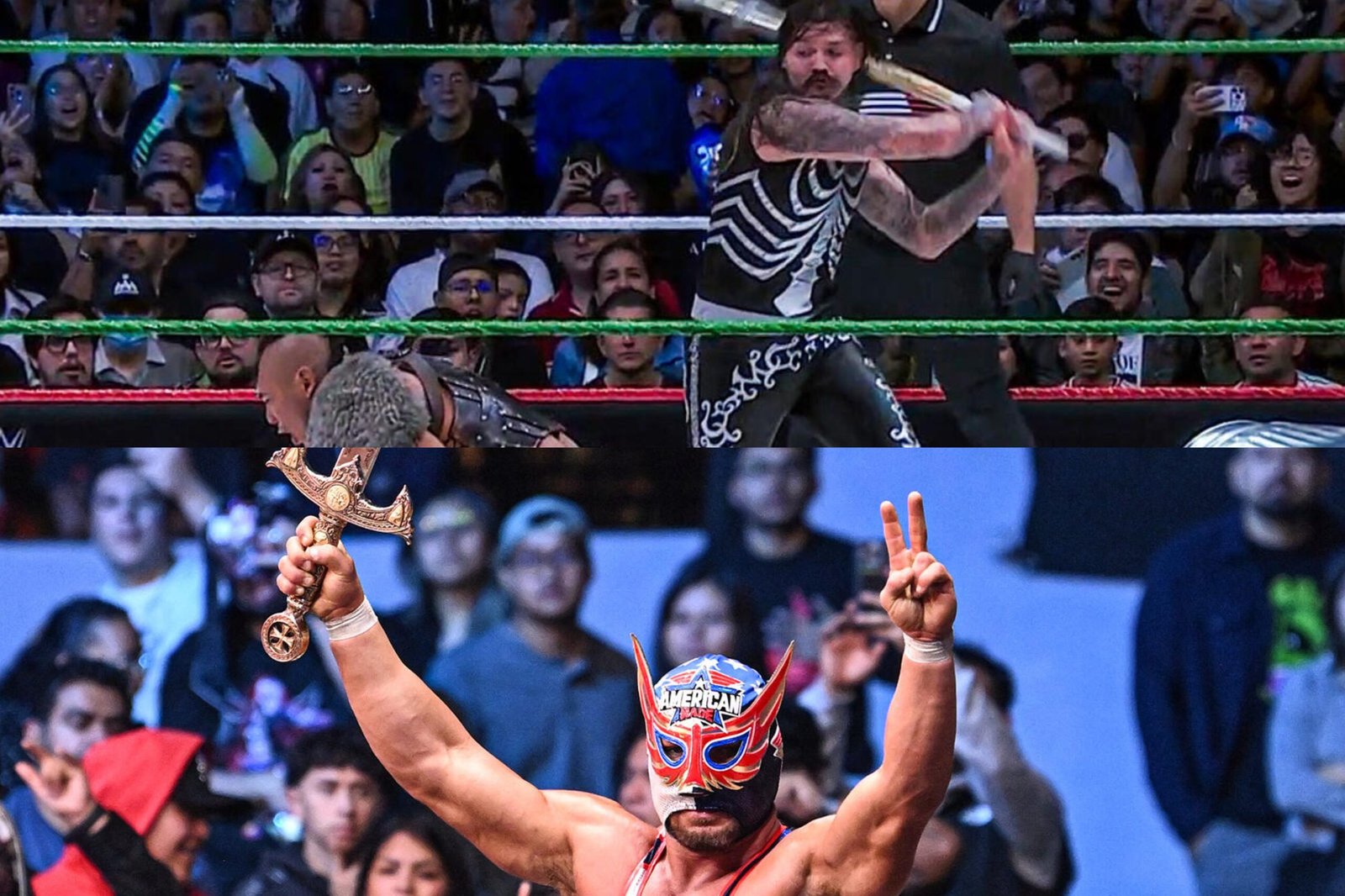
AAA’s Rey de Reyes is a three-week event this year, not a one-night sprint, and that format has helped the promotion make this Puebla presentation feel bigger than a standard television special. This article covers Part I and Part II only, the first two chapters that aired on March 14 and March 21, with Part III still to come on March 28. Through two weeks, Rey de Reyes has already given AAA some of its strongest momentum of the year: Bayley stepping into Flammer’s world, the Lucha Brothers reunion tease giving the show emotional weight, El Grande Americano winning the sword and a future AAA Mega Championship opportunity, and Dominik Mysterio surviving El Hijo del Vikingo in the match that became the biggest talking point of the event for reasons both impressive and troubling. Part II then did the harder job. It did not try to top Part I’s spectacle. It turned that spectacle into fallout, tension, and forward movement. That is why Rey de Reyes has felt important so far. It has not just been busy. It has felt like a promotion trying to make every match, interruption, and escalation matter.
Here are the full results
Part I — March 14, 2026
- Flammer (c) def. Bayley (AAA Reina de Reinas Championship)
- El Grande Americano def. Original El Grande Americano, La Parka, and Santos Escobar (Rey de Reyes Final)
- Dominik Mysterio (c) def. El Hijo del Vikingo (AAA Mega Championship, No Disqualification Match)
Part II — March 21, 2026
- Rey Fenix, Mr. Iguana, and Lola Vice def. La Hiedra, Colmillo de Plata, and Garra de Oro
- Psycho Clown & Pagano (c) vs. The War Raiders ended in a No Contest (AAA World Tag Team Championship)
- Chelsea Green demanded recognition in the AAA Mixed Tag Team title picture
- El Grande Americano’s sword presentation ended in an ambush involving Dominik Mysterio and Original El Grande Americano
- Vikingo, Omos, and Dorian Roldán shifted their focus toward Penta and the Intercontinental Championship
Part I felt major from the moment AAA opened with Rey Fenix and Penta rather than jumping straight into action. That choice mattered. The segment gave the show heart before the chaos started, and it framed Rey de Reyes as more than a bracket and a title defense. Fenix and Penta brought history, family, and expectation into the building, and the tease of the brothers reuniting again gave the event immediate emotional gravity. From there, Bayley answering Flammer’s open challenge gave Part I its first real shot of crossover-star importance. The match worked because Bayley wrestled like a polished outsider entering a volatile environment, while Flammer wrestled with the urgency of someone determined to prove she belonged in that spotlight. The interference finish kept the title on Flammer without undercutting Bayley’s presence, which made the segment feel productive instead of disposable. AAA protected the champion, protected the guest star, and kept the women’s title scene feeling active all at once.
The Rey de Reyes final was the centerpiece of Part I in a different way. It was not elegant, but it was never supposed to be. It was a layered AAA-style pileup of personalities and grudges, and it worked because everyone brought something distinct to it. La Parka brought connection and charisma. Santos Escobar brought menace and name value. Original El Grande Americano brought disruption. El Grande Americano brought the sympathetic hook AAA clearly wanted to build around. The match was full of interference, misdirection, and weapon teases, but the important thing is that it all built toward the right winner. El Grande Americano did not just win a tournament final. He was elevated by it. He left Part I with the sword, the title shot, and the strongest emotional connection of anyone on the show outside of the main event players. That mattered because Part II would ask the audience to care about his ceremony as more than just pageantry. Part I made sure they did.
Then came Dominik Mysterio vs. El Hijo del Vikingo, and that match is the reason the first two parts of Rey de Reyes cannot be discussed honestly in simple good-show, bad-show terms. As a piece of wrestling spectacle, it absolutely delivered. The crowd was hot, the stipulations gave everything extra weight, Dominik was excellent as the champion fighting to survive ugly circumstances, and Vikingo wrestled like a man determined to drag the match into something vicious and unforgettable. But the chair shot changed the entire post-show conversation. Once Vikingo threw the chair into Dominik’s head and the cut became visible, the match stopped being judged only on heat and drama. It started being judged on judgment. That is the hard truth of Part I. There was a strong, chaotic, compelling main event in there. There was also a reckless moment that ended up overshadowing too much of what the match otherwise did well.
Part II was smart enough not to chase the same type of shock. Instead, it played the aftermath and mostly did it well. Rey Fenix, Mr. Iguana, and Lola Vice against La Hiedra and Money Machine was exactly the kind of energetic, character-heavy match this version of AAA needs in the fallout slot. It had pace, personality, comedy, and just enough relational drama to keep it from feeling like exhibition filler. Chelsea Green’s promo was brief but useful, keeping the mixed-tag title story alive without slowing the show down. The World Tag Team Championship match between Psycho Clown and Pagano and The War Raiders gave the episode its physical centerpiece, and the no contest worked because the match was clearly designed to intensify the feud rather than resolve it. The post-match weapon chaos made the belts feel almost secondary to the personal violence now driving the issue, which is often where AAA is most effective.
The most important material on Part II, though, was saved for the sword presentation and the angles around it. El Grande Americano’s ceremony gave his tournament win real symbolic weight, which is exactly what it needed. AAA brought in history, gave the moment ceremony, and let him stand in the glow of the victory long enough for it to matter. Then Dominik Mysterio arrived, offered congratulations, and the whole thing immediately turned into another trap when Original El Grande Americano attacked. It was a good wrestling angle because it took a ceremonial segment and made it dangerous without making the earlier tournament feel pointless. At the same time, the backstage Vikingo segment with Omos and Dorian Roldán made it clear AAA is not portraying Vikingo as regretful after the Dominik match. It is portraying him as frustrated, unstable, and ready to redirect that obsession toward Penta. That is strong forward booking. It is also a choice that becomes more divisive when the audience is already debating whether the Dominik match went too far.
Reactions and Breakdown
The reaction to Rey de Reyes through its first two parts has been split in a way that actually captures the event well. On one side, there has been real praise. Part I was treated by major wrestling sites as a meaningful event rather than side programming, and Part II was treated as consequential fallout rather than a throwaway follow-up. That says a lot. AAA has succeeded in making Rey de Reyes feel alive. The crowds have sounded invested, the presentation has felt urgent, and the promotion has created a version of television that feels more combustible and less over-sanitized than most mainstream wrestling. Even when the booking gets chaotic, it often feels like chaos with purpose rather than noise for its own sake. That energy has been one of the defining strengths of the first two weeks.
The praise is easy to understand. Bayley added immediate gravity to Part I. El Grande Americano got elevated in a way that felt deliberate and effective. Rey Fenix gave Part II instant momentum. The tag title scene got rougher without feeling repetitive. The sword presentation turned a tournament win into something with visual and symbolic value. That is the kind of connective tissue good event television needs, and Rey de Reyes has had more of it than most wrestling specials manage. The first two parts have felt like chapters in the same story, not random content blocks arranged under one banner.
But the central criticism of Rey de Reyes remains the unprotected chair shot Vikingo delivered to Dominik Mysterio’s head in Part I. That criticism is not nitpicking. It is grounded in the spot itself, the visible injury, Dominik later sharing the wound on social media, WWE commentary noting on Raw that he was not medically cleared, and later reporting that he was in concussion protocol. Once that became the aftermath, the spot stopped being something that could be brushed off as part of a wild no disqualification match. It became the decision that most damaged the conversation around the show.
That is also where your criticism is strongest and most persuasive. Saying the chair shot was unnecessary, reckless, and harmful to Dominik’s short-term availability is a fair reading of what happened. The match already had enough: stipulations, interference, blood, heat, weapon use, and a crowd ready to react to every escalation. It did not need that spot to become memorable. In that sense, your criticism lines up with the hardest credible critique of Part I. AAA already had a gripping main event and still reached for something more dangerous than it needed. That is not toughness. That is poor judgment.
Where your criticism moves beyond what the sourced reporting firmly proves is in the broader claim that Vikingo has become an unsafe worker overall and a deterrent to AAA’s success. The available coverage does not establish that larger pattern. In fact, some of the same reaction praised the overall match, the event atmosphere, and Vikingo’s heel performance even while treating the chair shot and injury fallout as serious problems. So the sharper version of the argument is narrower and stronger: on this night, in this match, Vikingo was responsible for the most indefensible moment on the show, and that moment put an avoidable stain on an otherwise successful event. That claim is well supported. The bigger claim about his overall value to AAA is still more opinion than proven case.
Santos Escobar’s injury story added another layer to the conversation because it reinforced how physically costly this Rey de Reyes cycle has been. Public reporting after the event indicated that Escobar worked Rey de Reyes while hurt, aggravated a torn triceps around the show, and then underwent surgery that is expected to keep him out for months. That injury story was tied to his AAA work around Rey de Reyes, though not to the Dominik-Vikingo main event itself. Even so, it fed the larger perception that this event felt dangerous because AAA wanted it to feel dangerous, and that line can be thinner than a promotion wants to admit. When a show earns praise for intensity and also leaves behind real injury fallout, the conversation will naturally become more complicated than simple thumbs up or thumbs down.
That is why Rey de Reyes Part I and Part II have been both successful and frustrating. The success is obvious. The shows have felt major, the matches have carried real stakes, and the angles have created genuine anticipation for what comes next. The frustration is just as obvious. One reckless moment in the biggest match of the event changed the tone of the aftermath and gave critics a legitimate reason to question whether AAA confused escalation with necessity. That does not erase what the event got right. It does mean the first thing many people will remember is not just Dominik retaining or El Grande Americano winning the sword. It will be the chair shot and the fallout that followed.
What was announced for Part III of Rey de Reyes
AAA has already made Part III feel like a real final chapter rather than an afterthought. The biggest announcement is that Hijo del Vikingo will call out Penta, continuing the direction teased in Part II when Dorian Roldán redirected Vikingo’s frustration toward the Intercontinental Championship. Also announced is Abismo Negro vs. El Fiscal, another chapter in their ongoing rivalry over the Abismo Negro name. The title match announced for the March 28 episode is a AAA World Cruiserweight Championship four-way, with Laredo Kid (c) defending against Dragon Lee, TJ Perkins, and Jack Cartwheel. Those additions give Part III a clear identity: fallout from the first two weeks, another layer of inter-promotional star power, and at least one title match that could easily steal the show.
Final Thoughts
Through two parts, Rey de Reyes has done an impressive job of making AAA feel consequential. Part I gave the event its biggest peaks so far, from Bayley’s challenge to El Grande Americano’s tournament triumph to Dominik surviving the kind of main event people were always going to be talking about. Part II then did the less glamorous but equally important work of turning those developments into momentum. That is why Rey de Reyes has connected. It has not felt disposable, and it has not felt like content for the sake of content.
At the same time, the first two parts have exposed AAA’s biggest risk. The promotion is at its best when it feels wild without feeling careless. Rey de Reyes crossed that line at least once, and the aftermath made sure the audience could not ignore it. So the most honest verdict is not that Rey de Reyes Part I and Part II were a failure. They were not. They were compelling, eventful, and in several places genuinely excellent. They were also a reminder that one reckless decision can hijack the conversation from everything else a promotion worked hard to get right.
Make sure to subscribe to our Late Night Crew Wrestling YouTube Channel. Follow @yorkjavon, @kspowerwheels & @LateNightCrewYT on X.
I’m the quiet one until the bell rings then I’ve got takes. I live for WWE NXT and TNA, I want every promotion to succeed, and I will absolutely roast the bad decisions on sight (because someone has to). Anime taught me to respect long-term storytelling; wrestling taught me that sometimes the plan is “we panicked” and called it “unpredictable.” The Miz got me into all of this, so yeah I appreciate confidence, commitment, and the art of talking like you’re already the main event. Now I bring that same energy to the page as the main writer for Late Night Crew Wrestling because if you’re not here to be must-see and tell the truth, why are you here?!