Last night’s AEW Dynamite felt like one of those shows that quietly did a lot more heavy lifting than it may get credit for at first glance. On paper, the hook was obvious: Darby Allin’s first AEW World Championship defense against Tommaso Ciampa just one week after he shocked MJF and won the title. In execution, though, Dynamite was about far more than one main event. It was about the shape of AEW’s post-Dynasty landscape, the way Darby’s reign is already being framed as brave, reckless and probably unsustainable, the way MJF immediately pivoted from outrage to opportunism, the way Mark Davis and Will Ospreay tore into each other like former brothers trying to prove something personal, and the way several stories moved forward without the show ever feeling cluttered. By the end of the night, AEW had not only given Darby a bloody, hard-earned first defense, it had lined up Brody King as the next challenger, set MJF on a collision course with Kevin Knight’s TNT Title, deepened the mystery around the Death Riders and Ospreay, and dropped just enough for Collision and Double or Nothing to make the road ahead feel active. That is why this episode worked: it was violent, focused, story-heavy and purposeful from top to bottom.
Here are the full results
- Brody King def. Lio Rush
- Hikaru Shida def. Mina Shirakawa
- Mark Davis def. Will Ospreay via doctor stoppage
- Samoa Joe def. Cody Chhun
- Darby Allin (c) def. Tommaso Ciampa (AEW World Championship)
Breakdowns & Reactions
Dynamite opened with MJF doing what MJF does best after a loss: taking a real grievance, wrapping it in ego, and turning it into a tantrum. He called last week the “Seattle Screwjob,” ran through his timeline from beating Kenny Omega at Dynasty to being thrown into a title defense days later, and tried to frame Darby’s win as something illegitimate rather than something he simply could not stop. It was classic self-serving MJF, but it was effective because it also fit the broader storyline. AEW didn’t pretend last week happened in a vacuum. MJF’s anger had context. The twist was Kevin Knight cutting him off before Darby ever got there. Knight’s interruption gave the segment energy, and more importantly, it gave MJF a new lane. Instead of spending the whole night chasing a rematch, he sniffed around the TNT Title, insulted Knight as someone with a ceiling, baited him into putting the belt on the line, then ducked the fight and pushed it to next week. That was a smart heel move and a smart bit of booking. It protected the title match with Darby from being overshadowed, advanced Knight as a proud fighting champion, and kept MJF in the center of the show without burning through a bigger rematch too early. A lot of online reaction leaned into that same idea: people liked the bait-and-switch because it felt like MJF weaponizing cowardice instead of simply stalling the story.
The first match, Brody King vs. Lio Rush, was an effective contrast piece. Lio wrestled the match the only way it made sense for him to wrestle it: evasive, annoying, opportunistic and constantly trying to turn Brody’s size against him. Brody, meanwhile, had to work through movement, speed and an arm issue that became part of the story after he crashed into the barricade. Rush bit his hand, targeted the arm, hit the rebound stunner, torpedoed into him on the floor and landed the frog splash, but Brody’s kickout at one was the turning point that told you the comeback was coming. From there it was the sidewalk slam, cannonball and Gonzo Bomb. Simple, strong and exactly what it needed to be. What mattered just as much was what came after. Brody didn’t just call his shot randomly. He tied it to Darby, praised him, then warned him violence was still coming. That gave next week’s title match a personal edge instead of making it feel like a filler defense. Fans seemed to respond well to that too, because it came off less like a manufactured contender setup and more like a collision between two guys with history and mutual respect who both know how ugly things can get.
The Jericho and The Demand material was one of those mid-show threads that could have felt throwaway if the payoff were weak, but the Hurt Syndicate reveal gave it real weight. The backstage exchange itself was light, with Jericho riffing on Ricochet’s line about getting his ass beat every week and saying he did not need friends, only people who dislike Ricochet. On its own, that was fine. Nothing amazing. The reveal later that Bobby Lashley and Shelton Benjamin were the partners, with MVP punctuating it by saying, “It’s not personal; it’s business,” instantly made the whole thing matter more. It turned a comedy-leaning setup into a much more serious Collision hook. It also gave Collision a marquee six-man without overcomplicating the story. The angle drew attention online because it was a legitimately strong visual and a useful piece of brand power for Saturday’s show.
Ciampa’s pre-main event promo deserves credit because it framed the title match as more than a random challenger-of-the-week defense. He leaned into everything he has been told he is not, then reframed the moment around family, sacrifice and the idea that “glass ceilings are imaginary.” That gave the match emotional texture before the bell ever rang. This mattered, because everyone probably expected Darby to retain, but promos like that are what make a title defense feel alive anyway. Ciampa sounded like a man who understood this was not just an opportunity but maybe the opportunity. That came through later in the match when he wrestled like somebody trying to force the company to believe in him.
Cope’s challenge to FTR was one of the more divisive talking points from the show. He proposed one more crack at the AEW World Tag Team Titles at Double or Nothing, a New York Street Fight, with the added stipulation that if he and Christian lose, they retire as a team. The segment did its job in terms of raising stakes, but this was also one of the places where some of the post-show criticism landed. A few reactions and recaps saw the stipulation as a big hook; others felt like it risked redundancy after the chaos of the last match rather than offering a truly fresh direction. That split reaction makes sense. The angle is undeniably high stakes, but whether it feels necessary will depend on execution from here.
Hikaru Shida vs. Mina Shirakawa was one of the more story-dense matches on the show, and that was to its benefit. Before the bell, the tension already existed because Mina suspected Shida in the attack on Toni Storm, and Shida’s insincere “great style of Japanese wrestling” line fed the sense that something was off. Once the match started, Mina’s focus on the legs gave the bout shape. She built toward the figure four, mixed in the spinning backfist, dropkick and top-rope slingblade, and kept the pressure on. Shida, meanwhile, felt like somebody always looking for an angle rather than a straight-up sporting contest. That is why the finish worked. Shida reaching for the kendo stick, Mina catching it, Statlander intervening because Mina was “better than that,” and then Mina immediately eating the knee and Falcon Arrow was not just overbooked chaos for the sake of it. It advanced multiple relationships at once. Shida looked sneaky. Mina looked justified in being suspicious. Statlander looked well-meaning but naive. Then the post-match embrace from Shida made it even murkier. Wrestling sites generally praised the match for exactly that reason: it was not just action, it was story progression disguised as action.
The Okada-Takeshita video package was brief, but it mattered because AEW continues to position that Double or Nothing match as something bigger than stable-mates clashing. Okada’s line that Takeshita is not a champion sharpened the rivalry and gave the eventual title match a clean piece of disrespect to build around. It was efficient television.
The Collision setup segment that announced the 10-man tag was another example of Dynamite staying disciplined with time. Rather than wasting minutes on a long in-ring promo, AEW used the aftermath of last week’s Collision and The Dogs’ attack to slot the Young Bucks and Rascalz against The Dogs plus Death Riders in a ten-man for Playoff Palooza. It was quick, logical and useful. That same approach helped the show feel busy without feeling bloated.
Mark Davis vs. Will Ospreay was the most surprising result of the night and, depending on taste, arguably the best match bell to bell. The structure was strong from the start: Ospreay came in taped up, Davis came in furious, and the match immediately centered on power and accumulated damage. Davis shoulder-blocked him to the floor at the bell, rammed him into the barricade, and kept making the size difference feel real. Ospreay’s answers were explosive and desperate rather than dominant: the steps spot, the flying headscissors, the springboard elbow, the cannonball senton off the stage, the corkscrew kick, the forearm to the back of the neck, the Spanish Fly, the Hidden Blade counters. The match kept escalating, but it always came back to the same story: Ospreay could create moments, but Davis could crush him with one opening. The three backdrop suplexes, the lariat counters and especially the apron piledriver made Davis feel vicious rather than just large. Then AEW swerved the audience by actually doing the doctor stoppage. That finish hit because the show had already emphasized Ospreay being barely cleared and because the doctor specifically ruled him unable to continue due to lack of feeling in his arm. It was not a lazy stoppage; it was a story stoppage. Cageside, in particular, singled this out as one of the night’s strongest pieces and praised the shock value of the result. A lot of fan reaction online echoed that surprise, especially because Ospreay losing on Dynamite still feels rare enough to matter.
The aftermath made the Ospreay story even more interesting. Davis looked ready to pile-drive him again, then Marina Shafir appeared, Moxley and the Death Riders surrounded the ring, and they carried Ospreay away through the crowd. AEW had already teased interest in Ospreay last week, so this did not come out of nowhere. It deepened the mystery. Are the Death Riders recruiting him, protecting him, manipulating him, or trying to own a piece of the chaos around him? That ambiguity is the hook, and it was one of the more discussed angles coming out of the show because it did not explain itself immediately.
Alex Windsor’s backstage segment with Persephone was short but functional. The key point was that Jamie Hayter is still not medically cleared following Dynasty, Windsor still wants payback against Thekla and the Triangle of Madness, and Persephone stepped in to team with her on Collision. That is enough for now. AEW didn’t overdo it.
Samoa Joe’s return was not elaborate, but it was satisfying. The company framed it as his first action in more than three months after being medically cleared that day. Cody Chhun got a little offense and a brief flash of resistance, even escaping an early setup and firing a right hand, but once Joe settled in with the jabs, headbutts, running elbow and Muscle Buster, the point was made. Joe is back, Joe is dangerous, and The Opps are more complete with him standing next to HOOK again. The one fair criticism is that the segment could have used a little more promo meat afterward, because Joe’s presence is usually too valuable to leave entirely to aura. Still, for a reintroduction, it worked.
Then came Darby’s champion promo, and this is where the whole show snapped into its real identity. The “you deserve it” chants, Darby placing the title on the mat, the references to Portland, his family, the sherpas who helped him on Everest, and the idea that he only has “a 15-minute ride” with this championship all fed the same theme: Darby does not see the title as security, he sees it as a fuse. That is a compelling way to present a new champion because it is not about reign length or dominance. It is about sincerity, risk and self-destruction. MJF interrupting him one more time before the match was a strong choice because it reinforced the contrast. MJF sees the belt as property. Darby sees it as a test. Darby refusing a rematch unless MJF puts something on the line also made him sound like a champion opening the door to the whole locker room rather than just reliving the same grudge. And Ciampa kissing MJF on the cheek on his way to the ring was one of the best little character beats of the night. It was ridiculous in the best possible way because it undercut MJF and sharpened Ciampa’s edge at the same time.
The main event delivered exactly the kind of violent, scrappy, borderline-unhinged title defense AEW wanted for Darby’s first night as champion. It started hot, never really settled down, and constantly blurred the line between strategy and self-harm. Darby’s early Coffin Drop to the floor set the tone, but Ciampa quickly took over by driving him into the announce desk, barricade and metal frame under the ring. Darby’s counter through the timekeeper’s area blew the match open visually because that is when Ciampa came up bleeding. From there, the match became progressively nastier. Ciampa using the referee to block Darby’s route, knocking him off the top, exposing the turnbuckle, and then hitting the Psycho Driller to the floor gave the challenger a mean streak the match absolutely needed. Darby’s counters were not “clean” in the traditional sense; they were survival bursts. The improvised top-rope stomp, the Code Red, the near-fall escapes, and the willingness to keep taking punishment all fit the champion’s character. The finishing stretch was laid out really well too. Ciampa threw knee after knee, landed Project Ciampa, and still could not keep Darby down. Then he got arrogant. He tried to use the Scorpion Death Lock, took too long, and Darby reversed it to force the tap. That was smart because it protected Ciampa without making Darby look lucky. Darby won through grit and opportunism, exactly the way this reign is being framed. A lot of the strongest praise after the show centered on the same points: the pace, the physicality, the blood, and the idea that Darby’s title matches may become events built around seeing how much damage he can absorb before the body finally gives out. That is a dangerous formula in every sense, but it is undeniably compelling television.
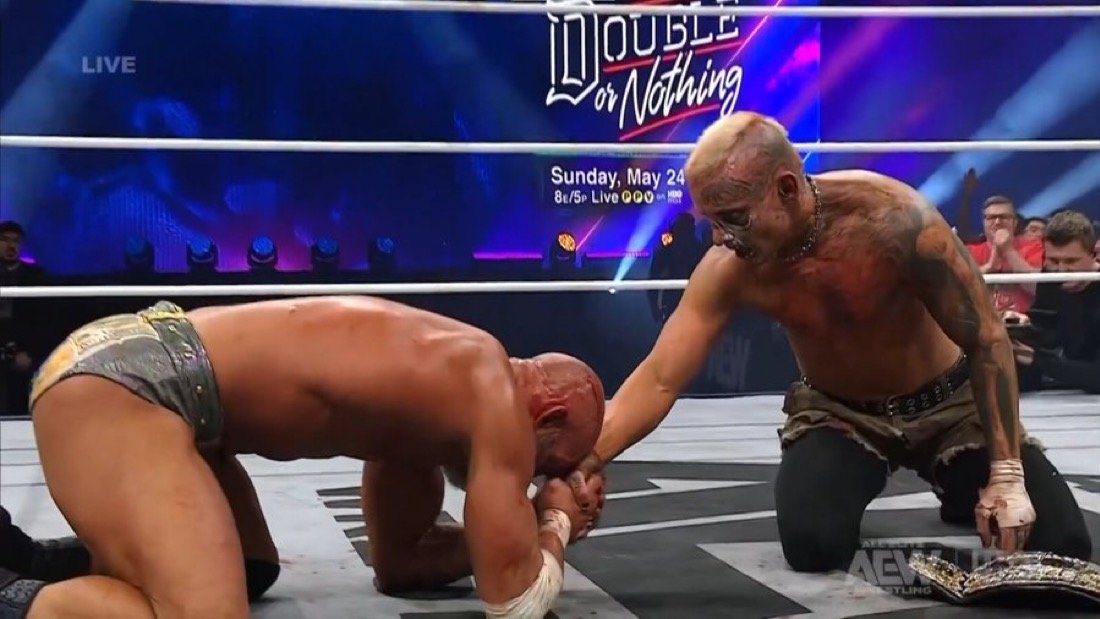
What also helped the main event was the respect at the end. Ciampa bowing, placing the title on Darby’s shoulder and applauding him on the way out kept the match from feeling like just another bloody war. It made it feel like a meaningful title defense. Then Brody King stepping in immediately after, telling Darby he had spoken to Tony Khan and officially challenging him for next week, kept the show from drifting into post-main-event dead air. Darby accepted, they shook hands, and AEW closed with the image of a champion who just survived one beating and already volunteered for another. That is the story. That is the reign. Whether it lasts or not, AEW knows exactly what kind of champion Darby is supposed to be.
As far as broader praise and criticism go, last night’s consensus leaned pretty positive. Cageside graded the show an A- and highlighted both Darby vs. Ciampa and Davis vs. Ospreay, while also calling Darby’s reign “car crash theatre,” which honestly is the cleanest way to describe what AEW is doing with him right now. The most common praise points were that the show connected its promos and matches well, advanced multiple stories with purpose, and made the world title scene feel active immediately after a major change. The most common criticism points were smaller and more selective: some questioned whether Cope and Christian vs. FTR really needs another escalation, and some wanted a little more substance around Joe’s return beyond the squash. But overall, Dynamite felt like a show that left people with hooks rather than loose ends, and that is the biggest compliment you can pay a weekly wrestling show.
What was announced for this Saturday’s AEW Collision and next week’s AEW Dynamite
AEW Collision Playoff Palooza
- Chris Jericho, Bobby Lashley & Shelton Benjamin vs. Ricochet, Bishop Kaun & Toa Liona
- Orange Cassidy, Roderick Strong & Kyle O’Reilly (c) vs. Andrade El Idolo, Hechicero & Lance Archer (AEW World Trios Championships)
- Jack Perry (c) vs. El Clon (AEW National Championship)
- The Young Bucks, Dezmond Xavier, Zachary Wentz & Myron Reed vs. Clark Connors, David Finlay, Claudio Castagnoli, Wheeler Yuta & Daniel Garcia
- Persephone & Alex Windsor vs. Thekla & Skye Blue
- Kris Statlander in action
- RUSH vs. Adam Priest
Next week’s AEW Dynamite
- Kevin Knight (c) vs. MJF (TNT Championship)
- Darby Allin (c) vs. Brody King (AEW World Championship)
Final Thoughts
Last night’s Dynamite was a strong, layered follow-up show that understood exactly what it needed to accomplish. It had to prove Darby Allin’s title win was not just a moment but the start of a compelling reign, and it did that. It had to give MJF a direction without rushing back to the obvious rematch, and it did that. It had to make Ospreay and Davis feel consequential beyond a grudge match, and it absolutely did that. It had to set up Collision and next week’s Dynamite without turning the episode into a commercial, and it pulled that off too. Most importantly, it felt like a wrestling show where things happened for a reason. The matches had consequences. The promos had connective tissue. The stories moved. AEW does not always strike that balance this cleanly on weekly TV, but last night it did. Darby vs. Ciampa gave the show its blood and heart, Ospreay vs. Davis gave it its shock, and everything around those matches gave it structure. That is why Dynamite came away feeling not just good, but genuinely important.
Make sure to subscribe to our Late Night Crew Wrestling YouTube Channel. Follow @yorkjavon, @kspowerwheels & @LateNightCrewYT on X.
I’m the quiet one until the bell rings then I’ve got takes. I live for WWE NXT and TNA, I want every promotion to succeed, and I will absolutely roast the bad decisions on sight (because someone has to). Anime taught me to respect long-term storytelling; wrestling taught me that sometimes the plan is “we panicked” and called it “unpredictable.” The Miz got me into all of this, so yeah I appreciate confidence, commitment, and the art of talking like you’re already the main event. Now I bring that same energy to the page as the main writer for Late Night Crew Wrestling because if you’re not here to be must-see and tell the truth, why are you here?!