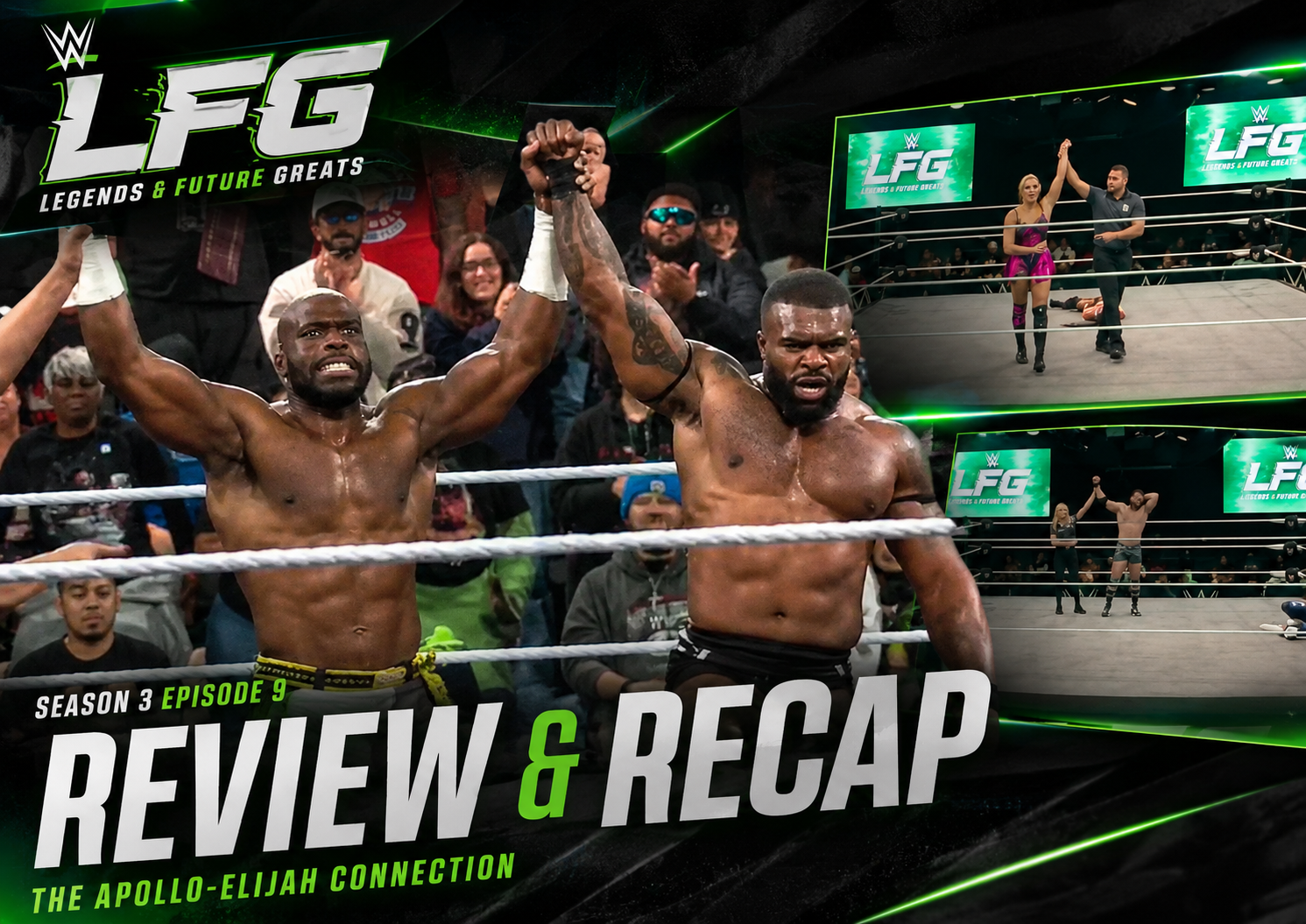
WWE LFG Season 3 reached Episode 9 last night with “The Apollo-Elijah Connection,” and this was one of those episodes that worked best when it remembered exactly what this season has become.
This is not really the same LFG from the first two seasons anymore. Through the first eight episodes, Season 3 has slowly moved away from the old team format, points system and coach-versus-coach competition energy. Episode 1, “A New LFG,” reset the whole show by making it clear there were no more teams, no more points and no more waiting around for a traditional NXT contract prize. It was a needed change because the old format had started to feel fake once so many of these names were already active around NXT, EVOLVE or the Performance Center system.
Episode 2, “All on the Line,” pushed that new direction harder by getting into the first tag match of the season and showing how quickly the coaches wanted the Future Greats to stop wrestling like trainees and start thinking like TV performers. Episode 3, “What’s in a Name?,” focused heavily on Anthony Luke becoming Kam Hendrix and showed how much WWE cares about names, presentation, attitude and whether a wrestler can make a new identity feel real instead of just wearing it like a costume.
Episode 4, “Walk on the Wild Side,” brought in Terry Taylor for a WrestleMania-sized lesson and started digging deeper into the emotional side of wrestling. That episode really made it clear that LFG is not just about who can hit moves. It is about who can make an audience believe something. Zena Sterling was a big focus there too, and her season has honestly been one of the more interesting ones because WWE clearly sees something in her, but the show has also not been afraid to point out that she still needs more fire, more anger and a stronger identity.
Episode 5, “Knock ‘em Out!,” brought Elijah Holyfield back after a long injury hiatus, and that has quietly become the spine of the season. Elijah has the look, the family name, the athletic background and the kind of physical credibility WWE loves, but the question has been whether he can turn all of that into actual pro wrestling presence. Episode 6, “Perception Is Reality,” gave us Elio LeFleur and Mike Derudder in a main event that showed just how useful this new format can be when the coaches are actually helping these wrestlers sharpen what they already do well instead of forcing a reality competition around them.
Episode 7, “Crews Control,” was the biggest turning point for Elijah because he got to face Apollo Crews one-on-one. Apollo brought the kind of veteran steadiness that exposed what Elijah still needed to learn without making him look bad. Elijah had to work, sell, listen, slow down and understand that being explosive is only valuable if the explosion comes at the right time. Then Episode 8, “A Brand New Zena,” gave Chris Island his best performance of the season, reminded everyone that Nikkita Lyons already carries herself like someone closer to TV-ready, and kept the Zena Sterling question alive because progress is good, but progress alone does not make somebody feel complete.
That is what made Episode 9 interesting.
This week was not the biggest episode of the season. It was not the most dramatic. It did not have one match that completely changed the conversation. But it was a very useful episode because every match had a purpose. Harlem Lewis and Braxton Cole were there to work on character, psychology and control. Zena Sterling and Sirena Linton were there to work on aggression, selling and emotional conflict. Apollo Crews and Elijah Holyfield teaming together was there to see if Elijah could take what he learned from Apollo and apply it while standing next to him instead of across from him.
That is where this version of WWE LFG is at its best.
Not fake drama. Not forced competition nonsense. Just wrestlers getting coached, going out there, getting exposed in good and bad ways, then having to stand there and listen when the people who know better tell them what actually happened.
Here are the full results
- Harlem Lewis defeated Braxton Cole
- Zena Sterling defeated Sirena Linton
- Apollo Crews and Elijah Holyfield defeated Jaime Garcia and Malik Blade
Breakdowns & Reactions
Harlem Lewis def. Braxton Cole
Grade: B-
Harlem Lewis and Braxton Cole opened the in-ring portion of the episode with a match that was not spectacular, but it did exactly what it needed to do.
This was less about blowing the roof off and more about seeing whether both men could take Booker T’s coaching and turn it into something that made sense once the bell rang. Booker worked with both of them before the match and focused heavily on Braxton Cole’s heel work. The point was simple but important: being a heel does not mean acting like a cartoon villain every second. It is about timing, arrogance, body language, control and knowing when to turn the volume up without making everything feel fake.
That was a big note for Braxton because his character can easily become too gimmicky if there is nothing underneath it. The “nerd” presentation gets a reaction, and the crowd chanting at him showed that, but being memorable for the surface-level character is not enough. He has to make that character useful inside the match.
To his credit, Braxton did some of that here.
The match started a little soft, and Booker clearly did not love the weak opening lockup, but once Harlem established control, Braxton found a lane. Harlem used the side headlock, shoulder tackle and slam to show his size and physical advantage early. Braxton then cut him off with the stun-gun and immediately shifted into neck-focused offense. That was the best thing Braxton did in the match because it showed he was not just throwing moves out there. He had a target. He returned to that target. He stayed on task.
The neckbreaker, snap suplex and hangman’s neckbreaker all made sense because Braxton kept going back to the same area. That is the kind of basic match-building that newer wrestlers need because once the audience understands what you are attacking, they can follow the match without needing everything to be flashy.
Harlem’s comeback was solid. He fought out, landed strikes, hit the clothesline and followed with a modified Michinoku Driver. He looked like the stronger, more natural babyface of the two, which was interesting because the episode even started planting that idea more directly. Harlem has a presence that feels easier to buy when he is not trying too hard. He does not need to do a lot to look believable.
The finish worked for both men. Braxton tried to cheat, got caught going for the low blow, and Harlem turned it into the roll-up victory. It protected Braxton’s heel instincts while still giving Harlem the clean momentum. It was simple, but simple was fine here.
The more important part came after the match.
Booker praised them for not rushing, which matters because so many developmental matches fall apart when everyone tries to cram a ten-minute idea into four or five minutes. Harlem and Braxton at least understood the pacing assignment. Booker had some nitpicks, but he seemed pleased overall.
Matt Bloom was a lot tougher on Braxton, and honestly, he needed to be.
Bloom told him his selling and creativity around the character were further behind than expected. That is not a small criticism. That is the kind of note that tells you WWE sees something, but also sees the gap. Braxton has a hook. He has a character people can react to. But if the selling is not strong and the character does not evolve past the obvious version, he is going to get passed quickly.
That was the real story coming out of this match. Harlem won and looked steady. Braxton lost and got a warning shot.
Harlem feels like someone slowly getting clearer. Braxton feels like someone WWE wants to believe in, but the clock is starting to tick louder.
What worked
- Harlem looked comfortable as the stronger, more believable babyface presence.
- Braxton did a good job staying focused on the neck instead of just doing random offense.
- Booker’s coaching gave the match a clear purpose.
- The finish fit Braxton’s character and gave Harlem the right win.
- The post-match feedback made the segment feel useful instead of just another short developmental match.
What didn’t work
- The opening lockup was weak and immediately showed why the coaches harp on fundamentals.
- Braxton’s character still needs more layers beyond the obvious “nerd heel” presentation.
- Harlem won, but the match was not strong enough to feel like a major breakout.
- Braxton’s selling and creativity being called out by Bloom is a real concern.
- The match did its job, but it was more productive than memorable.
Zena Sterling def. Sirena Linton
Grade: C+
Zena Sterling needed this win, but this was still one of those matches where the conversation after the match was more important than the match itself.
That has been the story with Zena for a lot of Season 3. WWE clearly sees the tools. She has the presence. She has the frame. She looks like someone they want to shape into something bigger. But the show keeps coming back to the same problem: Zena still needs to fully understand how to channel anger, aggression and emotion in a way that feels believable.
This match against Sirena Linton was supposed to help with that.
Terry Taylor worked with both women before the match and gave them the kind of advice that sounds simple until you actually have to do it. He wanted conflict. He wanted emotion. He wanted them to understand that fans do not just pay to see a color-by-numbers wrestling match. They pay to see larger-than-life personalities in a fight that feels like it matters.
Sirena came out of that coaching saying wrestlers are storytellers first, and that was the right lesson. The problem is that the match only partially delivered on it.
The opening was actually good. Zena shoved Sirena into the corner. Sirena slapped her. Zena slapped her back. That is exactly the kind of simple physical attitude the match needed. It immediately told the audience this was not just going to be a clean exchange of holds. There was supposed to be some bite to it.
Zena controlled early with the side headlock, clothesline and slam, but the match got a little shaky when it needed to shift into Sirena working an injured body part. Zena missed a corner charge, and that seemed like the moment where the shoulder or upper body was supposed to become the story. But it never fully clicked. Sirena did take over with a modified Bronco Buster, double stomp and body scissors, but the match did not stay in that pain long enough.
That was the biggest problem.
The body scissors could have been the emotional center of the match. It could have been where Sirena showed aggression, where Zena showed struggle, and where the audience started to get behind the comeback. Instead, they moved through it too quickly. Zena shifted her weight to escape, made her comeback, hit the clotheslines, suplex, running back splash and tilt-a-whirl slam for the win.
Nothing was awful. Nothing was embarrassing. It was not a bad match.
But it did not fully hit the assignment.
Terry Taylor and Matt Bloom both basically said the same thing afterward. They liked pieces of it, but they needed the women to stay in the body scissors longer and let the audience get into the struggle. That is the kind of criticism that matters because it is not about the move looking good. It is about whether the move means anything.
Sirena showed aggression, and that was good. Zena got the win, and she needed it. But the match still felt like two wrestlers trying to execute the idea of emotion instead of fully living inside it.
For Zena, this was progress, but not a breakout.
And that is the thing with her right now. She keeps moving forward, but the step that makes her feel fully realized still has not happened yet. She is getting better. She is not lost. She is not hopeless. But she still needs that one performance where everything comes together and the audience stops saying “she has potential” and starts saying “there it is.”
This was not quite that.
What worked
- The opening slap exchange gave the match some needed attitude right away.
- Zena looked strong during her comeback and the finish was decisive.
- Sirena’s aggression was one of the better parts of the match.
- Terry Taylor’s coaching gave the segment a clear lesson.
- The post-match feedback was honest without feeling like it buried either woman.
What didn’t work
- The injured-body-part story never fully landed.
- The body scissors needed more time to breathe.
- The match rushed through the part that should have created the most emotion.
- Zena won, but she still does not feel completely defined.
- Sirena showed bite, but the match needed more structure around that aggression.
Apollo Crews and Elijah Holyfield def. Jaime Garcia and Malik Blade
Grade: B+
This was the best match and strongest overall segment of the episode.
Not because it was some crazy classic. It was still a short LFG match. But it had the clearest structure, the best veteran presence, the strongest coaching payoff and the easiest story to understand.
Apollo Crews and Elijah Holyfield teaming together made sense because Episode 7 already gave us Elijah vs. Apollo. That match was about Apollo testing Elijah. This match was about Apollo guiding Elijah. That is a big difference, and it made their connection feel more important.
Apollo is exactly the kind of veteran LFG needs in this format. He is smooth, steady, athletic, believable and experienced enough to make the younger wrestlers look better without making the match feel like a training drill. He knows when to give, when to lead, when to slow things down and when to let someone else have the spotlight.
That helped Elijah a lot.
Before the match, Bubba Ray Dudley gave the four men some really useful coaching. The biggest note was about Elijah’s uppercut. Bubba and Booker did not want Elijah wasting punches throughout the match because the uppercut is his finish. That is basic wrestling psychology, but it is important. If the uppercut is supposed to end matches, then Elijah cannot throw five weaker versions of it before the finish and expect people to care when the real one lands.
Less is more.
That became the entire point of Elijah’s performance.
The match opened with Elijah overpowering Malik Blade, shoving him down off the lockup and immediately establishing the size and strength difference. Malik was smart to go to the arm instead of trying to match power with him. Jaime Garcia tagged in, got caught with a slam, and then Apollo entered to the biggest reaction because he was clearly the star presence in the match.
Apollo went for the gorilla press, Garcia slipped out, and then Malik and Jaime got their chance to shine. The blind tag into the top-rope clothesline was good. Malik knocking Elijah off the apron was even better. Those are the little things that show someone thinking like a tag wrestler instead of just waiting to hit their next spot.
Malik Blade might have quietly helped himself the most here.
Booker noted earlier that Malik has been around for a while and is on the bubble, and this was the kind of performance where he did not need to win to stand out. He looked sharp in the details. He cut off Apollo. He used the double-team sequence with Garcia well. He hit the splash off the top. He worked with urgency without looking panicked.
Jaime Garcia brought energy too. He has a lot of raw fire, and when he is not overplaying to the crowd, there is something very easy to root for in him. His rolling dropkick and dive to the floor gave the match a needed burst late, and he helped make the final stretch feel bigger than the short runtime.
Apollo deserves credit because he gave both younger guys enough offense to make the match feel competitive. He did not come in and big-league the match. He worked like a veteran who understood the assignment was not to make himself look good. It was to help everyone else look useful.
Then came the hot tag to Elijah.
This was exactly what Elijah should be at this stage. Simple. Powerful. Direct. No extra nonsense. He came in with clotheslines, dumped Malik to the floor, brought the aggression and looked like the match changed the second he got back in. That is the kind of presentation that fits him. He does not need to wrestle like a complicated technician right now. He needs to look like someone who can hurt people.
The finish was the best part because it paid off the coaching.
Garcia went for the springboard dropkick, Elijah avoided it, and then Elijah landed the uppercut for the win. That mattered because he protected the move. He did not waste it. He did not water it down. He waited, hit it when it counted, and got the pin.
That is development.
That is exactly what this show should be showing.
After the match, Bubba praised Malik and Garcia for the small things they did, and that was deserved. He also told Elijah to work bigger and project to the back of the house. That is another important note. Elijah has the tools, but WWE presentation is not just about looking strong up close. It is about making the person in the back row and the person watching at home feel it too.
Apollo also gave Elijah more advice afterward, and the show clearly wanted the audience to buy into this Apollo-Elijah pairing.
Honestly, it worked.
It is frustrating because Apollo Crews and Malik Blade being released after WrestleMania makes the whole thing feel a little weird in hindsight, but inside the episode itself, the pairing had something. Apollo gave Elijah direction. Elijah looked better next to him. Malik and Jaime got useful shine. The match felt like the most complete part of the night.
That is why it was the best segment.
What worked
- Apollo Crews was the perfect veteran anchor for the match.
- Elijah Holyfield protected the uppercut and made the finish matter.
- Malik Blade stood out with small tag-team details and smarter ring work.
- Jaime Garcia brought energy and gave the match a strong late burst.
- The match had the clearest story and best pacing of the episode.
- Bubba Ray Dudley’s coaching paid off directly in the finish.
What didn’t work
- The match was good enough that it made you want more time.
- Elijah still needs to project bigger and make his presence reach farther.
- Garcia’s energy is good, but he still needs to control when and how he lets it out.
- The Apollo-Elijah connection working this well makes Apollo’s post-WrestleMania release feel even more frustrating.
- Malik helped himself, but the episode also made it clear he is still in a prove-it spot.
Here are the current NXT call-ups and moves from this season so far
- Kendal Grey was moved up to NXT.
- Elio LeFleur was moved up to NXT.
- Keanu Carver was moved up to NXT.
- Drake Morreaux was moved to AAA.
Final Thoughts
WWE LFG Season 3 Episode 9 was not a home run, but it was another good example of why this season’s format works better than the older version.
This episode did not need fake arguments, team points or manufactured competition drama. It had enough tension built into the actual wrestling. Braxton Cole needed to show his character can be more than a surface-level gimmick. Harlem Lewis needed to keep building momentum. Zena Sterling needed to turn coaching into aggression. Sirena Linton needed to show she could make that aggression feel like part of a real story. Elijah Holyfield needed to prove he could listen, protect his finish and benefit from Apollo Crews’ guidance.
Some of that worked better than others.
Harlem looked steady and continues to feel like someone WWE can mold into a more believable act. Braxton had some good in-ring ideas, especially with the neck work, but Bloom’s criticism after the match should not be ignored. If your character is supposed to be a strength, the creativity around it cannot be behind. That is a problem he needs to fix quickly.
Zena and Sirena had a solid match, but it missed the emotional depth Terry Taylor wanted. Zena winning was the right call, but the performance still felt like another step instead of the step. She is improving, but there is still a gap between looking like someone WWE likes and feeling like someone WWE has to push.
The main event carried the episode.
Apollo Crews and Elijah Holyfield worked as a team because Apollo gave Elijah the calm structure he still needs. Elijah looked more controlled, more protected and more effective because he did not overdo it. Malik Blade and Jaime Garcia also deserve credit because they made the match feel like more than just an Elijah showcase. Malik especially did the small things well, and for someone the episode framed as being on the bubble, that matters.
The biggest compliment I can give Episode 9 is that it felt useful.
Not perfect. Not must-see. Not one of the strongest episodes of the season. But useful.
That is what WWE LFG should be. A show where fans can see the difference between potential and readiness. A show where the coaches are not just there for name value. A show where a short match can reveal whether someone understands timing, selling, character, aggression and how to make one move matter.
Episode 9 gave us that.
Harlem Lewis kept moving forward. Zena Sterling got a needed win but still has work to do. Braxton Cole got a warning. Malik Blade and Jaime Garcia helped themselves even in a loss. Elijah Holyfield looked better because Apollo Crews gave him a stronger lane to drive in.
That is a productive hour of developmental television.
Overall Episode Grade: B-
Episode 9 was clean, focused and useful, but not great enough to push into the higher range.
The Apollo Crews and Elijah Holyfield tag match was easily the best part of the show, and the finish was the strongest coaching payoff of the night. Harlem Lewis vs. Braxton Cole did its job and gave Harlem more momentum while giving Braxton some hard but necessary criticism. Zena Sterling vs. Sirena Linton was solid, but it also showed why both women still need to slow down and make the emotional part of the match land before racing to the finish.
This was not a bad episode at all. It was just more productive than exciting.
For WWE LFG, that is still a win.
Make sure to subscribe to our Late Night Crew Wrestling YouTube Channel. Follow @yorkjavon, @kspowerwheels & @LateNightCrewYT on X.
I’m the quiet one until the bell rings then I’ve got takes. I live for WWE NXT and TNA, I want every promotion to succeed, and I will absolutely roast the bad decisions on sight (because someone has to). Anime taught me to respect long-term storytelling; wrestling taught me that sometimes the plan is “we panicked” and called it “unpredictable.” The Miz got me into all of this, so yeah I appreciate confidence, commitment, and the art of talking like you’re already the main event. Now I bring that same energy to the page as the main writer for Late Night Crew Wrestling because if you’re not here to be must-see and tell the truth, why are you here?!