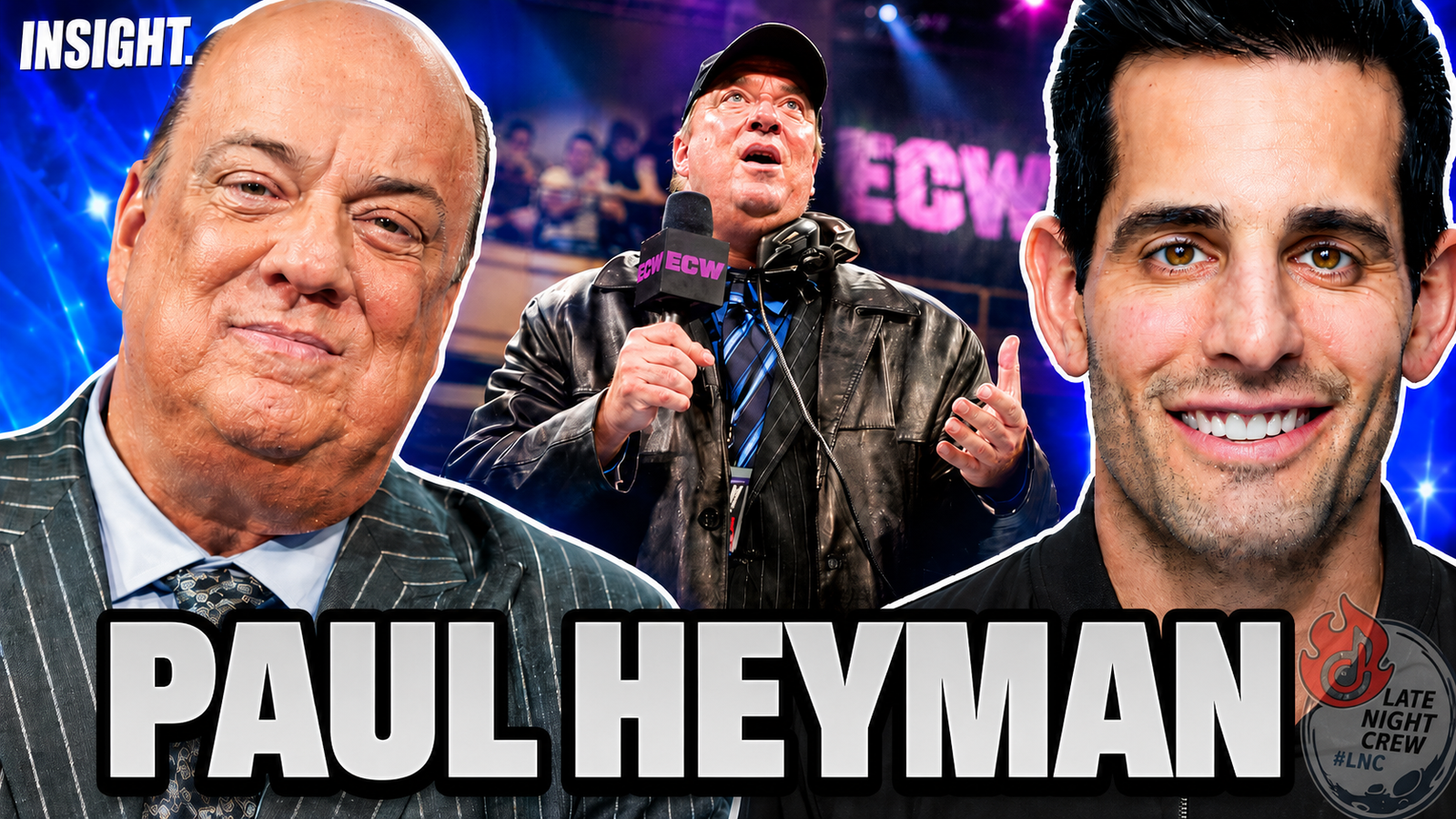
Paul Heyman does not do many long-form interviews, and that is what makes his new sit-down with Chris Van Vliet feel bigger than a normal wrestling podcast appearance. This was not just Heyman giving the same polished answers about Brock Lesnar, Roman Reigns, ECW, CM Punk and his place in WWE history. This was Heyman walking through the machinery behind his career, explaining why certain pairings became iconic, why others were never really designed to work, and how much of his genius comes from understanding the difference between managing a wrestler and presenting a once-in-a-generation act like a legitimate cultural force.
The interview works because Heyman is not treating his career like a highlight reel. He is treating it like a case study. Every name comes with a lesson. Brock Lesnar is the lesson in presentation. Roman Reigns is the lesson in reinvention. Curtis Axel and Cesaro are the lesson in bad timing and creative limitations. ECW is the lesson in controlled chaos, obsession and burnout. Even Heyman’s current WWE role is framed less like a job title and more like a responsibility to protect the story, the performer and the audience at the same time.
The Brock Lesnar Pivot Changed Everything
One of the most fascinating revelations from the interview is Heyman explaining that his return to WWE television in 2002 was not originally supposed to be tied to Brock Lesnar. According to Heyman, the plan was for him to come back at WrestleMania X8 and manage Chris Benoit. That changed the night before WrestleMania when Vince McMahon pulled Heyman aside and told him the Benoit direction was off. Instead, Heyman was being paired with Lesnar.
That one creative switch changed the entire trajectory of modern WWE.
Heyman’s explanation makes the Lesnar pairing sound less like luck and more like recognition. He saw what some around WWE apparently did not fully understand yet. Lesnar was not just another big developmental prospect. He was an NCAA Division I heavyweight champion with freakish explosiveness, terrifying size, legitimate athletic credibility and the kind of name that already sounded like a final boss. Heyman understood that WWE did not need to overcomplicate him. The formula was “simple, spotlighted, singular.” Let Brock be Brock. Let everybody else bounce off the force of nature.
That is the difference between a push and a presentation. A push tells the audience someone is important. Presentation makes the audience feel it before the wrestler even hits the ring. Heyman made Lesnar feel like an event, and the interview reinforces how much of that was intentional. Even the way Heyman says Brock’s name was never just a catchphrase. It was branding. It was meant to sound violent, guttural and dangerous. Not happy. Not hopeful. Not heroic. Dangerous.
That is why the Lesnar-Heyman pairing has lasted across eras. It never felt like a normal manager-client relationship. It felt like Heyman was the only man willing to stand close enough to the monster and translate the threat to the rest of the world.
Roman Reigns Was A Different Kind Of Heyman Project
The Roman Reigns discussion is just as important because Heyman’s role with Roman was never a copy-and-paste version of what he did with Brock. With Lesnar, Heyman was the Advocate. With Roman, he became the Wise Man. That title matters because the relationship was different.
Brock did not need vulnerability. Brock needed mythology. Roman needed depth. WWE had spent years trying to make Roman Reigns the company’s leading man, but it was not until the Tribal Chief era that everything clicked at the highest level. Heyman’s presence helped change how Roman was perceived before Roman even had to say a word. The camera would pan over to Heyman, and suddenly Roman was not the same character fans had been rejecting years earlier. He felt colder, smarter, more dangerous and more self-aware.
That is what Heyman brings when the partnership is right. He does not just talk for someone. He changes the temperature around them.
The interview makes it clear that Heyman understands the difference between being a mouthpiece and being a storyteller. With Roman, he was not there to hide a weakness. Roman can talk. Roman can carry himself. Roman can command a room. Heyman was there to frame the character, sharpen the stakes and help turn the Bloodline into WWE’s most layered long-term story in years.
Curtis Axel And Cesaro Were Not Talent Failures
The most honest part of the interview might be Heyman’s comments on the so-called failed “Paul Heyman Guys.” Curtis Axel and Cesaro are easy names for fans to bring up because both had talent, both had moments, and both were attached to Heyman without becoming the next Lesnar, Punk or Roman.
Heyman’s answer cuts through the usual lazy conversation. Curtis Axel, in his view, was not really positioned as a serious long-term Heyman project. He was placed into the role during the CM Punk feud as a functional piece of that story. That matters because fans often blame the performer or the pairing, when the truth is sometimes the creative purpose was limited from the beginning.
Cesaro is even more frustrating. Heyman openly acknowledged what fans have been saying for years: Cesaro checked the boxes. Wrestlers loved working with him. John Cena reportedly believed he could main-event WrestleMania with him. The problem was timing. Cesaro was paired with Heyman right after Brock Lesnar ended The Undertaker’s undefeated streak, which meant Heyman’s weekly television purpose was not really to make Cesaro the center of the universe. It was to keep Brock’s streak-breaking achievement alive while Brock was away.
That is brutal, but it is also the truth. Cesaro was standing next to Heyman, but the spotlight was still on Lesnar. The pairing was never built to fully serve Cesaro. It was built to preserve the aura of Brock Lesnar. That is why it always felt slightly off, even when the talent involved was undeniable.
The ECW Shadow Still Follows Heyman
Heyman also revisits ECW, his 2006 WWE departure, the rumors about Vince McMahon funding ECW, and how close he came to joining TNA. Those topics matter because ECW is still the foundation of how people understand Heyman. Before he was the Advocate, before he was the Wise Man, before he was the Hall of Famer standing next to Roman Reigns and Brock Lesnar, he was the obsessive, stubborn, brilliant and chaotic mind behind a promotion that changed what wrestling could feel like.
What stands out is that Heyman never really escapes ECW, and maybe he does not want to. ECW is both his greatest creative achievement and the thing that explains why he sees wrestling differently. He understands subcultures. He understands rebellion. He understands how to make an audience feel like they are part of something the rest of the world has not caught up to yet.
That is why Heyman’s best work still carries an ECW fingerprint. It is not the blood and chairs. It is the emotional manipulation. The feeling that what you are watching is more important than the company is even telling you it is. The belief that one promo, one camera shot, one name said the right way can change everything.
The Real-Life Medical Battle Adds Another Layer
The most personal reveal from the interview is Heyman discussing how he worked WWE Raw last year while dealing with a serious infection, a catheter and a PICC line. He said he was hospitalized, checked himself out to make Raw, performed, flew back and checked himself into the hospital again without telling people.
That is not something to romanticize carelessly, because nobody should have to put their health at risk to prove their value. But with Heyman, it explains the obsession. He was not just showing up because television needed him. He was showing up because, in his mind, the story needed him. The Vision had just launched, the audience needed continuity, and Heyman believed his responsibility was to the people invested in the story.
That is the part that separates Heyman from almost everyone else in wrestling. He talks about the business like a promoter, performs like a character, thinks like a writer, and protects the illusion like someone who still believes the audience deserves the best version of the lie.
Why This Interview Matters
This interview matters because it is not just Paul Heyman looking backward. It is Paul Heyman explaining how wrestling actually works when it is done at the highest level.
The headline clips will be about Brock Lesnar, Roman Reigns, Curtis Axel, Cesaro, ECW and the medical scare, but the real story is bigger than any one quote. Heyman is giving fans a look at the philosophy behind his career. He is explaining why some acts become immortal and why some never had a real chance. He is showing that greatness in wrestling is not only about talent. It is about timing, protection, presentation, trust and knowing exactly what emotion you are trying to pull out of the audience.
That has always been Heyman’s gift. He can make one name sound like a threat. He can make one camera shot change a career. He can make a wrestler feel bigger by standing beside them, not in front of them. And when the pairing is right, whether it is Brock Lesnar, Roman Reigns or CM Punk, Heyman does not just elevate the act.
He makes the act feel inevitable.
This was not just another interview. This was Paul Heyman reminding everyone that the best wrestling minds do not simply book moments. They understand why moments matter.
You can checkout the full interview below:
Make sure to subscribe to our Late Night Crew Wrestling YouTube Channel. Follow @yorkjavon, @kspowerwheels & @LateNightCrewYT on X.
I’m the quiet one until the bell rings then I’ve got takes. I live for WWE NXT and TNA, I want every promotion to succeed, and I will absolutely roast the bad decisions on sight (because someone has to). Anime taught me to respect long-term storytelling; wrestling taught me that sometimes the plan is “we panicked” and called it “unpredictable.” The Miz got me into all of this, so yeah I appreciate confidence, commitment, and the art of talking like you’re already the main event. Now I bring that same energy to the page as the main writer for Late Night Crew Wrestling because if you’re not here to be must-see and tell the truth, why are you here?!