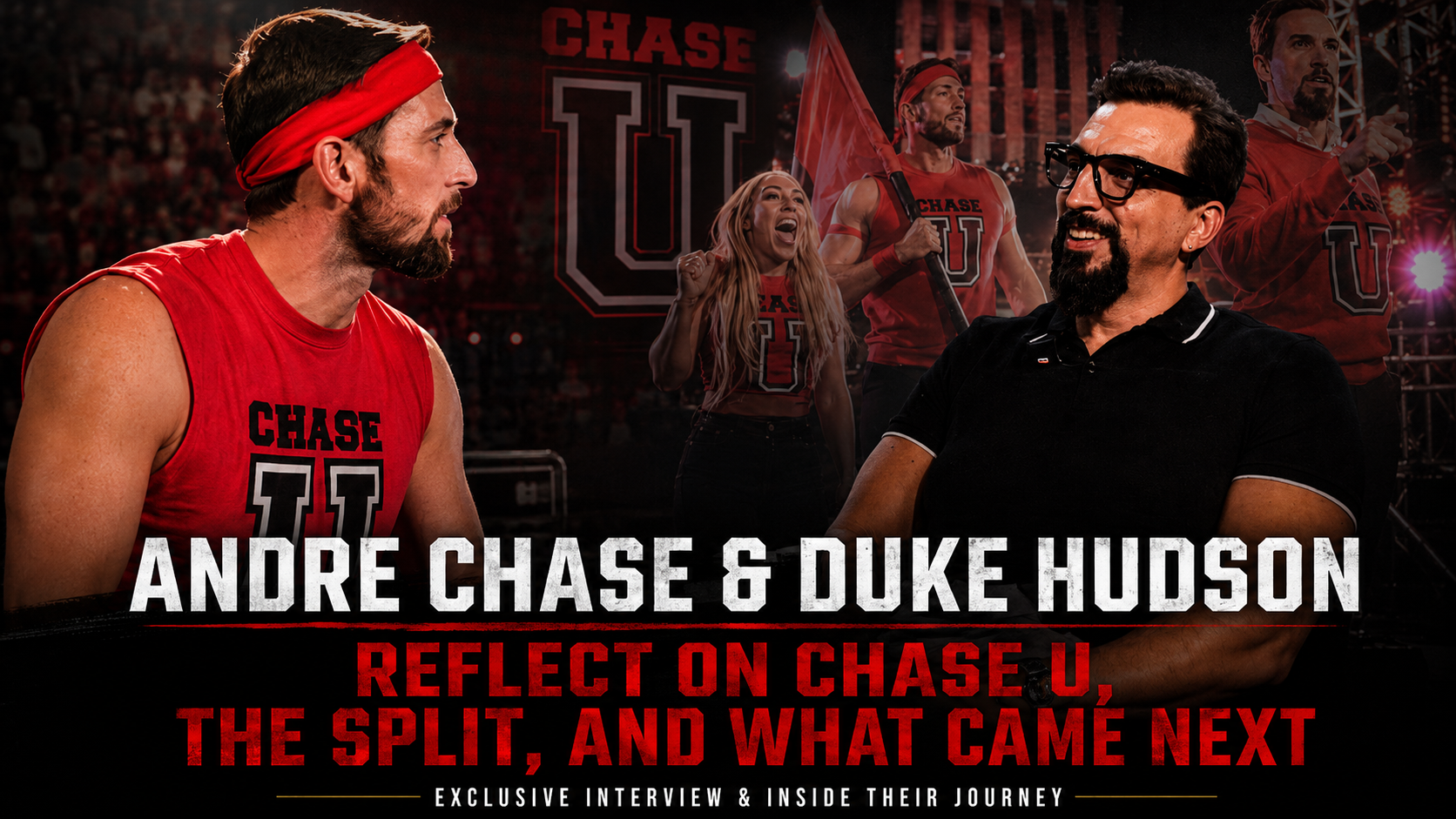
Andre Chase and Duke Hudson reuniting on Between Two Jobs did not feel like two former WWE NXT names simply looking back on old memories. It felt like the missing final chapter to Chase U, one of the most naturally over acts NXT had during the 2.0 and Shawn Michaels eras. Across the two-part interview, Chase and Hudson talked through the rise of Chase U, the way the group connected with fans, the frustration behind its breakup, and why Thea Hail still feels like one of the biggest unfinished stories left behind from the whole run.
The biggest headline coming out of the interview is Andre Chase saying WWE never gave him a real reason for splitting Chase U. That part matters because Chase was not arguing from emotion alone. He looked at it from the business side. The group was getting reactions. The merchandise was moving. The act was being used in multiple segments on NXT. Fans had attached themselves to the school, the chants, the characters, and the underdog identity. In Chase’s mind, if WWE always talks about numbers, crowd response, and merchandise as the things that matter, Chase U was checking those boxes.
That is what makes the breakup so frustrating in hindsight. Chase U was not a cold act. It was not a comedy group that overstayed its welcome with no real audience investment. It was a gimmick that could have easily failed, but it worked because everyone involved committed to it. Andre Chase made the professor role feel real. Duke Hudson became more than just the big man in the group. Thea Hail gave the entire act its emotional center. Together, they turned a silly idea into one of NXT’s most recognizable identities.
Chase explaining that the group sold strongly at events only makes WWE’s decision harder to defend. He pointed to Chase U merchandise performing on the level of heavily promoted names, while the group itself was built more like a grassroots movement than a corporate machine. That is the part that says everything. Trick Williams, Roxanne Perez, and other top NXT names were positioned like stars, and rightfully so. Chase U, meanwhile, had to win people over through consistency, crowd interaction, character work, and television chemistry. That is not a knock on anyone else. That is proof Chase U had real value.
The interview also gave more weight to Andre Chase’s own WWE story. Chase revealed WWE originally wanted him as a coach, and that the coaching offer paid better than signing as an active wrestler. He still chose to wrestle because he was not ready to stop. That decision says a lot about why his NXT run connected. He did not get into WWE by being handed a top spot. He got in the building, bet on himself, and turned a role that was never supposed to become major television into something fans actually cared about.
One of the strongest parts of the interview came when Chase talked about being told he would not be a TV wrestler. He was brought in with the idea that he would help the younger class at the Performance Center, not become a regular character on the show. Then Shawn Michaels saw him working with Julius Creed, questioned why Chase was not on television, and suddenly the door opened. That moment almost sums up his entire WWE run. Andre Chase kept turning “you are not supposed to be this” into “why are we not using this?”
That is why Chase U’s ending feels so strange. WWE had an act that created itself the hard way. It did not feel forced. It did not feel manufactured. It grew because fans bought into the characters. Duke Hudson’s involvement especially became one of those stories where the chemistry outgrew whatever the original creative plan may have been. Hudson could have simply been the guy who eventually betrayed Andre Chase, but the more time he spent in the group, the more he felt like he belonged there.
The Thea Hail conversation may have been the most important part of the interview for NXT’s current future. Duke Hudson made it clear that he believes Thea deserves a real opportunity, not another vague promise that her time will come because she is still young. That was a fair point. WWE has chosen to push young talent before. Roxanne Perez became a centerpiece of NXT at a young age. Other young names have been given major television chances. So when Hudson says Thea has heard the “you’re young” excuse too many times, it lands because fans watched Thea become one of the most beloved pieces of Chase U.
Thea was not just another student in the group. She was the emotional hook. Fans watched her grow, struggle, snap, mature, and find her confidence. Whether it was her wild energy in the early Chase U days, her friendship with Jacy Jayne, her pursuit of the NXT Women’s Championship, or her later attempts to stand on her own, Thea gave the audience a reason to care beyond the comedy. Hudson defending her felt less like a friend hyping up a friend and more like someone pointing out an obvious creative gap WWE still has not fully addressed.
That is the bigger story here. Chase U was successful because it made people care about multiple characters at once. Andre Chase benefited. Duke Hudson benefited. Thea Hail benefited. Riley Osborne got a role. Ridge Holland’s betrayal hit harder because the group mattered. Even when the act became messy, the audience understood the emotional language of the story. That is what wrestling factions are supposed to do. They are supposed to make individual characters stronger by putting them inside a world fans understand.
Instead, Chase U ended up becoming another example of WWE cooling off something that had already proven it worked. The group officially disbanding after Chase lost to Ridge Holland gave the story a dramatic endpoint, but it still felt like WWE was cutting off an act before fully exploring its ceiling. The later attempt to reboot Chase U never carried the same weight because the original chemistry was gone. Once Duke was out of the picture and Thea was separated from the heart of the group, the school did not feel like the same place anymore.
That is not to say Chase U needed to last forever. No wrestling act should stay frozen in place just because it got over. But there was a difference between evolving Chase U and simply dismantling it. WWE could have graduated the act into a bigger story. It could have used Chase U as a bridge between comedy, character development, tag team wrestling, and young talent progression. It could have tested the group on a bigger stage instead of assuming it had a ceiling.
The reason this interview hit so hard is because Chase and Hudson did not sound bitter just to be bitter. They sounded like two performers who knew they had something, knew the audience felt it, and still watched the decision get made above them. That is the frustrating side of wrestling creative. Sometimes the crowd tells you what is working. Sometimes the numbers back it up. Sometimes the performers understand the act better than anyone. And sometimes the company still chooses another direction.
Andre Chase and Duke Hudson’s conversation was a reminder that Chase U was never just a classroom joke. It became one of NXT’s best examples of turning a character-driven idea into real crowd investment. It gave Andre Chase the defining run of his WWE career. It gave Duke Hudson his strongest connection with the audience. It helped turn Thea Hail into someone fans still want to see get a bigger opportunity.
You can watch Part 1 here:
You can watch Part 2 here:
That is why the interview matters. It was not just about what happened to Chase U. It was about what WWE had, what WWE lost, and why fans still remember the group like something that deserved more than the ending it got.
Make sure to subscribe to our Late Night Crew Wrestling YouTube Channel. Follow @yorkjavon, @kspowerwheels & @LateNightCrewYT on X.
I’m the quiet one until the bell rings then I’ve got takes. I live for WWE NXT and TNA, I want every promotion to succeed, and I will absolutely roast the bad decisions on sight (because someone has to). Anime taught me to respect long-term storytelling; wrestling taught me that sometimes the plan is “we panicked” and called it “unpredictable.” The Miz got me into all of this, so yeah I appreciate confidence, commitment, and the art of talking like you’re already the main event. Now I bring that same energy to the page as the main writer for Late Night Crew Wrestling because if you’re not here to be must-see and tell the truth, why are you here?!